Photo vs. Picture is a common English confusion, especially when someone says, “Send me a pic” or “Send me the photo.”
Although photo and picture are often used interchangeably, they do not always mean exactly the same thing.
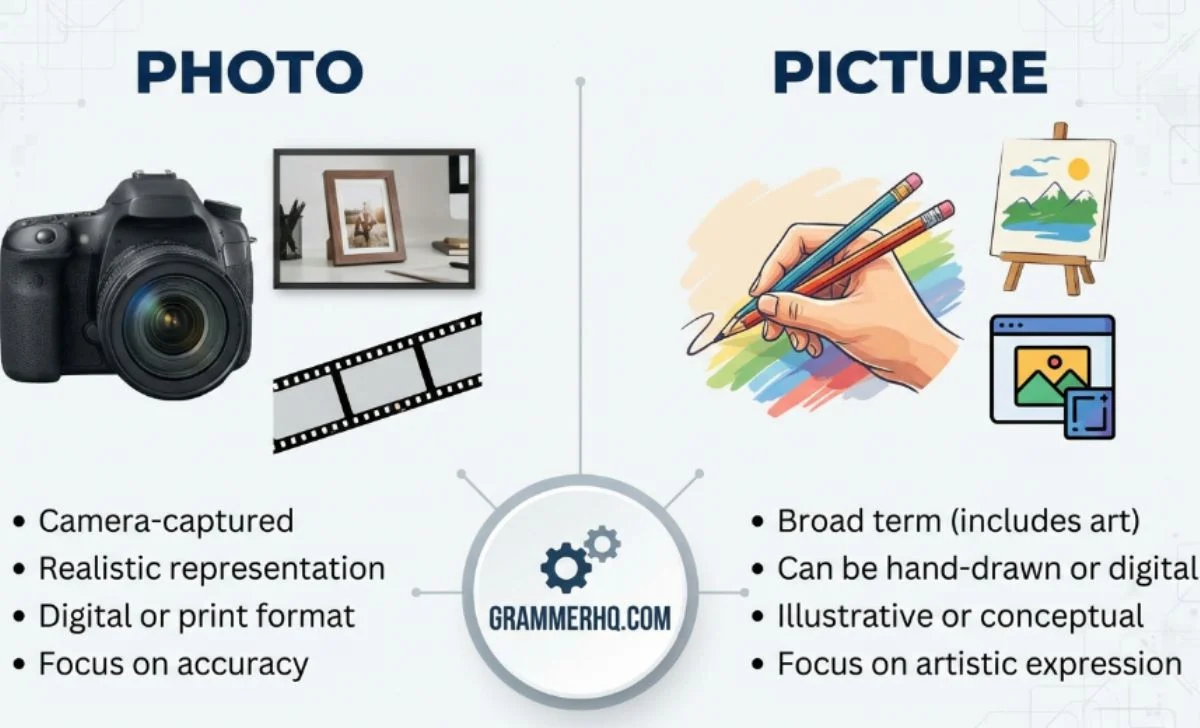
A photo specifically refers to a photograph, while picture has a broader meaning and can include drawings, paintings, and photographs.
Then there is image, which can describe almost any visual representation, and pic, the informal short form of picture.
In this guide, you’ll learn the clear difference between all four terms, when to use each one, and which word sounds most natural in everyday, professional, and digital communication.
Quick Answer
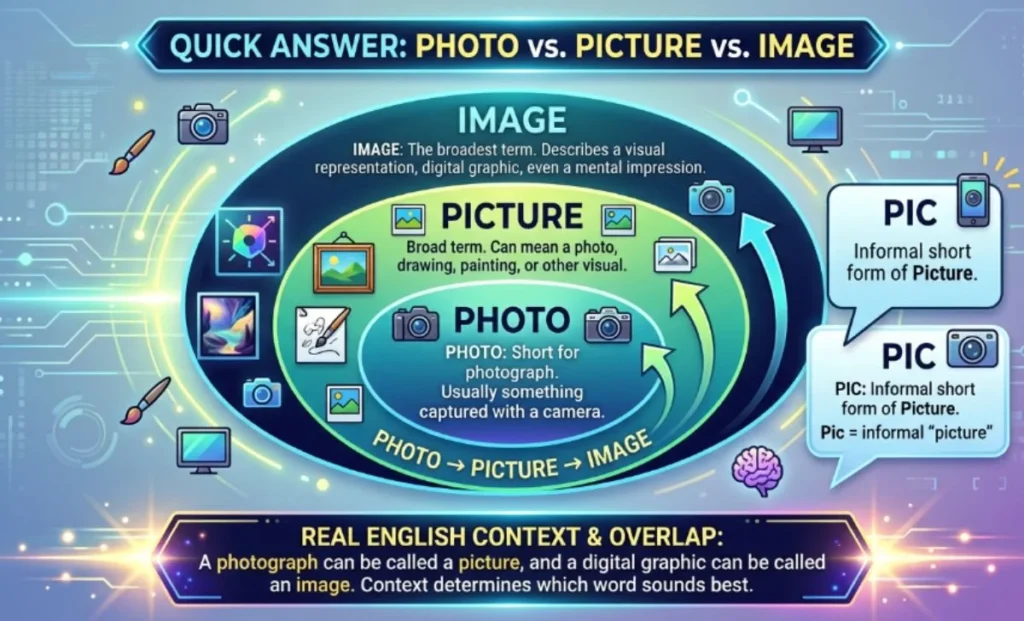
Photo means a photograph, usually something captured with a camera. Picture is broader and can mean a photo, drawing, painting, or other visual.
Image is the broadest term and can describe a visual representation, digital graphic, or even a mental impression. Pic is simply the informal short form of picture.
In simple terms:
Photo ⊂ Picture ⊂ Image
And:
Pic = informal “picture”
This is a useful shortcut, but real English has some overlap. A photograph can be called a picture, and a digital graphic can be called an image. Context determines which word sounds best.
Photo vs. Picture vs. Image vs. Pic: At a Glance
| Term | Basic Meaning | Typical Tone | Can Mean a Photograph? |
|---|---|---|---|
| Photo | Photograph | Neutral | Yes |
| Picture | Visual representation | Neutral | Yes |
| Image | Broad visual representation or impression | Neutral / formal / technical | Yes |
| Pic | Short form of picture | Casual | Yes |
The easiest memory trick is:
Photo = camera
Picture = visual
Image = broader representation
Pic = casual picture
The Relationship Between Photo, Picture, and Image
Think of the three words as overlapping circles rather than completely separate categories.
Image
Picture
Photo
A photo is a type of picture, while a picture is one type of image.
For example:
- A photograph of your family photo / picture / image
- A pencil drawing picture / image, but not normally a photo
- A company logo image, and sometimes a picture, but not a photo
- A mental impression of someone image, but not a photo or picture
This is why saying that the words are simply “the same” can create confusion. They overlap, but their meanings are not identical.
What Is a “Photo”?
Photo is the everyday shortened form of photograph.
A photograph is a visual record produced by a camera or photographic process. In modern English, photo is the normal word in casual conversation.
Examples
- I took a photo of the sunset.
- Can you send me a photo of the document?
- She posted a new photo on Instagram.
- This is my favorite photo from the trip.
- Please attach a recent photo to your application.
Notice how naturally photo works when the visual was actually captured as a photograph.
Photo vs. Photograph
There is no major difference in basic meaning.
Photograph sounds more formal:
Please submit a recent photograph.
Photo sounds more natural in everyday communication:
Please send me a photo.
The shortened form is so common that most speakers use photo far more often in ordinary conversation.
What Is a “Picture”?
Picture has a wider meaning than photo.
It can refer to something produced by drawing, painting, photography, printing, or another visual method.
For example:
- a photograph
- a drawing
- a painting
- a children’s illustration
- a printed visual
- sometimes a digital graphic
Examples
- The child drew a picture of a house.
- I took a picture of the mountains.
- Look at this picture from our vacation.
- She painted a beautiful picture.
- Can you send me a picture of the product?
This explains why native speakers can say:
“Send me a picture.”
even when they specifically want a photograph.
In everyday English, picture is often the more flexible word.
What Is an “Image”?
Image is broader and often sounds more technical, formal, or abstract than photo.
An image can be:
- a photograph
- a drawing
- a graphic
- a digital visual
- a scanned document
- a computer-generated visual
- a visual representation
- a mental impression
Digital meaning
You will often see image in technology and web-related contexts.
For example:
- Upload the image.
- The image is too large.
- Save the image as a PNG file.
- The website contains several images.
- The image quality is poor.
Here, image is useful because the file could be a photograph, illustration, icon, diagram, or graphic.
Abstract meaning
Image can also describe an impression or reputation.
- The company is trying to improve its image.
- He has a strong public image.
- The advertisement created a positive image of the brand.
You cannot normally replace image with photo in these sentences.
Which Word Is More Common?
The answer depends heavily on context and variety of English.
In everyday speech, picture and photo are both extremely common. Picture is especially flexible because it can refer to a photograph without specifying how the visual was created.
In digital, technical, publishing, and web contexts, image becomes much more common.
For example:
| Context | Most Natural Choice |
|---|---|
| Family vacation | photo / picture |
| Casual text | pic / picture / photo |
| Camera photography | photo |
| Drawing | picture |
| Painting | picture |
| Website graphic | image |
| Computer file | image |
| Brand reputation | image |
| Professional photography | photograph / photo |
| Social media | photo / pic |
So there is no single word that is “most correct” everywhere.
Photo vs. Picture: The Real Difference
The easiest distinction is how specific the word is.
Photo
A photo normally refers to something captured through photography.
I took a photo of the moon.
Picture
A picture can be a photo, drawing, painting, or other visual.
The child drew a picture of the moon.
But a photo can also be called a picture:
I took a picture of the moon.
That sentence is completely natural.
So the important rule is:
Every photo can usually be called a picture, but not every picture is a photo.
This is one of the most useful ways to remember the difference.
Authenticity vs. Art: Why the Distinction Matters
One subtle difference is the connection between photography and artistic creation.
When someone says photo, the word normally points to a photographic capture.
When someone says picture, the visual could have been created in many different ways.
Compare:
She showed me a photo of the building.
This strongly suggests a camera captured the building.
She showed me a picture of the building.
This could be a photo, drawing, painting, illustration, or another representation.
However, modern digital photography makes the boundary less rigid. Photos can be heavily edited, composited, filtered, or generated with software. So photo should not automatically be understood as “completely untouched reality.”
The key distinction is photographic origin, not absolute authenticity.
Photograph – Photo – Picture – Pic: A Formality Guide
These words differ not only in meaning but also in tone and register.
| Word | Tone | Best Use |
|---|---|---|
| Photograph | Formal | Reports, official documents, formal writing |
| Photo | Neutral | Everyday and professional communication |
| Picture | Neutral / conversational | General everyday use |
| Pic | Very casual | Texts, chats, social media |
Professional email
Use photo, photograph, or image depending on context.
Please send your profile photo.
More formal:
Please provide a recent photograph.
For a file or graphic:
Please attach the image.
Casual message
Send me a pic when you get there.
This sounds completely natural among friends.
Important rule
Pic is not a spelling mistake. It is an informal abbreviation.
But informal does not mean appropriate everywhere.
What About “Pic”?
Pic is a shortened, informal form of picture.
You will commonly see it in:
- text messages
- social media
- online chats
- captions
- casual emails
- comments
Examples
Send me a pic.
Nice pic!
Can you take a pic of us?
I posted a new pic yesterday.
These are natural in casual communication.
When should you avoid “pic”?
Avoid it when the writing needs a formal or professional tone.
For example, instead of:
Please send me your pic for the application.
write:
Please send me your photo for the application.
Or:
Please provide a recent photograph.
Pic is perfect for a friend. It is usually not the best choice for an official document.
Business, Website, and SEO Usage
The difference between photo, picture, and image becomes even more useful when you are writing for a business, website, or online store. Each word can suggest a slightly different type of visual.
Product Photo
Product photo usually means an actual photograph taken of a product.
The store uploaded new product photos of its latest shoes.
This wording works especially well when the visual was captured with a camera.
Product Picture
Product picture is also correct and sounds natural in everyday English. The term is broader than product photo because the visual could be a photograph, drawing, illustration, or another representation.
Can you send me a picture of the product?
In casual communication, picture is often a perfectly natural alternative to photo.
Product Image
Product image is especially common in e-commerce, web design, digital marketing, and technical writing.
Add high-quality product images to your online store.
The word image works well because an online product visual might be a photograph, graphic, illustration, diagram, or digitally created visual.
What About Alt Text?
When writing alt text, focus on describing what the visual actually shows rather than forcing words such as photo, picture, or image into the description.
For example, this is too vague:
image
A more useful description would be:
red running shoes on a white background
Good alt text should communicate the important visual information to people who cannot see the image. Keep it concise, relevant, and natural. Avoid adding keywords simply for SEO when they do not accurately describe the visual.
The goal is not to choose photo over picture. The goal is to provide an accurate description that makes sense in the context of the page.
Common Idioms and Collocations
English uses picture in many fixed expressions, while photo appears in more literal photography-related phrases.
| Expression | Meaning |
|---|---|
| take a photo | capture a photograph |
| take a picture | photograph something |
| paint a picture | create a painting or describe something vividly |
| picture-perfect | extremely attractive or ideal |
| the big picture | the overall situation |
| a picture is worth a thousand words | a visual can communicate a lot |
| out of the picture | no longer involved or relevant |
| picture this | imagine a particular situation |
| family photo | photograph of a family |
| photo album | collection of photographs |
| photo shoot | organized photography session |
| image quality | quality of a visual |
| brand image | public perception of a brand |
Take a photo vs. take a picture
Both are correct.
Can you take a photo of us?
Can you take a picture of us?
The first is slightly more specific about photography. The second is extremely common in everyday English.
Why Do We Say “Motion Picture”?
If picture can mean a photograph, why does motion picture mean a movie?
The answer comes from the historical meaning of picture as a visual representation.
Early cinema was often described as moving pictures because a sequence of images appeared to move when shown rapidly.
That history gave us expressions such as:
- motion picture
- moving picture
- picture show
- feature picture
Today, motion picture is a formal or historical term for a film or movie.
This is another reminder that picture has always had a broader meaning than simply “photograph.”
British English vs. American English
The core meanings of photo, picture, image, and pic are broadly shared in both British and American English.
There is no major British-versus-American rule saying that one variety uses photo while the other uses picture.
Both varieties commonly use:
Take a photo.
Take a picture.
Send me a picture.
Upload the image.
The main differences are more likely to come from context, personal preference, age, profession, and level of formality than from nationality.
Pronunciation
Photo and picture have established pronunciations in both major varieties of English, with normal accent differences.
The shortened form pic is pronounced like the beginning sound of picture followed by a /k/ sound.
Quick Quiz: Photo, Picture, Image, or Pic?
1. Your friend wants a casual photograph.
“Send me a ___ from your vacation.”
Answer: pic / photo / picture
All three can work, although pic is the most casual.
2. A child draws a house.
“He drew a ___ of his house.”
Answer: picture
A drawing is a picture, but it is not a photo.
3. A website contains a PNG graphic.
“Please upload the ___.”
Answer: image
Image is especially natural in digital and technical contexts.
4. An official application asks for a formal visual.
“Please submit a recent ___.”
Answer: photograph
This is the most formal option.
5. A company wants to improve how customers perceive it.
“The company wants to improve its brand ___.”
Answer: image
Here, image means reputation or public perception—not a photograph.
FAQs
1: Is “photo” short for “photograph”?
Yes. Photo is the standard shortened form of photograph and is extremely common in everyday English.
2: Can I say “picture” instead of “photo”?
Yes, in many everyday situations.
Take a picture of me.
and
Take a photo of me.
are both natural.
The difference is that picture has a broader meaning and does not necessarily refer to photography.
3: What’s the difference between an image and a photo?
A photo normally refers specifically to a photograph. An image is broader and can include photographs, drawings, graphics, digital visuals, and abstract representations.
4: Is “pic” proper English?
Yes, pic is a recognized informal word for picture. It is perfectly normal in casual communication but is generally less suitable for formal writing.
5: Is a photo a picture?
Yes. In ordinary English, a photograph can be called a picture.
But a picture does not have to be a photograph.
6: Is an image always a picture?
Not necessarily in every sense. Image can describe a visual representation, but it can also refer to an abstract impression or reputation, such as brand image.
7: Should I use “photo” or “picture”?
Use photo when you specifically mean a photograph. Use picture when you want a broader, everyday term or when the visual could be a drawing, painting, or photograph.
8: Should I use “image” or “photo” on a website?
Choose according to context. Photo is ideal when you are specifically discussing photography. Image is broader and often fits websites, digital media, graphics, and technical content.
Conclusion
The difference between photo, picture, image, and pic is mainly about scope and context. A photo is specifically a photograph, while a picture can be a photograph, drawing, painting, or another visual.
Image is broader still and can describe digital graphics or even an abstract reputation. Pic simply gives picture a casual, conversational form.
When in doubt, use photo for photography, picture for general everyday visuals, image for broader or digital contexts, and pic when the situation is informal.
None is universally “more correct” the best choice depends on what you mean and who you are talking to.
Read More Blogs:
- Further or Farther: Difference, Meaning, Usage & Examples
- Desert vs Dessert: Same Sound, Different Words?

Hi, I’m Amelia Parker, a grammar enthusiast and writer at GrammarHQ.com. I specialize in explaining spelling differences, confusing words, and common English mistakes through simple, practical, and easy-to-understand guides.