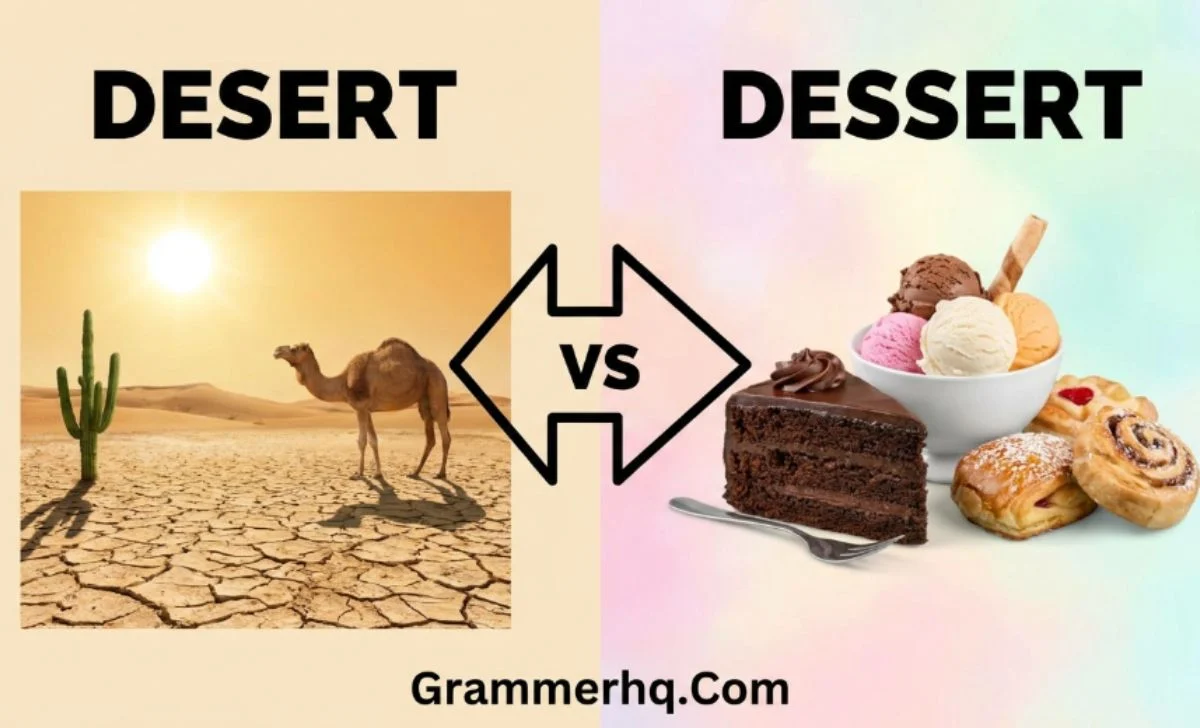
Have you ever typed desert or dessert and suddenly wondered whether you need one S or two? You are not alone. These words are easy to confuse because they look almost identical, but they have different meanings and uses.
Desert can mean a dry area of land or to leave someone or something, while dessert means sweet food served after a meal. There is also a common expression, just deserts, which has a completely different meaning.
In this guide, you will learn the difference between desert and dessert, how to pronounce them, how to remember the spelling, and how to use each word correctly in real-life English.
Quick Answer
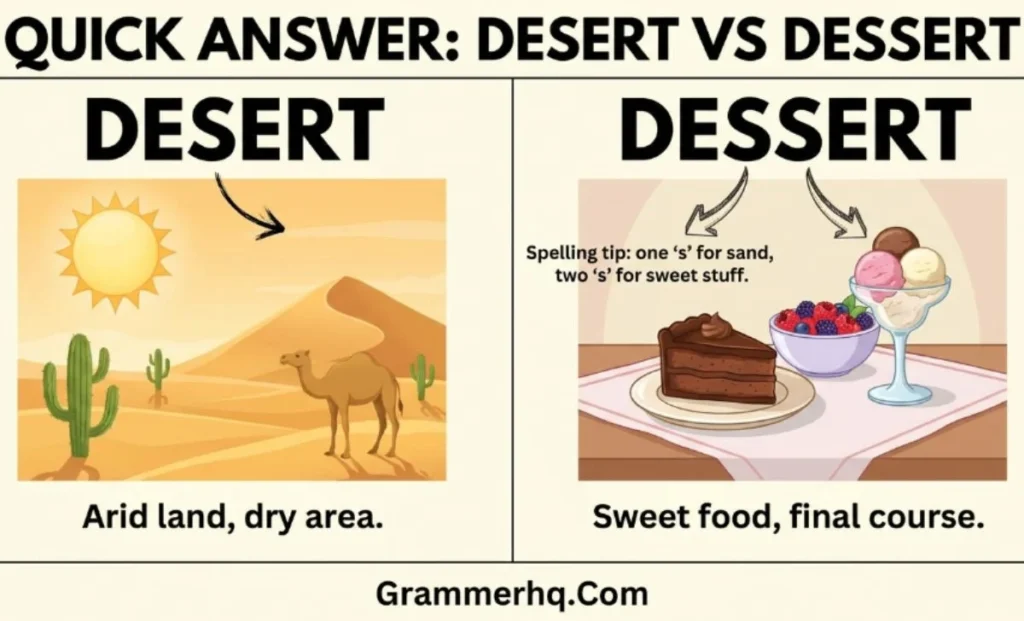
The difference is simple when you focus on meaning:
- Desert = a dry area of land.
- Desert = to leave or abandon someone or something.
- Dessert = sweet food served at the end of a meal.
- Just deserts = something that a person deserves, usually a reward or punishment.
Quick Examples
- The camel crossed the desert.
- He would never desert his family.
- We had ice cream for dessert.
- The dishonest businessman finally got his just deserts.
Easy rule:
Dry land or abandon = desert.
Sweet food = dessert.
Something deserved = just deserts.
What Does Desert Mean?
Desert has two common meanings. It can be a noun referring to a dry region, or a verb meaning to leave or abandon someone or something.
Desert as a Noun
A desert is a very dry area that receives little precipitation. Deserts can contain sand, rocks, mountains, gravel, or even ice.
For example:
- The Sahara is a famous desert.
- We carried extra water across the desert.
- The desert can become extremely cold at night.
Here, desert refers to a geographical place.
Desert as a Verb
As a verb, desert means to leave someone or something when you are expected to stay.
For example:
- He refused to desert his family.
- The captain would not desert his crew.
- She felt that her friends had deserted her.
So remember:
desert = dry land
desert = abandon
What Does Dessert Mean?
Dessert is the sweet course normally eaten at the end of a meal.
Common desserts include:
- Cake
- Ice cream
- Pie
- Pudding
- Cheesecake
- Pastries
- Chocolate
Real-Life Examples
Imagine you are eating at a restaurant. After your main meal, the waiter asks:
“Would you like to see the dessert menu?”
Here, dessert is correct because the word refers to sweet food.
You could also say:
- We ordered chocolate cake for dessert.
- She made apple pie for dessert.
- Would you like ice cream for dessert?
The key spelling point is:
Dessert has two S’s.
Desert vs Dessert: What Is the Difference?
The main difference is meaning and spelling.
| Word | Meaning | Example |
|---|---|---|
| desert | Dry area of land | The camel crossed the desert. |
| desert | To abandon | He would never desert his family. |
| dessert | Sweet food after a meal | We had cake for dessert. |
There is only one extra S, but that small difference changes the meaning completely.
If you are talking about the Sahara, dry land, water shortages, or a geographical region, use desert.
If you are talking about cake, ice cream, pie, or food after dinner, use dessert.
How to Pronounce Desert and Dessert
Pronunciation makes these words even more interesting because desert has two common pronunciations depending on its meaning.
Desert: Dry Land
When desert means a dry region, the stress is on the first syllable:
DEZ-ert
Example:
The Sahara is a DEZ-ert.
Desert: To Abandon
When desert means “to abandon,” the stress moves to the second syllable:
de-ZERT
Example:
He would never de-ZERT his family.
Dessert
Dessert is pronounced:
de-ZERT
So the verb desert and the noun dessert sound alike, while the geographical desert has a different stress pattern.
Why Do People Confuse Desert and Dessert?
The biggest reason is spelling. Look at the words:
desert
dessert
Only one extra S separates them.
The pronunciation also causes confusion. When desert means “abandon,” it sounds like dessert.
For example:
He might desert the team.
But:
We ordered dessert after dinner.
Because the words can sound alike, context becomes important.
Ask yourself:
Is the sentence about dry land? → desert
Is it about abandoning someone? → desert
Is it about sweet food? → dessert
How to Remember Desert vs Dessert
The easiest trick is to remember the two S’s in dessert.
Dessert = Second Serving
Think:
Dessert has two S’s because you may want a Second Serving.
This is only a memory trick, not the historical reason for the spelling, but it can make the correct spelling easier to remember.
You can also connect:
desert → dry
A desert is usually associated with very little rain.
So your memory can be:
- Desert = dry
- Dessert = sweet
- Dessert = two S’s
What Does “Just Deserts” Mean?
One of the most commonly confused expressions is just deserts.
The standard expression is:
just deserts
It means receiving the consequence, reward, or punishment that someone deserves.
For example:
After cheating his customers for years, he finally got his just deserts.
Here, deserts does not mean dry land, and it does not mean sweet food. It relates to the idea of what someone deserves.
So:
❌ just desserts
✅ just deserts
This is a useful expression to remember because the spelling often surprises English learners.
Common Mistakes With Desert and Dessert
1: Using Desert for Food
❌ We had ice cream for desert.
✅ We had ice cream for dessert.
Ice cream is sweet food served as a course, so dessert is correct.
2: Using Dessert for a Dry Region
❌ The Sahara is a huge dessert.
✅ The Sahara is a huge desert.
The sentence describes a geographical region, so use desert.
3: Using Dessert for Abandon
❌ He decided to dessert his family.
✅ He decided to desert his family.
Here, desert is a verb meaning “abandon.”
4: Writing “Just Desserts”
❌ She got her just desserts.
✅ She got her just deserts.
The standard expression is just deserts.
Desert vs Dessert in Real-Life Examples
Seeing desert and dessert in real sentences makes the difference much easier to understand. The correct word depends on what you are talking about: a dry place, leaving someone, or sweet food.
Desert as a Noun
The desert can be extremely hot during the day and surprisingly cold at night.
Travelers often carry extra water when crossing this dry region.
The Sahara is one of the best-known deserts in the world.
Desert as a Verb
He promised never to desert his family during difficult times.
When the team faced a serious problem, its captain refused to leave them.
A loyal friend does not desert someone when that person needs support.
Dessert
After dinner, we ordered chocolate cake for dessert.
The restaurant offered several sweet choices, including ice cream, cheesecake, and apple pie.
For many people, a favorite dessert is the perfect way to finish a meal.
Quick Comparison
- Desert = a dry area of land
- Desert = to leave or abandon
- Dessert = sweet food served after a meal
Remember: If you are talking about dry land or abandonment, use desert. When you mean something sweet at the end of a meal, use dessert.
FAQs
Is it desert or dessert?
Both are correct, but they have different meanings. Desert can mean a dry area of land or to abandon someone. Dessert means sweet food served after a meal.
Real-life example:
You would say, “The camel crossed the desert,” but “We had ice cream for dessert.”
Is dessert spelled with one S or two?
Dessert is spelled with two S’s.
Real-life example:
If you finish dinner at a restaurant and order cheesecake, you are ordering dessert.
What is the easiest way to remember desert and dessert?
Remember:
Desert = dry
Dessert = sweet + two S’s
Real-life example:
A trip through the Sahara involves a desert, while cake after dinner is dessert.
Do desert and dessert sound the same?
Not always. The geographical noun desert is pronounced DEZ-ert, while the verb desert and noun dessert are pronounced de-ZERT.
Real-life example:
“The Sahara is a DEZ-ert” and “We ordered de-ZERT.”
Is “just deserts” correct?
Yes. Just deserts is the standard expression for something a person deserves.
Real-life example:
If someone cheats people and is eventually punished, you might say, “He got his just deserts.”
Conclusion
The difference between desert and dessert becomes easy once you connect each spelling with its meaning. Desert means a dry area of land or to leave someone or something.
Dessert, with two S’s, means sweet food served after a meal. The expression just deserts has a separate meaning: receiving what you deserve.
When you are unsure, remember the simple rule: dry land or abandon = desert; sweet food = dessert; something deserved = just deserts. With these clear connections, you can choose the correct word confidently in everyday English.
Read More Blogs:

Hi, I’m Amelia Parker, a grammar enthusiast and writer at GrammarHQ.com. I specialize in explaining spelling differences, confusing words, and common English mistakes through simple, practical, and easy-to-understand guides.