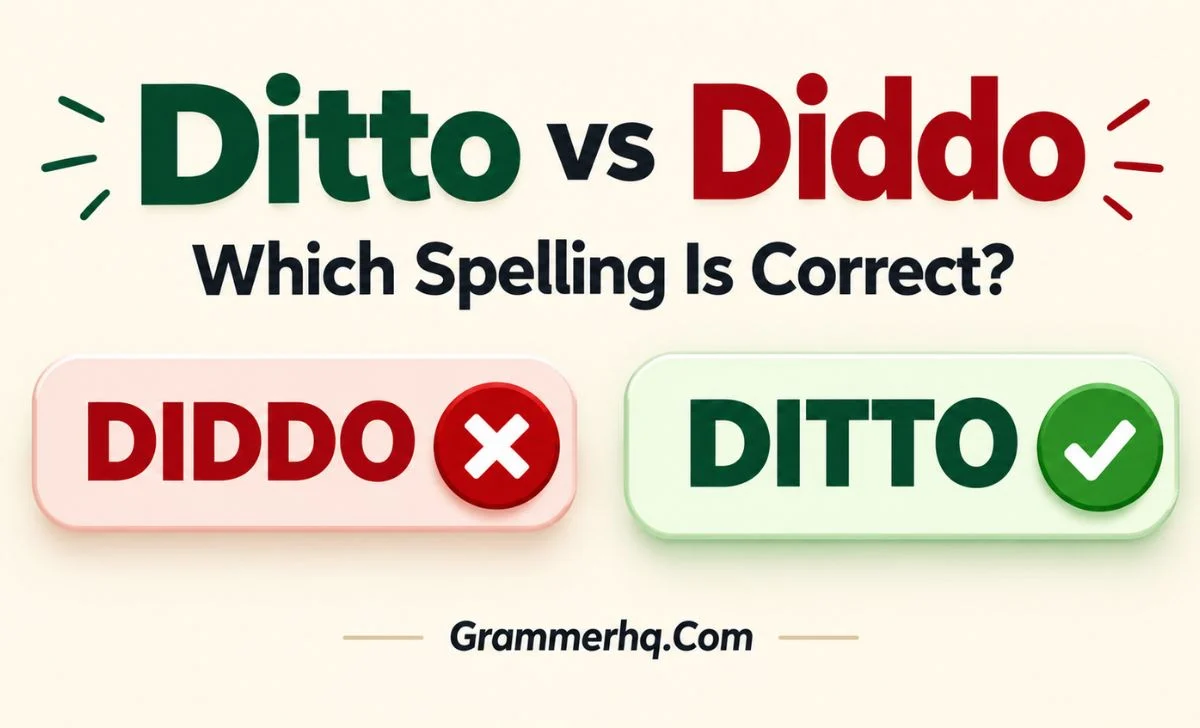
Ditto vs diddo can be confusing because the two spellings can sound very similar in fast speech. But when you mean “the same,” “me too,” or “as stated above,” there is one standard spelling: ditto.
Diddo is a common misspelling of ditto, not a standard spelling variant. The easiest rule is simple: write ditto with one d and two t’s.
Quick Answer
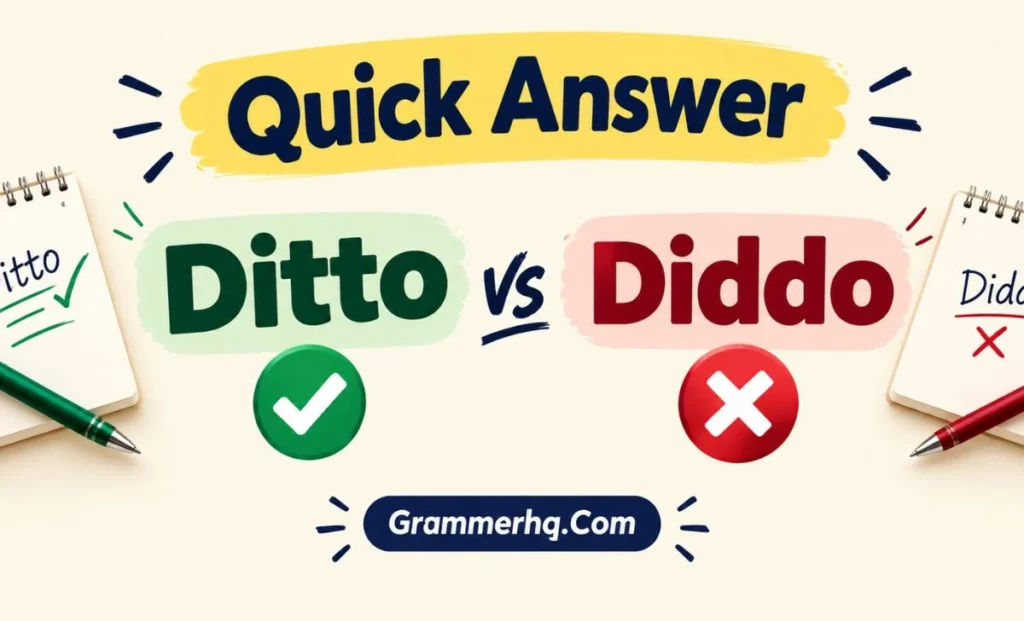
Ditto is correct. Diddo is incorrect when you mean “the same,” “me too,” or “as above.”
| Word | Correct? | Meaning |
|---|---|---|
| Ditto | ✅ Yes | The same, likewise, or as previously stated |
| Diddo | ❌ No | Common misspelling of ditto |
For example:
“I loved the movie.”
“Ditto.”
Here, ditto means “I loved it too” or “I feel the same way.”
Major English dictionaries recognize ditto as the standard word. Cambridge defines it as a way to agree with something just said or avoid repeating it, while Oxford also records its use for showing that information is repeated in a list.
What Does Ditto Mean?
Ditto means that something is the same as something already mentioned.
It can have slightly different uses depending on the situation.
1. Ditto means “me too”
In everyday conversation, ditto can show agreement or a shared feeling.
“I’m tired after that long trip.”
“Ditto.”
This means:
“I’m tired too.”
You can also say:
“I really enjoyed the concert.”
“Ditto.”
The second speaker is saying that they enjoyed it too.
2. Ditto means “the same as above”
Ditto can also save you from repeating information in a list, table, or record.
For example:
| Item | Color |
|---|---|
| Shirt | Blue |
| Jacket | Ditto |
| Shoes | Black |
Here, ditto means the jacket is also blue.
The same idea can be represented by a ditto mark, a symbol used to show that the information above should be repeated.
Why Do People Write “Diddo” Instead of “Ditto”?
The confusion is mostly understandable from pronunciation.
In American English, ditto is pronounced approximately “DIT-oh.” Cambridge gives the US pronunciation as /ˈdɪt̬.oʊ/, while Oxford gives /ˈdɪtəʊ/ for its listed pronunciation.
When people speak quickly, the t in ditto can sound less clear. That can make the word seem closer to “diddo” to some listeners.
But pronunciation does not change the established spelling.
So remember:
Ditto → correct spelling
Diddo → common spelling mistake
Ditto vs Diddo: What Is the Difference?
The difference is not a British-versus-American spelling issue.
Ditto is the standard English word. Diddo is not the standard spelling when someone intends the meaning “the same.”
Compare these examples:
Correct:
“I think this is the best option.”
“Ditto.”
Incorrect:
“I think this is the best option.”
“Diddo.”
The first sentence uses the established English word. The second uses a common misspelling.
There is also no need to treat diddo as a more casual version of ditto. If you mean “same here,” use ditto.
How to Use Ditto in a Sentence
Here are some natural examples:
Agreement
“I’m ready for the weekend.”
“Ditto.”
Shared opinion
“That was the best part of the movie.”
“Ditto.”
Repeating information
The first package weighs 5 kg; the second weighs ditto.
Referring to something mentioned above
The same rules apply to the second group. Ditto for the third.
Casual writing
“I can’t wait for the concert.”
“Ditto!”
The exact tone depends on context, but ditto is especially common in informal conversation and writing. Collins also records its use for avoiding repetition and as an informal way to confirm agreement.
Is “Diddo” Ever a Correct Word?
If you are asking about the ordinary English word meaning “the same”, then no—use ditto.
You might encounter Diddo as a name, username, brand, character name, or other proper name. That is different from using diddo as an English spelling of ditto.
So if your sentence means “me too,” “likewise,” or “same as above,” write ditto.
Is Ditto Formal or Informal?
Ditto is widely understood, but its best use depends on context.
In conversation, messages, comments, and other casual writing, it can be a natural short response:
“I agree with you.”
“Ditto.”
In formal documents, however, a more precise phrase can sometimes be clearer.
Instead of:
“Ditto.”
you might write:
“The same applies to this case.”
Or:
“The same information applies here.”
For lists and records, ditto has a long-established use for avoiding repeated information. Dictionaries also recognize ditto as more than just a conversational expression; it can function as a noun, adverb, verb, and adjective depending on context.
Where Does the Word “Ditto” Come From?
Ditto has a much older history than its modern “same here” use might suggest.
The word comes from Italian, related to detto, meaning “said” or “the said.” It entered English in the early modern period and became associated with repeating information that had already been stated.
That history explains why ditto works so naturally in lists and records: instead of writing the same information again, ditto indicates that the previous information applies again.
Ditto vs Diddo: Easy Way to Remember
If you often type diddo, use this simple memory trick:
DITTO has two T’s
Think:
DI + TTO = DITTO
There is one D, followed by two T’s.
So when you mean “same here”, remember:
“Two T’s in ditto.”
That small spelling rule can help you avoid the most common mistake.
FAQs
1: Is ditto or diddo correct?
Ditto is correct. Diddo is a common misspelling when the intended meaning is “the same,” “me too,” or “as previously stated.”
2: What does ditto mean?
Ditto means the same, likewise, me too, or as stated above, depending on the context.
3: Why does ditto sound like diddo?
In fast speech, the t in ditto can sound softer, particularly in American English. This can make some speakers hear something closer to “diddo,” even though the spelling remains ditto.
4: Can I use ditto in a text message?
Yes. Ditto is commonly used as a short way to express agreement or say “me too.”
5: Is diddo a British spelling of ditto?
No. Diddo is not a standard British spelling of ditto. The standard word is ditto.
6: What is another word for ditto?
Depending on the sentence, alternatives include same, likewise, me too, I agree, or the same applies.
Conclusion
When choosing between ditto vs diddo, use ditto.
Ditto is the standard English spelling and can mean “the same,” “me too,” “likewise,” or “as stated above.” It is useful in casual replies as well as in lists and records where repeated information does not need to be written again.
Diddo is a common misspelling, often caused by the way ditto can sound in quick speech.
So the rule is easy:
Ditto = correct
Diddo = incorrect when you mean “the same”
Read More Blogs