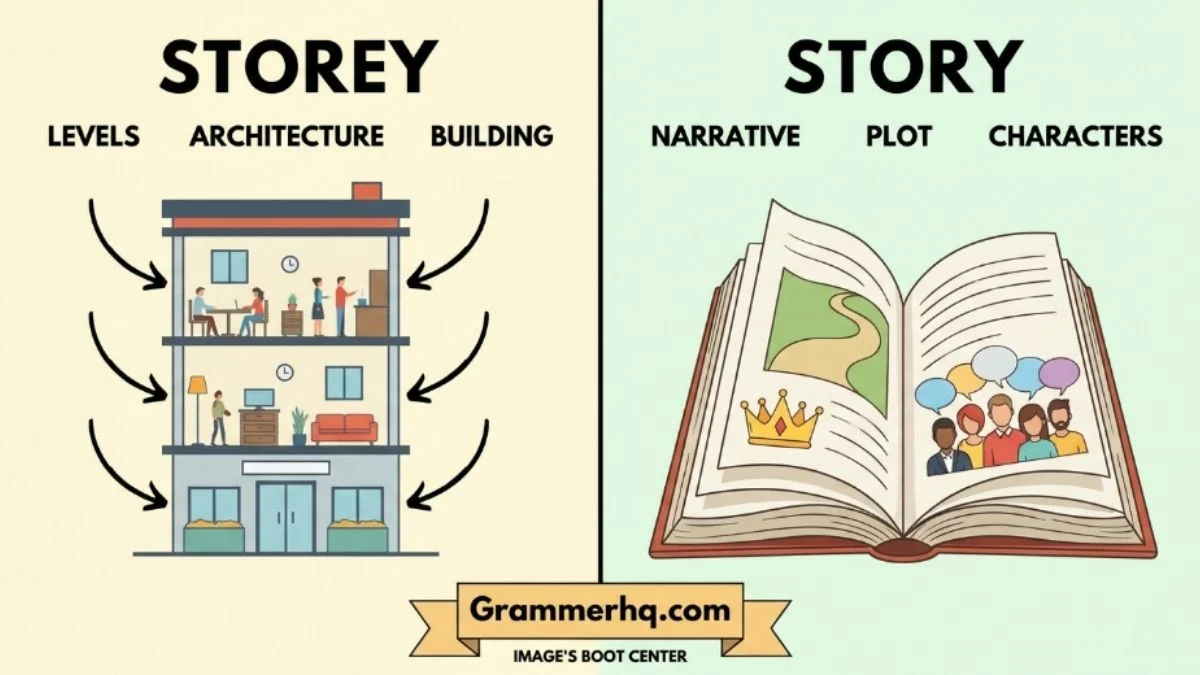
Storey vs Story can be confusing because both words sound the same, but their meanings and regional uses are different.
In British English, storey means a level of a building, while story means a narrative, tale, or account. In American English, story can mean both a narrative and a building level.
Understanding this simple difference will help you choose the right spelling every time.
Quick answer
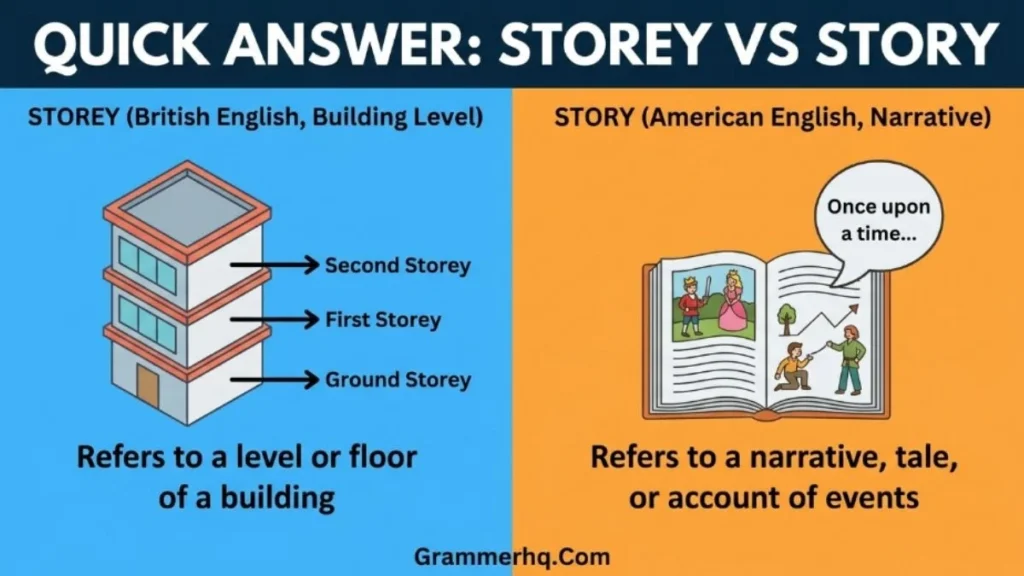
- Storey = a floor or level of a building, mainly in British English.
- Story = a narrative or tale in all varieties of English.
- Story also means a building level in American English.
- Storey → storeys; story → stories.
- Both words have the same pronunciation.
Storey vs. Story at a Glance
| Feature | Storey | Story |
|---|---|---|
| Building level | Yes | Yes, in American English |
| Narrative | No | Yes |
| Main use | British/Commonwealth English | American English for buildings; all English for narratives |
| Plural | storeys | stories |
| Pronunciation | Same | Same |
The easiest rule is: storey = building level in British English; story = narrative, or building level in American English.
What Does “Storey” Mean?
Storey is a noun meaning one level of a building. It is the spelling commonly used in British English and is also found in several other varieties of English influenced by British usage.
For example:
- They live in a two-storey house.
- The office is on the third storey.
- The hotel has twelve storeys.
- Firefighters reached the fifth storey.
The plural is storeys, not stories.
So:
one storey → two storeys → five storeys
If you are writing for a British audience, storey is normally the correct choice when talking about a building level.
What Does “Story” Mean?
Story has a much broader meaning.
Most commonly, it means a narrative, tale, or account of events:
She told us an interesting story about her childhood.
It can also refer to:
- a fictional tale
- a personal anecdote
- a news report
- a rumor or account
- an excuse or false explanation
For example:
The newspaper published a story about the accident.
He gave me some story about why he was late.
In American English, story has another meaning: a level of a building.
They bought a three-story house.
This means that American English uses story for both major senses, while British English normally uses storey for the building sense.
Where Do “Storey” and “Story” Come From?
The two words have a shared historical background.
Story ultimately traces back through Old French forms such as estoire and estorie to Latin historia, meaning an account, history, or narrative.
Over time, the word developed different senses in English, including the architectural sense of a building level.
The spelling storey became associated with the building sense, particularly in British usage. It is therefore better understood as a historical spelling variant rather than as a completely unrelated word.
You may also come across a popular theory connecting the building sense with painted windows or pictures showing stories on medieval buildings. It is an interesting explanation, but it should be treated as a disputed theory, not established fact.
The important point is that storey and story are historically connected.
Storey vs. Story by Region
| Region | Building level | Narrative |
|---|---|---|
| United States | story | story |
| United Kingdom | storey | story |
| Australia | storey | story |
| Canada | storey/story | story |
| South Africa | storey commonly used | story |
| South Asia | storey commonly used | story |
Regional usage can vary, especially in countries where British and American English both influence everyday writing.
The safest approach is simple: match the spelling to the English variety you are writing for.
Two-Storey or Two-Story?
When storey/story is used as part of a compound adjective before a noun, it stays singular.
Correct:
- a two-storey house
- a three-storey building
- a five-story hotel
- a ten-story tower
Incorrect:
- a two-storeys house
- a five-stories building
Why? Because the whole expression acts as a compound adjective.
Compare:
a two-storey house
with:
The house has two storeys.
There is another useful word here: storied.
A storied career means a career with a long, notable, or impressive history.
She enjoyed a storied career in journalism.
Storey vs. Floor vs. Level
Storey, floor, and level can overlap, but they are not always used in exactly the same way.
Storey/story is especially useful when talking about how many levels a building contains:
It is a six-storey apartment building.
Floor is commonly used when saying where something is located:
My office is on the third floor.
Level is broader and can be useful when referring to a particular height or section of a building.
There is also a major British-American difference in floor numbering:
- In British English, the level at street level is usually the ground floor, and the level above it is the first floor.
- In American English, the street-level floor is normally the first floor.
Technical building definitions can vary, so basements, mezzanines, attics, and roof spaces may be treated differently under particular building codes.
Storey Height: What Does It Mean?
In construction and real estate, storey height usually refers to the vertical distance associated with one building level, often measured from one floor level to the next.
There is no single standard height for every building. Residential, commercial, industrial, and high-rise buildings can all have different storey heights because of ceilings, structural systems, ventilation, utilities, and design requirements.
So saying that a building is three storeys high tells you the number of levels, not its exact height.
Storey vs. Story: Quick Examples
| British English | American English |
|---|---|
| It is a two-storey house. | It is a two-story house. |
| The building has six storeys. | The building has six stories. |
| Her office is on the fourth storey. | Her office is on the fourth story. |
| They built another storey. | They built another story. |
| The hotel is ten storeys high. | The hotel is ten stories high. |
But when the meaning is a narrative, both varieties use story:
She told me a fascinating story.
Not:
She told me a fascinating storey.
Common Mistakes to Avoid
Using “storey” for a narrative
❌ He told me a funny storey.
✅ He told me a funny story.
Using the wrong plural
❌ The building has five stories. (British building context)
✅ The building has five storeys.
But in American English:
✅ The building has five stories.
Writing “two-storeys”
❌ a two-storeys house
✅ a two-storey house
Assuming “storey” is incorrect
It is not incorrect. It is the standard British spelling for a building level.
Assuming “story” cannot describe a building
It can. Story is the normal American English spelling for a building level.
FAQs
1: Is “storey” a real word in American English?
Yes. Americans can recognize and use storey, but story is the normal American spelling for a building level.
2: What’s the plural of “storey”?
The plural is storeys.
3: Is it “two-storey” or “two-storeys”?
Use two-storey when it comes before a noun: a two-storey house.
4: Why do the British spell it “storey”?
Storey developed as a spelling associated with the architectural sense of the word, while story remained the standard spelling for a narrative.
5: Do Australians and Canadians use “storey” or “story”?
Australian English commonly uses storey for a building level. Canadian usage can include both storey and story, depending on context and regional preference.
6: Does “storey” include the ground floor?
It can, depending on how the building is being described. Technical definitions may differ under particular building regulations.
7: Are “storey” and “story” pronounced the same?
Yes. They are pronounced the same in normal English usage.
8: What does “a storied career” mean?
A storied career is a career with a notable, impressive, or eventful history.
Final Takeaway
The difference is easier than it first appears:
Storey = a building level, mainly in British English.
Story = a narrative everywhere, and a building level in American English.
Remember: storey has an “e” when you are using the British-style building spelling.
Read More Blogs: