Puting or putting is a common spelling confusion, but the correct form is simple: putting is correct, while puting is incorrect.
The word can look unusual because the final t in put is doubled before -ing is added. This gives us put + ting = putting.
But there is another useful detail: putting can also come from the verb putt, especially when talking about golf.
In everyday English, putting can mean placing something somewhere, while in golf, it refers to hitting the ball gently toward the hole.
In this guide, you will learn why putting has two ts, how to pronounce it, what it means, and how to use it correctly in real sentences.
Quick Answer
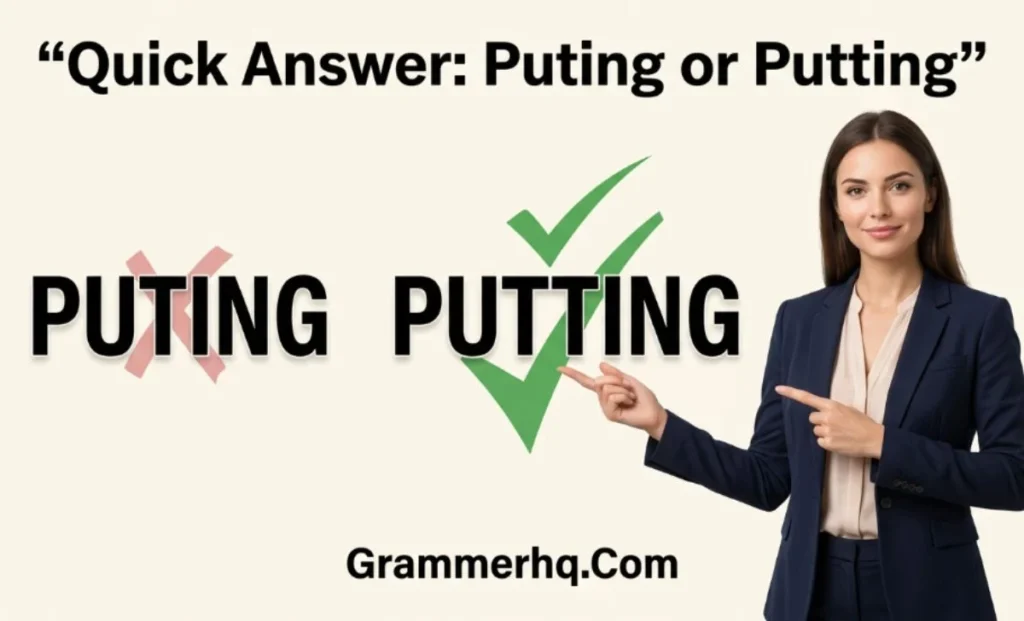
Putting is correct. Puting is a spelling mistake.
| Word | Correct? | Example |
|---|---|---|
| Putting | ✅ Correct | She is putting the books away. |
| Puting | ❌ Incorrect | She is puting the books away. |
The correct spelling is:
put + -ing = putting
If you are writing an email, school assignment, article, or professional document, use putting.
Is It Puting or Putting?
The correct form is putting, with two ts.
Putting is the present participle of put and can also work as a gerund, depending on how it is used in a sentence.
For example:
I am putting the dishes in the cabinet.
Here, putting describes an action that is happening now.
Another example is:
Putting things off can create unnecessary problems.
Here, putting functions as a noun-like form, called a gerund.
The spelling does not change between these uses. It is always putting, not puting.
Why Is Putting Spelled With Two Ts?
When -ing is added to put, the final t is doubled:
put → putting
This is part of a common English spelling pattern in which a final consonant may be doubled before a suffix beginning with a vowel.
You can see a similar pattern in:
- run → running
- sit → sitting
- stop → stopping
- get → getting
- cut → cutting
For put, the standard spelling is simply:
PUT + T + ING = PUTTING
It is better to remember the correct form than to apply a “double every final consonant” rule to every English verb. Spelling patterns have conditions and exceptions.
Writing puting leaves out the second t, which makes the word incorrect.
How Do You Pronounce Putting?
Putting has two syllables, with the stress on the first syllable. The word is pronounced the same way whether it refers to placing something somewhere or hitting a golf ball toward a hole.
Although putting is spelled with two ts, you do not pronounce two separate t sounds. The standard IPA pronunciation is /ˈpʊtɪŋ/.
What Does Putting Mean?
The meaning of putting depends on the context.
Putting as placing something
When it comes from the verb put, putting can mean placing or moving something into a particular position.
For example:
She is putting the milk in the refrigerator.
I am putting my phone on the desk.
They are putting the chairs outside.
This is the everyday use most people encounter.
Putting in golf
Putting can also refer to the action of hitting a golf ball gently toward the hole.
For example:
He spent the morning practicing his putting.
In this context, putting comes from the golf verb putt.
So the same spelling can have different meanings depending on the context.
Put vs Putt: Why Can Both Become Putting?
This is an easy detail to miss. Although put and putt are different verbs, their -ing forms are both spelled putting. The meaning depends on which verb is being used.
Put → putting
The verb put means to place something somewhere.
Examples:
They are putting the chairs outside.
She is putting the books on the shelf.
I am putting my keys on the table.
She is putting the keys on the table.
Putt → putting
Putt is a golf term for hitting a ball gently toward the hole.
He is putting on the final green.
The spelling is identical, but the meaning comes from the context.
| Base verb | -ing form | Meaning |
|---|---|---|
| put | putting | placing something |
| putt | putting | hitting a golf ball |
This is why putting can refer to two different actions without needing two different spellings.
Is Putting a Verb or a Noun?
Putting can have different grammatical roles.
Putting as a present participle
In a sentence such as:
Sarah is putting the groceries away.
Putting is the present participle of put and forms part of the present continuous verb phrase is putting.
Putting as a gerund
Consider:
Putting things off can make work harder.
Here, putting things off acts as the subject of the sentence. In traditional grammar, this use is called a gerund phrase.
The important point is that the spelling stays the same. Its grammatical role depends on how it is used.
Putting in Real-Life Sentences
Here are some natural examples showing different uses of putting:
- I am putting the documents in the folder.
- She is putting her phone on silent.
- We are putting together a presentation for tomorrow.
- Please stop putting off your homework.
- He is putting the groceries away.
- They are putting more effort into the project.
- Putting things off can make a small task harder.
- He is practicing his putting before the golf tournament.
These examples show why context matters. Putting can describe an action, appear in a phrasal verb, or refer to the golf skill of hitting the ball toward the hole.
Puting vs Putting: Common Mistake
The most common mistake is writing puting with only one t.
Incorrect
She is puting the books on the shelf. ❌
Correct
She is putting the books on the shelf. ✅
There is another mistake worth avoiding: using putted as the ordinary past tense of put.
For the normal verb put, the main forms are:
| Verb form | Correct form |
|---|---|
| Base form | put |
| Present participle | putting |
| Past tense | put |
| Past participle | put |
For example:
I put the keys on the table yesterday. ✅
Not:
I putted the keys on the table yesterday. ❌
The golf verb putt is different: its past tense is putted.
That distinction can help prevent another common source of confusion.
Is Putting the Same in American and British English?
Yes. Putting is spelled the same way in both American and British English.
| English variety | Correct spelling |
|---|---|
| American English | putting |
| British English | putting |
There is no standard American spelling puting and British spelling putting distinction.
If you are writing for a US or UK audience, putting is the correct form.
How to Remember the Correct Spelling
The easiest way to remember it is:
put → putting
Think of the spelling as:
PUT + T + ING = PUTTING
A simple memory trick is:
Put has one T, but putting has two.
Whenever you are unsure whether to write puting or putting, remember that the standard -ing form keeps the doubled t.
FAQs
Is “puting” a correct spelling?
No. Puting is a misspelling. The correct spelling is putting.
Is it puting or putting?
It is putting. The final t is doubled before -ing is added.
What is the -ing form of put?
The -ing form of put is putting.
Why does putting have two Ts?
The standard spelling doubles the final t when forming putting. Therefore, putting is correct, while puting is not.
What is the past tense of put?
The past tense of put is put.
She put the book on the desk yesterday.
Is putting the same in American and British English?
Yes. Putting is the standard spelling in both American and British English.
What is the difference between put and putt?
Put generally means to place something somewhere. Putt is a golf verb meaning to hit a golf ball gently toward the hole. Both have the -ing form putting.
Is putting a verb or a gerund?
It can be either, depending on the sentence. In “She is putting the books away,” it is a present participle. In “Putting things off causes problems,” it functions as a gerund.
Conclusion
Putting is the correct spelling, while puting is incorrect. It is the -ing form of put, and the standard spelling uses two ts.
The same spelling can also come from putt, the golf verb, so context determines the meaning.
When in doubt, remember:
Putting ✅
Puting ❌
Read More Blogs
- Shakey or Shaky: Which Spelling Is Correct?
- Refer or Reffer: Which Spelling Is Correct? Meaning & Usage