If you are unsure about Scarey vs Scary, you are not alone. These spellings look almost identical, but only one is correct in standard English.
Scary is the correct spelling and means causing fear, worry, or uneasiness. Scarey is a common misspelling and should be avoided in formal writing, schoolwork, professional communication, and published content.
The confusion usually comes from the word scare, which makes it tempting to add a “y” and write scarey.
However, English spelling rules change the ending of some words when forming adjectives. Learning why scary is correct can help you avoid this mistake and write with greater confidence.
In this guide, you’ll learn the difference, meaning, examples, spelling rule, and easy ways to remember the correct form.
Quick Answer
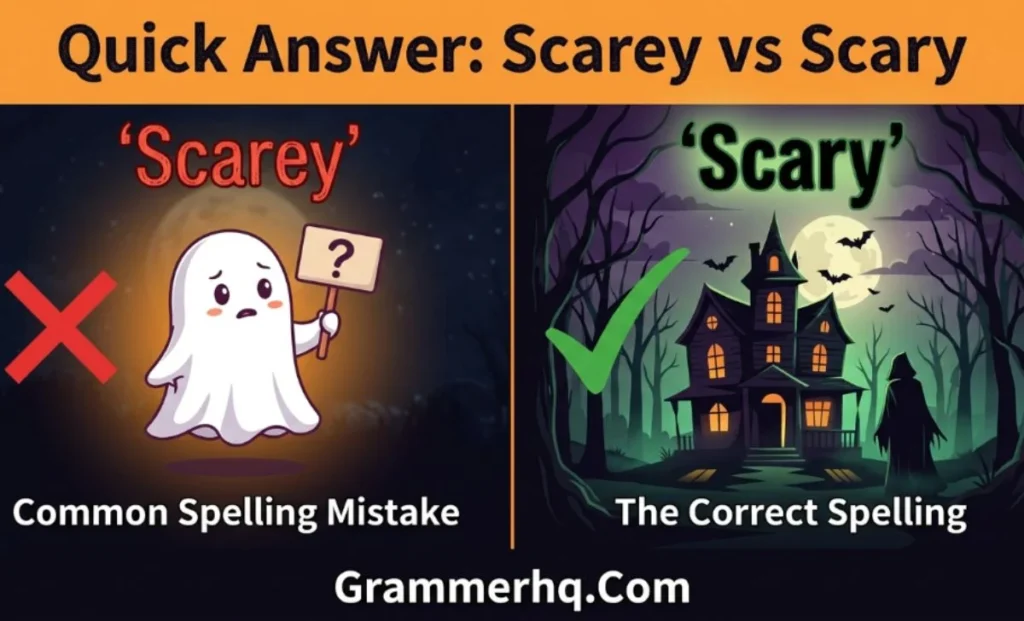
Scary is the standard spelling.
Scarey is a recognized variant spelling, not simply a word that does not exist. Collins lists scarey as a variant of scary in British English.
| Word | Meaning | Best choice? |
|---|---|---|
| scary | frightening or causing fear | ✅ Yes |
| scarey | variant of scary | ⚠️ Rare; usually avoid |
For example:
That was a scary experience.
The road looked scary after dark.
The practical rule is simple: when in doubt, write scary.
What Does Scary Mean?
Scary is an adjective used to describe something that makes you feel afraid, worried, or alarmed.
It can describe much more than horror movies. You might call a storm, accident, noise, situation, experience, or even a difficult decision scary.
For example:
The movie was scary, but the ending was good.
That was a scary moment when the car suddenly stopped.
The storm looked scary from our window.
Walking home alone in the dark felt scary.
Losing my wallet in a foreign country was a scary experience.
In each example, scary describes the situation or thing that causes the feeling of fear.
Is Scarey a Real Word?
Yes, with an important qualification.
It would be inaccurate to say that scarey never exists in English. Collins records scarey as a variant spelling of scary in British English.
But dictionary recognition does not mean that the two spellings are equally common or equally advisable.
Scary is the form readers normally expect in contemporary writing. That makes it the better choice for most people.
Think of it this way:
- Scary → standard and familiar
- Scarey → recognized variant, but uncommon
- For normal writing → choose scary
This distinction is important because many online articles make the opposite mistake: they confidently label scarey as completely invalid, even though dictionary evidence shows that the situation is more nuanced.
Scarey vs Scary in American and British English
The difference is not simply “American scary, British scarey.”
That would give learners the wrong idea.
Scary is the normal spelling in both American and British English. Scarey is a documented British variant, but it is much less common.
So if you are writing for:
- American readers
- British readers
- international readers
- students
- customers
- professional audiences
scary is the safest and most familiar form.
For example, this works naturally in any broad English audience:
The storm became scary very quickly.
You do not need to switch to scarey simply because your reader uses British English.
Why Do People Write Scarey?
The mistake is understandable because the word is related to scare.
A writer may look at:
scare
and naturally think:
scare + y = scarey
But the standard spelling is:
scary
The extra e is not part of the standard form.
There is also a pronunciation problem. When people hear a word rather than see it written, they cannot easily tell whether the final sound should be represented by -y or -ey.
That is why someone might write:
That movie was scarey.
even though they already know the word scary.
The easiest solution is to memorize the standard spelling rather than trying to spell it from the sound.
Scary vs Scared: Don’t Mix Them Up
Scary describes something that causes fear.
Scared describes someone who feels fear.
Compare:
The dog looked scary.
I was scared of the dog.
The dog causes the reaction, so it is scary. The person experiences the reaction, so the person is scared.
Here are some everyday examples:
The roller coaster was scary, but I wasn’t scared after the first ride.
The thunder was scary, and the children were scared.
The abandoned house looked scary, so we decided not to go inside.
This distinction is much more useful than simply memorizing a spelling rule because it helps you choose the right word when writing a complete sentence.
Scare vs Scary: What’s the Difference?
The word scare can work as a verb or noun, while scary is an adjective.
As a verb:
The sudden noise scared me.
Here, scared means “frightened.”
As an adjective:
The sudden noise was scary.
Here, scary describes the noise.
As a noun:
That gave me a real scare.
So the relationship is:
scare → frighten someone
scary → causing fear
scared → feeling fear
Once you understand that difference, many common sentences become easier to write correctly.
Scary, Scarier, and Scariest
The standard forms are:
scary → scarier → scariest
Scary when describing something frightening:
That movie is scary.
Scarier when comparing two things:
The second movie was scarier than the first.
Use scariest when comparing three or more things or identifying the highest degree:
That was the scariest part of the trip.
Do not add the extra e:
❌ scareier
❌ scareiest
The standard forms are:
✅ scarier
✅ scariest
Collins also lists scarier and scariest as the comparative and superlative forms of scary.
Scary in Real-Life Situations
One reason scary is so useful is that it can describe many different levels of fear.
A child might say:
The thunder was scary.
Someone driving through a severe storm might say:
The road conditions were getting scary.
After a serious accident, someone might say:
It was a really scary experience, but everyone was safe.
The word does not have to describe horror or supernatural things. It can describe anything that creates fear or alarm.
That is why expressions such as scary movie, scary story, scary situation, scary experience, and scary moment are so natural.
Common Scarey vs Scary Mistakes
Here are the mistakes most worth remembering:
The movie was scarey.
The movie was scary.
I was scary during the storm.
I was scared during the storm.
The movie was scareier than the first one.
The movie was scarier than the first one.
That noise scary me.
That noise scared me.
The first mistake is spelling. The others come from confusing related words.
Should You Ever Write Scarey?
Usually, no.
If you are simply trying to write standard modern English, scary is the better choice. It is familiar to readers and avoids making your spelling look unusual.
However, it is worth knowing that scarey can appear as a legitimate variant, especially in British English.
So if you encounter scarey in a book, website, quotation, or British source, you should not automatically assume that the writer invented the word.
The important distinction is:
Recognized does not mean preferred.
For your own writing, scary is the practical choice.
FAQs
1: Is scarey or scary correct?
Scary is the standard spelling. Scarey is a recognized but uncommon variant.
2: Is scarey a real English word?
Yes. Collins records scarey as a variant spelling of scary, particularly in British English.
3: Is scarey a British spelling?
It is a documented British variant, although scary remains the normal spelling in British English.
4: Which spelling should I use in American English?
Use scary. It is the standard and familiar choice.
5: Why do people spell scary as scarey?
The confusion likely comes from the related word scare. Writers may naturally expect the final e to remain when forming the adjective.
6: What is the difference between scary and scared?
Scary describes something that causes fear. Scared describes someone who experiences fear.
7: What is the comparative form of scary?
The comparative is scarier.
The second movie was scarier.
8: What is the superlative form of scary?
The superlative is scariest.
That was the scariest scene.
9: Should I use scarey in formal writing?
Generally, no. Although it is a recognized variant, scary is the clearer and more conventional choice for formal and professional writing.
Final Verdict
Scary is the spelling you should normally use.
It means frightening or causing fear and is the standard form used by modern English writers. Scarey is recorded as a variant spelling, particularly in British English, but it is much less common.
So whether you’re writing a school assignment, business email, blog post, social media caption, or professional document, choose:
Scary ✅
And remember the related forms:
Scary → Scarier → Scariest
Scare → Scared → Scary
That one distinction will help you avoid both the spelling mistake and the common grammar mistake.
Read More Blogs

Hi, I’m Amelia Parker, a grammar enthusiast and writer at GrammarHQ.com. I specialize in explaining spelling differences, confusing words, and common English mistakes through simple, practical, and easy-to-understand guides.