Thursdays vs Thursday’s can be confusing because the only visible difference is a small apostrophe. But that apostrophe changes the grammatical job of the word.
Use Thursdays when you mean more than one Thursday or something that happens regularly on that day. Use Thursday’s when something is connected to one Thursday, or when it is a contraction of Thursday is or Thursday has.
For example:
- We have meetings on Thursdays.
- Thursday’s meeting starts at 10 a.m.
- Thursday’s the busiest day of my week.
Quick Answer
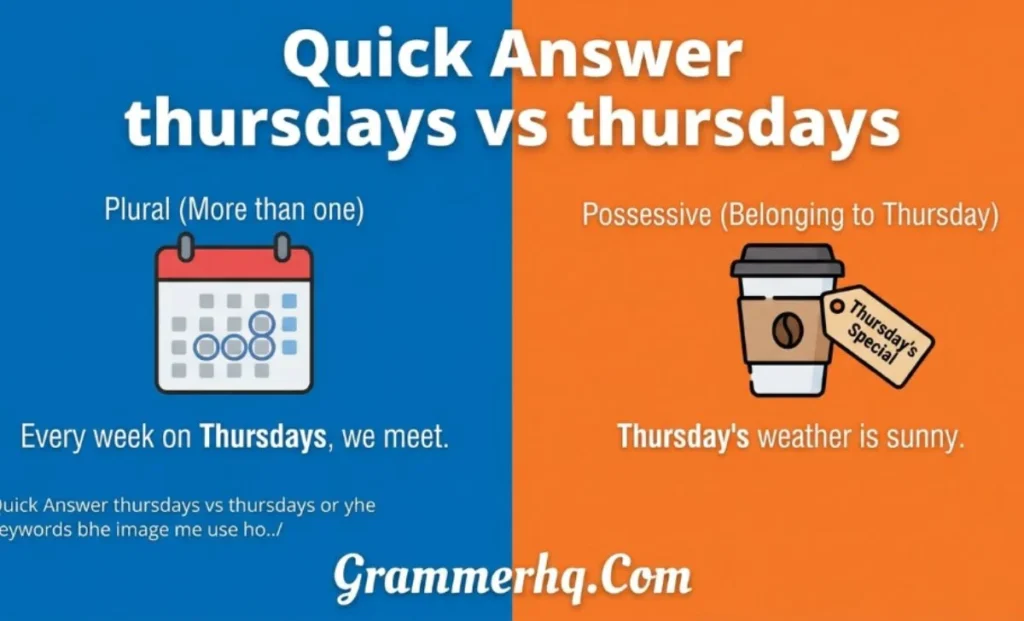
Thursdays is the plural form of Thursday. It can refer to several Thursdays or a recurring weekly activity.
Thursday’s is usually the singular possessive form, showing that something is associated with one Thursday. It can also be a contraction of Thursday is or Thursday has.
| Form | Meaning | Example |
|---|---|---|
| Thursday | One specific day | I’ll call you Thursday. |
| Thursdays | More than one or recurring Thursdays | We work on Thursdays. |
| Thursday’s | One Thursday’s possession or association | Thursday’s meeting was canceled. |
| Thursday’s | Thursday is / Thursday has | Thursday’s been busy. |
| Thursdays’ | Possession involving several Thursdays | The Thursdays’ schedules differed. |
The key is simple: do not use an apostrophe just to make Thursday plural.
What Does “Thursdays” Mean?
Thursdays is the regular plural of Thursday.
Use it when you are talking about several Thursdays or something that happens regularly on that weekday.
For example:
I take an English class on Thursdays.
The store closes early on Thursdays.
There are five Thursdays in October.
The same form can also appear without on in expressions such as:
I work Thursdays.
This means the person regularly works on Thursdays. Cambridge also gives “The shops stay open late on Thursdays” as a natural example of the plural form.
Does “Thursdays” Need an Apostrophe?
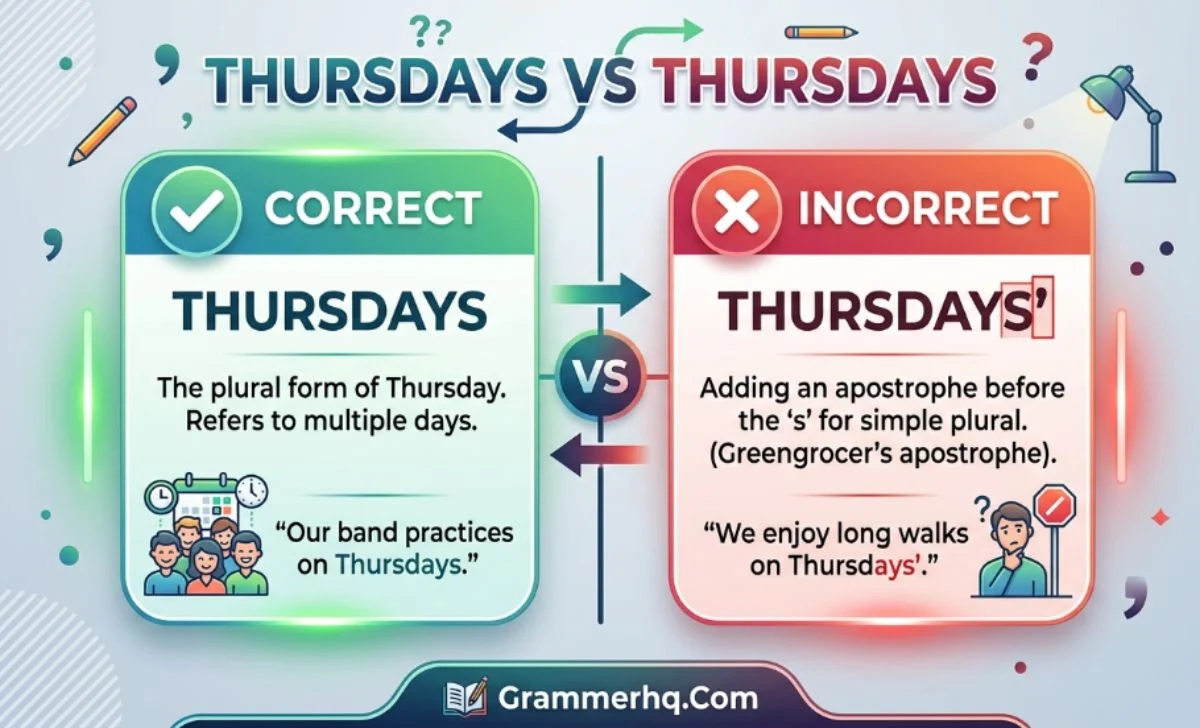
No, not when it is simply plural.
Correct:
We meet on Thursdays.
Incorrect:
We meet on Thursday’s.
The apostrophe is unnecessary because nothing is being shown as possessive.
What Does “Thursday’s” Mean?
Thursday’s has two main uses: it can show possession or association, and it can work as a contraction.
Thursday’s as a Possessive
Use Thursday’s when something is connected with one particular Thursday.
For example:
Thursday’s meeting was canceled.
Thursday’s schedule is already full.
I reviewed Thursday’s agenda before the call.
Here, the apostrophe shows the relationship between Thursday and the noun that follows it.
You can think of it as:
the meeting associated with Thursday
the schedule for Thursday
the agenda for Thursday
Thursday’s as a Contraction;
An important detail is that Thursday’s does not always show possession.
It can also be a shortened form of Thursday is or Thursday has.
For example:
Thursday’s the best day for me.
This means:
Thursday is the best day for me.
Another example:
Thursday’s been unusually busy.
This means:
Thursday has been unusually busy.
A useful test is to expand Thursday’s into Thursday is or Thursday has. If the sentence still makes sense, you are looking at a contraction rather than a possessive.
Thursday vs Thursdays: What Is the Difference?
The difference between Thursday and Thursdays is mainly about whether you mean one occurrence or repeated occurrences.
Use Thursday for one specific day:
I’ll see you Thursday.
The appointment is Thursday.
Use Thursdays for repeated or multiple Thursdays:
I see my doctor on Thursdays.
The library is busiest on Thursdays.
You can also use this Thursday, next Thursday, or last Thursday when referring to one particular Thursday.
Every Thursday vs On Thursdays
This is one of the most common places where writers make a mistake.
Both every Thursday and on Thursdays can describe a weekly routine, but they use different forms.
Every Thursday
Use the singular form after every:
We publish a new article every Thursday.
She visits her grandmother every Thursday.
The team has a meeting every Thursday.
On Thursdays
Use the plural when describing a recurring day:
We publish new articles on Thursdays.
She visits her grandmother on Thursdays.
The team has meetings on Thursdays.
What About “Every Thursdays”?
Every Thursdays is incorrect in standard English.
❌ We publish an article every Thursdays.
✅ We publish an article every Thursday.
The simple rule is:
every + singular noun
on + plural weekday when describing a recurring schedule
What Does “Thursdays’” Mean?
Thursdays’ is the plural possessive form.
It means something is associated with several Thursdays.
For example:
The last three Thursdays’ schedules were unusually busy.
Here, Thursdays is plural, and the apostrophe comes after the s because the possession belongs to multiple Thursdays.
Another example:
The two Thursdays’ events attracted large crowds.
This form is grammatically correct, but it is much less common than Thursdays or Thursday’s. In many cases, rewriting the sentence makes it easier to read:
The events on the two Thursdays attracted large crowds.
That version is often clearer because the reader does not have to process a plural possessive.
Common Mistakes With Thursdays and Thursday’s
1. Using an apostrophe to make Thursdays plural
❌ I work late on Thursday’s.
✅ I work late on Thursdays.
The apostrophe is not needed because Thursdays is simply the plural form.
2. Forgetting the apostrophe in a possessive
❌ Thursdays meeting was canceled.
✅ Thursday’s meeting was canceled.
The meeting is associated with one Thursday, so Thursday’s is appropriate.
3. Using “every Thursdays”
❌ We have training every Thursdays.
✅ We have training every Thursday.
After every, use the singular form.
4. Confusing “Thursday’s” with a plural
❌ Thursday’s are usually quiet.
✅ Thursdays are usually quiet.
If the subject is more than one Thursday, use Thursdays without an apostrophe.
Thursday Morning vs Thursday’s Morning
Some expressions do not need an apostrophe at all.
Write:
Thursday morning
Thursday afternoon
Thursday evening
Thursday night
Cambridge likewise lists expressions such as Thursday morning, Thursday afternoon, Thursday evening, and Thursday night.
For example:
The interview is scheduled for Thursday morning.
Not:
The interview is scheduled for Thursday’s morning.
If you are talking about something associated with the morning, you may need a different structure:
Thursday morning’s meeting was moved online.
However, in ordinary writing, the Thursday morning meeting is often cleaner.
A Simple Way to Remember the Difference
When you are unsure, ask yourself three questions.
Do I mean several Thursdays or a recurring weekly activity?
Use Thursdays.
We have classes on Thursdays.
Is something associated with one particular Thursday?
Use Thursday’s.
Thursday’s class was canceled.
Can I replace “Thursday’s” with “Thursday is” or “Thursday has”?
If yes, it is a contraction.
Thursday’s been exhausting.
= Thursday has been exhausting.
This quick test handles most everyday uses.
Real-Life Examples
Workplace
Team meetings are held on Thursdays.
Thursday’s meeting will begin at 9 a.m.
School
The science lab meets on Thursdays.
Thursday’s lesson covered sentence structure.
Appointments
The clinic is open late on Thursdays.
Thursday’s appointment has been moved to 3 p.m.
Personal Plans
I usually go shopping on Thursdays.
Thursday’s weather looks perfect for a walk.
Contraction
Thursday’s our final day.
Here, Thursday’s means Thursday is.
Is “Thursdays” or “Thursday’s” Correct?
Both can be correct, but they are used differently.
Thursdays
- multiple Thursdays
- recurring weekly activities
- regular schedules
- phrases such as on Thursdays
Thursday’s
- something associated with one Thursday
- a singular possessive
- the contractions Thursday is and Thursday has
Use Thursdays’ only when something is associated with several Thursdays.
The apostrophe should therefore depend on the meaning of the sentence, not simply on how the word looks.
FAQs
1: Is “Thursdays” correct?
Yes. Thursdays is the standard plural form of Thursday and is also used for recurring activities.
We work on Thursdays.
2: Does “Thursdays” need an apostrophe?
No. The ordinary plural is Thursdays, without an apostrophe.
3: Is “Thursday’s” correct?
Yes. Thursday’s can be a singular possessive or a contraction of Thursday is or Thursday has.
4: Is it “every Thursday” or “every Thursdays”?
The correct form is every Thursday.
I exercise every Thursday.
5: Is “on Thursdays” correct?
Yes. On Thursdays is a standard way to describe something that happens regularly on Thursday.
We have staff meetings on Thursdays.
6: What is the plural of Thursday?
The plural is Thursdays, with no apostrophe.
The month has five Thursdays.
7: What is the possessive form of Thursday?
The singular possessive is Thursday’s.
Thursday’s meeting starts at noon.
The plural possessive is Thursdays’.
The two Thursdays’ schedules were different.
8: Can “Thursday’s” mean “Thursday is”?
Yes.
Thursday’s the day I work from home.
This means:
Thursday is the day I work from home.
9: Can “Thursday’s” mean “Thursday has”?
Yes.
Thursday’s been very busy.
This means:
Thursday has been very busy.
Conclusion
The difference between Thursdays vs Thursday’s comes down to the job the word is doing.
Use Thursdays when you mean multiple Thursdays or a recurring weekly activity:
We meet on Thursdays.
Use Thursday’s when something is associated with one Thursday:
Thursday’s meeting was canceled.
It can also mean Thursday is or Thursday has when used as a contraction.
And if several Thursdays share possession, Thursdays’ is possible, although rewriting the sentence is often clearer.
The easiest rule to remember is simple: never add an apostrophe just to make Thursday plural.
Read More Blogs