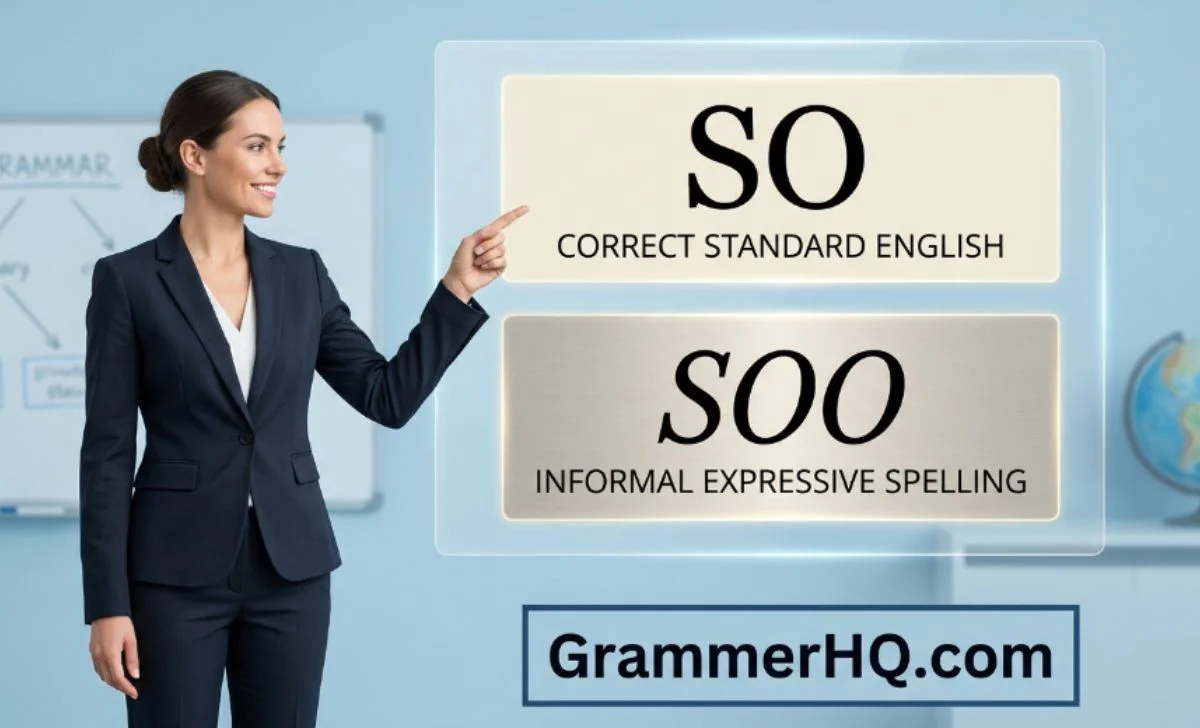
If you are wondering about Soo vs So, the answer is usually simple: so is the standard English spelling.
It is used in everyday speech and writing, while soo is generally an informal spelling you may see in texts, social media posts, and casual online conversations.
People often use soo to add emphasis or make the word sound stretched. For example, “I’m so tired” is standard English, while “I’m soo tired” gives the sentence a more expressive, informal tone.
So, the difference is not simply about spelling. It also depends on context, tone, and whether you are writing formally or casually.
Quick Answer
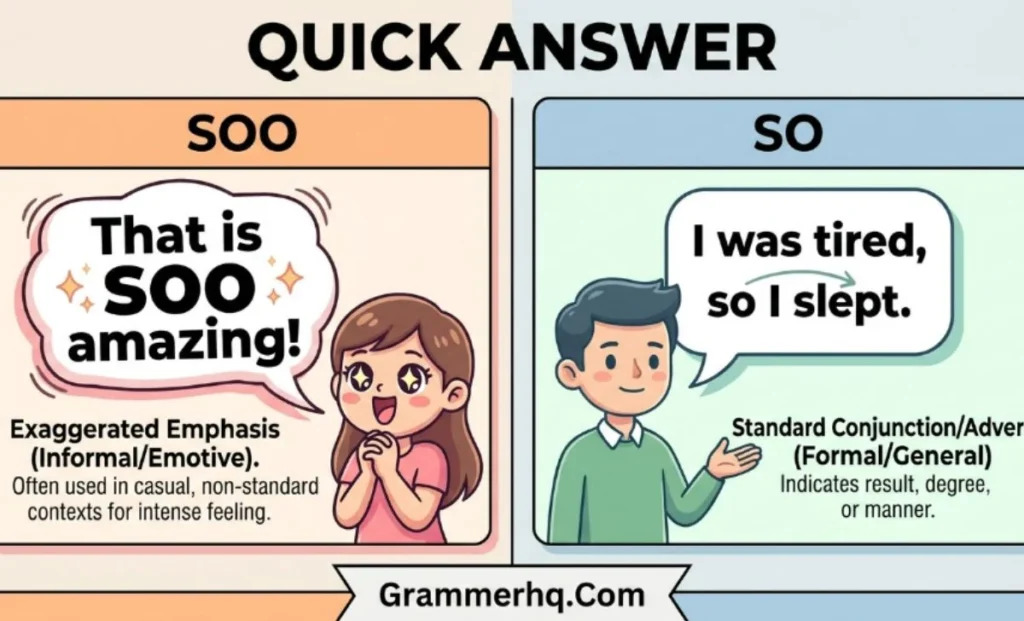
So is the correct standard English spelling.
Soo is generally a nonstandard, informal spelling that people use online to emphasize the word or imitate a stretched pronunciation.
| Form | Standard English? | Typical use |
|---|---|---|
| so | Yes | Formal and informal writing |
| soo | No, as the standard spelling of so | Casual texting and online communication |
| sooo | No | Stronger informal emphasis |
The simple rule
If you are writing an essay, email, article, application, or other formal text, use so.
If you are texting a friend or writing a playful social media post, soo or sooo may be used intentionally to express extra emotion.
Standard: I am so excited.
Informal: I am sooo excited!
What Does “So” Mean?
So is a common English word with several grammatical uses. Its meaning depends on the sentence.
“So” meaning “very” or “to a great degree”
Here, so works as an intensifier.
The movie was so good.
She was so happy to see her friends.
This coffee is so hot.
In these sentences, so increases the degree of the adjective.
“So” meaning “therefore”
So can also connect an action with its result.
It started raining, so we went inside.
I was tired, so I went to bed early.
Here, so is similar to therefore or as a result.
“So” meaning “in the same way”
It can also refer to something that was already mentioned.
“I love this song.”
“So do I.”
Another example:
“She can speak Spanish.”
“So can her sister.”
“So” at the beginning of a sentence
In conversation, so is often used to introduce a question, explanation, or new point.
So, what happened?
So, let’s start with the easiest example.
This use is especially common in spoken and conversational English.
What Does “Soo” Mean?
In the context of “soo vs so,” soo is usually an informal spelling of so. People often add an extra o to make the word feel longer, stronger, or more emotional.
For example:
I am so tired.
sounds neutral.
I am soo tired.
sounds more expressive.
And:
I am sooo tired.
can sound even more dramatic or playful.
The extra letters do not normally create a new standard grammatical form. Instead, they communicate tone and emphasis.
Why Do People Write “Soo” Instead of “So”?
Online communication does not always follow the conventions of formal written English. People often change spellings deliberately to reproduce the feeling of spoken conversation.
One common technique is vowel elongation.
The progression can look like this:
so → soo → sooo → sooooo
The additional o’s can suggest that the speaker is stretching the sound.
For example:
That puppy is so cute.
This is neutral.
That puppy is sooo cute!
This feels more enthusiastic.
The spelling has changed, but the basic word has not become a different standard English word. The extra letters mainly add emotion, emphasis, humor, excitement, or exaggeration.
Soo vs So in Texting and Social Media
The difference becomes clearer in informal digital communication.
When “soo” can work
You may see soo in:
- Text messages
- Casual chats
- Social media comments
- DMs
- Memes
- Informal captions
- Playful online conversations
For example:
“I’m soo hungry right now.”
“That was sooo funny!”
“You are soo lucky!”
These sentences are understandable because the writer is using spelling to express a conversational tone.
When you should use “so”
Use so when you want standard English, including in:
- School assignments
- Academic writing
- Business emails
- Job applications
- Reports
- Professional websites
- Formal letters
For example:
I am so grateful for your help.
Not:
I am soo grateful for your help.
The second version may be understood, but it looks deliberately informal.
Soo vs So vs Sooo: What’s the Difference?
These forms can look almost identical, but they communicate different levels of emphasis.
| Form | Meaning/role | Tone |
|---|---|---|
| so | Standard English word | Neutral |
| soo | Informal stretched spelling | Emphatic |
| sooo | More extended spelling | Strongly expressive |
| sooooo | Highly extended spelling | Dramatic or playful |
There is no fixed grammatical rule saying that two extra o’s mean one specific amount of emotion. The effect depends on context and the person writing.
For example:
I missed you so much.
is normal.
I missed you sooo much!
sounds warmer and more emotional.
I missed you sooooo much!
can sound exaggerated, dramatic, or playful.
Is “Soo” a Real Word?
This question needs a little nuance.
If you mean “Is soo the standard English spelling of so?”, the answer is no.
Standard English uses so, not soo, for the common word meaning “to a great degree,” “therefore,” or other established uses.
However, saying that soo can never appear as a word or name in any context would be too broad. You may encounter the spelling in names, transliterations, or language-specific contexts. That is different from using soo as the ordinary English spelling of so.
So, for everyday English writing, remember:
So = standard English
Soo = usually an informal or expressive spelling
Is “Soo” a Misspelling?
Sometimes, yes.
If someone intends to write the standard English word so but accidentally types soo, it is simply a spelling error.
But in a text such as:
“That is sooo cute!”
the extra letters are probably intentional.
This is why context matters. The same spelling can be:
- an accidental typo in one sentence, or
- deliberate emphasis in another.
In formal writing, however, there is little reason to use soo intentionally.
How to Pronounce “So”
The standard word so has established pronunciations in English, with both British and American English dictionaries documenting it.
The important point for soo vs so is that adding another o in informal writing does not automatically create a separate standard pronunciation.
When someone writes:
“I’m sooo tired!”
the extra letters are usually a written way of showing that the speaker is stretching the sound for emphasis.
You can think of it as writing the tone of speech rather than creating a new English word.
British English vs American English
There is no standard British-versus-American spelling difference here.
Both British English and American English use:
so
The spelling soo is not an alternative British spelling or an American spelling of so.
If you are writing for a British, American, Canadian, Australian, or international English-speaking audience, so remains the standard choice.
Common Mistakes With “Soo”
Using “soo” in formal writing
❌ The results were soo surprising.
✅ The results were so surprising.
Assuming “soo” is a different grammatical form
The extra o does not normally give the word a new grammatical function.
Treating “soo” as a British or American spelling
It is not a standard regional spelling difference.
Confusing expressive spelling with standard spelling
Words such as sooo, nooo, and yesss can appear online because people use extra letters to express emotion. That does not make those spellings standard forms for formal writing.
Easy Trick to Remember Soo vs So
Use this simple rule:
One “o” = standard English. Extra “o’s” = extra emotion.
So:
so → standard
soo → informal emphasis
sooo → stronger emphasis
If you are unsure which one to use, choose so. It works in both formal and informal English.
Soo vs So: Real-Life Examples
1: Casual conversation
“I’m so tired today.”
Standard and completely natural.
2: Texting a friend
“I’m soo tired 😭”
The extra o makes the message feel more emotional.
3: Social media
“This sunset is sooo beautiful!”
The extended spelling adds enthusiasm.
4: Professional email
“We are so pleased with the results.”
Use the standard spelling.
5: Academic writing
“The experiment was so successful that the researchers repeated it.”
Again, so is the appropriate choice.
6: Deliberate exaggeration
“That was sooooo embarrassing!”
The extra letters are being used for dramatic effect, not formal grammar.
Which One Should You Use?
The safest choice is simple: use so.
| Situation | Best choice |
|---|---|
| Academic paper | so |
| School assignment | so |
| Professional email | so |
| Resume or application | so |
| Business report | so |
| Normal conversation | so |
| Texting friends | so or soo, depending on tone |
| Casual social media | so, soo, or sooo, depending on style |
| Formal publication | so |
If your goal is correct, standard English, there is no need to add another o.
FAQ,s
Is “soo” correct English?
Soo is not the standard English spelling of so. It can appear intentionally in informal digital communication to add emphasis or express emotion.
Is “soo” a word?
In ordinary English usage, so is the standard word. Soo may appear in other contexts, including names or language-specific uses, but it is not the standard spelling of the common English word so.
Is it “soo” or “so”?
Use so in standard English. Use soo only when deliberately writing in an informal, expressive style.
What does “soo” mean in texting?
In texting, soo usually means so, but the extra o adds emphasis or emotion.
“I’m soo excited!”
The writer is making so feel more expressive.
Why do people type “soo”?
People often type soo to imitate a stretched pronunciation or to add emphasis, excitement, exaggeration, or a playful tone.
Can I use “soo” in an email?
You can use it in a very casual personal message if the tone is intentionally informal. For professional or formal emails, use so.
What does “sooo” mean?
Sooo is an informal spelling of so with extra emphasis. The additional letters often make the message sound more emotional, excited, dramatic, or playful.
Is “soo” slang?
It is better described as an informal or expressive spelling rather than treating it as a standard English word. Its meaning usually comes from the context in which it is written.
Is “so” the correct spelling in British and American English?
Yes. So is the standard spelling in both British English and American English.
Conclusion
When choosing between soo vs so, use so for standard English. It is the correct spelling for formal writing, everyday English, academic work, professional communication, and normal conversation.
Soo is mainly seen in informal digital communication, where people add an extra o to make the word sound stretched or more emotional.
Forms such as sooo and sooooo take that expressive style even further. The easiest rule is simple: use “so” for correct standard English, and use extra “o’s” only when you intentionally want an informal, expressive tone.
Read More Blogs: