Segue vs Segway is a classic spelling mix-up because both words are pronounced the same, but they do completely different jobs.
If you are moving from one topic to another, the word you need is segue. If you are talking about the two-wheeled transportation brand, it is Segway.
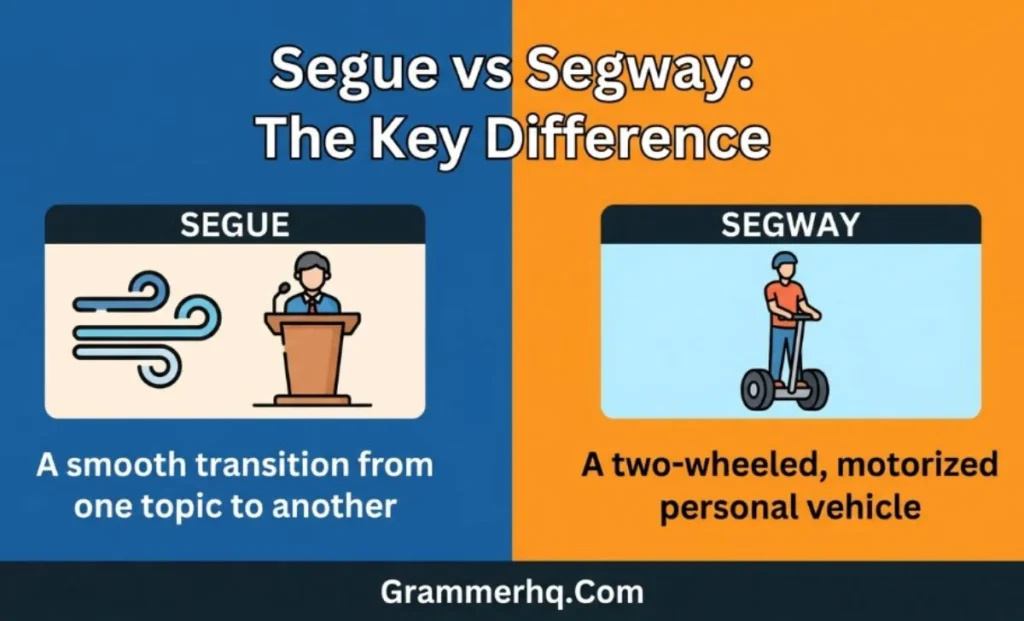
Segue = a smooth transition
Segway = a transportation brand
For example:
Let’s segue into the next question.
We explored the city on a Segway.
The pronunciation may sound identical, but the meaning makes the correct spelling clear.
Segue vs Segway: The Key Difference
The simplest way to tell them apart is to think about what is moving.
With a segue, an idea, conversation, song, or scene moves smoothly into something else.
With a Segway, a person moves from one place to another using a personal transportation device.
| Word | Meaning | Example |
|---|---|---|
| segue | A smooth transition between subjects or situations | The host made a smooth segue into the next topic. |
| Segway | A brand name associated with personal transportation | The tourists rode a Segway through the city. |
So, if you are changing the subject, use segue.
If you are talking about the transportation product, use Segway.
What Does Segue Mean?
Segue means to move smoothly from one thing to another. It can describe a transition between topics, ideas, conversations, songs, scenes, or activities.
It can be used as both a noun and a verb.
Segue as a Noun
As a noun, a segue is a smooth transition.
The speaker made a natural segue from the introduction to the main topic.
That question was a perfect segue into our discussion about education.
You will often see segue used with words such as smooth, natural, or perfect.
Segue as a Verb
As a verb, segue means to move smoothly from one subject or situation to another.
Let’s segue into the next part of the presentation.
The conversation segued from travel into food.
The documentary segues into a discussion of climate change.
The pattern segue into is especially common when introducing a new topic.
Oxford lists segue as both a noun and a verb and gives the pronunciation /ˈseɡweɪ/. It also lists forms such as segues, segued, and segueing. (Oxford Learner’s Dictionaries)
What Does Segway Mean?
Segway is a brand name associated with personal transportation products. The name is best known for the self-balancing, two-wheeled vehicles that allow a rider to stand while traveling.
For example:
We booked a Segway tour around the historic district.
The guide showed us how to ride the Segway safely.
Unlike segue, Segway is not the word you use for a change of subject.
The official Segway company now covers a broader range of personal mobility products, including electric scooters and other vehicles. (Segway)
Is Segway a Misspelling of Segue?
Sometimes but not always.
If you mean a transition between ideas or topics, segway is the wrong spelling.
❌ Let me segway into the next point.
✅ Let me segue into the next point.
But if you are referring to the transportation brand, Segway is correct.
✅ We rented a Segway for the afternoon.
This distinction matters because Segway is a real name, not simply a misspelling of segue.
Why Are Segue and Segway So Easy to Confuse?
The main reason is simple: they sound alike.
The spelling of segue can look surprising when you first see it. Someone may hear:
“segue”
and reasonably assume it should be spelled segway.
That confusion becomes even stronger because Segway is already a familiar word and brand name.
There is also a useful connection between the meanings:
- A segue moves an idea from one topic to another.
- A Segway moves a person from one place to another.
Think of it this way:
Ideas segue. People ride Segways.
How Do You Pronounce Segue?
Segue is commonly pronounced “SEG-way.”
Its dictionary pronunciation is /ˈseɡweɪ/. Interestingly, this is why its spelling causes so many mistakes: the pronunciation gives you almost no clue that the word is spelled segue. (Oxford Learner’s Dictionaries)
Segway is also pronounced essentially the same way.
So hearing the word alone will not tell you which spelling the speaker means. You need the context.
How to Use Segue in Real Life
Segue is useful in many situations where one subject naturally leads to another.
In a Conversation
Speaking of travel, that segues nicely into my next question.
In a Presentation
Now, let’s segue into the results.
In an Article
This example provides a useful segue into the next section.
In a Podcast
After discussing the interview, the host segues into the latest news.
In Music or Film
The final scene segues into the closing credits.
In each example, one subject or moment flows naturally into another.
What Does “Nice Segue” Mean?
If someone says “Nice segue,” they usually mean:
“That was a smooth or clever transition to another topic.”
For example:
“That reminds me of something related to our next subject.”
“Nice segue.”
Here, segue describes the way the speaker moved from one idea to another.
It has nothing to do with a Segway vehicle.
Is It “Segue Into” or “Segway Into”?
When you mean move smoothly to another subject, the correct phrase is:
segue into
For example:
Let’s segue into the final part of the discussion.
Not:
❌ Let’s segway into the final part of the discussion.
This is one of the most common mistakes caused by the similar pronunciation of the two words.
What Are the Verb Forms of Segue?
Because segue works as a verb, it can appear in several forms:
| Verb form | Example |
|---|---|
| segue | We segue into the next topic. |
| segues | She segues into the conclusion. |
| segued | He segued into another subject. |
| segueing | The discussion is segueing toward a new issue. |
These forms can look unusual at first, but they follow the normal use of segue as a verb. Oxford lists segues, segued, and segueing as forms of the word. (Oxford Learner’s Dictionaries)
Is Segue British or American English?
Segue is used in both British and American English.
It is not a case where one spelling is British and the other is American.
The distinction is based on meaning, not regional English:
- segue = a smooth transition
- Segway = the brand/product
So you should not use Segway simply because you are writing for an American audience, or segue because you are writing for a British audience.
How to Remember Segue vs Segway
Here is the easiest memory trick:
Segue = Switch topics
Segway = Ride
If the sentence is about an idea, conversation, presentation, song, or scene changing direction, choose segue.
The speaker segued into a new topic.
If the sentence is about transportation, choose Segway.
The tourists rode Segways around the city.
One moves ideas. The other moves people.
FAQs
1: Is “segway” correct when changing the subject?
No. When you mean a smooth transition to another subject, the correct spelling is segue.
Let me segue into the next topic.
2: What does “nice segue” mean?
“Nice segue” means a smooth, clever, or natural transition from one topic to another.
3: Is segue a noun or a verb?
Segue can be both a noun and a verb. As a noun, it means a smooth transition. As a verb, it means to move smoothly from one subject or situation to another.
4: How do you pronounce segue?
Segue is commonly pronounced “SEG-way,” /ˈseɡweɪ/.
5: What is the past tense of segue?
The past tense is segued.
The presenter segued into the final topic.
6: What is a Segway?
A Segway is a brand associated with personal transportation products, including its well-known two-wheeled self-balancing vehicles.
7: Is “segue into” correct?
Yes. Segue into is the standard expression when you mean to move smoothly into another topic.
8: What is the plural of segue?
The plural noun is segues.
The presentation included several smooth segues between topics.
Conclusion
The difference between segue vs Segway is easier once you focus on meaning.
Use segue when something moves smoothly from one topic, idea, scene, song, or activity to another. Use Segway when you mean the transportation brand or its products.
Remember:
Segue = transition
Segway = transportation
So if you are changing the subject, don’t segway into it—segue into it.
Read More Blogs
- Succesful vs Successful: Which Spelling Is Correct?
- Humorous vs. Humerous: Which Spelling Is Correct?

Hi, I’m Amelia Parker, a grammar enthusiast and writer at GrammarHQ.com. I specialize in explaining spelling differences, confusing words, and common English mistakes through simple, practical, and easy-to-understand guides.