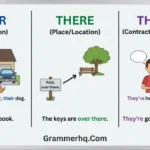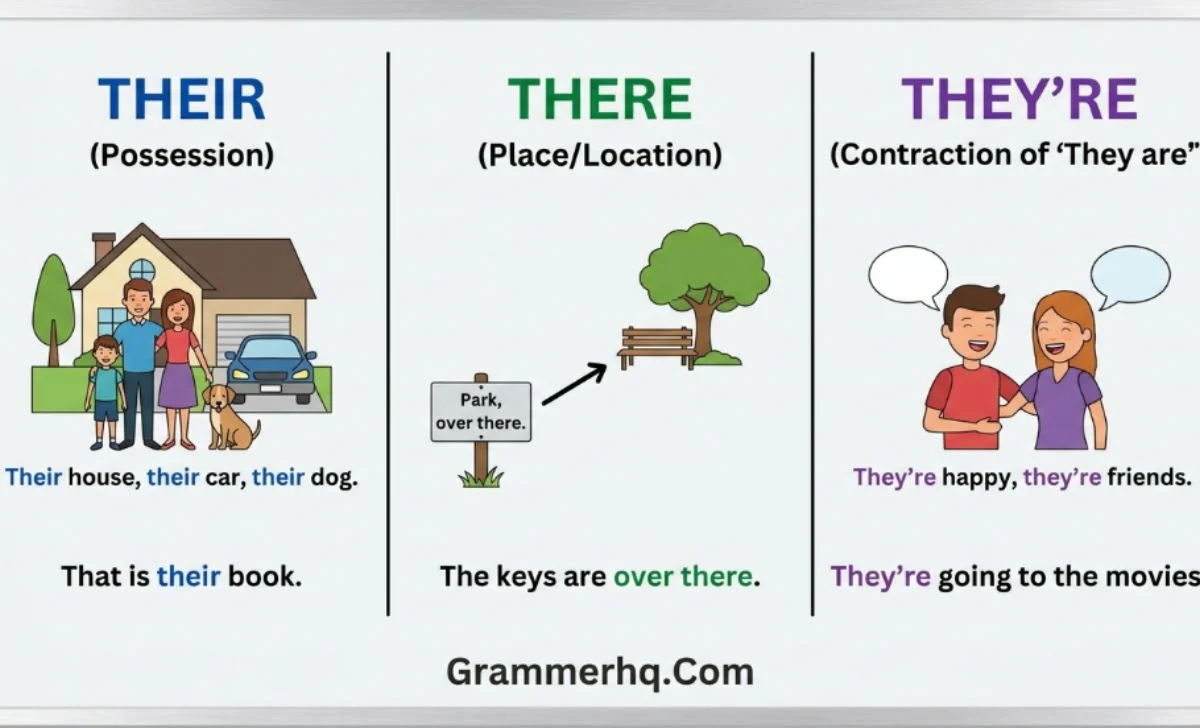
Their vs There vs They’re is a common source of confusion because the three words sound alike but have different meanings.
Their shows that something belongs to someone, there points to a place or introduces something that exists, and they’re means they are.
The difference becomes clear once you look at how each word works in a sentence. For example, “They’re taking their bags over there” uses all three correctly: they’re means they are, their shows possession, and there refers to a place.
These simple rules can help you choose the right word in everyday writing, emails, schoolwork, and professional communication.
Quick Answer
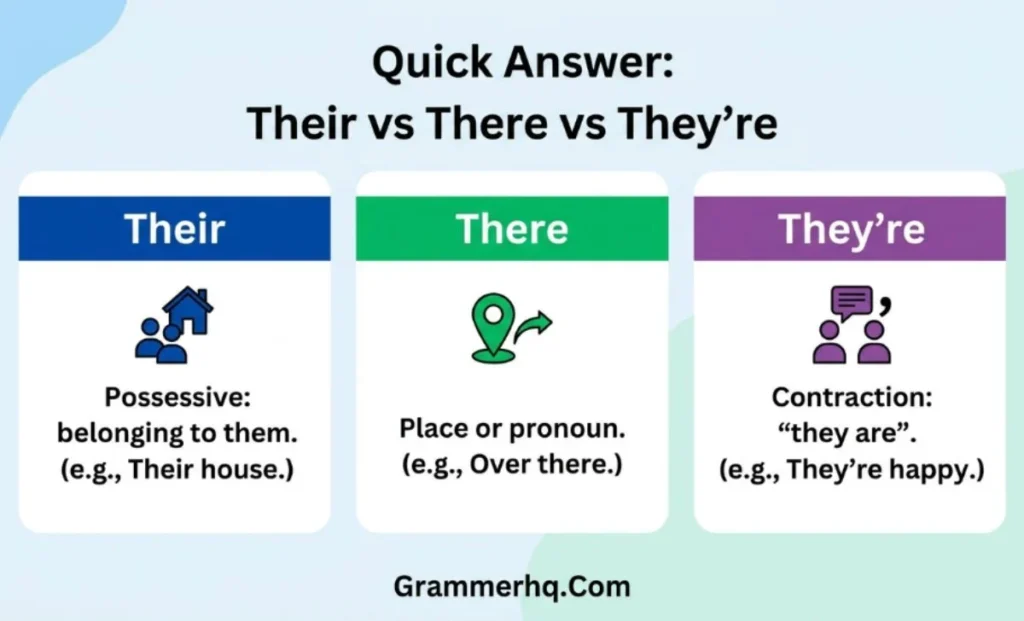
- Their = belonging to them
Their house is beautiful. - There = a place or the existence of something
The keys are over there.
There are three books. - They’re = they are
They’re coming home.
The Easiest Rule
Possession → their
Place or existence → there
They are → they’re
Quick test: If you can replace they’re with they are and the sentence still makes sense, they’re is correct.
What Is the Difference Between Their, There, and They’re?
These three words are homophones: they sound the same or very similar but have different meanings and spellings.
| Word | Meaning | Quick Test | Example |
|---|---|---|---|
| Their | Belonging to them | Does it show ownership? | Their car is new. |
| There | Place or existence | Does it refer to a place or use “there is/are”? | The car is over there. |
| They’re | They are | Replace it with “they are” | They’re ready. |
The key is to focus on the job the word does in the sentence, not how it sounds.
What Does “Their” Mean?
Their shows that something belongs to, is connected with, or is associated with people or a group.
It usually comes before a noun.
Examples
- Their house is near the school.
- The students brought their books.
- We visited their new office.
- The team celebrated their victory.
- The children finished their homework.
A simple way to think about their is to ask:
“Whose?”
The students forgot their bags.
Whose bags? The students’ bags.
How to Remember “Their”
Think of their as the word for ownership.
A useful memory trick is that their contains heir, and an heir can receive something that belongs to them.
Their = belonging to them.
What Does “There” Mean?
There has two major everyday uses.
1. There Refers to a Place
Use there when talking about a location or position.
- Put the bag over there.
- I left my phone there.
- We went there yesterday.
- Your shoes are right there.
- She is waiting over there.
A simple memory trick is:
There contains “here.”
Both here and there can refer to places.
Come here.
Go there.
2. There Introduces Something
There is also used in sentences such as there is, there are, there was, and there were.
- There is a problem.
- There are two options.
- There was a loud noise.
- There were many people at the event.
In these sentences, there does not mean a physical location. It introduces the existence of something.
What Does “They’re” Mean?
They’re is a contraction of they are.
The apostrophe shows that letters have been left out.
They’re = They are
Examples
- They’re happy.
- They’re working today.
- They’re ready to leave.
- They’re coming to the party.
- They’re studying for the test.
The “They Are” Test
This is the fastest test for they’re.
Replace they’re with they are.
If the sentence still makes sense, they’re is correct.
They’re late.
They are late. ✓
They’re coming soon.
They are coming soon. ✓
But:
Their car is outside.
They are car is outside. ✗
So the correct word is their.
The substitution test is also recommended by current grammar resources because it quickly separates they’re from the other two words.
Their vs There vs They’re: Easy Memory Tricks
You can remember all three with one simple formula:
Their = Possession
Something belongs to them.
Their house
Their car
Their idea
There = Place or Existence
Something is in a place, or something exists.
Go there.
The keys are over there.
There is a problem.
They’re = They Are
Expand the word.
They’re happy.
→ They are happy.
They’re working.
→ They are working.
The 3-Second Rule
Before choosing the word, ask:
Does it show ownership? → Their
Does it show a place or existence? → There
Can I replace it with “they are”? → They’re
Their vs There vs They’re in Everyday Sentences
Seeing all three words in normal sentences makes the difference much easier to understand.
- Their children are playing outside.
- The children are over there.
- They’re playing football.
Here is another example:
They’re taking their bags over there.
Each word has a different job:
- They’re = they are
- Their = the bags belong to them
- There = a place
Another example:
They’re waiting for their friends over there.
Once you understand the meaning of each word, these sentences become much easier to write correctly.
Common Their, There, and They’re Mistakes
1. Their vs They’re
❌ Their going home.
✅ They’re going home.
Why? The sentence means They are going home.
2. They’re vs Their
❌ They’re car is outside.
✅ Their car is outside.
Why? The car belongs to them, so use their.
3. Their vs There
❌ Put the books over their.
✅ Put the books over there.
Why? The sentence refers to a place.
4. Their vs There in “There Are”
❌ Their are three students.
✅ There are three students.
Why? The sentence introduces the existence of three students.
5. There vs They’re
❌ There coming tomorrow.
✅ They’re coming tomorrow.
Why? They’re can be expanded to they are.
6. There vs Their
❌ The students left there books.
✅ The students left their books.
Why? The books belong to the students.
Why Are Their, There, and They’re So Easy to Confuse?
The main reason is simple: they sound the same in everyday speech.
When you hear the word, you cannot always tell which spelling the writer needs. The meaning and grammatical role of the word determine the correct spelling.
This is especially easy to miss when writing quickly, texting, posting on social media, or typing an email.
That is why proofreading should focus on meaning, not just spelling.
Is “Their” Used for One Person?
Yes. Their can also be used with singular they when referring to one person whose gender is unknown, irrelevant, or intentionally not specified.
For example:
Every student should bring their laptop.
Here, their refers to each individual student.
Another example:
Someone left their phone on the desk.
Singular their is widely used in modern English.
Their, There, or They’re? Quick Practice
Choose the correct word.
- ___ going to visit ___ grandparents.
- Put the boxes over ___.
- The students forgot ___ homework.
- ___ are several restaurants nearby.
- ___ planning to sell ___ old car.
- I think ___ waiting outside.
- The children left ___ shoes over ___.
- ___ house is across the street.
- ___ is a problem with the computer.
- ___ going to bring ___ own food.
Answers
- They’re, their
- there
- their
- There
- They’re, their
- they’re
- their, there
- Their
- There
- They’re, their
FAQs
What is the difference between their, there, and they’re?
Their shows possession, there refers to a place or introduces existence, and they’re means they are.
How do I know whether to use their or there?
Ask whether you mean belonging to them or a place. If it shows ownership, use their. If it refers to a place, use there.
What does they’re stand for?
They’re is short for they are.
When should I use their?
Use their when something belongs to or is associated with them.
They lost their keys.
When should I use there?
Use there for a place or in structures such as there is and there are.
The keys are over there.
There are two keys.
How can I remember their, there, and they’re?
Remember:
Their = possession
There = place or existence
They’re = they are
Is “they’re” the same as “they are”?
Yes. They’re is the contraction of they are.
They’re ready. = They are ready.
Can “there” mean more than a place?
Yes. There can introduce the existence of something:
There is a problem.
There are five students.
Why do spell checkers sometimes miss their, there, and they’re mistakes?
All three are correctly spelled English words. A spell checker may recognize the spelling as valid even when the word is wrong for the sentence. The meaning and context must be checked.
Final Quick Reference
Their → shows possession
There → shows a place or existence
They’re → means they are
Remember This:
Their belongs.
There is a place.
They’re = they are.
If you remember those three rules, you can avoid most their vs there vs they’re mistakes in everyday writing.
Read More Blogs