If you have ever written about a piece of jewelry and stopped to wonder whether it is a broach or brooch, you are not alone.
The two words sound the same in their most common pronunciations, but their meanings are not identical.
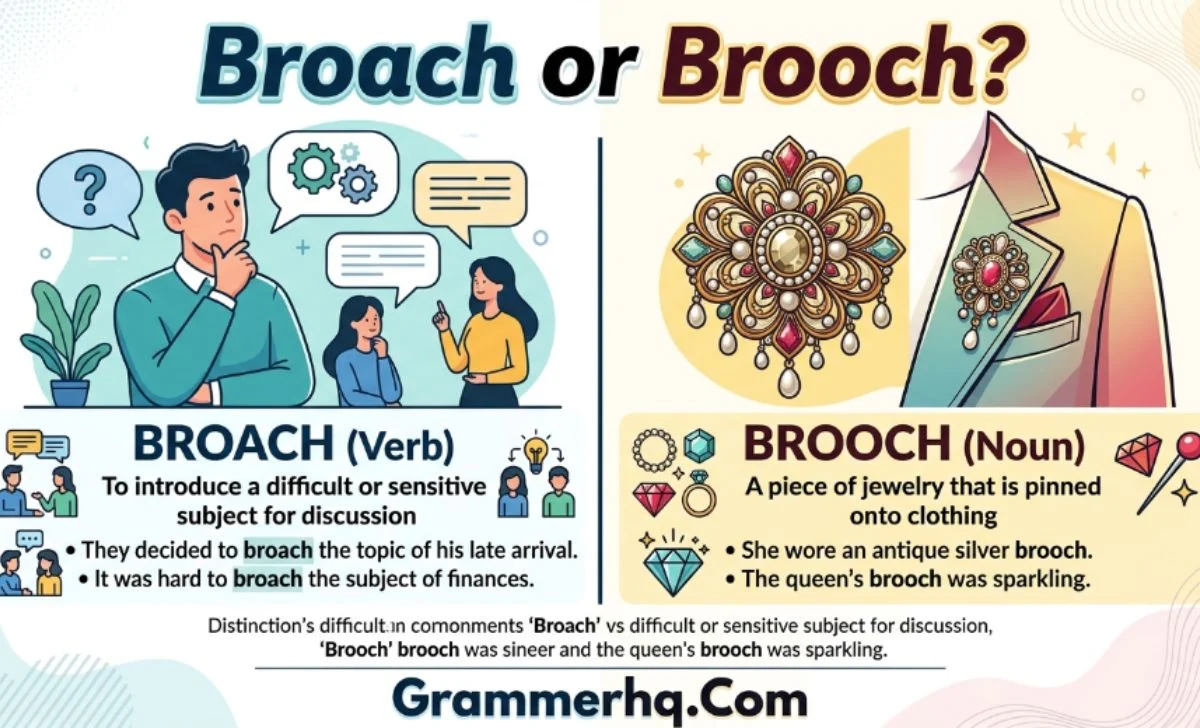
Brooch is the standard spelling for a decorative pin worn on clothing, while broach is most commonly a verb meaning to bring up a subject for discussion.
However, there is an interesting twist: broach can also be a noun, and its older meanings include several types of tools, a roasting spit, and a device for tapping a cask.
It can even describe a boat turning dangerously sideways or a whale breaking the surface of the water. That makes this pair more interesting than a simple “jewelry vs. conversation” rule.
Quick Answer
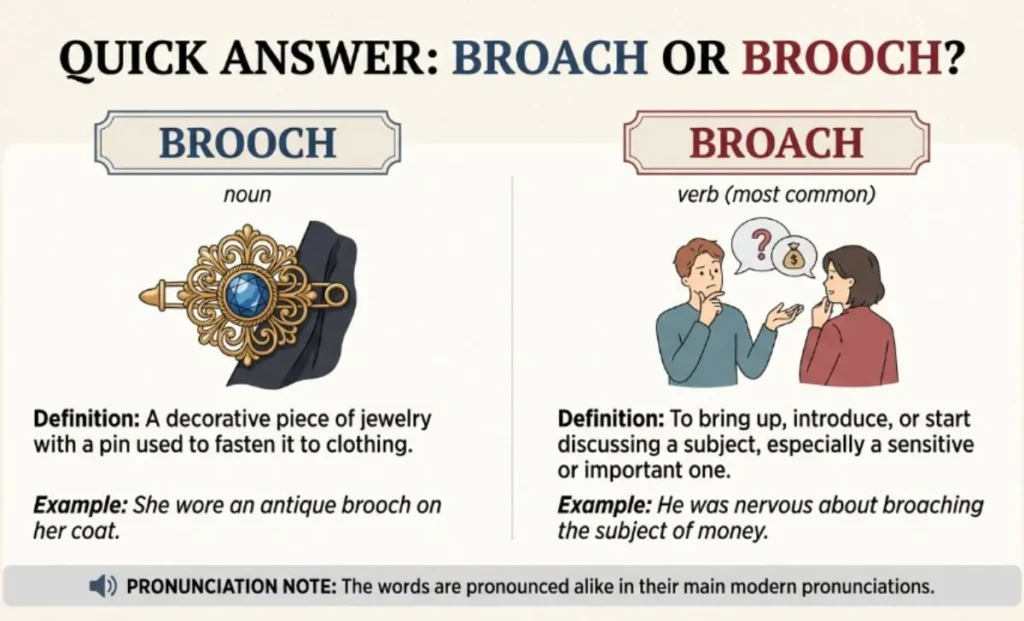
Brooch is a noun meaning a decorative piece of jewelry with a pin used to fasten it to clothing.
Broach is most commonly a verb meaning to bring up, introduce, or start discussing a subject, especially a sensitive or important one.
- Brooch: She wore an antique brooch on her coat.
- Broach: He was nervous about broaching the subject of money.
The words are pronounced alike in their main modern pronunciations, but their spellings and meanings differ.
Broach vs. Brooch: At-a-Glance
| Word | Part of Speech | Main Meaning | Example |
|---|---|---|---|
| brooch | Noun | A decorative jewelry pin | She wore a silver brooch. |
| broach | Verb | To introduce a topic | He decided to broach the issue. |
| broach | Noun | A tool, spit, or cask-tapping device | The mechanic used a broach to shape the hole. |
| broach | Verb | To pierce or tap something | They broached the cask. |
| broach | Verb | To break the surface of water | The whale broached near the boat. |
| broach | Verb | To veer dangerously sideways at sea | The vessel broached in heavy waves. |
The safest everyday rule is simple: brooch for jewelry; broach for introducing a topic. But that rule does not describe every legitimate meaning of broach.
What Does “Brooch” Mean?
A brooch is a decorative piece of jewelry that is fastened to clothing with a pin. It may be made from metal, decorated with gemstones, or designed as a simple ornamental piece.
Brooches can be worn on coats, dresses, scarves, jackets, collars, or other garments. They can also have sentimental value, especially when they are family heirlooms.
Examples of “Brooch”
- She pinned a beautiful brooch to her jacket.
- Her grandmother gave her a gold brooch.
- The antique brooch had a small sapphire in the center.
- She wore her mother’s brooch to the wedding.
In modern standard usage, brooch is the spelling readers normally expect when you mean jewelry. Cambridge defines it as a small piece of jewelry with a pin at the back for fastening to clothing.
Brooch in Fashion and Everyday English
You may see phrases such as:
- antique brooch
- diamond brooch
- gold brooch
- silver brooch
- vintage brooch
- decorative brooch
- family brooch
- brooch pin
So if the sentence is about wearing, buying, designing, or displaying jewelry, brooch is usually the word you want.
What Does “Broach” Mean?
In modern everyday English, broach is most often a verb meaning to bring up a subject, question, problem, or idea for discussion.
It is especially common when the topic may be difficult, sensitive, unexpected, or important.
Examples of “Broach”
- I need to broach the subject of his performance.
- She finally broached the question of salary.
- He was unsure how to broach the topic with his parents.
- The manager broached the idea of changing the schedule.
- I didn’t know how to broach the subject without causing an argument.
The most useful pattern to remember is:
broach + topic/subject/question/idea
For example:
She decided to broach the subject at dinner.
Here, broach does not mean “talk about” in a general sense. It suggests introducing something into the conversation, often for the first time. Collins similarly defines it as mentioning a subject in order to start a discussion.
The Twist: “Broach” Has Hidden Noun Meanings Too
This is where the usual broach vs. brooch explanation becomes incomplete.
Although most people meet broach as a verb, dictionaries also recognize broach as a noun. These noun meanings are older, specialized, or technical, but they are real English.
1. A Tool for Tapping a Cask
A broach can refer to a tool used to pierce or tap a cask so that liquid can be drawn out.
For example:
The old brewer used a broach to tap the cask.
The related verb is also to broach a cask, meaning to pierce it so its contents can be drawn off.
2. A Spit for Roasting Meat
Historically, a broach could also mean a pointed rod or spit used for roasting meat.
For example:
The meat was placed on a broach over the fire.
This sense comes from the word’s older association with pointed instruments.
3. A Cutting or Shaping Tool
In manufacturing, a broach is a specialized cutting tool with teeth used to enlarge or shape holes or other surfaces.
The process is called broaching.
For example:
The machine uses a broach to shape the internal surface of the hole.
This is a genuine technical meaning, not a misspelling of brooch.
4. “Broach” Can Mean “Brooch”
There is an even more surprising point: broach has historically been used as a spelling for the jewelry word brooch.
Merriam-Webster notes that broach and brooch are historically the same word, and that both spellings were used for jewelry from around the 13th century.
Over time, brooch became strongly associated with the jewelry sense, while broach developed additional tool and verb meanings.
So writing:
She wore a beautiful broach.
is not an invented word. It is a historically attested use. However, brooch is the clearer and safer modern spelling when you mean jewelry.
Beyond Jewelry and Conversation: Rare but Real Meanings
The word broach can move into some surprising areas of English.
“The Whale Broached”
In this context, broach means to break the surface of the water.
For example:
The whale broached beside the boat.
This use is also found with fish and other animals that rise through the surface. Merriam-Webster specifically notes the use for something such as a whale breaking the surface from below.
“The Ship Broached”
In nautical English, to broach has a specialized meaning.
A sailing vessel can broach when it suddenly turns or veers so that it becomes broadside to the waves, potentially putting the vessel in a dangerous position.
For example:
The small boat broached in the heavy waves.
Or:
The crew struggled to prevent the vessel from broaching to.
This is a completely different sense from “introduce a topic,” but the spelling is still broach. American Heritage and Collins both record this nautical use.
Where Do “Broach” and “Brooch” Come From?
The history of these words explains why their meanings overlap.
The Middle English form broche was connected with pointed objects and instruments. It came through Old French forms related to broche, ultimately linked to a Latin root associated with something projecting or pointed.
A Simplified History
| Period | Development |
|---|---|
| Earlier Latin/French forms | Words associated with pointed objects or implements |
| Middle English | broche appears with several related meanings |
| Around the 13th century | The word can refer to jewelry as well as pointed implements |
| Later English | broach develops additional tool and verb senses |
| Modern English | brooch becomes strongly associated with jewelry |
Merriam-Webster explains that the Middle English ancestor broche referred both to jewelry and to a pointed instrument.
Over the centuries, the spelling brooch became tied specifically to jewelry, while broach retained and developed other meanings.
That shared history is the reason these words look and sound so similar today.
How Do You Pronounce “Broach” and “Brooch”?
In their dominant modern pronunciations, broach and brooch sound the same.
The main pronunciation is the sound found in words such as coach and poach.
However, brooch has another established pronunciation in some English usage, with a vowel like the one in pooch or mooch.
Cambridge records both pronunciations for American English, while usage guides describe the /uː/ version as less common.
So the important point is:
Broach: normally has the “coach” pronunciation.
Brooch: usually sounds like broach, but a less common pronunciation with the “pooch” vowel also exists.
Easy Memory Tricks for Broach vs. Brooch
You do not need to memorize every historical meaning to get the everyday distinction right.
Broach = Action
Think:
Broach → bring up an issue.
If you are doing something in a conversation, broach is likely correct.
I need to broach the subject.
Brooch = Ornament
Think:
Brooch → O for ornament.
If you are talking about something you wear, choose brooch.
She wore a beautiful brooch.
Another Simple Trick
Think:
Brooch has two O’s → think of a decorative ornament.
And:
Broach has A → think “agenda” or an issue you are about to raise.
These are memory aids, not rules of English, but they make the spelling easier to recall.
Common Collocations With “Broach”
Because broach is commonly used as a verb meaning “introduce a topic,” certain combinations appear again and again.
Common Examples
- broach the subject
- broach the topic
- broach the question
- broach an idea
- broach the issue
- broach a sensitive subject
- broach the matter
- broach the possibility
Examples:
She was afraid to broach the subject.
He finally broached the question of promotion.
We should broach the idea at the next meeting.
She carefully broached the issue with her manager.
Among these, broach the subject and broach the topic are especially useful patterns for learners.
Common Mistakes: Broach vs. Brooch
The easiest way to avoid mistakes is to look at the meaning, not just the sound.
| Incorrect | Correct | Why |
|---|---|---|
| She wore a beautiful broach. | She wore a beautiful brooch. | Jewelry → brooch |
| He decided to brooch the subject. | He decided to broach the subject. | Introduce a topic → broach |
| I bought a diamond broach. | I bought a diamond brooch. | Jewelry → brooch |
| We need to brooch the issue. | We need to broach the issue. | Raise a subject → broach |
| She pinned a silver broach to her dress. | She pinned a silver brooch to her dress. | Decorative pin → brooch |
One Important Nuance
You may occasionally encounter broach meaning a piece of jewelry. That usage has historical support and is recorded by dictionaries. It is not simply a word that someone accidentally invented.
Still, for modern everyday writing, brooch is the better choice when you specifically mean the jewelry item. Merriam-Webster explicitly notes that broach has been used for the jewelry sense but recommends recognizing the historical overlap rather than treating the two spellings as completely unrelated.
Broach or Brooch: Which Is More Common?
For modern everyday writing, brooch is the standard choice for the jewelry item, while broach is far more useful as the verb meaning “bring up a topic.”
A useful usage comparison comes from Garner’s Modern English Usage, which reports a strong preference for brooch over broach in the jewelry context, giving a historical/current example ratio of about 18:1 for “diamond brooch” versus “diamond broach.”
That does not mean broach is never correct for jewelry. It means that if your goal is clear modern English, brooch is the spelling readers are most likely to expect for the decorative pin.
So remember:
Jewelry → brooch
Introduce a topic → broach
Quick Quiz: Broach or Brooch?
Choose the correct word in each sentence.
1. She wore an antique ___ at the wedding.
Answer: brooch
2. He didn’t know how to ___ the subject.
Answer: broach
3. The manager finally ___ the question of salary.
Answer: broached
4. Her grandmother gave her a beautiful gold ___.
Answer: brooch
5. The captain tried to stop the boat from ___ to.
Answer: broaching
Score:
- 5/5: You have mastered the basic distinction.
- 3–4/5: You understand the difference; review the verb forms.
- 0–2/5: Remember the core rule: brooch = jewelry; broach = introduce a topic.
FAQs
1: Are “broach” and “brooch” pronounced the same?
Usually, yes. Broach and the most common pronunciation of brooch sound alike. However, brooch also has a less common pronunciation in some English usage that uses the vowel found in words such as pooch.
2: Can “broach” mean jewelry?
Yes. Historically and in some dictionary usage, broach can mean a brooch, or decorative pin. The two words come from the same historical source. However, brooch is the clearer modern spelling for jewelry.
3: What is a broach tool?
A broach is a specialized cutting tool used to shape or enlarge holes or other surfaces. The process is called broaching, especially in manufacturing and metalworking.
4: What does “the ship broached” mean?
It means the vessel veered or turned dangerously so that it became broadside to the waves. This is a specialized nautical meaning of broach.
5: What does “the whale broached” mean?
It means the whale rose through or broke the surface of the water. This is another established verb sense of broach.
6: Is “broach the subject” correct?
Yes. Broach the subject is a standard expression meaning to introduce a subject for discussion.
She finally broached the subject with her parents.
7: Is “broach” a noun or a verb?
It can be both. As a verb, it can mean to introduce a topic, pierce or tap something, or break the surface of water. As a noun, it can refer to various tools, a roasting spit, or, historically, a piece of jewelry.
Conclusion:
The simplest modern distinction is still the best one: brooch means a decorative jewelry pin, while broach usually means to bring up or introduce a subject.
But the full story is more interesting. Broach can also be a noun for tools, a roasting spit, or a cask-tapping device.
As a verb, it can describe piercing a container, shaping something with a cutting tool, a whale breaking the surface, or a boat turning dangerously broadside to the waves.
Historically, broach and brooch share the same Middle English ancestor, which explains why their spellings and meanings overlap.
For everyday writing, keep this one-line rule:
Brooch = jewelry. Broach = bring up a topic.
Read More Blogs:
- Amount or Ammount: Which Spelling Is Correct?
- Spelt or Spelled: Which Is Correct? UK vs US English Explained