Vender vs Vendor can be confusing because both spellings refer to someone who sells goods or services, but they are not equally common in modern English.
Vendor is the standard and far more widely used spelling in business, technology, retail, and professional writing.
Vender is also a real English word and is recognized as a less common US variant, so calling it simply “wrong” is not completely accurate.
If you want the spelling that most readers expect today, vendor is the clear choice. In this guide, you’ll learn the meaning, usage, spelling difference, and simple rule for choosing between vender and vendor.
Quick Answer
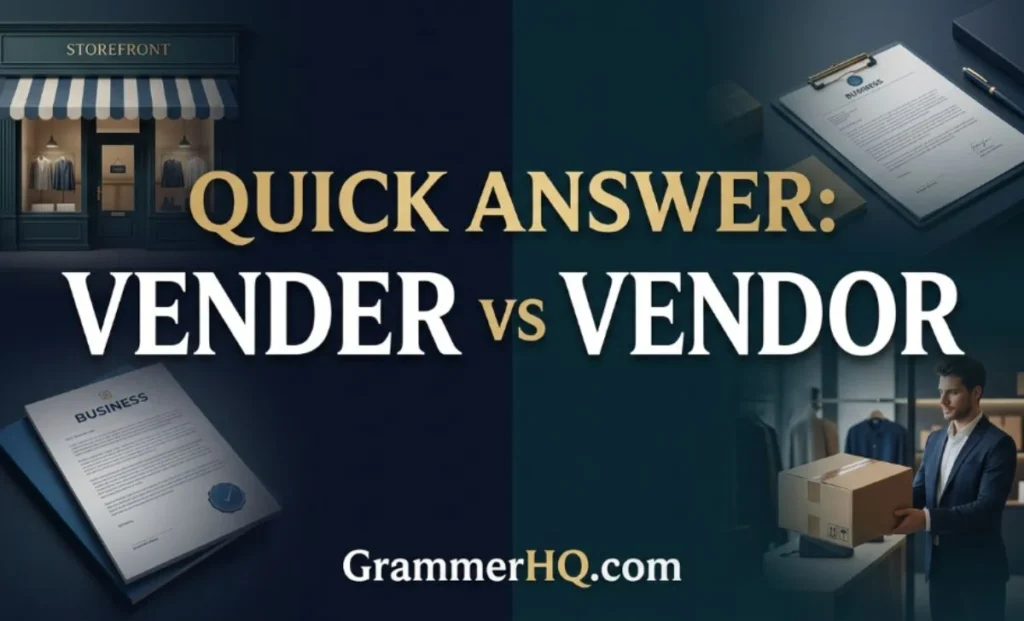
Vendor is the standard spelling used for a person or company that sells goods or services.
Vender is a recognized variant spelling with the same basic meaning, but it is much less common.
For most modern writing, especially business, academic, workplace, and online content, use vendor.
| Word | Status | Meaning | Recommended? |
|---|---|---|---|
| Vendor | Standard spelling | A person or company that sells goods or services | Yes |
| Vender | Less common variant | A person or business that sells something | Usually use vendor |
Cambridge defines vendor as someone who sells something and also uses it for a person or company that sells goods or services. Its Business English entry notes that US English also uses “vender.”
What Does Vendor Mean?
Vendor is a noun that means a person, business, or company that sells goods or services.
For example:
- The vendor sells fresh fruit at the market.
- We contacted a software vendor about the new system.
- The company selected a local vendor for the project.
- Several food vendors attended the event.
The word is common in many settings, including retail, technology, business, and property transactions. Cambridge also uses vendor for someone selling property.
Common phrases with vendor
You may see vendor in phrases such as:
- street vendor
- food vendor
- software vendor
- hardware vendor
- local vendor
- commercial vendor
- online vendor
- vendor agreement
- vendor management
These combinations are especially common in modern business and technology writing.
Is Vender a Correct Word?
Yes. Vender is a real word.
This is an important point because some online grammar articles incorrectly present vender as simply a misspelling.
Cambridge has a separate entry for vender and directs readers to vendor. It labels the word as a US commerce term.
Dictionary.com also lists vender as an American noun meaning vendor, while Collins describes it as a variant spelling of vendor.
However, being a valid dictionary variant does not mean the two spellings are equally common.
Vendor is the form most readers will expect.
That makes vendor the better choice for most everyday and professional writing.
Vender vs Vendor in American English
The situation is slightly more interesting in American English.
Both spellings can be found in US sources, but vendor is the overwhelmingly familiar modern form. Cambridge specifically notes “US also vender” in its Business English definition.
So these sentences are understandable:
The street vendor sells fresh vegetables.
The street vender sells fresh vegetables.
But the first version uses the spelling that modern readers are much more accustomed to seeing.
For a website, business document, school assignment, email, or professional article, vendor is generally the clearer choice.
Vender vs Vendor in British English
Vendor is the standard spelling you should expect in British English.
The word is also used in British legal and property contexts. Cambridge, for example, defines a vendor as someone selling something, particularly property, in its Business English material.
So if you are writing for a British audience, vendor is the natural choice.
Do Vender and Vendor Have Different Meanings?
Usually, no.
Both words refer to someone who sells something.
The main difference is spelling and usage frequency, not meaning.
Vendor
A standard modern spelling:
The vendor provided the company with new equipment.
Vender
A less common variant:
The vender provided the company with new equipment.
The meaning is essentially the same. The first sentence simply uses the spelling that is much more familiar to modern readers.
Why Is Vendor More Common?
The two forms developed from the verb vend, meaning to sell.
The spelling vendor became the established modern form in general English, while vender survived as a variant.
That is why you may still encounter vender in dictionaries, older material, or some US commercial usage.
The important point for modern writers is not to assume that every less-common spelling is automatically incorrect.
In this case, authoritative dictionaries recognize vender, but vendor is the normal modern choice.
Vendor or Vender: Which Should You Use?
Use vendor in almost all situations where you want the most familiar modern spelling.
Choose vendor for:
- Business writing
- Professional emails
- School assignments
- Websites and blogs
- Contracts and documents
- Technology writing
- Marketing content
- Online stores
- General American English
- British English
You may encounter vender in US sources, historical material, or contexts where that variant is intentionally retained.
Easy rule to remember
Vendor = standard modern choice.
Vender = valid but much less common variant.
Examples of Vendor in a Sentence
Here are some natural examples:
- We hired a new vendor to supply office equipment.
- The food vendor sold fresh sandwiches.
- Our software vendor released a new update.
- The company is looking for a reliable local vendor.
- Several vendors were selling products at the festival.
- The property vendor agreed to the terms of the contract.
- We need to contact the vendor about the delayed order.
These examples show why vendor is useful across many areas of modern English.
Common Mistake: Calling Vender Simply “Wrong”
One of the biggest problems with explanations of vender vs vendor is treating the issue as a simple correct-versus-incorrect spelling question.
That is not completely accurate.
Some current online articles describe vender as an error or an outdated form, but dictionary evidence is more nuanced.
Cambridge recognizes vender as a US commerce variant, while Dictionary.com and Collins also list it as a variant of vendor.
Therefore, a more accurate rule is:
Vendor is the standard and preferred modern spelling, while vender is a less common recognized variant.
That distinction matters if you want your writing to be both accurate and precise.
Vendor vs Vender: Final Difference
The difference is mainly frequency and standard usage, not meaning.
Vendor is the spelling you should normally choose because it is the established modern form and is widely used for people and companies that sell goods or services.
Vender is also recognized, especially as a US variant, but it is much less familiar to most modern readers.
So, if you are writing a sentence today and are unsure which spelling to use, choose vendor.
Final answer
Vendor is the standard spelling. Vender is a valid but less common variant.
If your goal is clear, modern, professional English, vendor is usually the best spelling to use.
FAQs
Is vender a misspelling of vendor?
Not necessarily. Vender is a recognized variant spelling of vendor, although it is much less common. Cambridge lists it as a US commerce form.
Is vendor or vender correct?
Both are recognized, but vendor is the standard and much more common modern spelling.
Is vender used in American English?
Yes. Cambridge specifically identifies vender as a US commerce variant. However, vendor remains the more familiar choice for modern American readers.
Is vendor British or American?
Vendor is used in both British and American English. It is the standard spelling in both varieties.
What is the plural of vendor?
The plural is vendors.
Example:
Several vendors were selling food at the event.
Should I use vender in formal writing?
You can encounter vender in legitimate US usage, but vendor is generally the safer choice for formal and professional writing because it is far more familiar to readers.
Do vender and vendor sound the same?
In normal English pronunciation, they are pronounced essentially the same. Cambridge gives vendor as /ˈven.dɚ/ in US English.
Conclusion
When choosing between vender vs vendor, the safest modern choice is vendor. It is the standard spelling used for a person, business, or company that sells goods or services.
Vender is not simply a nonexistent or meaningless spelling. Major dictionaries recognize it as a variant, with Cambridge specifically noting its US commercial use.
For everyday, professional, academic, business, and online writing, however, vendor is the spelling most readers will expect.
Remember: Vendor is standard. Vender is a less common variant.
Read More Blogs