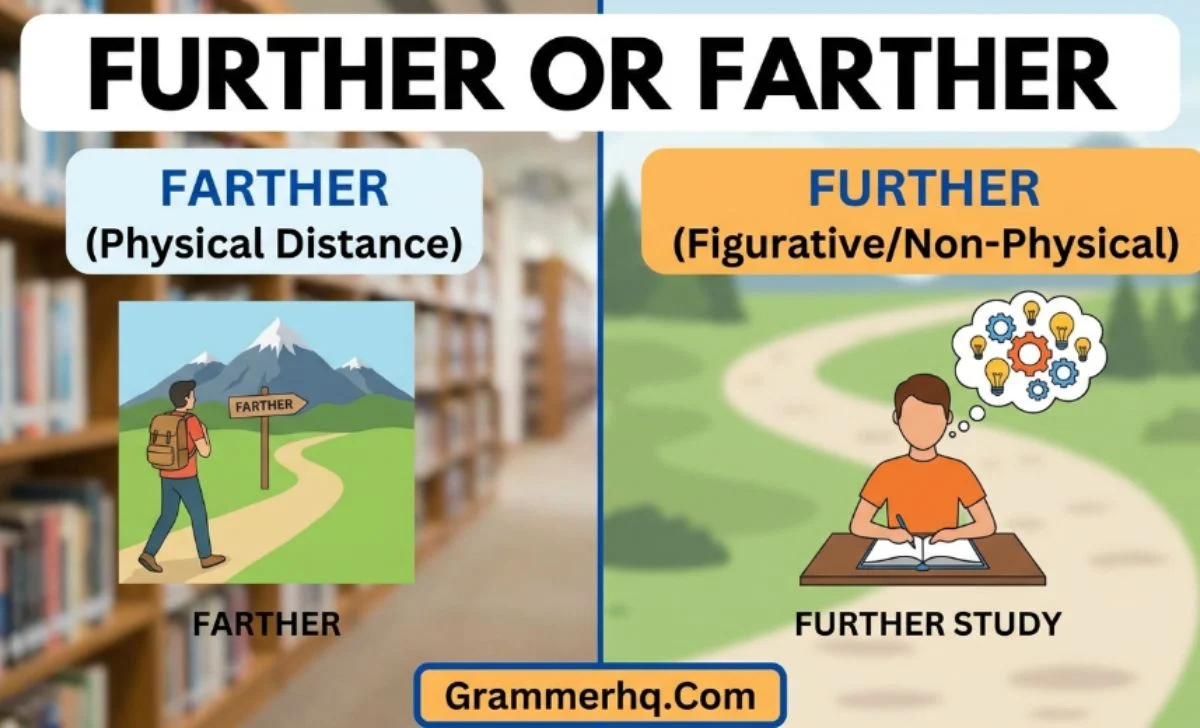
Have you ever written a sentence and suddenly wondered, “Should I use further or farther?” The confusion is understandable because both words are related to far, and in some situations, both can describe distance.
The easiest starting point is this: farther is commonly used for physical distance, while further has a broader meaning that includes “additional,” “more,” and “to advance.”
But that rule is not absolute. Modern English often uses further for physical distance too.This guide explains the difference without oversimplifying it, so you can choose the right word based on what you actually mean.
Quick Answer
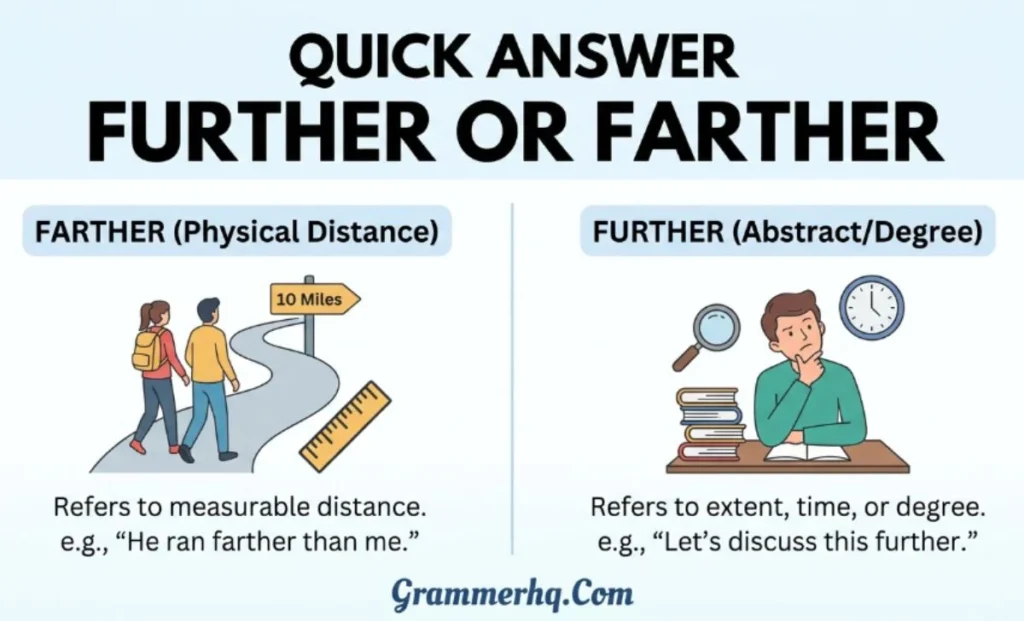
Farther is commonly used for physical or measurable distance.
We drove farther than we planned.
Further has several broader uses. It can mean additional, more, or to advance, and it can also describe distance.
We need further information before making a decision.
Simple rule to remember
- Farther → usually associated with physical distance
- Further → additional, more, advancement, or distance
The traditional rule is useful, but it should not be treated as an unbreakable grammar law. When talking about distance, further and farther can overlap.
Further vs Farther: What Is the Difference?
The difference mainly depends on context.
| Word | Common Meaning | Example |
|---|---|---|
| Farther | Greater physical distance | The station is farther than I expected. |
| Further | Additional or more | We need further information. |
| Further | Greater distance | We walked further along the trail. |
| Further | Advance or promote | The program will further her career. |
A useful traditional distinction is:
Farther → physical distance
Further → abstract or additional meaning
However, actual English usage is more flexible. Further is also commonly used for physical distance, particularly in British English and in everyday speech.
So the better approach is to understand the meaning of the sentence, rather than memorize a rigid rule.
What Does Farther Mean?
Farther is generally used to describe something that is at a greater physical distance.
It is especially natural when the distance can be measured, compared, or imagined as physical space.
Examples of Farther
- My house is farther from the station than yours.
- We walked farther than we expected.
- The blue car traveled farther than the red one.
- How much farther do we have to go?
- The village is farther north than the city.
- She moved farther away from the road.
Here, the word relates to location, movement, or physical distance.
Common expressions with farther
You will often see farther with:
- farther away
- farther from
- farther than
- farther down the road
- farther along
- farther ahead
- farther north
- farther south
- farther east
- farther west
For example:
The hotel is farther away than I thought.
What Does Further Mean?
Further has a much broader range of uses. It can refer to distance, but it is also common when talking about additional information, discussion, research, progress, or development.
Further Meaning “Additional” or “More”
We need further information.
The doctor ordered further tests.
Please provide further details about the project.
In these sentences, further means additional or more.
That is why farther cannot replace further in phrases such as:
- further information
- further details
- further research
- further discussion
- further questions
- further explanation
- further education
- further investigation
For example:
The researchers need further evidence before reaching a conclusion.
There is no physical distance here. The meaning is additional evidence.
Further as a Verb
One important difference is that further can also function as a verb.
As a verb, further means to advance, promote, or help something develop.
Examples
The course helped further her career.
The organization wants to further scientific research.
The new policy could further economic development.
You cannot normally replace further with farther in these sentences.
This broader grammatical use is one reason further has a wider range of meanings.
Can Further Be Used for Physical Distance?
Yes.
This is the part that many simple grammar guides oversimplify.
Consider these sentences:
We walked farther down the road.
We walked further down the road.
Both can be used when the meaning is physical distance.
Farther remains a clear and traditional choice for measurable distance, especially in American English. But further is also established in distance expressions.
So saying “further is never used for physical distance” would be too strong.
A better rule is:
Use farther when you want to clearly emphasize physical distance, but recognize that further can also be correct in distance contexts.
Further Away or Farther Away?
Both expressions are used in English.
The airport is farther away than I expected.
The airport is further away than I expected.
If you are deliberately emphasizing literal physical distance, farther away is the traditional choice.
But further away is also natural and widely understood.
The same principle applies to other distance expressions. Context matters more than an artificial rule that says one form is always correct and the other is always wrong.
Further Down the Road or Farther Down the Road?
Both can be correct when down the road refers to physical distance.
There is a restaurant farther down the road.
There is a restaurant further down the road.
But further down the road can also have a figurative meaning:
We can discuss the budget further down the road.
Here, it means later in the future, not a physical location.
This is a good example of why context matters when choosing between further and farther.
Further From or Farther From?
When you are talking about literal physical distance, both forms can appear:
The new office is farther from my home.
The new office is further from my home.
Farther from is the more traditional choice when the physical distance is the focus.
However, further from is also found in standard English, especially where the expression has a broader or figurative sense.
For example:
That explanation is further from the truth than the first one.
Here, further is clearly figurative.
Further North or Farther North?
Both further north and farther north can be used to describe greater distance in a northern direction.
The weather becomes colder farther north.
The weather becomes colder further north.
The choice can vary with region, style, and context. If you want a straightforward traditional choice for physical distance, farther is safe.
Further vs Farther in American and British English
English usage is not completely uniform across regions.
In American English, the traditional distinction between farther for physical distance and further for other meanings is often taught and followed.
In British English, further is commonly used more broadly, including for physical distance.
However, neither variety can be reduced to one absolute rule. Modern speakers use these words with some overlap.
For formal writing, a practical convention is:
Use farther for clear physical distance and further for additional or abstract meanings.
But do not assume that further is automatically incorrect when distance is involved.
Further vs Farther as Parts of Speech
Understanding their grammatical roles makes the difference even clearer.
Farther
Farther is commonly used as an adjective or adverb.
Adjective:
The farther shore was difficult to see.
Adverb:
We walked farther.
Further
Further can work as an adjective, adverb, or verb.
Adjective:
Do you have any further questions?
Adverb:
We need to investigate further.
Verb:
The program will further economic growth.
This wider grammatical range gives further meanings that farther does not normally have.
Farther vs Farthest and Further vs Furthest
These words are related to the comparative and superlative forms of far.
Farther and Farthest
For physical distance:
John ran farther than Mark.
Sarah ran the farthest of everyone.
Further and Furthest
For additional or abstract ideas:
We need to look further into the problem.
This is the furthest we can go without more evidence.
Furthest can also refer to physical distance, just as further can.
The safest approach is again to look at the meaning and context.
Common Mistakes With Further and Farther
1: Using farther for “additional”
We need farther information. ❌
Correct:
We need further information. ✅
Here, further means additional.
2: Saying further is always wrong for distance
We walked further than yesterday. ❌
This sentence is not automatically wrong.
Correct:
We walked further than yesterday. ✅
Farther would also be a natural choice when physical distance is the intended meaning.
3: Treating the traditional rule as absolute
The physical-versus-figurative distinction is a useful guideline, but modern English allows more flexibility.
An Easy Memory Trick for Further vs Farther
Here is a simple way to remember the difference:
Think “far” → farther
If you are clearly talking about physical distance, farther is usually the safest choice.
We walked farther.
Think “additional” → further
If you mean more, additional, or continued, choose further.
We need further information.
Then remember the important exception:
Further can also describe physical distance.
This makes the memory trick useful without turning it into a misleading absolute rule.
Further or Farther: Real-Life Examples
Farther
- The supermarket is farther from my house.
- We drove farther than planned.
- How much farther is the station?
- The hikers traveled farther before stopping.
- The cabin is farther away than it looks.
Further
- Please send further details.
- The doctor requested further tests.
- We need further research.
- Let’s have further discussion tomorrow.
- She wants to further her education.
- The experience helped further his career.
- We walked further along the beach.
These examples show the key distinction: farther is strongly associated with distance, while further works across distance, additional meaning, and advancement.
Further or Farther: Quick Comparison
| Use | Better Choice | Example |
|---|---|---|
| Physical distance | Farther | We walked farther. |
| Additional information | Further | I need further information. |
| More research | Further | We need further research. |
| Career advancement | Further | She wants to further her career. |
| Physical distance | Further can also work | We walked further. |
| Additional questions | Further | Do you have further questions? |
The table gives you the practical rule without pretending that English usage has no overlap.
FAQs
Is farther or further correct?
Both are correct. Farther is commonly associated with physical distance, while further has broader meanings such as additional, more, and advancement.
Can further mean physical distance?
Yes. Further can describe physical distance, and this usage is common in modern English.
Is “further information” correct?
Yes. Further information means additional information.
Is “farther information” correct?
No, not when you mean additional information. The natural expression is further information.
Is “further away” correct?
Yes. Further away is a standard expression. Farther away is also correct when referring to physical distance.
Is “farther down the road” correct?
Yes. It is natural when referring to a physical location. Further down the road can also be used.
What is the difference between farther and farthest?
Farther is a comparative form, while farthest is a superlative form. For example: “She ran farther” versus “She ran the farthest.”
What is the difference between further and furthest?
Further is the comparative form and furthest is the superlative form. Both can be used for distance and broader meanings, depending on context.
Conclusion
The easiest way to understand further vs farther is to focus on meaning rather than memorize an absolute rule.
Farther is commonly used for physical or measurable distance, while further has a broader range of meanings, including additional, more, advancement, and distance.
If you are clearly comparing physical distance, farther is a safe traditional choice. If you mean additional information, research, discussion, or progress, use further.
And when you see further used for physical distance, do not assume it is wrong.Once you understand that small distinction, choosing between further and farther becomes much easier.
Read More Blogs: