Counselor vs councilor can be confusing because the two words look and sound almost the same, but they have different meanings.
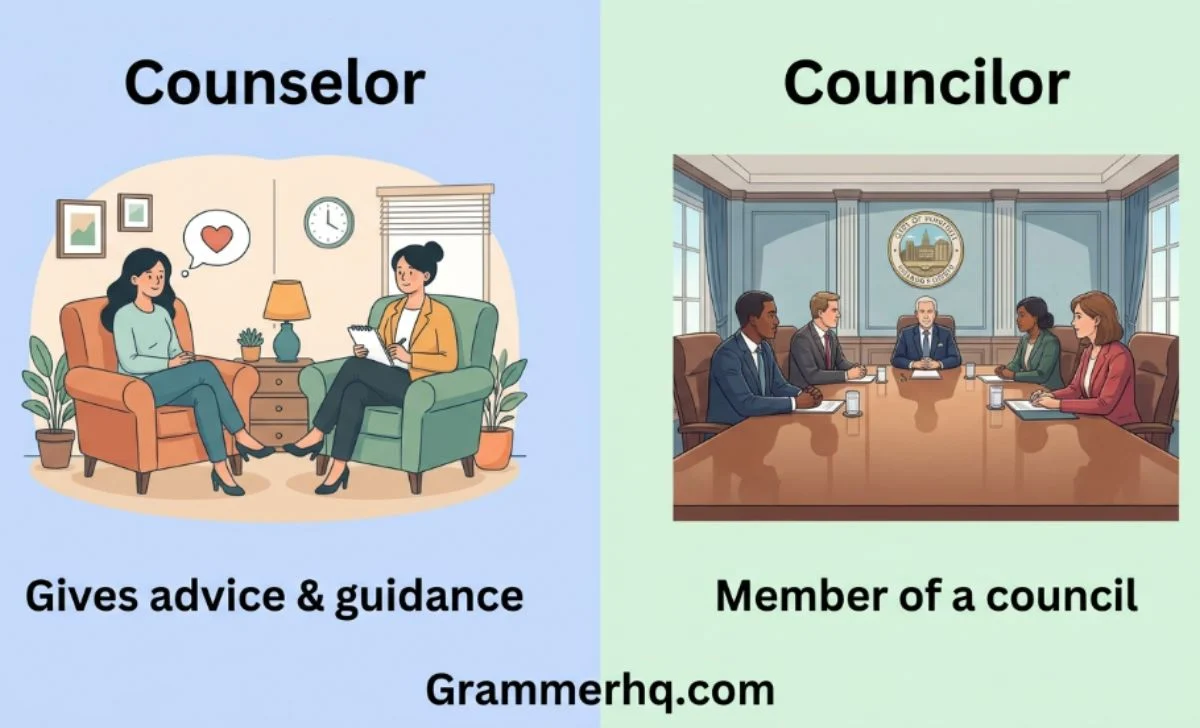
A counselor gives advice, guidance, or support, while a councilor is a member of a council. The difference becomes even more confusing in British English, where the spellings counsellor and councillor are commonly used.
If you are unsure which word is correct, the easiest way to remember the difference is to connect counselor with counsel (advice) and councilor with council (a group that makes decisions).
Quick Answer
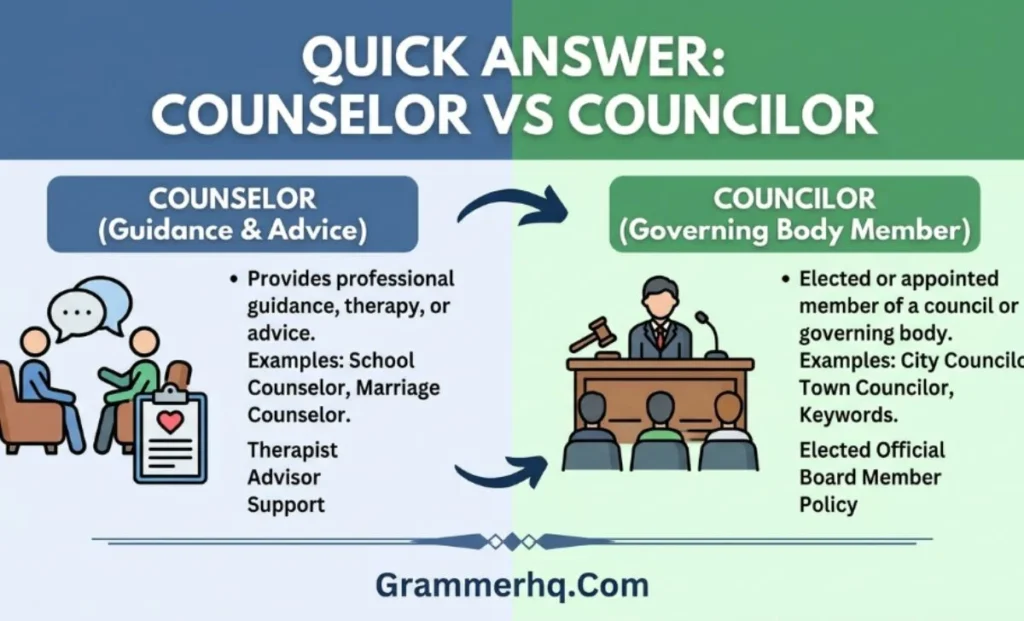
Counselor is a person who gives advice, guidance, or professional support.
Councilor is a person who serves on a council, especially a local government council.
| Word | Meaning | Example |
|---|---|---|
| Counselor | A person who gives advice or guidance | The school counselor helped me choose my classes. |
| Councilor | A member of a council | The city councilor voted on the new proposal. |
Easy rule to remember
Counsel → Counselor → advice
Council → Councilor → council
The spelling follows the word it is connected to.
What Does Counselor Mean?
Counselor is a noun for someone who provides advice, guidance, support, or counseling.
The word can be used in several settings. For example, a counselor may work in a school, career service, camp, legal setting, or mental health setting.
Merriam-Webster defines counselor as someone who gives advice and also lists meanings connected with law and summer camps.
Examples of counselor
- The school counselor helped students plan for college.
- I spoke with a career counselor about my job options.
- The couple visited a marriage counselor.
- The camp counselor organized activities for the children.
- The company asked its legal counselor for advice.
In every case, the central idea is guidance, advice, or support.
Counselor in legal English
There is another useful meaning of counselor: a lawyer or legal adviser.
For example:
The company consulted its legal counselor before signing the agreement.
The related word counsel can also refer to legal advice or a lawyer. This is one reason the spelling counselor is connected to counsel, not council.
What Does Councilor Mean?
A councilor is a member of a council.
A council is a group that meets to discuss issues, make decisions, or govern an organization or community. In everyday American English, councilor often refers to someone serving on a city, town, or local government council.
Merriam-Webster defines councillor, with councilor as a variant, as a member of a council.
Examples of councilor
- The city councilor supported the new housing plan.
- Residents met with their local councilor.
- The councilor spoke during the municipal meeting.
- Several councilors voted against the proposal.
- She was elected as a councilor last year.
Here, the person’s role is connected to a council, not to giving personal advice.
Counselor vs Councilor: The Real Difference
The easiest way to understand these words is to go back to their root words.
Counsel
Counsel means advice, guidance, or professional advice. It can also refer to a lawyer or legal advisers.
From counsel, we get:
counsel → counselor
So:
Counselor = someone who gives counsel.
Council
Council refers to a group of people who meet to discuss matters or make decisions.
From council, we get:
council → councilor
So:
Councilor = someone who serves on a council.
This gives you a reliable spelling rule:
If you mean advice, think counselor.
If you mean a council member, think councilor.
Counselor vs Councilor Examples
Seeing the two words side by side makes the difference much clearer.
Counselor
Correct:
The school counselor helped the student select his courses.
Why? The person provides guidance.
Correct:
She made an appointment with a career counselor.
Why? The person gives career advice.
Correct:
The camp counselor supervised the children.
Why? Counselor can also describe someone who supervises campers.
Councilor
Correct:
The city councilor proposed a new transportation plan.
Why? The person is a member of a council.
Correct:
The residents contacted their local councilor.
Why? The person represents the community through a council.
Correct:
The councilor voted on the proposed budget.
Why? The person is participating in council decision-making.
Counselor or Councilor: Which One Should You Use?
Ask yourself one simple question:
What does this person do?
If the person advises, guides, supports, or counsels people, use counselor.
If the person serves as a member of a council, use councilor.
Compare these two sentences:
The counselor helped the student choose a college.
Here, the person gives guidance.
The councilor voted on the city’s new budget.
Here, the person serves on a governing council.
Both sentences are correct because each word matches the person’s role.
Counselor vs Counsellor: American and British English
There is another spelling that can make this topic confusing.
In American English, the usual spelling is:
counselor
In British English, the usual spelling is:
counsellor
The meaning is generally the same. The extra l is mainly a regional spelling difference.
For example:
American English:
She spoke with a school counselor.
British English:
She spoke with a school counsellor.
Merriam-Webster lists counsellor as a variant of counselor.
So do not confuse counsellor with councillor. They refer to different roles.
Councilor vs Councillor: American and British English
The same regional spelling pattern appears with the council-related word.
American English:
councilor
British English:
councillor
Both refer to a member of a council.
For example:
American English:
The city councilor attended the meeting.
British English:
The city councillor attended the meeting.
Merriam-Webster recognizes councilor as a variant of councillor.
The four spellings at a glance
| Meaning | American English | British English |
|---|---|---|
| Person who gives advice | Counselor | Counsellor |
| Member of a council | Councilor | Councillor |
This is the easiest way to keep all four spellings straight.
Counselor vs Councilor Pronunciation
In many varieties of English, counselor and councilor sound the same or extremely similar.
That is one major reason people confuse them.
When you hear the word, pronunciation may not tell you which spelling is intended. The context does.
For example:
- “I spoke to the school ___ about my classes.” → counselor
- “The city ___ voted on the proposal.” → councilor
The first sentence is about guidance. The second is about government.
So when writing, do not rely on sound. Think about the person’s role.
Common Mistake: Using Councilor for a Counselor
One common error is using councilor when talking about a person who provides advice.
For example:
Incorrect for an advice-giving role:
The school councilor helped students prepare for college.
Correct:
The school counselor helped students prepare for college.
The reason is simple: the person gives counsel, not membership in a council.
The opposite mistake can also happen:
Incorrect for a government role:
The city counselor voted on the proposal.
Correct:
The city councilor voted on the proposal.
The person belongs to a council, so councilor is the right word.
Can Someone Be Both a Counselor and a Councilor?
Yes.
The words describe roles, not mutually exclusive identities.
For example, a person could work as a counselor during the week and also serve on a local council. In that case, the same individual could correctly be called a counselor in one context and a councilor in another.
The important point is that the words themselves still have different meanings.
So the correct choice depends on which role you are describing.
How to Remember Counselor vs Councilor
Use this simple two-word trick:
Counsel = advice
Council = group
Then add the person ending:
Counsel + or = counselor
Council + or = councilor
You can also remember:
Counselor → gives counsel
Councilor → belongs to a council
This method is better than trying to memorize the spelling alone because it connects the spelling to the meaning.
FAQs
Is a counselor and a councilor the same thing?
No. A counselor provides advice, guidance, or support, while a councilor is a member of a council.
Is it counselor or councilor for a school?
Usually counselor. A school counselor helps students with educational, career, or personal guidance.
Is a city official a counselor or councilor?
If the person is a member of a city council, councilor is the correct word in American English.
Is councilor the American spelling?
Yes. Councilor is the standard American spelling for a member of a council. Councillor is the common British spelling.
Is counselor the American spelling?
Yes. Counselor is the standard American spelling, while counsellor is the common British spelling.
What is the easiest way to remember counselor and councilor?
Think counsel = advice and council = group. Therefore, counselor gives counsel, while councilor serves on a council.
Final Answer
Counselor and councilor are both correct words, but they describe different people.
Use counselor for someone who gives advice, guidance, support, or counseling.
Use councilor for someone who serves on a council, especially a local government council.
Remember:
Counsel → Counselor → Advice
Council → Councilor → Council Member
For regional spelling, remember:
US: counselor, councilor
UK: counsellor, councillor
Once you connect each word to its root, counsel vs council, the spelling becomes much easier to choose correctly.
Read More Blogs