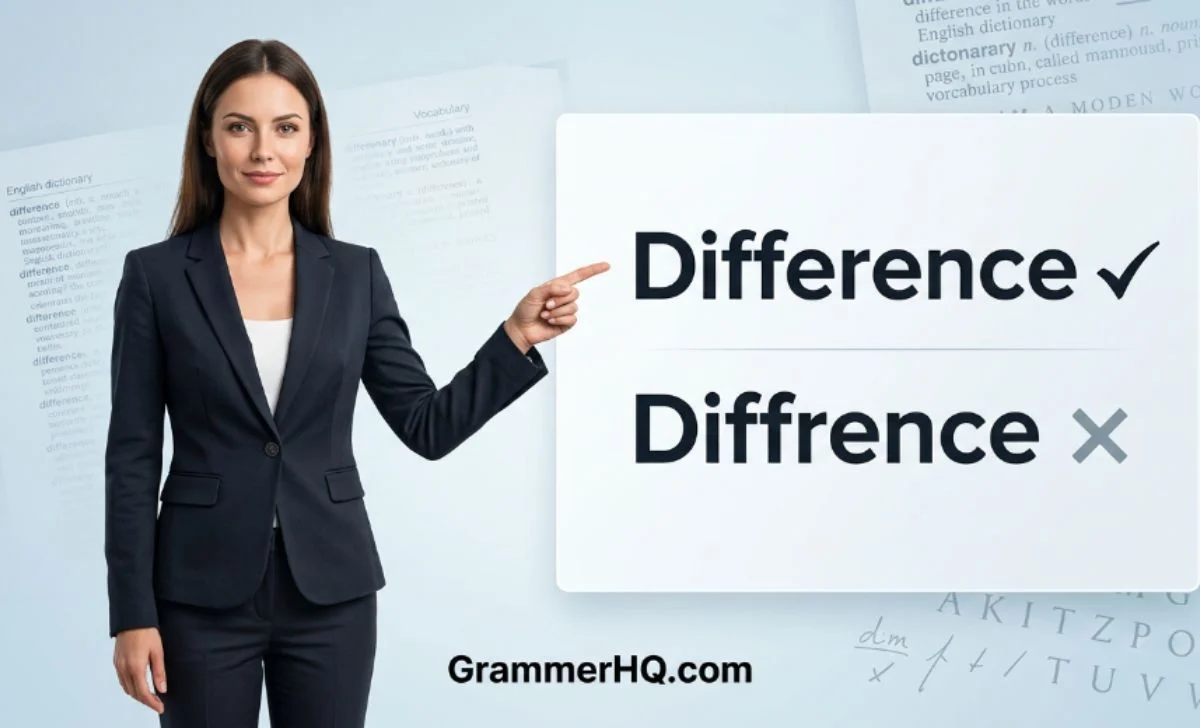
If you are confused about difference vs diffrence, the correct spelling is difference. Diffrence is a common misspelling, but it is not a standard English word.
The confusion often happens because the middle sounds in difference are not strongly pronounced in everyday speech, making the spelling easy to overlook.
In this guide, you will learn the correct spelling, meaning, pronunciation, common mistakes, related words, and practical examples so you can use difference confidently in everyday and professional English.
Quick Answer
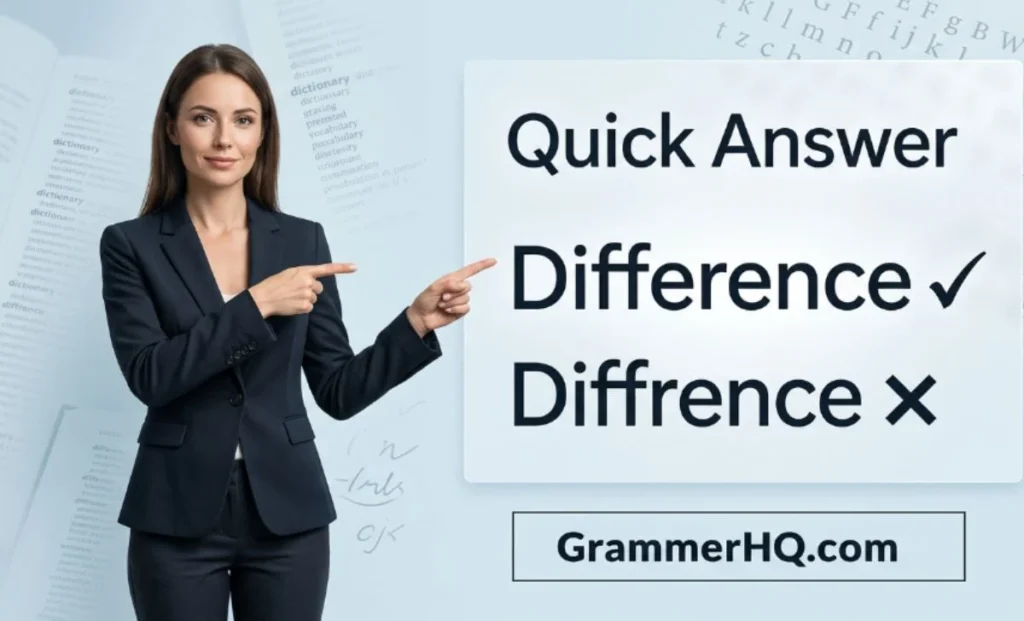
Difference is the correct spelling.
Diffrence is incorrect.
| Word | Correct? | Example |
|---|---|---|
| difference | ✅ Yes | There is a clear difference between the two answers. |
| diffrence | ❌ No | There is a clear diffrence between the two answers. |
The correct spelling is:
D-I-F-F-E-R-E-N-C-E
A simple way to remember it is to pay attention to the e after the second f:
difference ✅
diffrence ❌
Why Is “Difference” Correct?
Difference is the standard English spelling of the word. Major dictionaries such as Merriam-Webster and Cambridge list difference as a noun and give several meanings, including a distinction between things, a disagreement, and the amount by which two things differ. Merriam-Webster: difference
The spelling contains two fs followed by e-r-e-n-c-e:
dif + fer + ence → difference
The most common error is dropping the e and writing diffrence.
That mistake does not create an alternative spelling. It simply produces a misspelled form of the word.
What Does “Difference” Mean?
Difference is a noun that describes the way two or more things are not the same.
For example:
There is a big difference between these two phones.
The sentence means that the phones are not alike in one or more ways.
The word can also have several related meanings.
A distinction between things
Can you see the difference between these two pictures?
Here, difference means the feature or features that make the pictures unlike each other.
A variation in quality or amount
There is a noticeable difference in price between the two products.
In this sentence, difference refers to a variation in price.
A disagreement
They had a difference of opinion about the new policy.
Here, the word refers to a disagreement between people.
A difference in quantity
There is a ten-minute difference between the two arrival times.
This use refers to the amount by which two measurements or quantities differ.
How Do You Pronounce “Difference”?
Cambridge Dictionary gives separate UK and US pronunciations for difference. The UK pronunciation is /ˈdɪf.ər.əns/, while the US pronunciation is /ˈdɪf.ɚ.əns/. Cambridge Dictionary: difference pronunciation
For many English learners, an approximate pronunciation is:
DIF-uh-rens
The middle sounds can become less noticeable when people speak quickly. This is one reason the spelling can be easy to get wrong.
However, whether you use British or American English, the spelling remains:
difference
Why Do People Write “Diffrence”?
The mistake is easy to understand.
When difference is spoken naturally, the unstressed middle sounds may not be very clear. Someone who is spelling the word from memory may hear something closer to “dif-frence” and leave out the e.
English spelling also cannot always be predicted directly from pronunciation. A word may contain letters that are easy to overlook when spoken.
So if you write diffrence, you are not using another form of the word. You are simply leaving out a letter from the correct spelling.
Difference vs Different vs Differ
Difference, different, and differ are closely related words, but they have different grammatical roles.
| Word | Part of speech | Meaning | Example |
|---|---|---|---|
| differ | Verb | To be unlike | The two results differ. |
| different | Adjective | Not the same | The results are different. |
| difference | Noun | The distinction between things | There is a difference between the results. |
Differ
Use differ as a verb.
Their opinions differ on this subject.
Different
Use different as an adjective to describe something.
The two designs look different.
Difference
Use difference as a noun when referring to the distinction itself.
What is the difference between the two designs?
Knowing this distinction can prevent more than just the diffrence spelling mistake.
Easy Trick to Remember “Difference”
Here is a simple memory trick:
DIFFER + ENCE = DIFFERENCE
Think of the word as containing:
DIFFER → DIFFERENCE
Most importantly, remember the e after the second f:
diff + e + rence
So when you are unsure between:
diffrence ❌
difference ✅
remember that difference has that extra e.
This is a spelling memory aid rather than a claim about the word’s historical development.
Common Misspellings of “Difference”
Because of the way the word sounds, several incorrect forms can appear in writing.
- diffrence ❌
- diference ❌
- differrence ❌
- diferrence ❌
- difference ✅
The standard spelling is always difference.
For example:
What is the difference between these two options?
Not:
What is the diffrence between these two options?
If you are writing something important, such as a resume, report, assignment, or business email, a spell checker can also help catch this error.
How to Use “Difference” in a Sentence
You will often see difference in a few common sentence patterns.
Difference between
Use difference between when comparing two or more things.
What is the difference between these two laptops?
The teacher explained the difference between the two grammar rules.
Difference in
Use difference in when referring to a particular quality, amount, or characteristic.
We noticed a difference in quality.
There is a large difference in price.
A simple rule is:
difference between → comparing things
difference in → comparing a specific feature, quality, or amount
Make a difference
This expression means to have an effect or produce a meaningful change.
Your support can make a difference.
Tell the difference
This means to recognize how two things are different.
Can you tell the difference between real leather and synthetic leather?
No difference
This expression means that something does not matter to the outcome or choice.
It makes no difference which route we take.
Significant difference
This phrase is common in academic, scientific, business, and professional writing.
The researchers found a significant difference between the two groups.
Difference in British English vs American English
There is no spelling difference between British and American English for this word.
Both use:
difference ✅
This is different from spelling pairs such as:
- colour / color
- favour / favor
- organise / organize
Whether you are writing for a British or American audience, difference is the correct spelling.
The pronunciation may vary slightly, but the written form does not. Cambridge provides both UK and US pronunciation information for the word. Cambridge Dictionary: difference
Difference vs Diffrence Examples
Here are some everyday examples that make the correction clear:
| Incorrect | Correct |
|---|---|
| What is the diffrence? | What is the difference? |
| I cannot see any diffrence. | I cannot see any difference. |
| There is a big diffrence in price. | There is a big difference in price. |
| The diffrence is easy to notice. | The difference is easy to notice. |
| We need to understand the diffrence. | We need to understand the difference. |
In real life, you might ask:
What is the difference between these two plans?
Or while shopping:
Is there a difference in quality between these two brands?
These are natural ways to use the word in everyday English.
FAQ,s
Is “diffrence” a correct spelling?
No. Diffrence is a misspelling. The correct spelling is difference.
How do you spell difference?
The correct spelling is:
D-I-F-F-E-R-E-N-C-E
Is “difference” a noun?
Yes. Difference is a noun. It can describe a distinction, variation, disagreement, or difference in quantity. Merriam-Webster: difference
What is the difference between “differ” and “difference”?
Differ is a verb, while difference is a noun.
The two answers differ.
There is a difference between the answers.
What is the difference between “different” and “difference”?
Different is an adjective, while difference is a noun.
These two products are different.
There is a difference between these products.
Is “difference” spelled the same in British and American English?
Yes. Both British and American English use difference. The pronunciation can vary slightly, but the spelling is the same.
Why is “diffrence” so common?
The middle sounds in difference can be weak in normal speech, so it is easy to overlook the e when spelling the word from memory.
Conclusion
The correct spelling is difference, not diffrence. The word is a noun used to describe a distinction, variation, disagreement, or the amount by which things differ.
A useful way to remember the spelling is to notice the e in the middle: difference. The spelling is the same in both British and American English. If you are ever unsure, remember the simple rule: difference is correct, while diffrence is a misspelling.
Correct: difference ✅
Incorrect: diffrence ❌
Read More Blogs: