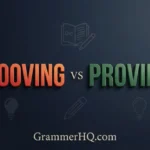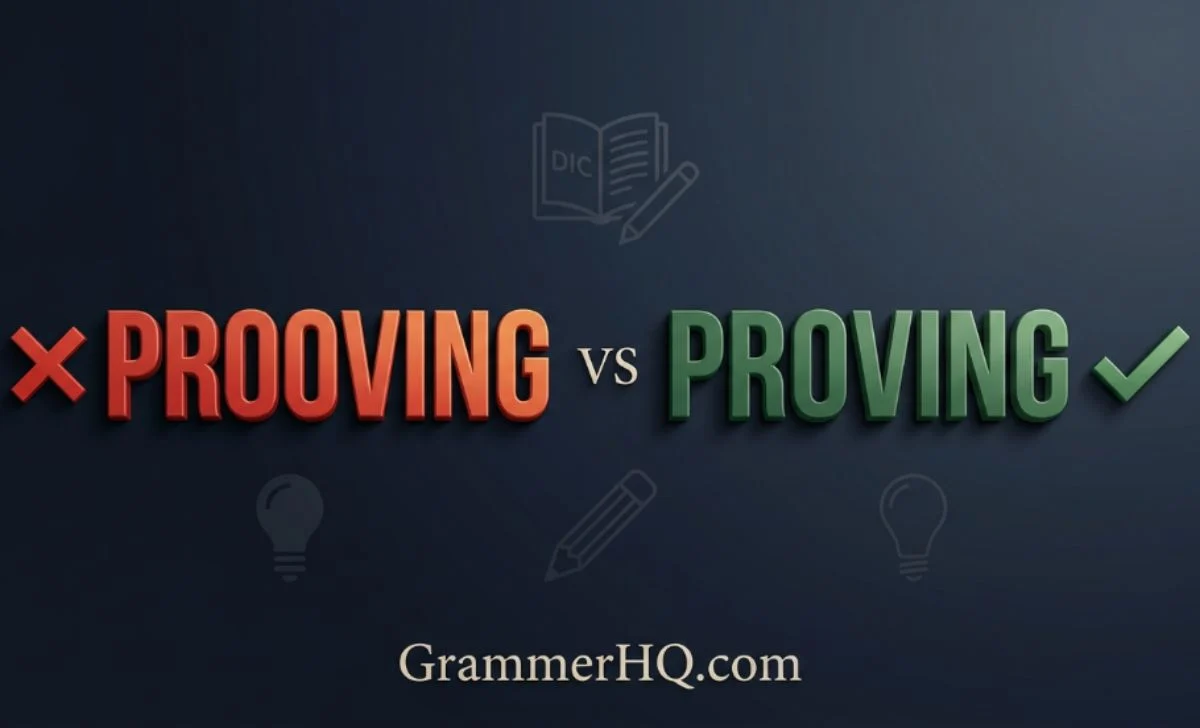
Prooving vs proving can be confusing because both spellings look almost identical, but only one is correct. Proving is the standard English spelling, while prooving is a misspelling.
The word comes from prove, and when the -ing ending is added, the final silent e is dropped: prove proving. This simple spelling rule explains why adding an extra o creates an incorrect form.
Whether you are writing a school assignment, professional email, report, or everyday message, choosing the correct form matters.
In this guide, you’ll learn why proving is correct, what it means, how it is used in real sentences, and how it differs from related forms such as prove, proved, and proven.
Quick Answer
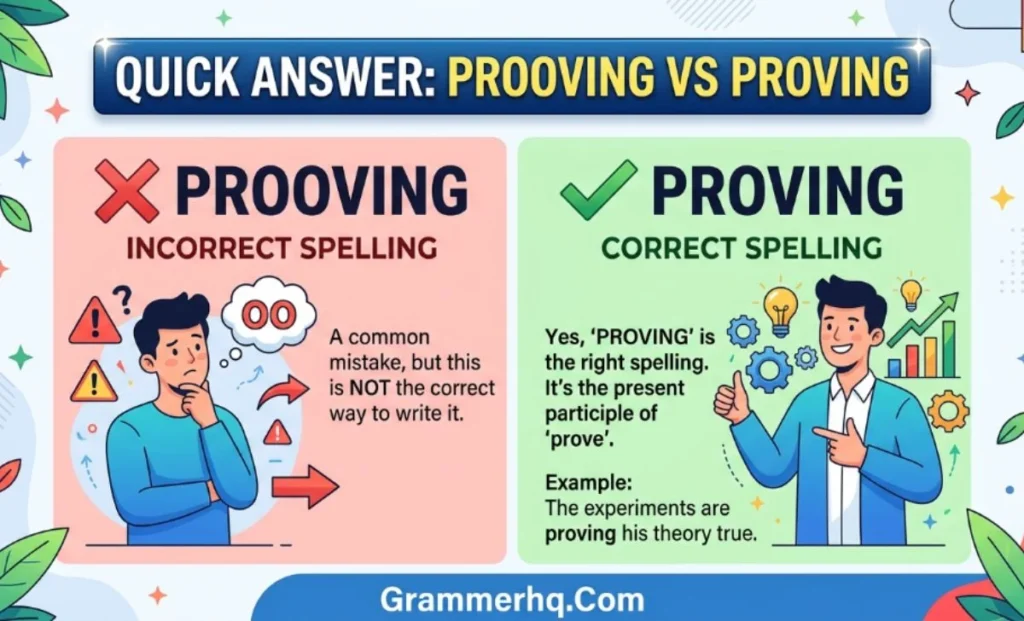
- Proving ✅ — correct spelling
- Prooving ❌ — incorrect spelling
- Prove → proving — the correct spelling change
Example:
✅ She is proving her point with clear evidence.
❌ She is prooving her point with clear evidence.
Proving is the present participle of prove and can also function as a gerund, depending on how it is used.
Prooving vs Proving
| Word | Correct? | Meaning |
|---|---|---|
| Proving | ✅ Yes | Showing or demonstrating that something is true, correct, or valid |
| Prooving | ❌ No | A misspelling of proving |
There is no difference in meaning between these two spellings because prooving is not a standard alternative spelling. If you mean the -ing form of prove, use proving.
Why Is “Proving” Correct?
The confusion comes from the spelling of prove. It is easy to think that adding -ing simply means attaching the ending to the whole word:
prove + ing → prooving ❌
But verbs ending in a final silent e commonly drop that e before -ing is added:
- make → making
- write → writing
- move → moving
- take → taking
- use → using
- prove → proving
So the correct formation is:
prove − e + ing = proving
The extra o in prooving does not belong there.
What Does “Proving” Mean?
Proving means showing, establishing, or demonstrating that something is true, correct, effective, or valid.
For example, someone may be:
- proving a claim with evidence
- proving a mathematical statement
- proving that a product works
- proving a point in an argument
- proving their ability
- proving that a theory is correct
The exact meaning depends on the sentence.
Examples of Proving
- The scientist is proving the theory through further experiments.
- The evidence is proving useful in the investigation.
- She is proving that the new method works.
- He kept proving his point with reliable evidence.
- The player is proving that hard work can make a difference.
These are natural uses of proving in everyday, academic, professional, and technical English.
Prove vs Proving vs Proved vs Proven
These forms all come from the verb prove, but they are used differently.
| Form | Use | Example |
|---|---|---|
| prove | Base form | We need to prove the claim. |
| proves | Present tense, third person | The evidence proves the claim. |
| proving | Present participle / gerund | She is proving her point. |
| proved | Past tense / past participle | The test proved successful. |
| proven | Past participle, especially common in some constructions | The method has proven effective. |
For the spelling question, the important form is:
prove → proving
Not prove → prooving.
Common Mistake: “Proove” vs “Prove”
Another spelling mistake related to this word is proove.
The standard verb is:
prove ✅
Not:
proove ❌
That matters because proving comes from the correct base verb prove:
prove → proving
Once the base spelling is clear, the -ing form becomes much easier to remember.
Is “Prooving” Ever Correct?
In standard modern English, prooving is not the normal spelling of the -ing form of prove.
You may occasionally see it in online posts, informal messages, or user-generated content, but its appearance does not make it a standard spelling.
For school assignments, professional documents, articles, emails, and other edited writing, use proving.
Prooving or Proving in American and British English
There is no standard American vs. British spelling difference here.
Both American and British English use:
proving ✅
So this is not a case like organize/organise or color/colour. The correct spelling remains proving in both varieties of English.
How to Remember the Correct Spelling
Use this simple pattern:
PROVE → remove the final E → add ING → PROVING
Think of similar examples:
move → moving
write → writing
make → making
prove → proving
If you remember that the final e drops before -ing, there is no reason to add another o.
Proving in Real-Life Writing
You will often see proving when someone is talking about evidence, results, ability, or a claim.
For example:
At work:
The new software is proving more reliable than the old system.
School:
The student is proving the answer with a mathematical formula.
Science:
The experiment is proving useful for testing the hypothesis.
Everyday conversation:
You keep proving that you can handle difficult situations.
These examples show why proving is more than just a spelling form—it is a normal and widely used English word form.
FAQs
Is “prooving” a correct spelling?
No. Prooving is a misspelling. The correct spelling is proving.
Which is correct: prooving or proving?
Proving is correct. It is the -ing form of prove.
Why is it “proving” instead of “prooving”?
Because the final silent e in prove is removed before -ing is added:
prove → proving
Is proving a verb?
Yes. Proving is the present participle of prove. It can also function as a gerund when it acts as a noun in a sentence.
Is “prooving” an American spelling?
No. Prooving is not a standard American spelling. Proving is used in both American and British English.
What is the correct form of prove with -ing?
The correct form is:
prove → proving
Not prooving or proveing.
Conclusion
Proving is the correct spelling, while prooving is a misspelling. The correct form comes from prove by removing the final silent e before adding -ing:
prove → proving
So whenever you need the -ing form of prove, write proving.
Read More Blogs

Hi, I’m Amelia Parker, a grammar enthusiast and writer at GrammarHQ.com. I specialize in explaining spelling differences, confusing words, and common English mistakes through simple, practical, and easy-to-understand guides.