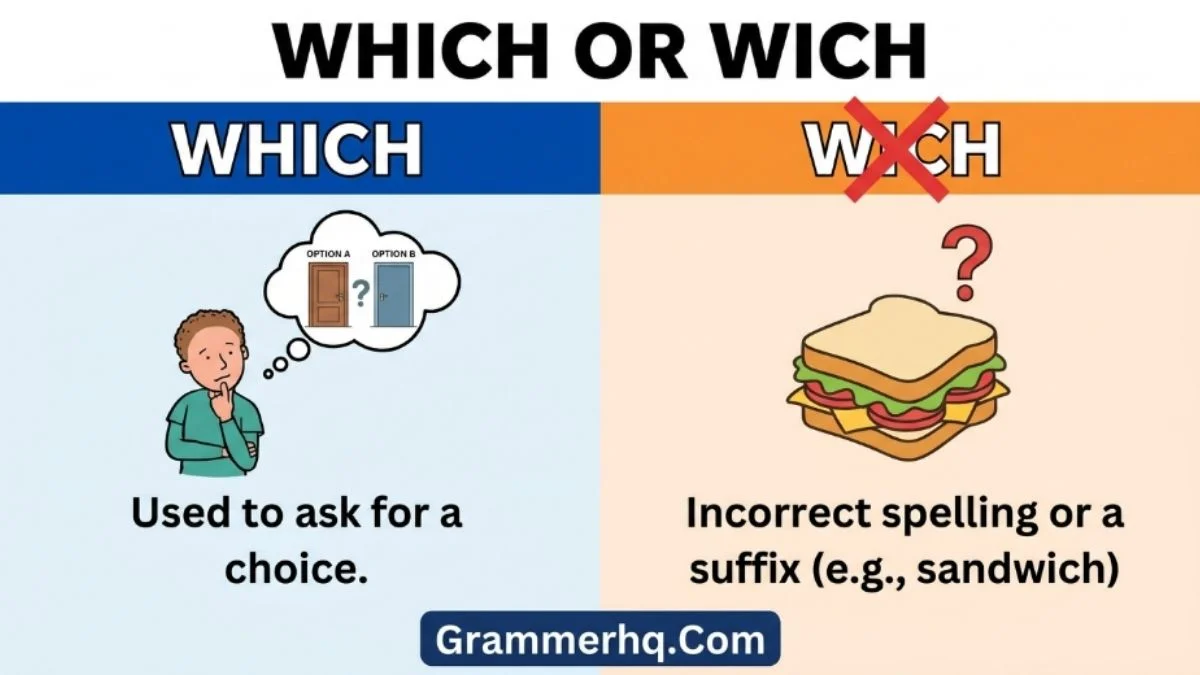
Which or Wich, which spelling is correct? The answer is simple: which is the correct spelling when you mean “what one” or “what kind,” while wich is usually a misspelling in everyday English.
But there’s a surprising twist: wich is also a genuine element in place names such as Norwich, Ipswich, Northwich, and Middlewich.
The silent h in which makes the confusion even easier to understand. In this guide, you’ll discover the real origin of both forms, when wich is actually correct, and how to tell which, wich, and witch apart.
Quick Answer
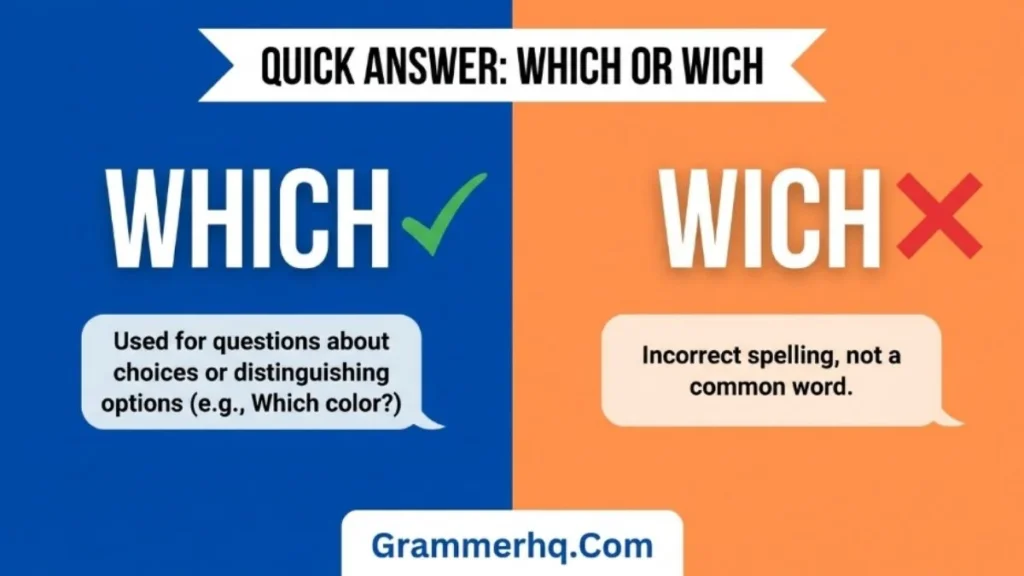
✅ Which = the correct everyday English spelling.
❌ Wich = usually a misspelling of which.
✅ Wich = legitimate in some place names and historical uses.
Examples
- ✅ Which one do you want?
- ❌ Wich one do you want?
- ✅ Which book should I read?
- ✅ I visited Northwich last summer.
Simple rule: If you mean “what one?”, use which.
Why Do People Write “Wich” Instead of “Which”?
The biggest reason is pronunciation.
For many English speakers, which is pronounced /wɪtʃ/, which sounds the same as or very similar to witch. The h is not pronounced as a separate sound.
That makes wich an easy spelling mistake, especially when someone is typing quickly.
For example:
- ❌ Wich color do you prefer?
- ✅ Which color do you prefer?
- ❌ Wich one is yours?
- ✅ Which one is yours?
Fast texting can make the problem worse. When people type a word based on how it sounds, they may naturally leave out letters they cannot hear.
But English spelling is not always phonetic. The h in which is part of an established spelling pattern and reflects the word’s history.
A useful way to remember it
Think of which as part of the wh- family:
who → what → when → where → which → whose
If you’re asking someone to identify or choose something, keep the h:
Which one?
Not:
❌ Wich one?
Where Does “Which” Come From?
The story behind which goes back more than a thousand years.
Modern which developed from Old English hwilc, meaning roughly “which” or “what kind.” It belongs to an old Germanic family of interrogative words and is related historically to other English wh- words.
That connection helps explain its spelling.
Old English did not spell the word exactly as modern English does. Over centuries, pronunciation, spelling conventions, and the position of letters changed. The modern form which eventually became established.
You can see the same historical family in words such as:
- what
- who
- where
- when
- whose
- which
These words all developed through the history of English and related Germanic languages.
But here is the surprising part
The wich in a place name such as Northwich is not simply which with the h removed.
The place-name element -wich has a different historical background. Old English wic/wīc was associated with a dwelling, settlement, or trading place, and in some areas the word became strongly associated with salt-producing settlements.
So:
which and -wich may look almost identical, but they have different histories.
That is the key reason you can correctly write:
Which book do you want?
but also:
Northwich is a town in Cheshire.
The first contains the everyday English word which. The second contains the historical place-name element -wich.
When Is “Wich” Actually Correct?
This is where the simple “wich is always wrong” rule breaks down.
Wich is normally wrong when you are trying to write the everyday word which. However, wich is legitimate in several specific contexts.
1. Place names
The most familiar examples are English place names:
- Norwich
- Ipswich
- Northwich
- Middlewich
- Nantwich
- Droitwich
- Harwich
- Sandwich
You should not “correct” these names by adding an h.
For example:
✅ I live near Northwich.
Not:
❌ I live near Northwhich.
2. Cheshire’s “wich” towns
Cheshire is particularly interesting because several towns with -wich have historical links to salt production.
Northwich, Middlewich, and Nantwich are strongly associated with the area’s salt industry. Historical evidence connects the place-name element wich with salt-working in this region.
This gives wich a genuine historical meaning rather than making it merely a spelling error.
The word can therefore appear in historical discussions of salt works, brine, and salt-producing settlements.
3. Historical usage
Older English sources record wich in specialized regional usage connected with salt-working places or salt-producing areas.
That usage is not something most modern English speakers need in everyday writing. But it explains why the spelling survived in certain names and historical records.
4. Brand names
You may also see Which Wich, the name of a sandwich brand.
Here, the unusual combination is deliberate wordplay and branding.
So if you see:
Which Wich
don’t assume that wich is being used as an ordinary spelling of which. It is part of the brand’s chosen name.
What Does “Which” Mean?
Which is used when you want to identify or choose one or more people or things from a group. In simple terms, it often means “what one?” or “what ones?”
Which as a Question Word
When you use which in a question, you are usually asking someone to choose or identify something from a specific group.
Which movie do you want to watch?
Which route is faster?
Which shirt is yours?
In each example, the speaker wants to know exactly which person or thing is being chosen or identified.
Which Before a Noun
When which comes directly before a noun, it functions as a determiner. It helps specify the particular person or thing being discussed.
Which book are you reading?
Which car belongs to Sarah?
Which answer is correct?
Here, which works together with the noun to narrow down the possible choices.
Which as a Pronoun
Sometimes, which can stand alone without a noun following it. In this case, it functions as a pronoun.
Which do you prefer?
I don’t know which to choose.
The noun does not need to be repeated because the context already makes the meaning clear.
Which in a Relative Clause
The word can also introduce a relative clause that provides information about a noun mentioned earlier.
The house, which was built in 1920, has been restored.
In this sentence, which refers back to the house and introduces additional information about it.
So, which is much more than a simple question word. Depending on how it is used, it can function as a determiner, pronoun, or relative pronoun.
Which vs Witch vs Wich
These three spellings cause confusion because which and witch are pronounced identically by many speakers.
But their meanings are completely different.
| Word | Meaning | Example |
|---|---|---|
| which | asks about a choice or identifies something | Which one is yours? |
| witch | a person traditionally associated with magic | The witch lives in the forest. |
| wich | mainly found in place names and historical usage | I visited Northwich. |
Remember them like this:
Which = choice
Witch = magic
Wich = names/history
Compare:
Which book should I buy?
The witch appeared in the story.
Northwich is in Cheshire.
Once you connect each spelling with its meaning, the difference becomes much easier to remember.
Which vs That: What’s the Difference?
Another common question is whether to use which or that in a relative clause.
The simplest distinction is this:
- that is commonly used for information essential to identifying the noun.
- which is especially common for additional information set off by commas.
Compare these sentences
| Sentence | Function |
|---|---|
| The book that you recommended is excellent. | Identifies which book |
| The book, which you recommended, is excellent. | Adds extra information |
In the first sentence, that you recommended helps identify the book.
In the second, the speaker has already identified the book and adds extra information.
The comma matters
Compare:
The car that I bought yesterday is red.
The clause identifies the car.
Now:
My car, which I bought yesterday, is red.
The clause provides additional information.
However, don’t turn this into an absolute rule that which always requires commas. English usage is more flexible than that, and which can occur in restrictive constructions too.
The important question is:
Is the information essential to identifying the noun, or is it extra information?
How to Remember “Which” Forever
Here are three simple tricks.
1: Remember the WH family
Put which next to:
who, what, when, where, whose
They all begin with the familiar wh spelling.
2: Use the “what one?” test
When you’re unsure, replace which with what one.
Which dress do you like?
What one do you like?
The meaning is close, so which is the correct word.
3: Separate “which” from “witch”
Think:
Which = choice
Witch = magic
And then remember:
Wich = mostly names/history
One important warning: spellcheck can catch wich in many sentences, but it cannot understand every context. A correctly spelled word can still be the wrong word.
Which or Wich in Real-Life Examples
Texting
❌ Wich one should I choose?
✅ Which one should I choose?
❌ Wich movie are we watching?
✅ Which movie are we watching?
❌ Wich option would you prefer?
✅ Which option would you prefer?
For professional communication, always use which when asking about a choice.
Academic writing
❌ The researchers examined wich factors influenced the results.
✅ The researchers examined which factors influenced the results.
Place names
❌ I visited Northwhich last year.
✅ I visited Northwich last year.
This is an important distinction: wich can be wrong inside an ordinary sentence but completely correct inside a proper name.
FAQs
1: Is “wich” ever a real word?
Yes. Wich occurs in historical or regional English and survives particularly in English place names. It is not, however, the normal spelling of the everyday word which.
2: Which or witch?
Use which when talking about a choice or identifying something:
Which one do you want?
Use witch for the magical figure:
The witch cast a spell.
3: Which or that?
Both can introduce relative clauses. That is commonly used in restrictive clauses, while which is especially common in nonrestrictive clauses set off by commas.
4: Why is the H in “which” silent?
The h reflects the word’s historical development and spelling pattern. Modern pronunciation does not give the h its own separate sound.
5: Is “wich” correct in British English?
Not as the normal spelling of which. However, British place names contain -wich, and wich also has historical and regional uses.
6: What is “Which Wich”?
Which Wich is a sandwich brand whose name deliberately plays with the words which and wich.
7: What part of speech is “which”?
Which can function as a determiner when it comes before a noun (which book?) and as a pronoun when it stands alone (which do you prefer?). It can also introduce relative clauses.
Conclusion
When you’re asking “what one?”, the correct spelling is which with an h. Wich is usually a spelling mistake in ordinary English, but it is a genuine form in historical usage and appears in established place names such as Norwich, Ipswich, Northwich, and Middlewich.
And don’t confuse either word with witch, which refers to a magical figure. The easiest memory trick is simple: which = choice, witch = magic, wich = names and history.
Read More Blogs:
- Spelt or Spelled: Which Is Correct? UK vs US English Explained
- Taught vs Tought: Which Spelling Is Correct?