Elegy vs. eulogy can confuse even confident English speakers. Both words are associated with grief, loss, and remembrance, and their similar sounds make them easy to mix up.
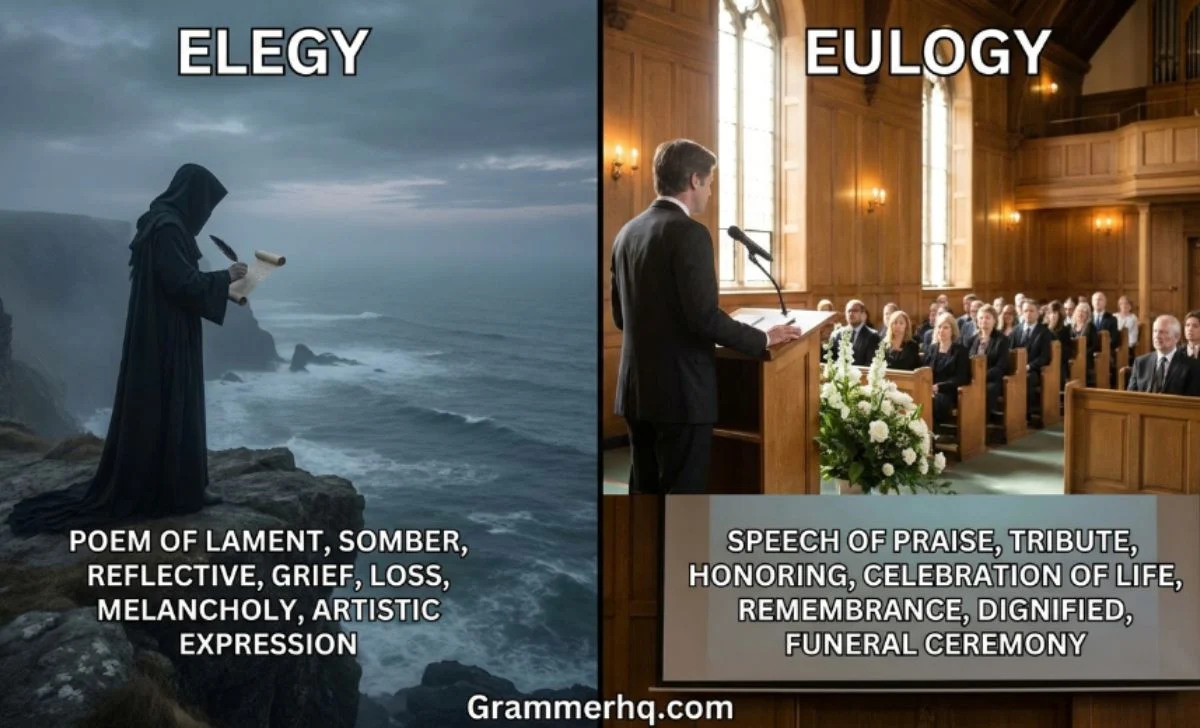
However, they are not interchangeable. An elegy is traditionally a poem or literary work that mourns a loss and reflects on its meaning.
A eulogy, by contrast, is usually a speech or tribute that remembers, honors, and celebrates a person, especially at a funeral or memorial service.
The easiest way to remember the difference is simple:
An elegy explores loss. A eulogy honors a life.
But the distinction goes further. An elegy can mourn a lost relationship, place, era, or way of life not only a person’s death. A eulogy can also include humor, stories, gratitude, and celebration alongside grief.
Elegy vs. Eulogy at a Glance
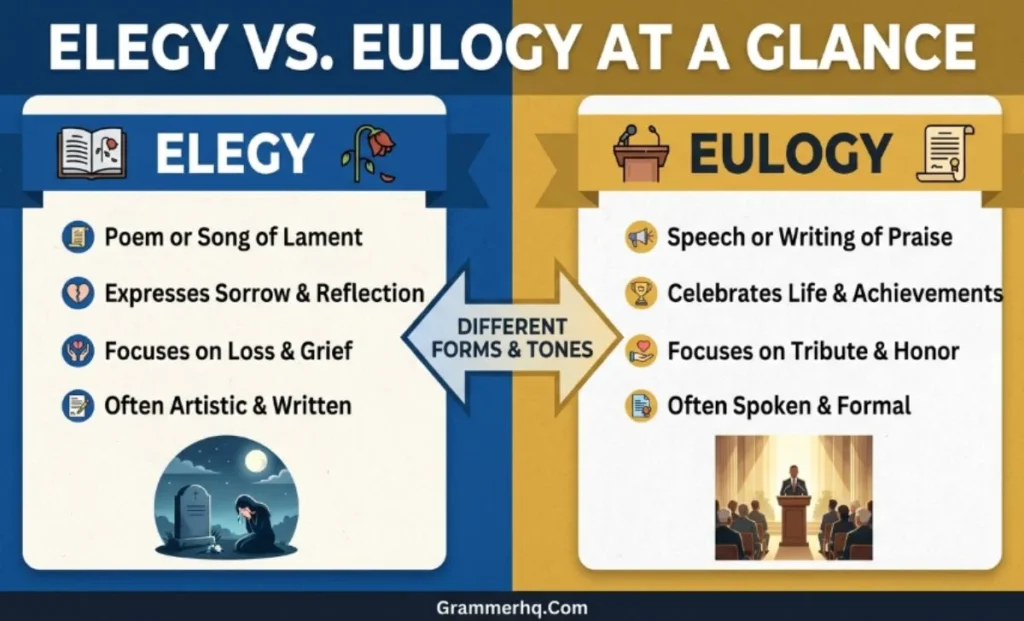
| Feature | Elegy | Eulogy |
|---|---|---|
| Definition | A poem or literary work expressing grief or mourning | A speech or tribute honoring a deceased person |
| Literary Form | Usually poetry or reflective literature | Usually prose and spoken language |
| Tone | Melancholic, reflective, meditative | Respectful, personal, affectionate, sometimes humorous |
| Delivery | Read or published as literature | Usually spoken at a funeral or memorial |
| Timing | Can be written anytime after a loss | Usually delivered during a funeral or memorial service |
| Length | No fixed length | Commonly several minutes long |
| Who Writes It? | A poet, writer, or anyone expressing grief creatively | A family member, friend, colleague, clergy member, or other speaker |
The biggest difference is purpose and form. An elegy is generally a work of mourning and reflection, while a eulogy is a spoken tribute centered on a person’s life and character.
In other words, an elegy asks, “What does this loss mean?” A eulogy more often asks, “Who was this person, and why should we remember them?”
That distinction becomes much clearer once you look at each word separately.
What Is an Elegy?
An elegy is a poem or other literary work that expresses sorrow, mourning, or reflection over a loss. The loss may involve death, but death is not an absolute requirement.
Traditional elegies often respond to the death of a person. However, writers also use the form to mourn disappearing places, lost relationships, vanished traditions, historical eras, or other forms of change.
That wider meaning is one reason elegy vs. eulogy can be confusing. Both can involve grief, but an elegy is more concerned with the experience and meaning of loss than with delivering a formal tribute.
Origin & Pronunciation
The word elegy comes from the Greek elegeia, associated with a form of mourning poetry and the Greek word elegos, traditionally connected with lament.
In modern English, elegy is pronounced with three syllables, with the stress on the first syllable.
The word’s literary history is much older than the modern funeral speech. That is important because an elegy is fundamentally a literary genre or mode, not simply another word for a funeral tribute.
Key Traits of an Elegy
A typical elegy may contain several of these features:
- Mourning: It expresses grief over a loss.
- Reflection: The writer thinks about what the loss means.
- Memory: The lost person, place, period, or experience is remembered.
- Melancholy: The emotional atmosphere is often serious or sorrowful.
- Acceptance: Some elegies gradually move toward consolation or acceptance.
- Poetic language: Imagery, symbolism, metaphor, rhythm, and other literary techniques are common.
An elegy does not necessarily spend most of its time listing someone’s achievements. Instead, it may explore questions such as:
What has disappeared? What remains? How has the loss changed the living?
That is why an elegy can feel deeply personal even when it is not written for a funeral.
Famous Elegies You Should Know
Some of the best-known English-language elegies include:
- Thomas Gray’s “Elegy Written in a Country Churchyard” — reflects on mortality, ordinary lives, and the inevitability of death.
- John Milton’s “Lycidas” — mourns the death of Edward King while combining personal grief with broader religious and pastoral themes.
- Percy Bysshe Shelley’s “Adonais” — written in response to the death of fellow poet John Keats.
- Walt Whitman’s “When Lilacs Last in the Dooryard Bloom’d” — mourns Abraham Lincoln while reflecting on national grief and death.
- Alfred, Lord Tennyson’s “In Memoriam A.H.H.” — a long meditation on grief, faith, doubt, and the death of Arthur Henry Hallam.
- W. H. Auden’s “In Memory of W. B. Yeats” — considers the death and continuing influence of the poet W. B. Yeats.
- Dylan Thomas’s “A Refusal to Mourn the Death, by Fire, of a Child in London” — confronts death, innocence, and wartime destruction.
These works demonstrate an important point: an elegy is not simply a poem that says someone died. It transforms loss into reflection.
Can an Elegy Be About Something Other Than Death?
Yes.
Death is the most familiar subject of an elegy, but an elegiac work can mourn many kinds of loss.
A writer might create an elegy for:
- a childhood that has ended
- a relationship that has disappeared
- a hometown that has changed
- a disappearing culture or tradition
- a lost historical period
- a former way of life
- an abandoned landscape
- an unrealized dream
For example, a poem mourning a childhood home that has been demolished could be elegiac even though nobody has died.
So, if your definition of an elegy is simply “a poem about someone’s death,” it is too narrow.
Elegy = literary mourning or reflection on loss.
What Is a Eulogy?
A eulogy is a speech or tribute that honors and remembers a person, especially someone who has died.
Unlike an elegy, a eulogy is usually associated with a specific person and a specific occasion. It is commonly delivered at a funeral, memorial service, celebration of life, or similar gathering.
A good eulogy does more than announce facts about someone’s life. It gives listeners a sense of who that person was.
It may include memories, stories, personality traits, accomplishments, relationships, humor, gratitude, and reflections on the person’s influence.
Origin & Pronunciation
Eulogy comes from the Greek eulogia, meaning praise or blessing. The word combines Greek elements associated with “good” and “speech/word.”
This pronunciation also explains an important grammar point: eulogy begins with a consonant sound, even though it begins with the letter e.
Therefore:
a eulogy ✓
an eulogy ✗
More on that below.
What a Eulogy Typically Includes
There is no single required formula, but an effective eulogy often follows a natural structure:
1. Opening
Begin by acknowledging the person, the occasion, and the loss.
2. Personal connection
Explain who the person was to you or to the people gathered.
3. Memories and stories
Specific stories are usually more powerful than a long list of achievements. One vivid memory can reveal more about a person than ten generic compliments.
4. Character and achievements
Mention qualities, accomplishments, relationships, work, service, or contributions that mattered.
5. Meaning and legacy
Explain what the person’s life changed, taught, or left behind.
6. Closing
End with gratitude, farewell, hope, a meaningful memory, or a final expression of love.
A strong eulogy therefore balances information with emotion.
Famous Eulogies Worth Studying
Several famous tributes illustrate how different a eulogy can sound depending on the speaker and the person being remembered.
- Robert F. Kennedy’s remarks for Martin Luther King Jr. — a powerful example of grief combined with a call for compassion and unity.
- Charles Spencer’s tribute to Diana, Princess of Wales — a highly personal remembrance of his sister that also addressed her public legacy.
- Oprah Winfrey’s tribute to Rosa Parks — emphasized Parks’s courage, influence, and personal impact. Contemporary reporting confirms Winfrey was among the speakers at Parks’s memorial.
- Mona Simpson’s eulogy for Steve Jobs — offered an intimate family perspective rather than focusing only on Jobs’s enormous professional achievements.
- Mark Antony’s funeral speech in Shakespeare’s Julius Caesar — a famous fictional example of funeral oratory, rhetoric, and persuasion.
These examples show that a eulogy does not have to sound like a biography. The most memorable ones usually reveal something human and specific.
Can You Give a Eulogy for Someone Still Living?
Yes, in some contexts.
The traditional meaning of eulogy is strongly associated with honoring someone who has died. However, the word can sometimes be used more broadly for a formal speech of praise.
For example, a person might give a tribute to a retiring teacher, colleague, mentor, or public figure. You may also hear the phrase “living eulogy” for an extended tribute delivered while someone is still alive.
That said, if you are writing for a retirement party, tribute, tribute speech, or farewell speech may be clearer than eulogy because eulogy still strongly suggests death in ordinary usage.
Elegy vs. Ode vs. Dirge vs. Epitaph vs. Obituary vs. Panegyric
If you are comparing these words, knowing only elegy vs. eulogy is not enough. Several neighboring terms describe different ways of responding to death, loss, memory, or praise.
| Term | What It Means | Main Purpose | Typical Form |
|---|---|---|---|
| Elegy | A work expressing grief or mourning | Explore loss and grief | Usually poetry/literature |
| Eulogy | A speech honoring a person | Remember and praise someone | Usually spoken prose |
| Ode | A poem of praise or serious reflection | Celebrate or honor a subject | Poetry |
| Dirge | A song, poem, or lament for the dead | Express mourning | Song or poem |
| Epitaph | Words written in memory of someone, often on a tombstone | Give a brief memorial statement | Short inscription |
| Obituary | A published notice or article about someone’s death and life | Inform the public and record key facts | Newspaper/online article |
| Panegyric | Formal, elaborate praise | Glorify or strongly praise someone/something | Speech or writing |
Elegy vs. Ode
An elegy centers on loss or mourning.
An ode generally celebrates, praises, or reflects on its subject.
So:
Elegy → grief and loss
Ode → praise and celebration
An ode does not need to involve death.
Elegy vs. Dirge
A dirge is specifically associated with mourning, especially a funeral lament or mournful song.
A dirge is therefore often more directly connected with the sound or expression of mourning, whereas an elegy is a broader literary form of reflection on loss.
Eulogy vs. Obituary
A eulogy is normally delivered as a tribute.
An obituary is normally written to inform readers about someone’s death and summarize their life.
An obituary might include:
- full name
- age
- date of death
- family information
- education or career
- achievements
- funeral details
- surviving relatives
A eulogy is more likely to include:
- personal memories
- stories
- emotions
- character
- humor
- gratitude
- spoken farewell
Obituary = public information.
Eulogy = personal tribute.
Eulogy vs. Epitaph
An epitaph is usually extremely short and is traditionally associated with a grave marker or memorial inscription.
A eulogy can last several minutes and tell stories.
Think of it this way:
Eulogy = spoken remembrance
Epitaph = written remembrance in miniature
Eulogy vs. Panegyric
A panegyric is an elaborate expression of praise. It does not require a funeral and can praise a living person, leader, institution, or even an idea.
A eulogy can contain panegyric elements, but the two words are not synonyms.
Eulogy is tied to the context of honoring a person, especially after death.
Panegyric emphasizes formal or extravagant praise.
Which One Do You Need? A Quick Decision Guide
Choosing between these terms becomes easy when you focus on what you are creating.
- Writing a poem about grief or loss? → Elegy
- Speaking at someone’s funeral? → Eulogy
- Writing a poem mainly to praise or celebrate something? → Ode
- Writing or performing a mournful funeral song? → Dirge
- Writing a short inscription for a grave or memorial? → Epitaph
- Publishing a notice about someone’s death and life? → Obituary
- Writing an elaborate formal piece of praise? → Panegyric
- Giving a retirement speech for someone who is alive? → Usually tribute or farewell speech
Here is the simplest test:
Ask what the audience is receiving.
If you are reading a literary expression of grief, think elegy.
A speech about someone’s life at a memorial is usually a eulogy.
Short words carved or printed on a memorial are called an epitaph.
When the main purpose is to inform people about someone’s death and life, the term is obituary.
How to Write a Eulogy
Writing a eulogy can feel overwhelming because you are trying to summarize a meaningful life in only a few minutes. The answer is not to include everything. Choose what matters most.
1. Start With Your Relationship
Explain who the person was to you.
Instead of:
“John was a great man.”
Try to establish the relationship and make it personal.
2. Choose Two or Three Meaningful Stories
Specific memories make a eulogy feel authentic.
Think about moments that show:
- kindness
- humor
- courage
- generosity
- family devotion
- unusual habits
- lessons they taught you
3. Explain What Those Stories Reveal
Do not simply tell a story and move on.
Tell the audience why that memory matters.
A small story about someone always helping neighbors may reveal more about their character than a paragraph of adjectives.
4. Mention Their Legacy
What remains because this person lived?
It could be:
- children and grandchildren
- friendships
- professional achievements
- community service
- lessons
- traditions
- acts of kindness
5. Keep the Tone Human
A eulogy can be sad without being relentlessly gloomy.
If the person loved jokes, food, music, sports, or a particular habit, appropriate humor can make the tribute feel more like the person being remembered.
6. Finish With a Clear Goodbye
Your final words should feel intentional.
You might express gratitude, love, admiration, hope, or simply say goodbye.
The goal is not to write the most impressive speech.
The goal is to make people remember the person.
How to Write an Elegy
Writing an elegy requires a different mindset. You are not simply giving a biography of someone who died. You are exploring what the loss feels like and what it means.
1. Decide What Has Been Lost
Your subject might be:
- a person
- a relationship
- a home
- a childhood
- a tradition
- a place
- an era
2. Establish the Emotional Landscape
Choose the dominant feeling.
Is the poem:
- sorrowful?
- nostalgic?
- angry?
- reflective?
- peaceful?
- bittersweet?
3. Use Concrete Imagery
Instead of saying only “I miss my grandfather,” show the reader what remains:
an empty chair, a familiar photograph, a quiet room, an unused tool, or a voice remembered in the distance.
Images allow readers to experience the loss.
4. Move Beyond Grief
Many powerful elegies do more than remain in sadness.
They may move toward:
- acceptance
- remembrance
- gratitude
- spiritual reflection
- continuing influence
- hope
5. End With Meaning
The ending does not have to be happy.
But it should leave the reader with a sense of what the loss has taught, changed, or revealed.
That is what separates a strong elegy from a simple statement of sadness.
Elegy vs. Eulogy: Grammar Notes
The most common grammar question here is surprisingly simple:
Is it “a eulogy” or “an eulogy”?
The correct phrase is:
a eulogy ✓
Why?
English articles depend on sound, not simply on the first written letter.
Although eulogy starts with the letter e, its pronunciation begins with a /y/ sound. Because that is a consonant sound, we use a.
Compare:
- a eulogy ✗
- an eulogy ✗
- a eulogy ✓
The same principle appears in words such as:
- a university
- a European
- a user
- a unicorn
They begin with a vowel letter but a consonant sound.
By contrast:
- an elegy ✓
- an obituary ✓
- an ode ✓
- an epitaph ✓
The practical rule is:
Choose “a” or “an” according to the sound that follows, not the spelling of the first letter.
FAQs
1: Is it “a” or “an” eulogy?
It is “a eulogy.” The word begins with a consonant /y/ sound, so a is used rather than an.
2: Is Hillbilly Elegy an elegy or a eulogy?
Hillbilly Elegy is the title of J. D. Vance’s memoir, not a funeral speech. The word elegy in the title is being used in a broader literary sense connected with reflection on a disappearing or changing way of life.
That distinction is useful because it demonstrates that elegy does not always mean “a poem for someone who died.” A work can use an elegiac perspective to reflect on cultural, social, personal, or historical loss.
3: Can a eulogy be funny?
Yes. A eulogy can include appropriate humor, especially when humor reflects the personality of the person being remembered.
A funny story can make a tribute more personal, but the humor should serve the remembrance rather than turn the eulogy into a comedy routine.
4: What’s the difference between a eulogy and an obituary?
An obituary primarily informs readers about someone’s death and summarizes important facts about their life. A eulogy is a personal tribute, usually delivered aloud at a funeral or memorial.
An obituary answers, “What happened and who was this person?”
A eulogy often answers, “What did this person mean to us?”
5: Is an elegy always about death?
No. Death is a traditional and common subject, but an elegy can mourn other forms of loss, including a lost relationship, place, childhood, tradition, or era.
6: How long should each one be?
There is no universal required length for either.
An elegy can be anything from a short poem to a long literary work.
A eulogy is usually much shorter than a full biography and should fit the funeral or memorial setting. In many practical situations, a focused speech of several minutes is more effective than a long speech containing every detail of someone’s life.
The best rule is:
Say enough to make the person memorable, but not so much that the central story disappears.
Final Thoughts
Elegy and eulogy are related, but they are not the same word.
An elegy is primarily a literary expression of mourning or reflection on loss. It is often a poem and can address death, but it can also mourn a lost relationship, place, era, or way of life.
A eulogy is primarily a spoken tribute that remembers and honors a person, especially someone who has died.
If you remember only one distinction, remember this:
Elegy explores loss; eulogy honors a life.
Once you understand that difference, related terms such as ode, dirge, epitaph, obituary, and panegyric become much easier to separate and you can choose the right word with confidence.
Read More Blogs:
- Dual vs Duel: What’s the Difference? Meaning, Usage & Examples
- Dragged or Drug: Is Drug the Past Tense of Drag?