
Imagine you’re writing a caption about a warm cabin, a soft blanket, and a hot cup of tea. You type “cosy”, but your spell checker changes it to “cozy.”
Now you pause and wonder: Which spelling is actually correct? The good news is that both cosy and cozy are correct—the difference depends on the type of English you use.
Cosy is the preferred spelling in British English, while cozy is standard in American English. In this guide, you’ll learn the difference between cosy vs cozy, their pronunciation, meaning, origin, regional usage, and when to use each spelling.
You’ll also find simple examples, common mistakes to avoid, and easy memory tips so you can choose the right spelling with confidence every time.
Quick Answer

Both cosy and cozy are correct spellings of the same adjective. They have the same meaning, pronunciation, and usage. The only difference is the variety of English you are writing.
- Cosy is the preferred spelling in British English.
- Cozy is the preferred spelling in American English.
- Neither spelling is more correct than the other.
Examples
✅ British English
We spent a cosy evening by the fireplace.
✅ American English
We spent a cozy evening by the fireplace.
Both sentences describe a warm, comfortable, and pleasant atmosphere. Only the spelling changes.
What Does “Cosy/Cozy” Mean?
The word cosy (cozy) means:
- Warm and comfortable
- Pleasant and relaxing
- Small but inviting
- Giving a feeling of comfort or safety
Common Examples
- a cozy home
- a cosy cottage
- a cozy blanket
- a cosy café
- a cozy bedroom
- a cosy corner
- a cozy atmosphere
- a cosy winter evening
These phrases are common in everyday English and carry exactly the same meaning regardless of spelling.
Quick Comparison
| Feature | Cosy | Cozy |
|---|---|---|
| Correct spelling | ✅ Yes | ✅ Yes |
| Meaning | Same | Same |
| Pronunciation | Same | Same |
| British English | ✅ Preferred | Rare |
| American English | Rare | ✅ Preferred |
| Formal writing | ✅ Yes | ✅ Yes |
Why People Confuse Cosy or Cozy
| Point of Comparison | Cosy | Cozy |
|---|---|---|
| Correct Spelling | ✅ Correct | ✅ Correct |
| English Variety | British English (UK, Ireland, Australia, New Zealand) | American English (United States) |
| Meaning | Warm, comfortable, and inviting | Warm, comfortable, and inviting |
| Pronunciation | /ˈkəʊ.zi/ | /ˈkoʊ.zi/ |
| Dictionary Status | Standard British spelling | Standard American spelling |
| Best Used For | UK-based writing, schools, and publications | US-based writing, schools, and publications |
| Formal Writing | Accepted in British English | Accepted in American English |
| SEO & Audience | Best for UK readers | Best for US readers |
| Which Is More Correct? | Correct in British English | Correct in American English |
Examples
- We spent the evening in a cosy cottage by the lake. (British English)
- She made the living room feel cozy with candles and blankets. (American English)
- The café has a cosy atmosphere that’s perfect for winter mornings.
- They decorated their new apartment to make it look cozy and welcoming.
- A cosy fireplace makes the entire house feel more relaxing.
- Nothing feels more cozy than reading a book on a rainy afternoon.
Quick Tip
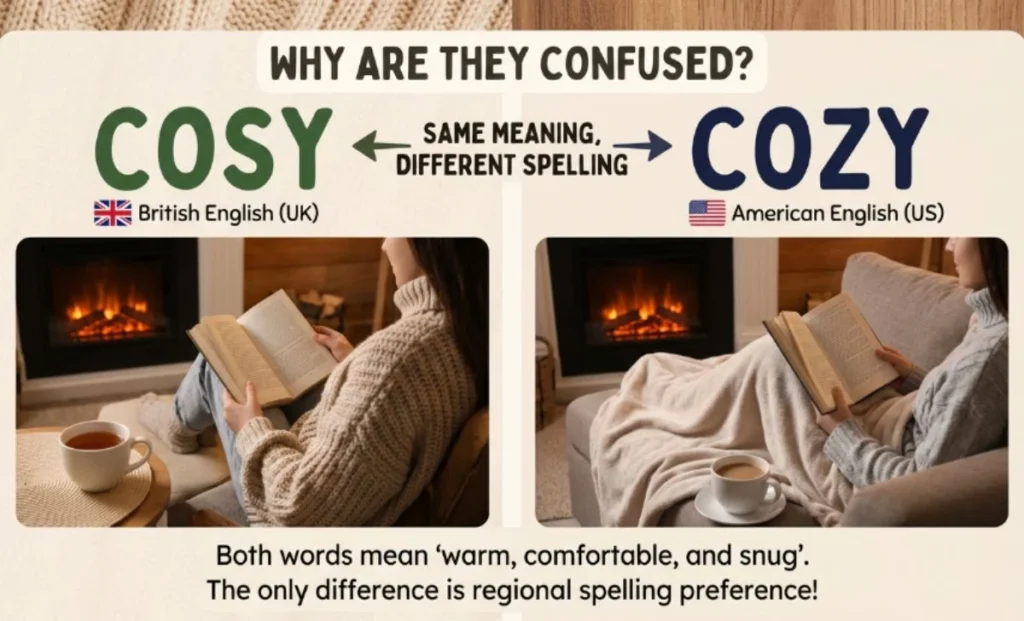
- The confusion exists because cosy and cozy have exactly the same meaning and pronunciation. The only difference is regional spelling: use cosy for British English and cozy for American English.
The Origin of Cosy vs Cozy
The story behind cosy and cozy shows how English changes over time. Although the spellings look different today, they come from the same word and have shared the same meaning for centuries.
Where Did the Word Come From?
The exact origin of the word isn’t completely certain, but language experts believe cosy appeared in Scotland during the 18th century. It was used to describe something that felt warm, comfortable, safe, and pleasant.
From Scotland, the word spread across Britain and later to other English-speaking countries.
At first, the spelling cosy was more common because British English influenced early written English.
How Did “Cozy” Appear?
As American English developed, many spellings changed to create a simpler and more consistent writing system.
During the late 18th and early 19th centuries, American lexicographer Noah Webster encouraged spelling reforms. His dictionaries helped popularize many American spellings that differed from British English.
Although Webster did not invent every American spelling, his work influenced the widespread use of forms like:
| British English | American English |
|---|---|
| Colour | Color |
| Favourite | Favorite |
| Centre | Center |
| Cosy | Cozy |
Over time, cozy became the standard spelling in the United States, while cosy remained the preferred form in Britain and many Commonwealth countries.
British and American Spelling Differences

The difference between cosy and cozy is part of a larger pattern of regional spelling variations.
| British English | American English |
|---|---|
| Colour | Color |
| Favourite | Favorite |
| Neighbour | Neighbor |
| Jewellery | Jewelry |
| Grey | Gray |
| Travelling | Traveling |
| Cancelled | Canceled |
| Cosy | Cozy |
Learning these patterns makes it easier to understand why English sometimes offers two correct spellings for the same word.
Where Is “Cosy” Used?
The spelling cosy is most common in:
- 🇬🇧 United Kingdom
- 🇦🇺 Australia
- 🇳🇿 New Zealand
- 🇮🇪 Ireland
- 🇿🇦 South Africa
- Many other Commonwealth countries
Examples
- We stayed in a cosy seaside cottage.
- This café has a cosy atmosphere.
- Their living room feels warm and cosy.
If you’re writing for readers in these countries, cosy is the better choice.
Where Is “Cozy” Used?
The spelling cozy is the preferred form in:
- 🇺🇸 United States
It’s also widely understood in countries where American English influences media, entertainment, and online content.
Examples
- We rented a cozy mountain cabin.
- She bought a cozy sweater for winter.
- The restaurant has a cozy dining area.
If your audience is mainly American, use cozy.
Which Countries Prefer Each Spelling?
| Country | Preferred Spelling |
|---|---|
| United States | Cozy |
| United Kingdom | Cosy |
| Australia | Cosy |
| New Zealand | Cosy |
| Ireland | Cosy |
| South Africa | Cosy |
| Canada | Either (depends on the publication or style guide) |
Canada is unique because both British and American English influence Canadian writing. Many Canadian publishers have their own editorial preferences.
Cosy vs Cozy Synonyms
- Both cosy and cozy have the same meaning and share the same synonyms. Common synonyms include comfortable, snug, warm, inviting, homely (homey), welcoming, intimate, relaxing, and pleasant.
- The only difference is spelling: cosy is used in British English, while cozy is preferred in American English.
- Choose the spelling that matches your audience, but you can use the same synonyms with either version.
- These alternatives help make your writing more natural and descriptive without changing the meaning.
Examples:
- The cosy cabin was snug and welcoming. (UK)
- Their cozy living room felt warm and comfortable. (US)
- We found an inviting little café with a cosy/cozy atmosphere.
Is It Cozy vs Cosy in the UK?
- In the UK, the correct and preferred spelling is cosy. British English dictionaries, schools, publishers, and newspapers use cosy as the standard form.
- While cozy is widely recognized because of American media, it is considered the American spelling. If you’re writing for a British audience, use cosy to match UK spelling conventions.
- If you’re writing for an American audience, use cozy instead. Both words have the same pronunciation and meaning—the only difference is the regional spelling.
Examples:
- The cosy cottage overlooked the countryside. (UK)
- We spent a cosy evening by the fireplace. (UK)
- Their living room looks cozy and inviting. (US)
- She wore a cozy sweater on the cold morning. (US)
Cozy Weather Meaning:
- Cozy weather refers to weather that makes you feel warm, comfortable, relaxed, and happy indoors.
- It usually describes cool, rainy, snowy, or slightly chilly days when people enjoy blankets, hot drinks, books, or time with family.
- The phrase focuses on the comfortable feeling the weather creates, not just the temperature. In British English, you may also see it written as cosy weather, but the meaning is exactly the same.
- It’s a common expression in everyday English, social media captions, and lifestyle writing.
Examples:
- Rainy afternoons are perfect for cozy weather and a cup of hot chocolate.
- We stayed inside because the cozy weather was ideal for watching movies.
- Autumn brings cozy weather with cool breezes and colorful leaves.
- I love cozy weather because it makes reading by the fireplace even more enjoyable.
FAQ,s
1. Is cosy or cozy correct?
Yes, both spellings are correct. Cosy is the standard spelling in British English, while cozy is the preferred spelling in American English. They have exactly the same meaning and differ only by regional spelling.
Example:
- The cottage felt cosy after the fireplace was lit. (UK)
- Their living room looks cozy with warm lights. (US)
2. What is the difference between cosy and cozy?
There is no difference in meaning or pronunciation. Both words describe something warm, comfortable, relaxing, or inviting. The only difference is the variety of English being used.
Example:
- We spent the weekend in a cosy cabin.
- They decorated a cozy reading nook.
3. Which is more common: cosy or cozy?
Cozy is more common in the United States, while cosy is widely used in the United Kingdom, Australia, New Zealand, and other Commonwealth countries.
Example:
American website: A cozy home.
British magazine: A cosy home.
4. Is cosy British and cozy American?
Yes. Cosy follows British English spelling conventions, while cozy follows American English spelling. Both are accepted by dictionaries and style guides.
Example:
- A cosy village pub. (UK)
- A cozy coffee shop. (US)
5. How do you pronounce cosy and cozy?
Both words are pronounced the same.
UK: /ˈkəʊ.zi/
US: /ˈkoʊ.zi/
The pronunciation stays the same even though the spelling changes.
6. What does cosy or cozy mean?
Both words mean warm, comfortable, snug, welcoming, and relaxing. They are often used to describe homes, rooms, cafés, clothing, furniture, or pleasant situations.
Example:
- She wore a cosy sweater.
- We enjoyed a cozy evening by the fire.
7. Can I use cosy and cozy interchangeably?
Yes. Both spellings are correct, but you should stay consistent throughout your writing. Choose the spelling that matches your target audience.
Example:
- British blog → cosy
- American blog → cozy
8. Is cozy accepted in British English?
Cozy is understood in British English, but cosy is the preferred and more natural spelling. Using cozy in UK writing may look American.
Example:
British English: A cosy cottage.
9. Is cosy an adjective?
American English: A cozy cottage.
Yes. Cosy (or cozy) is an adjective used to describe something that feels warm, comfortable, safe, or inviting.
Example:
- Their apartment is cosy.
- This café feels cozy.
10. What are some synonyms for cosy and cozy?
Common synonyms include:
- Comfortable
- Snug
- Warm
- Inviting
- Homely
- Relaxing
- Pleasant
- Welcoming
Example:
A cosy room is also a warm and inviting room.
11. Is cosy or cozy used in formal writing?
Yes. Both spellings are suitable for formal and informal writing. Simply choose the version that matches your audience or style guide.
Example:
- UK report: The hotel offers cosy accommodation.
- US brochure: The hotel offers cozy accommodations.
12. How can I remember the difference between cosy and cozy?
- Cosy = UK (British English)
- Cozy = US (American English)
The meaning never changes—only the spelling does.
Example:
Whether you write cosy cottage or cozy cottage, readers will understand the same idea: a warm, comfortable place.
Conclusion
The choice between cosy and cozy is one of regional spelling, not correctness. Both words mean exactly the same thing, are pronounced the same way, and are recognized by leading English dictionaries.
The only real difference is where they’re commonly used: cosy is the preferred spelling in British English, while cozy is standard in American English.
Understanding this distinction helps you write naturally for your audience and keeps your communication polished and professional.
Whether you’re writing a blog, email, book, marketing copy, or social media post, matching the spelling to your readers creates a better experience.
If your audience is international, either spelling is perfectly acceptable just stay consistent throughout your writing.
Mastering small differences like cosy vs cozy is an easy way to improve your English and write with greater confidence every time.
Read More Blogs:
Mantel or Mantle? The Difference Explained?
What Is the Difference Between Email and Gmail?