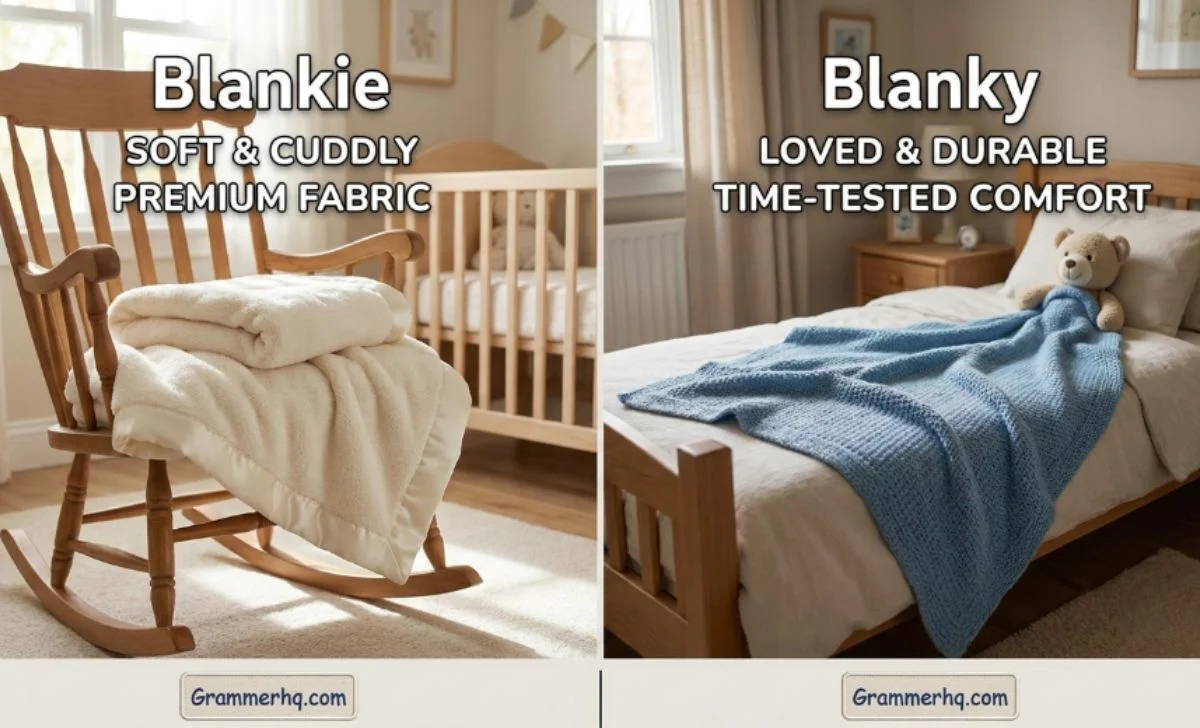
Blankie vs Blanky can be confusing because both words refer to a child’s comfort blanket, yet their spellings and usage are not exactly the same.
Have you ever seen one spelling and wondered whether the other was simply a mistake? You are not alone. Blankie is an informal term commonly associated with American English, while blanky is also a recognized informal form, with established British English baby-talk usage.
Neither word should automatically be dismissed as incorrect. The real difference comes down to regional usage, tone, and context. If you are writing for a general or formal audience, blanket is usually the safest choice.
In this guide, you’ll learn exactly what blankie and blanky mean, how they differ, how they are pronounced, and which form you should use in everyday English.
Quick Answer
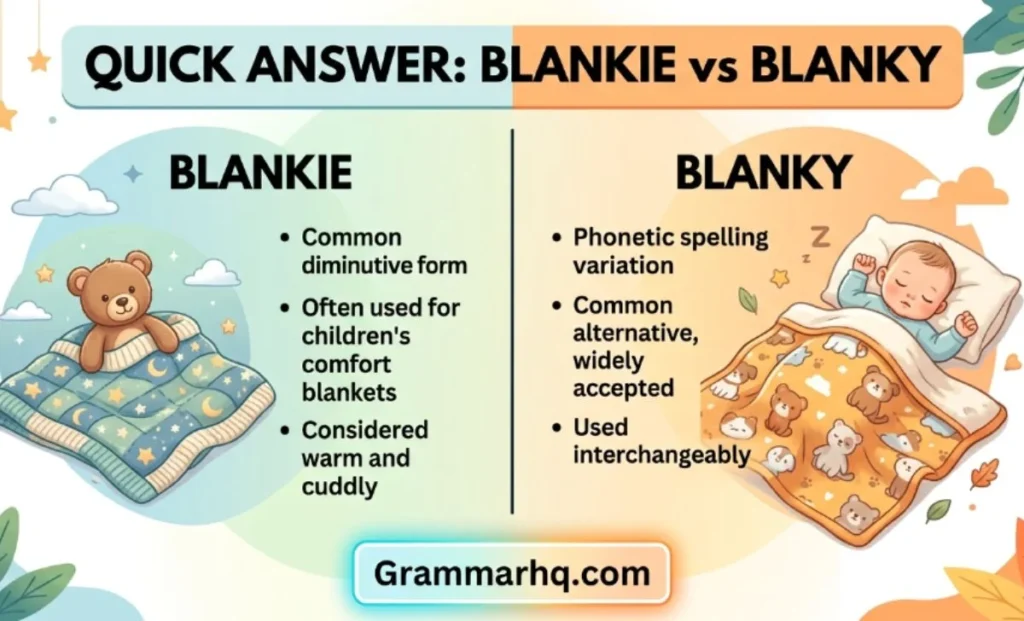
Blankie and blanky are both informal words for a comfort blanket, but their usage differs.
- Blankie — informal, mainly US English.
- Blanky — informal/baby talk, with established British English usage.
- Blanket — standard and neutral English.
Cambridge Dictionary describes blankie as an informal, mainly US word for a blanket, especially one used by a young child for comfort. Collins Dictionary records blanky as a British English baby-talk word meaning a comfort blanket.
So, blanky is not simply a misspelling of blankie.
What Does Blankie Mean?
Blankie is an informal word for a blanket, particularly a child’s favorite or comforting blanket.
A blankie may be something a child sleeps with, carries around, or becomes emotionally attached to. The word has a warm, affectionate tone and is common in family and child-centered conversation.
Examples of blankie
- The baby fell asleep with her blankie.
- Don’t forget Noah’s blankie.
- She takes her blankie everywhere.
- His old blankie is still his favorite.
- We found the missing blankie under the bed.
Because blankie is informal, it is more natural in everyday conversation than in formal writing.
What Does Blanky Mean?
Blanky is also a real word. Collins Dictionary records it as British English baby talk for a comfort blanket.
Like blankie, it is associated with children and affectionate speech. It is not the ordinary word for a blanket in standard formal English.
Examples of blanky
- Where is your blanky?
- The child would not sleep without his blanky.
- She carried her blanky into the car.
- Mum washed the baby’s blanky.
- He has had the same blanky since he was a toddler.
If blanky sounds unfamiliar to you, that does not make it incorrect. Its regional and informal usage explains why some English speakers encounter it less often.
Blankie vs Blanky: What’s the Difference?
The main difference is usage, region, and tone.
| Feature | Blankie | Blanky |
|---|---|---|
| Meaning | A child’s comfort blanket | A comfort blanket |
| Word type | Noun | Noun |
| Register | Informal | Baby talk / informal |
| Regional association | Mainly US | British English |
| Common setting | Family and casual speech | Child-directed speech |
| Formal writing | Usually avoid | Usually avoid |
| Neutral alternative | Blanket | Blanket |
The two words overlap in meaning, but they are not simply interchangeable in every variety of English.
Is Blanky a Real Word?
Yes. Blanky is a real English word.
Collins Dictionary lists blanky as a British English noun and labels it baby talk, with the meaning “a comfort blanket.”
This is an important distinction because a word can be real and dictionary-recognized without being common everywhere.
For example, an American English speaker may be much more familiar with blankie than blanky. That difference in familiarity does not make blanky wrong.
So:
Unfamiliar ≠ incorrect.
Is Blankie a Real Word?
Yes. Blankie is a recognized English word.
Cambridge Dictionary lists blankie as an informal, mainly US noun associated with a blanket used by a young child for comfort.
Merriam-Webster also records blankie as a word meaning a child’s blanket.
You may also encounter blankey, another spelling of the same informal term.
Blankie vs Blanky in American and British English
Regional usage is one of the clearest differences between the two forms.
Blankie in American English
Blankie is especially associated with American English.
You may see it in:
- family conversations
- parenting content
- children’s books
- casual messages
- childhood memories
- dialogue involving children
For a mainly American audience, blankie is generally the more familiar choice.
Blanky in British English
Blanky has established British English usage as a baby-talk term for a comfort blanket.
It works particularly well in:
- conversations with children
- British family contexts
- children’s dialogue
- informal descriptions of childhood
Is this like color vs colour?
No.
Blankie and blanky should not be treated as a strict US-versus-UK spelling pair like color/colour.
Their meanings overlap, but the words have different dictionary labels, levels of familiarity, and informal usage patterns.
Why Are Blankie and Blanky Spelled Differently?
Both forms developed as informal, affectionate forms related to blanket.
English often creates child-friendly or affectionate words by changing the ending of familiar words. The -ie and -y endings can both give a word a softer or more informal feel.
That helps explain why blankie and blanky can refer to the same type of comfort object despite their different spellings.
There is no need to assume that one spelling is simply a mistake made by people who cannot spell blanket.
Blankie, Blanky, or Blanket: Which Should You Use?
The best choice depends on the situation.
Use blankie when:
- You want informal American English.
- You are talking about a child’s comfort blanket.
- The tone is affectionate or personal.
- You are writing casual dialogue.
Example:
Emma refuses to sleep without her blankie.
Use blanky when:
- British English context is appropriate.
- You are using child-directed language.
- The informal tone fits the situation.
Example:
The little boy reached for his blanky.
Use blanket when:
- You need neutral English.
- You are writing formally.
- You are addressing a general audience.
- You simply mean the bedding or covering.
Example:
Please bring an extra blanket for the guest room.
Blanket is the best all-purpose choice when you do not need the affectionate or child-centered meaning.
Are Blankie and Blanky Formal English?
No. Both are informal forms.
Blanky is more specifically associated with baby talk, while blankie is an informal term commonly associated with children and comfort.
Compare:
The child slept with her blankie.
with:
The hotel provided an extra blanket.
The first sentence has a personal, child-centered tone. The second is neutral and suitable for professional writing.
So being a real word does not automatically mean a word is appropriate in formal writing.
Blankie vs Security Blanket: Are They the Same?
Not exactly.
A blankie is an informal name for a child’s comfort blanket.
A security blanket describes an object that provides emotional comfort or a sense of safety.
A child’s blankie may function as a security blanket, but the terms focus on different things.
Blankie focuses on the object and its informal name.
Security blanket focuses on the comfort or security the object provides.
Blankie vs Blanky Pronunciation
The two words are pronounced very similarly.
Blankie: /ˈblæŋ.ki/
Blanky: /ˈblæŋkɪ/
In simple English, both sound roughly like:
BLANG-kee
Their similar pronunciation is one reason people often become unsure about which spelling to use.
What Is the Plural of Blankie and Blanky?
The plural is blankies.
- One blankie → two blankies
- One blanky → two blankies
Examples
The children packed their blankies for the trip.
We washed all the baby’s blankies.
The spelling changes to -ies in the plural.
Common Mistakes With Blankie and Blanky
1. Saying “blanky is wrong”
This is too broad. Blanky is recognized in British English as a baby-talk word for a comfort blanket.
2. Treating blankie as formal English
Blankie is informal. Use blanket when neutral or formal language is needed.
3. Assuming they are exact US and UK spellings
They have regional associations, but they are not a strict spelling pair like center/centre.
4. Calling every blanket a blankie
Blankie usually suggests a child’s familiar or comforting blanket. It is not always interchangeable with the neutral word blanket.
5. Assuming an unfamiliar word is incorrect
Regional and informal English can produce words that are perfectly valid but less familiar to some speakers.
Blankie vs Blanky: Real-Life Examples
Talking to a child
“Did you bring your blankie?”
The affectionate context makes blankie natural.
American family conversation
“Don’t forget her blankie before we leave.”
Blankie fits naturally in casual American English.
British child-directed speech
“Have you got your blanky?”
Blanky fits the British baby-talk sense.
Formal writing
“The child was given a warm blanket.”
Here, blanket is the better choice because the sentence needs neutral language.
Childhood memory
“I still remember sleeping with my old blankie.”
The informal word works well because the sentence is personal and nostalgic.
Easy Way to Remember Blankie vs Blanky
Use this simple guide:
Blankie → informal, mainly US
Blanky → informal/baby talk, established in British English
Blanket → neutral and standard
This is a useful memory aid, not an absolute rule. Context still determines which word sounds most natural.
FAQs
1: Is blankie or blanky correct?
Both can be correct. Blankie is an informal term mainly associated with US English, while blanky is recognized in British English baby talk as a word for a comfort blanket.
2: Is blanky a real word?
Yes. Blanky is a recognized British English baby-talk noun meaning a comfort blanket.
3: What does blankie mean?
Blankie is an informal word for a blanket, especially a child’s familiar comfort blanket.
4: What does blanky mean?
Blanky means a comfort blanket and is associated with British English baby talk.
5: Is blankie American or British?
Blankie is mainly associated with American English.
6: Is blanky British or American?
For its blanket-related meaning, blanky is associated with British English and baby talk.
7: Are blankie and blanky pronounced the same?
They are pronounced very similarly, roughly like “BLANG-kee.”
8: Is blankie formal English?
No. Blankie is informal. Blanket is better for formal or neutral writing.
9: What is the plural of blankie?
The plural is blankies.
10: What is the plural of blanky?
The plural is also blankies.
11: Should I use blanket or blankie?
Use blanket for neutral or formal English. Use blankie when an informal, affectionate, or child-centered tone is appropriate.
Final Verdict:
Blankie and blanky can both refer to a child’s comfort blanket, but they are used differently.
- Blankie — informal and mainly associated with American English.
- Blanky — informal/baby talk, with established British English usage.
- Blanket — the best neutral and formal choice.
So, blanky is not simply a wrong spelling of blankie. If you are writing for an American audience or want a familiar child-centered term, blankie is usually the safer choice.
In British English, blanky can be perfectly natural in baby-talk and informal contexts.
When in doubt, choose blanket for neutral English and reserve blankie or blanky for situations where the affectionate, child-centered meaning matters.
Read More Blogs: