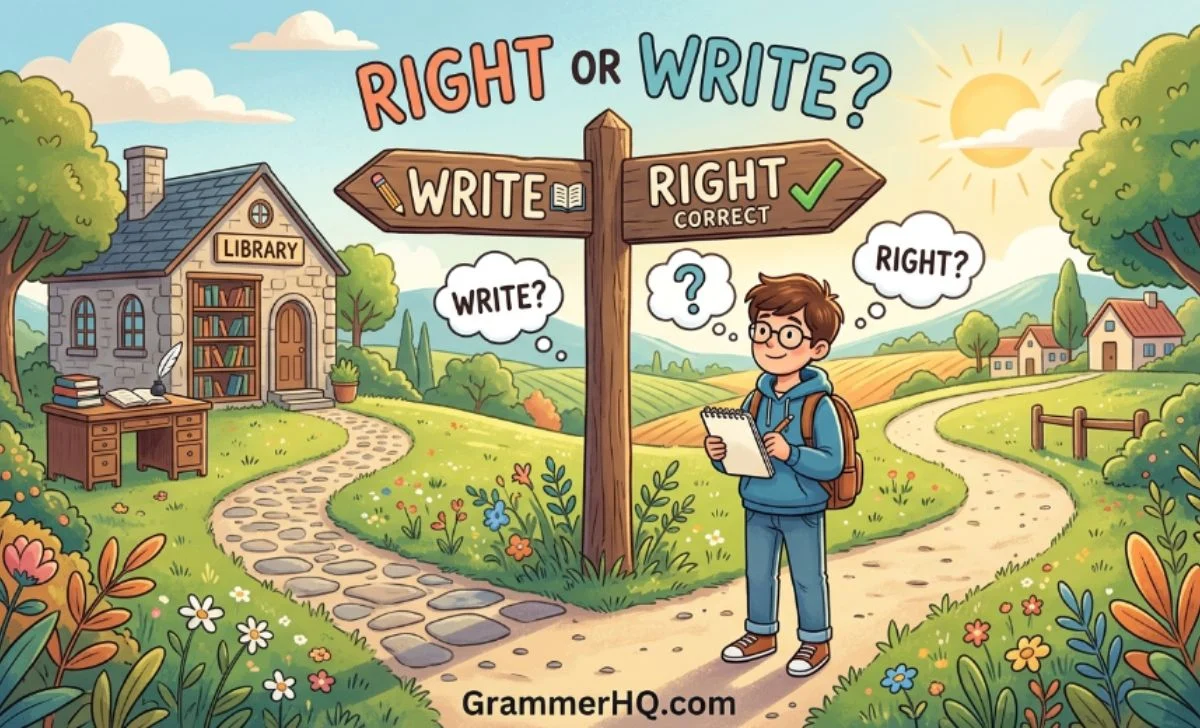
Have you ever paused while writing a sentence because you weren’t sure whether to use right or write? You’re not alone. These two words sound exactly the same, yet they have completely different meanings and functions in English.
Because they’re homophones words that share the same pronunciation but differ in spelling and meaning even native speakers occasionally mix them up in emails, school assignments, social media posts, and professional writing.
A single spelling mistake can change the meaning of your sentence and make your writing appear less polished. Understanding the difference is easier than you might think.
Once you learn what each word means, when to use it, and how to remember the distinction, you’ll rarely confuse them again.
Quick Answer
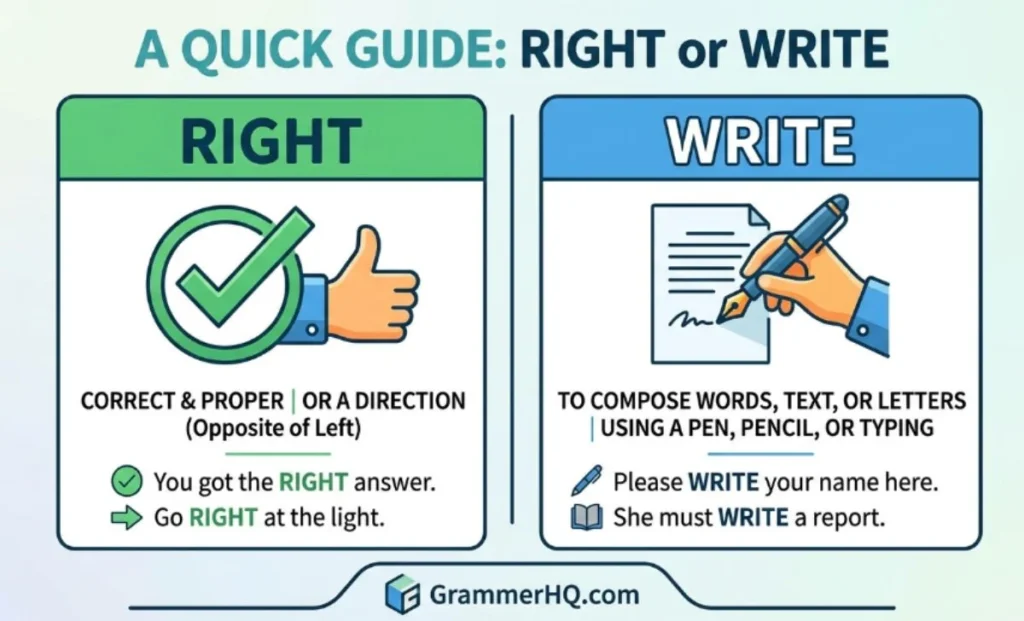
Right usually means correct, proper, true, or the opposite of left, while write means to form words, letters, or text using a pen, keyboard, or another writing tool.
Although both words are pronounced the same, they have different meanings, different grammatical functions, and cannot be used interchangeably.
What Does Right Mean?
Right is one of the most versatile words in English. Depending on the context, it can function as an adjective, noun, adverb, or verb. Most commonly, it describes something that is correct, accurate, appropriate, or morally acceptable.
It can also refer to:
- The opposite direction of left
- A legal or moral entitlement
- Something that is true or accurate
- A suitable or proper choice
- Agreement with facts or reality
Examples of Right:
- Your answer is right.
- Turn right at the next traffic light.
- Everyone has the right to express their opinion.
- She made the right decision.
- You’re absolutely right about that.
In each example, right refers to correctness, direction, entitlement, or appropriateness—not writing.
What Does Write Mean?
Write is a verb. It means to create letters, words, sentences, or other written content using a pen, pencil, keyboard, or digital device. Whenever someone records information in written form, the correct word is write.
People write many kinds of content, including:
- Emails
- Essays
- Books
- Reports
- Letters
- Notes
- Messages
- Articles
- Stories
Examples of Write:
- Please write your full name here.
- She loves to write short stories.
- I’ll write you an email tomorrow.
- Students must write their answers clearly.
- He wants to write a novel.
Notice that write always describes the action of producing written words.
Pronunciation
One reason learners confuse these words is that they are pronounced exactly the same.
| Word | IPA (UK) | IPA (US) | Pronunciation |
|---|---|---|---|
| Right | /raɪt/ | /raɪt/ | rhymes with light |
| Write | /raɪt/ | /raɪt/ | rhymes with light |
Both words have identical pronunciation because the W in write is silent.
This makes Right and Write perfect examples of homophones in English.
Why People Confuse Right and Write
Many English learners assume that words with the same pronunciation must also have the same spelling. However, English contains hundreds of homophones, and right and write are among the most common.
Here are the main reasons people confuse them:
They Sound Identical
Both words are pronounced /raɪt/, so you cannot tell which one is intended by listening alone.
Silent Letter
The W in write is silent, making its pronunciation identical to right.
Fast Typing
When writing quickly, many people accidentally choose the wrong spelling because both words sound the same in their minds.
Spellcheck Doesn’t Always Help
Since right and write are both correctly spelled English words, grammar checkers may not detect the mistake if the sentence remains grammatically valid.
For example:
❌ Please right your name here.
The spelling is correct, but the word choice is wrong.
Right vs Write: Comparison Table
| Feature | Right | Write |
|---|---|---|
| Part of Speech | Adjective, Noun, Adverb, Verb | Verb |
| Meaning | Correct, proper, opposite of left, legal entitlement | To produce written words |
| Pronunciation | /raɪt/ | /raɪt/ |
| Type | Homophone | Homophone |
| Used For | Correctness, direction, rights, accuracy | Writing text or information |
| Example | You are right. | Please write your answer. |
| Common Mistake | Using right when referring to writing | Using write when meaning “correct” |
The Grammar Rule
The easiest way to choose between right and write is to ask yourself a simple question:
Am I talking about something that is correct, true, proper, or the opposite of left?
→ Use right.
Am I talking about putting words on paper or a screen?
→ Use write.
Although both words sound identical, they belong to different parts of speech and express completely different ideas.
Use Right When You Mean:
- Something is correct
- Someone is accurate
- A decision is appropriate
- A legal or moral entitlement
- A direction (opposite of left)
Examples:
- You gave the right answer.
- Is this the right address?
- Turn right after the bridge.
- She fought for equal rights.
- Choosing honesty is always the right thing to do.
Use Write When You Mean:
- Creating words or sentences
- Recording information
- Producing written content
- Composing emails, books, reports, or messages
Examples:
- Please write your phone number.
- I need to write a report today.
- She enjoys writing poetry.
- Can you write your signature here?
- He plans to write his first novel.
Grammar Tip:
If you can replace the word with record, compose, or put into words, the correct choice is write.
Real-Life Examples of Right and Write
Understanding grammar becomes much easier when you see words used in everyday situations.
Everyday Conversation
✅ You’re right about the meeting time.
✅ Please write your address clearly.
School
✅ Students must write their answers in blue ink.
✅ Emma gave the right answer first.
Business Email
✅ Please write your employee ID in the subject line.
✅ You contacted the right department.
Academic Writing
✅ Always write complete sentences.
✅ Using reliable sources is the right approach.
Social Media
✅ Don’t forget to write a caption.
✅ You were right all along!
Customer Support
✅ Please write your order number below.
✅ You have reached the right support team.
Office Communication
✅ I’ll write the meeting notes.
✅ This is the right file.
Personal Life
✅ She loves to write in her journal every night.
✅ You made the right decision.
Incorrect vs Correct Examples:
❌ Please right your email address.
✅ Please write your email address.
Why?
You’re recording information, so the verb write is required.
❌ I think you’re write.
✅ I think you’re right.
Why?
The sentence expresses correctness, not writing.
❌ Turn write at the next corner.
✅ Turn right at the next corner.
Why?
This sentence refers to direction.
❌ Can you right your name here?
✅ Can you write your name here?
Why?
Writing a name requires the verb write.
❌ She always writes answers that are write.
✅ She always writes answers that are right.
Why?
The first writes describes the action, while right describes correctness.
Common Mistakes and Why They Happen
Even advanced English learners sometimes confuse these homophones. Here are the most common mistakes and their causes.
Mistake 1: Using Right Instead of Write
❌ Please right your name.
✅ Please write your name.
Why it happens:
People rely on pronunciation instead of meaning. Since both words sound the same, they accidentally choose the familiar spelling.
Mistake 2: Using Write Instead of Right
❌ Your answer is write.
✅ Your answer is right.
Why it happens:
Learners remember that write is a common English word but forget that the sentence describes correctness.
Mistake 3: Ignoring Context
❌ Take the write turn.
✅ Take the right turn.
Why it happens:
The writer focuses on sound instead of the sentence’s meaning.
Mistake 4: Depending Only on Spell Check
Many spell checkers won’t flag mistakes like these because both words are valid English spellings.
For example:
❌ You are write.
A spell checker may not notice the error because write is correctly spelled, even though it’s the wrong word for the context.
Mistake 5: Translating Word for Word
Some learners translate directly from their native language without considering English grammar.
Instead of translating, always ask:
“Am I talking about being correct, or am I talking about writing?”
That simple question usually gives you the correct answer.
Memory Trick
Here’s a simple mnemonic you’ll remember instantly:
Write starts with W, and Writing also starts with W.
W → Write → Writing → Words
Whenever you’re talking about putting words on paper or a screen, choose write.
For right, think of the phrase:
The right answer is correct.
Both right and correct describe accuracy.
Quick Memory Chart:
| If you mean… | Use |
|---|---|
| Correct | Right |
| Opposite of left | Right |
| Record words | Write |
| Type an email | Write |
| Compose a letter | Write |
| Accurate answer | Right |
Real-World Usage
Choosing the correct word matters because small spelling errors can change how professional and trustworthy your writing appears.
Professional Emails:
Writing:
Please write your employee number below.
looks professional.
Writing:
Please right your employee number below.
creates an obvious language mistake.
Academic Writing:
Teachers and examiners expect accurate word choice. Confusing right and write can lower marks in school assignments, essays, and English proficiency exams such as IELTS or TOEFL.
Business Communication:
Reports, contracts, proposals, and official documents require precise language. Using the wrong homophone may confuse readers and reduce your credibility.
Everyday Conversations:
Although people cannot hear the difference in speech, the correct spelling becomes important in:
- Text messages
- Social media posts
- Online forms
- Notes
- Letters
- Emails
- Blog articles
- Comments
Using right and write correctly helps your communication appear clear, accurate, and professional.
Practice Quiz
Test your understanding of right and write by completing the following exercises.
Multiple Choice:
1. Which sentence is correct?
A. Please right your name on the form.
B. Please write your name on the form.
C. Please writing your name.
Answer: B
2. Which word means “correct”?
A. Write
B. Right
Answer: B
3. Complete the sentence:
Turn ______ at the traffic lights.
A. right
B. write
Answer: A
Fill in the Blanks:
4. I need to ______ an email to my manager.
Answer: write
5. Your answer is ______.
Answer: right
6. Please ______ your phone number here.
Answer: write
7. She made the ______ decision.
Answer: right
Correct the Mistake:
8. Please right your address below.
✅ Correct: Please write your address below.
9. You are write about the schedule.
✅ Correct: You are right about the schedule.
10. Take the write turn after the bridge.
✅ Correct: Take the right turn after the bridge.
FAQ,s
Is it right or write?
It depends on what you mean. Use right when talking about something that is correct, true, proper, or the opposite of left. Use write when referring to the action of producing words, letters, or other written content.
Why do right and write sound the same?
They are homophones, which are words that share the same pronunciation but have different spellings and meanings. The W in write is silent, so both words are pronounced /raɪt/.
Is write always a verb?
Yes. Write is primarily used as a verb because it describes an action, such as writing a letter, report, email, or book.
Examples:
- Please write your name.
- She likes to write stories.
Can right be used as more than one part of speech?
Yes. Right is a versatile word that can function as an adjective, noun, adverb, or verb depending on the sentence.
Examples:
- That’s the right answer. (adjective)
- Everyone has equal rights. (noun)
- Turn right here. (adverb)
- They worked to right an injustice. (verb)
How can I remember the difference between right and write?
A simple memory trick is:
- Write begins with W, and Writing also begins with W.
- Right means correct, true, or opposite of left.
If you’re creating words, use write. If you’re talking about correctness or direction, use right.
Do native English speakers confuse right and write?
Yes. Although native speakers know the difference in meaning, they occasionally mistype these words because they sound exactly alike. Careful proofreading usually catches the mistake.
Are right and write common IELTS or TOEFL mistakes?
Yes. Homophones like right and write frequently appear in English proficiency exams because they test vocabulary, spelling, grammar, and contextual understanding. Knowing the difference can help you avoid unnecessary errors.
Key Takeaways
- Right means correct, true, proper, legal entitlement, or the opposite of left.
- Write means to produce written words using a pen, pencil, keyboard, or other writing tool.
- Both words are homophones and are pronounced /raɪt/.
- Always choose the word based on the meaning of the sentence, not its pronunciation.
- Remember: W = Write = Writing = Words.
Conclusion
Although right and write sound exactly the same, they serve completely different purposes in English. Right refers to correctness, direction, or entitlement, while write describes the action of putting words into written form.
Paying attention to the meaning of your sentence not just the pronunciation will help you choose the correct word every time.
With the grammar rules, comparison table, real-life examples, memory trick, and practice quiz you’ve learned here, you’ll be able to use right and write confidently in everyday conversations, academic writing, professional communication, and exams.
Read More Bloogs: