Gluing and glueing can both look correct, especially because the base word is glue. So which spelling should you use?
The short answer is that both gluing and glueing are accepted forms of the verb glue, but gluing is the better default for most modern writing, especially when writing for an American audience.
Cambridge Dictionary lists both forms as present participles of glue.The two forms have the same meaning and pronunciation. The main difference is how commonly they are used and which spelling is more familiar to readers.
Gluing or Glueing: Which Is Correct?
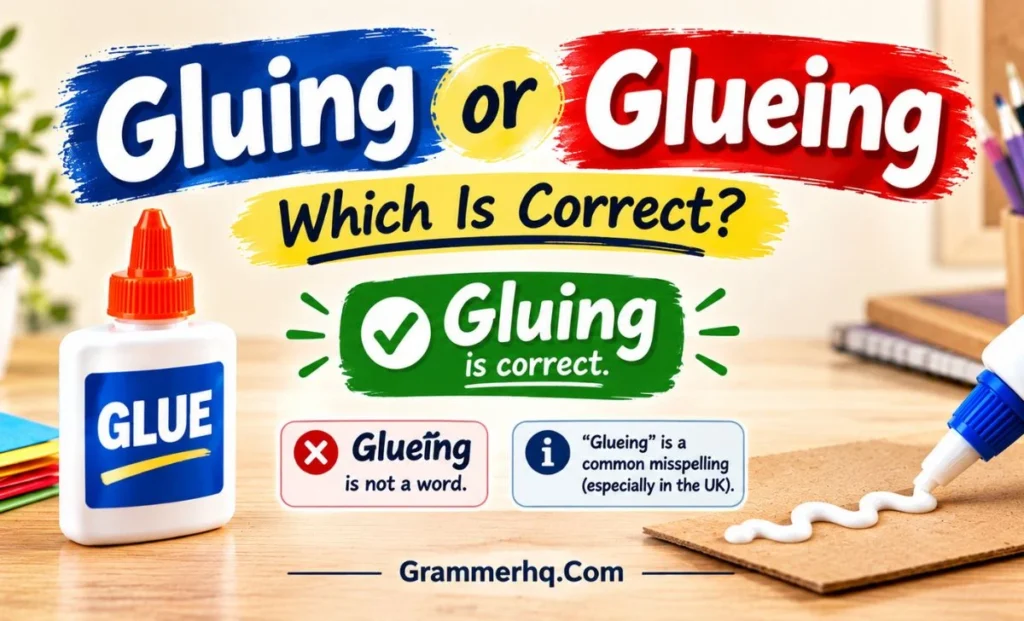
Both “gluing” and “glueing” are correct spellings, but “gluing” is the preferred choice for most everyday, academic, professional, and online writing.
| Spelling | Status | Example |
|---|---|---|
| Gluing | Accepted and widely preferred | She is gluing the pieces together. |
| Glueing | Accepted variant | She is glueing the pieces together. |
If you need to choose just one spelling, use gluing.
This is particularly useful for American English, where gluing is the familiar form. Cambridge’s American English entry also recognizes gluing, while its main dictionary entry gives both glueing and gluing.
What Does Gluing Mean?
Gluing means joining two or more things with glue or another adhesive.
It is the present participle of the verb glue. It can also work as a gerund, depending on how it is used in a sentence.
For example:
- Mia is gluing the photos into her scrapbook.
- We are gluing the broken pieces back together.
- Gluing the model took most of the afternoon.
In each example, the word refers to attaching something with glue.
Cambridge defines glue as a substance used to join things together and also as a verb meaning to join things using glue. It lists glueing or gluing as the present participle and glued as both the past tense and past participle.
What Does Glueing Mean?
Glueing has the same meaning as gluing.
For example:
She is glueing the paper to the cardboard.
The sentence means exactly the same thing as:
She is gluing the paper to the cardboard.
The difference is spelling, not meaning.
Cambridge has a separate dictionary entry for glueing and identifies it as the present participle of glue.
So, if you see glueing in a book, article, or other English text, it should not automatically be treated as a spelling mistake.
Why Is It Spelled Gluing?
The spelling gluing follows a common English pattern in which a final silent e is dropped before -ing is added.
For example:
- make → making
- hope → hoping
- use → using
- move → moving
- write → writing
- glue → gluing
That gives us:
glue + ing → gluing
The spelling can look unusual because glue already ends in the letters ue. That makes glueing seem natural at first glance.
However, English spelling patterns are not completely mechanical. Some verbs keep their final e in related forms, so it is better to learn the common patterns rather than assume that every verb follows one simple rule.
For glue, gluing is the form most writers will want to use.
Why Does “Glueing” Exist?
The extra e in glueing can look like a spelling error because many familiar verbs drop a final e before -ing.
But glueing has a real place in English usage. It is not simply an invented misspelling.
Cambridge currently lists glueing as a present participle of glue, alongside gluing.
That is why saying “glueing is always wrong” is too absolute.
The practical point is different: gluing is the safer and more familiar choice for most modern writing. It avoids making readers wonder whether the spelling is intentional.
Gluing vs Glueing in American and British English
This pair is sometimes presented as a strict American-versus-British spelling difference. The reality is more nuanced.
American English
Gluing is the form to choose for general American English writing.
For example:
The technician is gluing the loose panel back into place.
She is gluing the pieces of the model together.
I spent an hour gluing labels onto the boxes.
If your website, school assignment, business document, or other content is aimed mainly at readers in the United States, gluing is the natural choice.
British English
British English also uses gluing, while glueing can be found as an accepted variant in dictionary sources.
Cambridge’s English dictionary lists both forms rather than treating glueing as an outright error.
So it would be misleading to say:
American English = gluing
British English = glueing
That is too simple.
A better rule is:
Use gluing as your default, regardless of audience, unless you have a specific reason to retain the variant glueing.
How to Use Gluing in a Sentence
Here are some natural examples from everyday and professional situations:
Crafts
The children are gluing colored paper onto the cards.
Home repairs
Dad is gluing the broken wooden frame back together.
School projects
We spent the afternoon gluing the pieces of the science model together.
Packaging
The machine is gluing the boxes before they are shipped.
Digital or technical writing
The word can also be used figuratively:
The software works by gluing several existing components together.
Here, gluing does not mean using physical adhesive. It means connecting separate parts into one working system.
Is Gluing a Verb or a Gerund?
It can be either, depending on the sentence.
Gluing as a present participle
She is gluing the photographs into her notebook.
Here, gluing forms part of the continuous verb phrase is gluing.
Gluing as a gerund
Gluing the pieces requires patience.
Here, gluing acts like a noun because it names an activity.
The spelling stays the same in both cases.
What Is the Past Tense of Glue?
The past tense and past participle of glue are both glued.
The main forms are:
- Base form: glue
- Third-person singular: glues
- Past tense: glued
- Past participle: glued
- Present participle: gluing or glueing
Examples:
She glued the handle back onto the cup.
They have glued the pieces together.
He is gluing the final piece into place.
Cambridge also lists glued as the past tense and past participle of glue.
Is “Glueing” a Wrong Spelling?
No. “Glueing” should not automatically be called wrong.
Major dictionary evidence recognizes glueing as a form of glue. Cambridge, for example, lists it as a present participle.
However, gluing is the better default for most modern writing.
If you are writing a school assignment, business document, website, product description, or general article, using gluing is the simplest way to avoid an unfamiliar-looking variant.
The important distinction is:
Accepted does not always mean equally common or equally preferred.
Common Mistakes With Gluing
The most common confusion is keeping the final e and assuming that glueing must be the only logical form.
Another form to avoid is:
Glueeing
That spelling adds an unnecessary extra e and is not the standard form.
So, when you need the -ing form of glue, remember:
glue → gluing
And while glueing is also recognized, gluing is the safer choice for most writing.
Gluing or Glueing: Which Should You Use?
If you are still unsure, this simple guide will help:
| Situation | Recommended form |
|---|---|
| American English | Gluing |
| School or university writing | Gluing |
| Professional writing | Gluing |
| Website content | Gluing |
| General everyday writing | Gluing |
| A source that uses “glueing” | Keep the original spelling when appropriate |
You do not need to change the meaning or pronunciation. The choice is mainly about spelling preference and consistency.
FAQs
Is gluing or glueing correct?
Both are accepted spellings, but gluing is the better default for most modern writing.
Is glueing a misspelling?
Not necessarily. Cambridge lists glueing as a present participle of glue, so it should not automatically be marked as an error.
Which is more common: gluing or glueing?
Gluing is the more familiar choice for most modern readers, particularly in American English.
Does British English use glueing?
Yes, glueing can be found in British English, but gluing is also used. It is not a simple US-versus-UK spelling split.
What is the past tense of glue?
The past tense is glued.
Is gluing a gerund?
It can be. In a sentence such as “Gluing the pieces takes time,” gluing functions as a gerund.
What is the correct spelling for most professional writing?
Use gluing. It is the clearest and safest default for most modern professional and general writing.
Conclusion
Gluing and glueing are both recognized forms of the verb glue, so the choice is not as simple as calling one spelling wrong. Cambridge lists both as present participles.
For most modern writing, however, gluing is the better choice. It is familiar to readers, especially in American English, and works naturally in school, professional, online, and everyday writing.
So if you are deciding which spelling to use, remember:
Gluing = preferred default
Glueing = accepted variant
When in doubt, choose gluing.
Read More Blogs
- Paid or Payed: Which Is Correct? Meaning, Rules & Examples
- Conscious vs Concious: Which Spelling Is Correct?

Hi, I’m Amelia Parker, a grammar enthusiast and writer at GrammarHQ.com. I specialize in explaining spelling differences, confusing words, and common English mistakes through simple, practical, and easy-to-understand guides.










