Have you ever paused while writing and wondered, “Is it breath or breathe?” You are not alone. These two words are among the most commonly confused English words because they look almost identical and both relate to the same basic function: breathing.
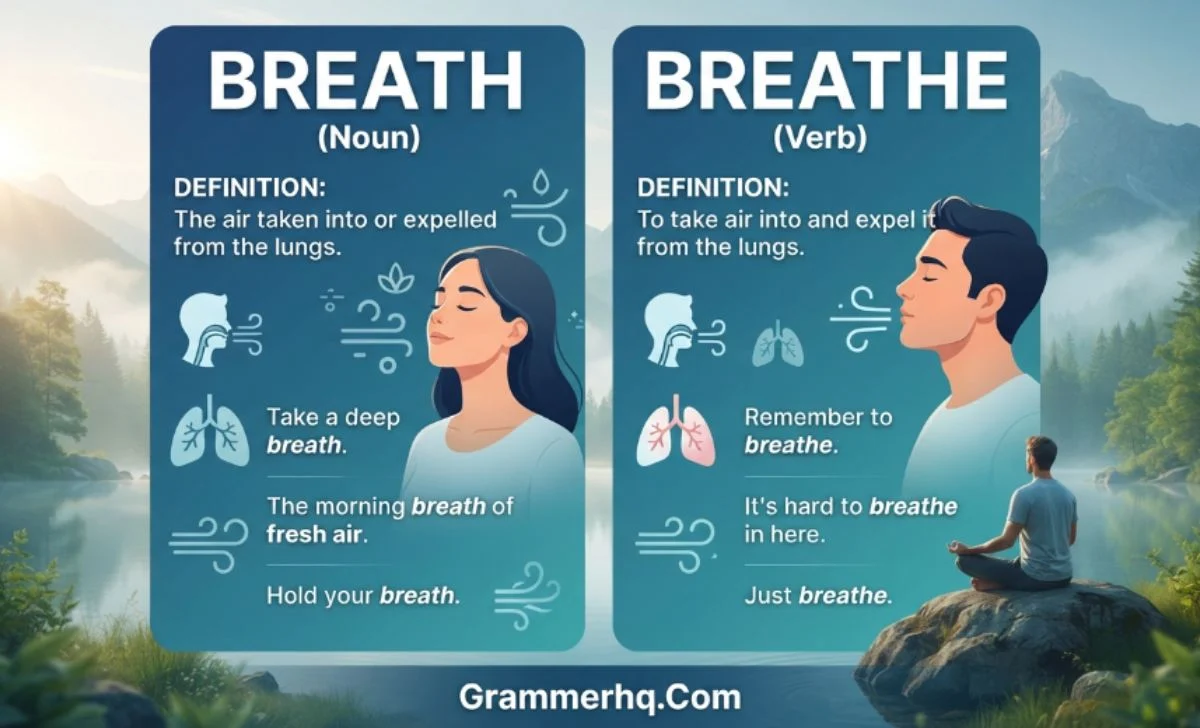
However, they are not interchangeable. Breath is a noun that refers to the air you take in or release, while breathe is a verb that describes the action of taking air into and pushing it out of your lungs.
Knowing this simple difference can prevent common grammar and spelling mistakes in emails, essays, conversations, and professional writing.
In this guide, you will learn how to use breath and breathe correctly, how to pronounce them, why people confuse them, and an easy trick that makes the difference simple to remember.
Quick Answer
The difference is simple:
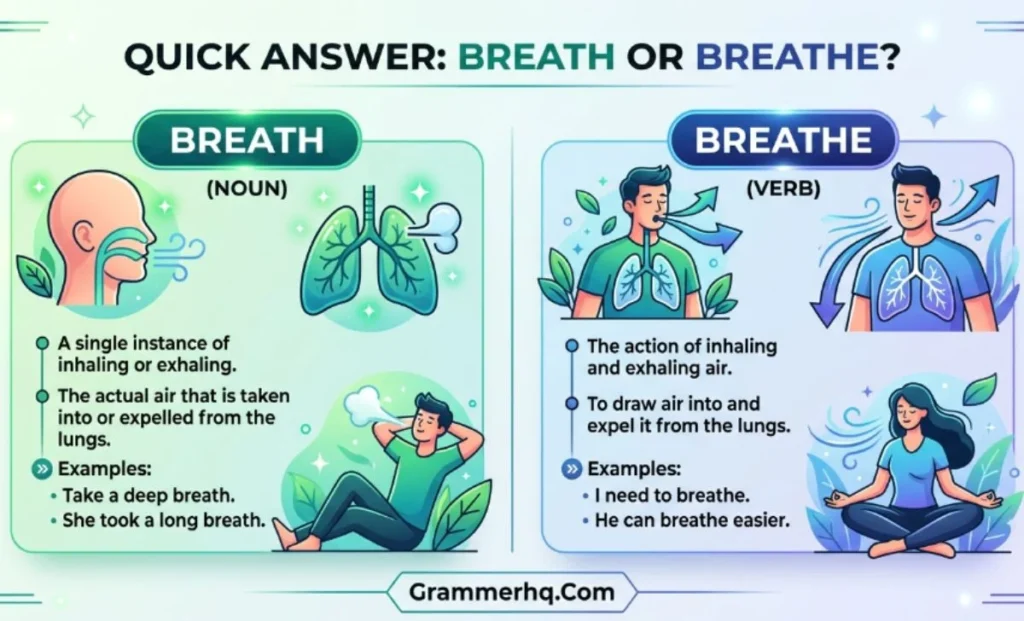
- Breath is a noun. It means the air taken into or released from the lungs.
- Breathe is a verb. It means to take air into the lungs and release it.
Examples
- Take a deep breath before you speak.
- Try to breathe slowly.
- She held her breath underwater.
- Humans breathe oxygen to stay alive.
The easiest rule
Breath = thing
Breathe = action
If you can put “a” or “your” before the word, you probably need breath:
Take a breath.
If the word describes what someone is doing, use breathe:
Please breathe slowly.
Breath vs Breathe: Part of Speech
Understanding the grammar role makes the difference much easier.
Breath Is a Noun
A noun names a person, place, thing, or idea. Breath refers to the air moving into or out of the lungs.
Examples:
- I took a deep breath.
- She lost her breath after running.
- Hold your breath for five seconds.
- His breath was visible in the cold air.
Here, breath names something rather than describing an action.
Breathe Is a Verb
A verb describes an action. Breathe means to inhale and exhale.
Examples:
- I breathe deeply when I feel nervous.
- The baby is breathing normally.
- Remember to breathe slowly.
- It was difficult to breathe in the smoke.
A useful question is:
Is the word naming the air, or describing the action?
Air = breath
Action = breathe
How to Pronounce Breath and Breathe
Although the spellings are similar, the pronunciation is different.
Breath
Pronunciation: /breθ/
The vowel sound is short, similar to the sound in death and left. The final th is also unvoiced.
Say:
breath
Breathe
Pronunciation: /briːð/
The vowel sound is a long ee sound, and the final th is voiced.
Say:
breathe
The pronunciation difference is important because it can help you recognize which word someone is using in conversation.
Quick pronunciation clue
Breath → short sound
Breathe → long “ee” sound
Why Do People Confuse Breath and Breathe?
The confusion is understandable because the two words share most of their spelling and have closely related meanings.
1. They Look Almost Identical
The only major spelling difference is the final e:
breath
breathe
That small difference is easy to overlook while typing or writing quickly.
2. They Have Related Meanings
Both words are connected with respiration, air, lungs, and inhaling or exhaling. Because their meanings are closely related, writers sometimes use one in place of the other.
3. Their Pronunciations Are Similar
The words begin with the same bre- sound, so English learners may have difficulty distinguishing them at first.
4. They Have Different Grammar Roles
This is the biggest issue.
Breath = noun
Breathe = verb
Once you understand this grammatical difference, choosing the correct spelling becomes much easier.
Easy Trick to Remember Breath or Breathe
Here is one of the simplest ways to remember the difference:
Breath = Noun
Think of breath as a thing you can take.
Take a breath.
You can also say:
Hold your breath.
Catch your breath.
Breathe = Verb
Think of breathe as an action.
Breathe deeply.
Breathe slowly.
I can breathe normally now.
The Extra-E Rule
Breathe has an extra e, and it is the verb.
So remember:
Action = Breathe
Thing = Breath
This one rule can prevent most breath/breathe spelling mistakes.
Breath and Breathe: Word Origin
The two words have a long history in English and are closely related to the idea of breathing and air.
Breath comes from Old English brǣþ, referring to breath, air, or exhalation.
Breathe comes from the Old English verb brǣþan, meaning to breathe or exhale.
Their shared history explains why the words look and sound so similar today.
The relationship between the two words is also reflected in other English word pairs where spelling helps distinguish a noun from a verb.
British English vs American English
Unlike some commonly confused spelling pairs, breath and breathe are spelled the same in both British and American English.
| Feature | British English | American English |
|---|---|---|
| Noun | breath | breath |
| Verb | breathe | breathe |
| Meaning | Same | Same |
| Grammar | Same | Same |
So you do not need to choose between British and American spelling here.
Whether you are writing for readers in the United States, United Kingdom, Canada, Australia, or New Zealand, the standard spellings remain breath and breathe.
When to Use Breath
Use breath when you are talking about the air itself or referring to breathing as a noun.
Common expressions include:
- take a breath
- hold your breath
- catch your breath
- lose your breath
- out of breath
- a deep breath
- a short breath
Examples
Take a deep breath and relax.
I was completely out of breath after running.
She held her breath while swimming underwater.
He took a moment to catch his breath.
In each sentence, breath functions as a noun.
When to Use Breathe
Use breathe when you are describing the action of inhaling and exhaling.
Examples
Try to breathe slowly.
It is difficult to breathe in a room filled with smoke.
The doctor told him to breathe normally.
Remember to breathe before you begin speaking.
Because each example describes an action, breathe is the correct word.
Common Breath and Breathe Mistakes
These mistakes are extremely common, but they are easy to fix.
| Incorrect | Correct |
|---|---|
| Take a deep breathe. | Take a deep breath. |
| I can’t breath. | I can’t breathe. |
| She held her breathe. | She held her breath. |
| Please breath slowly. | Please breathe slowly. |
| He lost his breathe. | He lost his breath. |
A Simple Test
Look at the word before the blank.
Take a deep ___.
Because a comes before the missing word, you need a noun:
Take a deep breath.
Now look at:
Please ___ slowly.
The missing word describes an action:
Please breathe slowly.
This quick test works in many everyday sentences.
Breath or Breathe in Everyday English
These words appear in conversations, emails, academic writing, and professional communication.
Everyday Conversation
Give me a second to catch my breath.
Just breathe and stay calm.
Fitness and Exercise
Take a deep breath before starting.
Remember to breathe during the exercise.
Professional Writing
Take a moment to catch your breath before the presentation.
Try to breathe slowly before speaking in front of the audience.
Academic Writing
Humans breathe air through the respiratory system.
A single breath contains several gases.
The surrounding grammar usually makes the correct choice clear.
Breath vs Breathe: Quick Comparison
| Feature | Breath | Breathe |
|---|---|---|
| Part of speech | Noun | Verb |
| Meaning | Air taken in or released | To inhale and exhale |
| Pronunciation | /breθ/ | /briːð/ |
| Main idea | Thing | Action |
| Example | Take a breath. | Breathe slowly. |
| Common phrase | Out of breath | Breathe deeply |
Remember
Take a breath.
Breathe slowly.
If you remember these two sentences, you will usually know which word to choose.
FAQs
1: Is it “take a breath” or “take a breathe”?
The correct phrase is “take a breath.” Breath is a noun, and the phrase refers to the air you take into your lungs.
2: Is breath a noun or a verb?
Breath is a noun. It refers to air taken into or released from the lungs.
3: Is breathe a noun or a verb?
Breathe is a verb. It describes the action of inhaling and exhaling.
4: Is it “I can’t breath” or “I can’t breathe”?
The correct sentence is:
I can’t breathe.
Breathe is a verb because it describes the action of inhaling and exhaling.
5: Are breath and breathe interchangeable?
No. They have different grammatical functions. Breath is a noun, while breathe is a verb.
6: How can I remember the difference?
Remember:
Breath = thing
Breathe = action
The extra e in breathe can remind you that it is the verb.
Conclusion
The difference between breath and breathe is simple once you focus on grammar. Breath is a noun for the air taken into or released from your lungs, while breathe is a verb describing the action of inhaling and exhaling.
Their similar spelling and related meanings make them easy to confuse, but the extra e in breathe provides a useful memory clue. When you take a breath, you are referring to a thing.
When you breathe, you are describing an action. Remember “breath = noun, breathe = verb,” and you can avoid one of the most common spelling and grammar mistakes in English.
Read More Blogs:

Hi, I’m Amelia Parker, a grammar enthusiast and writer at GrammarHQ.com. I specialize in explaining spelling differences, confusing words, and common English mistakes through simple, practical, and easy-to-understand guides.