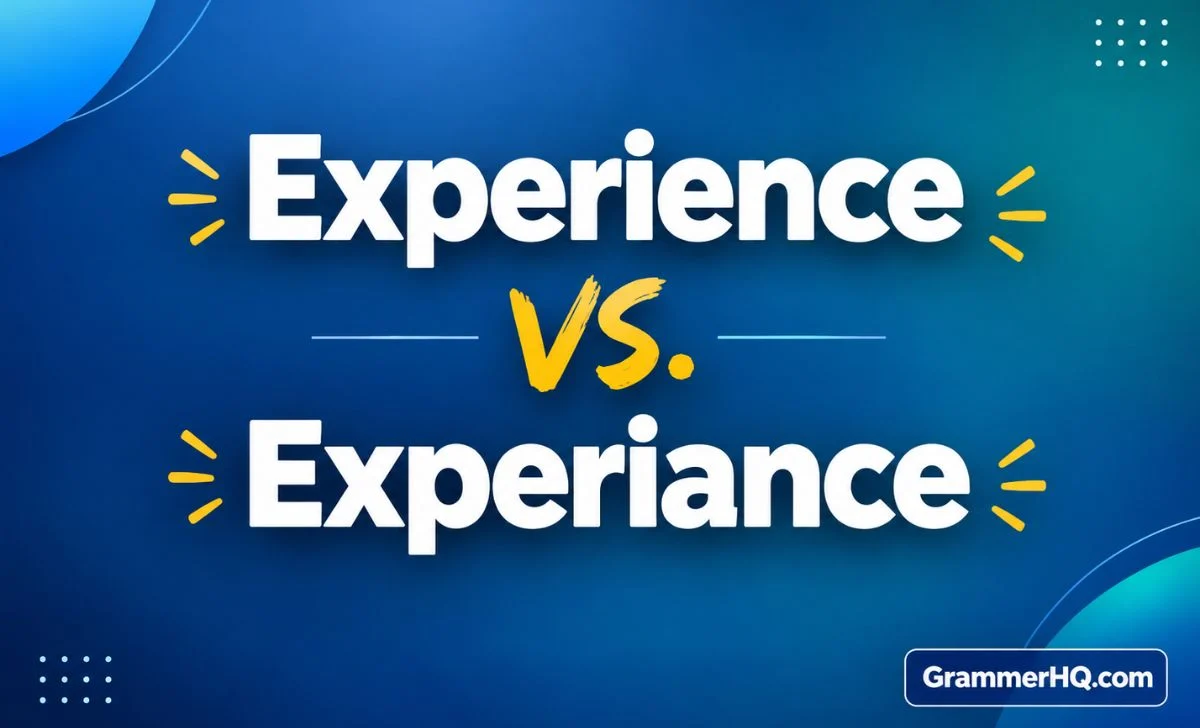
Have you ever wondered whether Experience vs Experiance is the correct spelling? You are not alone. This is a common spelling confusion, especially for English learners and writers who want their writing to look professional.
The correct spelling is experience, while experiance is a misspelling. The word experience can refer to knowledge gained through doing something, an event that happens to you, or the practical skills you develop over time.
In this guide, we will clearly explain the difference between Experience vs Experiance, show you the correct spelling, pronunciation, meaning, and real-life examples, and share an easy way to remember it.
By the end, you will know exactly which spelling to use and avoid this common mistake with confidence.
Quick Answer
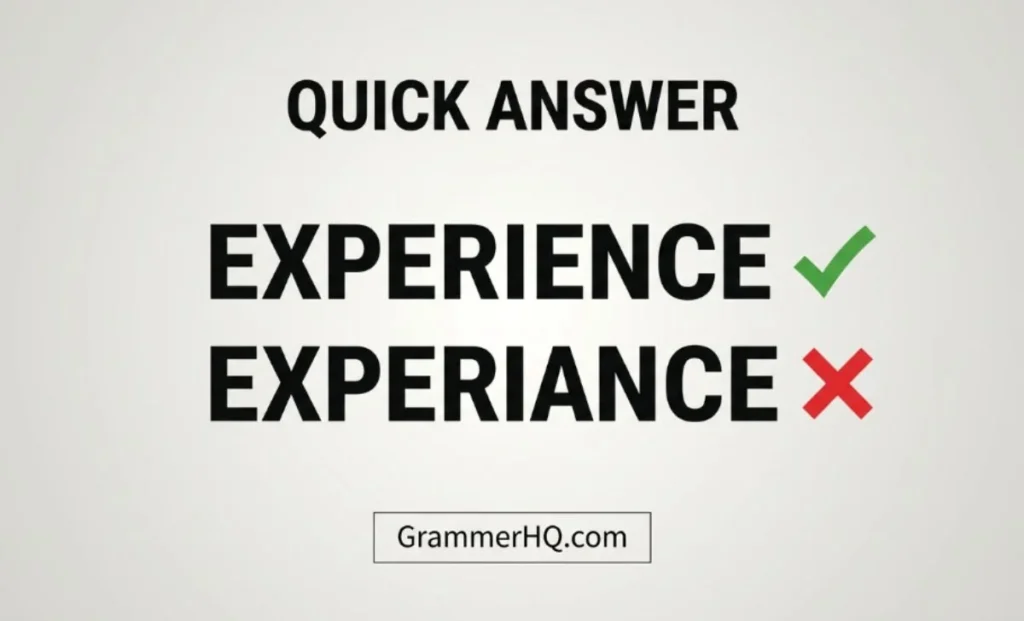
Experience is correct.
Experiance is incorrect.
| Spelling | Status | Example |
| Experience | ✅ Correct | She has five years of experience. |
| Experiance | ❌ Incorrect | She has five years of experiance. |
The simplest rule is:
Experience ends in -ence, not -ance.
So write:
experi + ence = experience
Not:
experi + ance = experiance
If you’re writing a résumé, CV, essay, email, application, or professional document, always use experience.
Why Is Experience Correct?
The standard English spelling is:
E-X-P-E-R-I-E-N-C-E
The common misspelling is:
E-X-P-E-R-I-A-N-C-E
The important difference is the vowel before n:
- experience → -ence ✅
- experiance → -ance ❌
Experiance is not a standard alternative spelling. It is simply a misspelling of experience. Spelling references list experiance among the common errors associated with this word.
The mistake is understandable. When people hear the word spoken quickly, the middle sounds may not clearly reveal whether the written form contains e or a. This can lead writers to spell the word according to how they think it sounds.
But pronunciation does not make experiance correct.
Correct spelling: experience
Incorrect spelling: experiance
What Does Experience Mean?
Experience has several related meanings.
As a noun, it can mean knowledge or skill gained by doing something. It can also refer to an event or situation that someone personally goes through.
For example:
She has extensive experience in teaching.
Here, experience means knowledge and skill gained through practical work.
Compare that with:
Traveling alone was an unforgettable experience.
Here, experience refers to an event or activity that happened to someone.
Depending on context, experience can refer to:
- knowledge
- skill
- practical knowledge
- professional ability
- personal involvement
- exposure to something
- an event
- a situation
- something you have personally gone through
This is why experience is such a useful word in everyday and professional English.
Experience as a Noun
One of the most common uses of experience is as a noun.
It can describe knowledge or skill developed through practice, work, study, or life.
Work Experience
I have three years of work experience in marketing.
Here, experience means the knowledge and skills gained through employment.
Professional Experience
The company is looking for someone with relevant professional experience.
This refers to knowledge and skills gained in a professional environment.
Practical Experience
Students need practical experience, not just theoretical knowledge.
This means learning by actually doing something.
Life Experience
Life experience often teaches lessons that books cannot.
Here, the word refers to knowledge gained through living and facing different situations.
Personal Experience
I know this from personal experience.
This means the speaker has personally encountered the situation.
Firsthand Experience
She has firsthand experience of working with children.
This means she knows about something because she personally experienced it.
Experience as a Verb
A useful point that is often overlooked in basic spelling articles is that experience is also a verb.
As a verb, it means to go through, encounter, or undergo something.
For example:
Many people experience stress at work.
She experienced several difficulties during the journey.
We are experiencing technical problems.
In these examples, experience describes something that happens to a person rather than accumulated knowledge.
Common Word Forms
| Form | Example |
| experience | I experience problems like this often. |
| experiences | She experiences stress before exams. |
| experienced | He experienced several difficulties. |
| experiencing | They are experiencing delays. |
These forms are all built from the same correct spelling.
Why Do People Spell Experience as Experiance?
If experience is so common, why does experiance appear so often?
There are several reasons.
1. The Pronunciation Can Be Misleading
The word is often spoken quickly, so its individual vowel sounds may not be obvious.
2. The Middle Vowels Are Easy to Confuse
The sequence in experience can be visually and phonetically confusing. A writer may remember the ending as -ance instead of -ence.
3. English Spelling Is Not Completely Phonetic
English contains many words whose spelling cannot be predicted perfectly from pronunciation. People therefore sometimes write what they think they hear.
4. Fast Typing
A quick typo can change experience into experiance without the writer noticing.
Spelling resources document experiance alongside several other common misspellings of experience.
The solution is not to memorize every possible mistake. Instead, remember the correct ending:
experiENCE
The Best Way to Remember the Spelling
If you often confuse experience and experiance, use this simple trick.
Remember: ENCE
The correct word ends with:
E-N-C-E
So think:
experi + ENCE = experience
Not:
experi + ANCE = experiance
A useful visual reminder is:
experiENCE
You can also learn the word through common phrases:
- gain experience
- have experience
- work experience
- professional experience
- practical experience
- relevant experience
Seeing the correct spelling repeatedly in meaningful phrases makes it easier to remember than memorizing the word in isolation.
Experience vs Experiance in Sentences
The difference becomes especially clear when you compare correct and incorrect examples.
Example 1
✅ I have five years of experience in web development.
❌ I have five years of experiance in web development.
Example 2
✅ The interview was a valuable experience.
❌ The interview was a valuable experiance.
Example 3
✅ She gained practical experience during her internship.
❌ She gained practical experiance during her internship.
Example 4
✅ He has extensive professional experience.
❌ He has extensive professional experiance.
Example 5
✅ We are experiencing technical difficulties.
❌ We are experiancing technical difficulties.
Example 6
✅ She experienced a major change in her career.
❌ She experianced a major change in her career.
Notice that the same spelling principle remains in the related forms:
experience → experienced → experiences → experiencing
Common Collocations With Experience
Learning common word combinations can make the correct spelling easier to remember naturally.
Some common expressions include:
- work experience
- professional experience
- relevant experience
- previous experience
- practical experience
- personal experience
- life experience
- firsthand experience
- hands-on experience
- years of experience
- valuable experience
- teaching experience
- customer experience
- user experience
- gain experience
- get experience
- have experience
- learn from experience
- speak from experience
For example:
The position requires two years of relevant experience.
She gained valuable experience during her internship.
You can learn a lot from experience.
These phrases are useful because they show how experience appears in natural English rather than treating it as an isolated spelling exercise.
Experience in a Résumé or CV
The word experience is especially important in professional writing.
If you’re preparing a résumé or CV, you may use headings such as:
Professional Experience
Work Experience
Relevant Experience
Previous Experience
Writing:
❌ Professional Experiance
or:
❌ Work Experiance
introduces an avoidable spelling error into an important document.
The correct form is always:
Experience
This is particularly important in phrases such as years of experience, relevant experience, and professional experience.
Common Misspellings of Experience
Experiance is not the only spelling error associated with this word.
Other commonly documented forms include:
- experince
- expereince
- expierence
- experence
- experiense
- experiece
- experance
- experienc
- expreience
- exprience
Spelling references identify a range of these forms as misspellings caused by missing, adding, rearranging, or substituting letters.
You don’t need to memorize them all.
The important target is:
experience
When proofreading, watch especially for missing letters and vowel substitutions.
How Do You Pronounce Experience?
Experience has established pronunciations in both British and American English. Cambridge provides UK and US pronunciation information for the word.
A simple pronunciation guide is:
ik-SPEER-ee-uhns
The exact pronunciation can vary naturally between speakers and accents.
But there is an important distinction:
Pronunciation can vary. Standard spelling does not change to “experiance.”
So hearing the word differently is not a reason to write the incorrect form.
British English vs American English
Is experiance a British spelling while experience is American?
No.
Both British English and American English use:
✅ experience
Neither standard variety uses:
❌ experiance
British and American speakers can have slightly different pronunciations, but experiance is not a legitimate regional spelling variation.
This means you should use experience whether you are writing for readers in the UK, US, Canada, Australia, or elsewhere.
Experience Word Family
Understanding the word family can strengthen your spelling memory.
Experience
She has valuable experience.
Experiences
Traveling gave him many new experiences.
Experienced
She is an experienced teacher.
Experiencing
The company is experiencing rapid growth.
These forms share the same core spelling.
A common mistake is to carry the -ance error into other forms. For example:
❌ experianced
❌ experiancing
The correct forms are:
✅ experienced
✅ experiencing
The Origin of the Word Experience
The spelling of experience has a long history.
Oxford traces the word through Middle English and Old French back to Latin experientia, related to experiri, meaning to try or test. Merriam-Webster gives a similar Latin and Anglo-French history.
This history is also related to words such as:
- experiment
- expert
- experiential
The modern spelling therefore has a historical basis. Experiance is not an alternative historical spelling that should be used in modern standard English.
Is Experience vs Experiance Like Affect vs Effect?
No, and this is an important distinction.
Some confusing word pairs contain two correct words, such as:
- affect / effect
- advice / advise
- breath / breathe
- complement / compliment
But experience vs experiance is not one of those pairs.
There are not two standard words with different meanings here.
Instead:
Experience = correct word
Experiance = misspelling
That makes this confusion easier to solve once you know the correct spelling.
A One-Second Spelling Test
When you’re writing quickly and hesitate between the two forms, don’t try to pronounce the whole word.
Just check the ending.
Correct
experiENCE
Incorrect
experiANCE
Ask yourself:
Does experience end in -ENCE?
Yes.
That tiny check can prevent the mistake in an email, assignment, résumé, article, or application.
Experience vs Experiance: Complete Comparison
| Feature | Experience | Experiance |
| Standard English word | ✅ Yes | ❌ No |
| Correct spelling | ✅ Yes | ❌ No |
| Standard dictionary form | ✅ Yes | ❌ No |
| Can be a noun | ✅ Yes | ❌ No |
| Can be a verb | ✅ Yes | ❌ No |
| Used in résumés | ✅ Yes | ❌ No |
| Used in British English | ✅ Yes | ❌ No |
| Used in American English | ✅ Yes | ❌ No |
| Common spelling mistake | No | ✅ Yes |
FAQs
1: Is it experience or experiance?
Experience is the correct spelling. Experiance is a misspelling.
2: Is experiance a word?
Experiance is not the standard English word you should use. The correct form is experience.
3: How do you spell experience?
The correct spelling is:
E-X-P-E-R-I-E-N-C-E
4: Why is experiance wrong?
The standard spelling uses -ence, not -ance:
experience ✅
experiance ❌
5: Is experience a noun or a verb?
It can be both. As a noun, it can refer to knowledge, skill, or an event. As a verb, it can mean to go through or encounter something.
6: What is the plural of experience?
The plural is experiences.
Her travels gave her many unforgettable experiences.
7: What is the past tense of experience?
The past tense is experienced.
He experienced several problems during the journey.
8: What is the -ing form of experience?
The -ing form is experiencing.
The company is experiencing rapid growth.
9: What are common misspellings of experience?
Common misspellings include experiance, experince, expereince, expierence, experence, and experiense.
10: Is experiance British English?
No. Experience is the standard spelling in both British and American English.
11: How can I remember the spelling of experience?
Remember the ending:
experi + ENCE = experience
Think -ENCE, not -ANCE.
Final Verdict
If you are choosing between the two, the answer is simple:
Experience ✅
Experiance ❌
Experience is the standard English spelling. It can mean knowledge or skill gained through practice, an event you go through, or the act of encountering something.
Experiance is simply a misspelling.
The easiest rule to remember is:
experiENCE — not experiANCE
So whether you’re writing a résumé, CV, school assignment, professional email, blog post, or everyday message, choose experience.
Once you remember the -ENCE ending, this common spelling confusion becomes much easier to avoid.
Quick memory check:
Experience = E before N.
Read More Blogs
- Spelt or Spelled: Which Is Correct? UK vs US English Explained
- Taught vs Tought: Which Spelling Is Correct?

Hi, I’m Amelia Parker, a grammar enthusiast and writer at GrammarHQ.com. I specialize in explaining spelling differences, confusing words, and common English mistakes through simple, practical, and easy-to-understand guides.