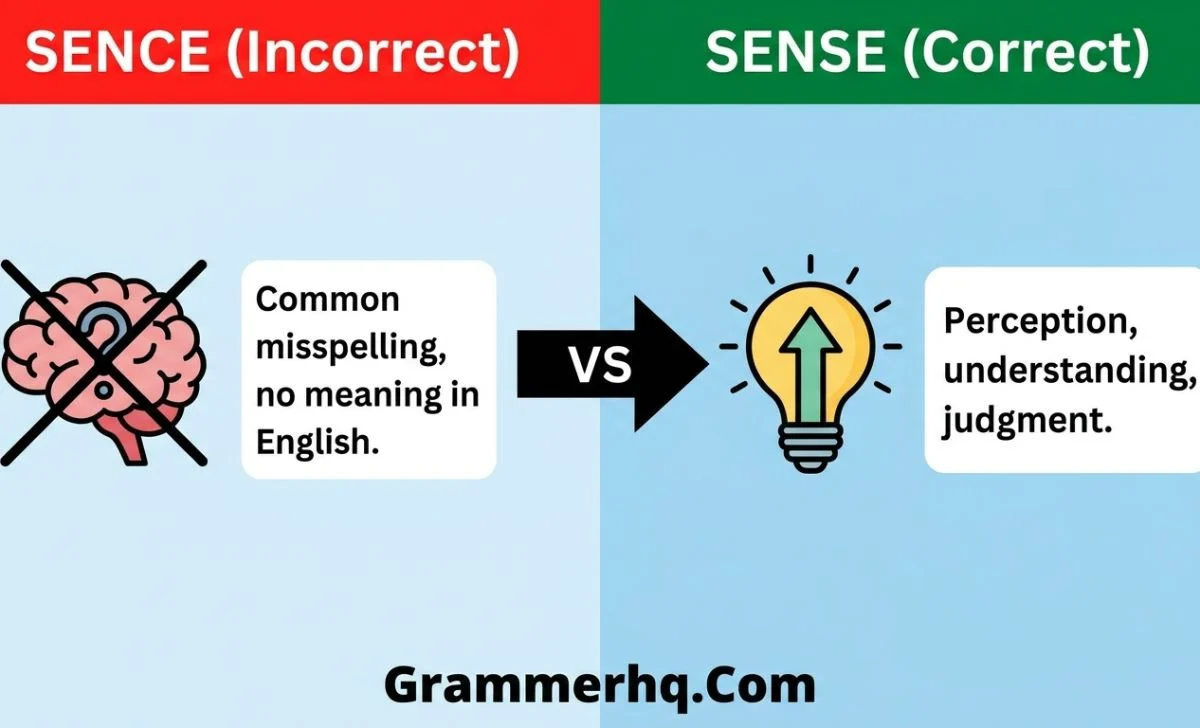
Sence vs Sense is an easy spelling mix-up because both forms can sound the same when spoken. If you are referring to meaning, understanding, perception, awareness, or good judgment, the correct modern spelling is sense.
Sence is not the standard spelling used in modern English.For example, write “That makes sense,” not “That makes sence.”
The same spelling is used in both American and British English, so this is not a US-versus-UK spelling difference.
Quick Answer
Sense is the correct spelling in modern standard English.
Sence is generally a misspelling when you mean sense.
| Word | Modern standard English | Example |
|---|---|---|
| Sense | ✅ Correct | That explanation makes sense. |
| Sence | ❌ Not the standard spelling | That explanation makes sence. |
There is one small historical detail worth knowing: sence has appeared in older and dialectal forms of English. However, that does not make it the normal spelling for modern writing.
What Is the Difference Between Sence and Sense?
The difference is mainly one of standard spelling and usage.
Sense
Sense is a standard English word that can work as both a noun and a verb.
As a noun, it can refer to a physical ability, an understanding of something, an impression, practical judgment, or the meaning of something.
She has a good sense of direction.
As a verb, sense means to notice or become aware of something.
I could sense that he was uncomfortable.
Sence
In ordinary modern English, sence is not the spelling you should use when you mean sense.
It often appears because someone spells the word according to how it sounds. That can happen easily with English words whose pronunciation does not clearly reveal their spelling.
So if you are writing an essay, email, report, article, assignment, or everyday message, choose sense.
What Does Sense Mean?
The word sense has several common meanings, which explains why it appears in many different types of sentences.
Sense as a Physical Ability
A sense can be one of the ways people perceive the world.
The familiar five senses are:
- sight
- hearing
- smell
- taste
- touch
For example:
A dog’s sense of smell is much stronger than ours.
Sense as Awareness or Feeling
Sense can describe an awareness or impression that something is true or happening.
I had a sense that something was wrong.
Here, the word does not refer to one of the five physical senses. It means an awareness or feeling.
Sense as Good Judgment
In common sense, the word refers to practical judgment.
You need some common sense when making a decision like that.
This is why someone may be described as sensible when they usually make reasonable decisions.
Sense as Meaning
Sense can also mean the meaning of a word, statement, or situation.
I understand the words, but I don’t understand the sense of the sentence.
This meaning is especially common when discussing language, ideas, or interpretation.
Sense as a Verb
As a verb, sense means to notice or recognize something, often without being told directly.
She could sense that her friend was upset.
The noun and verb have the same spelling, although their roles in a sentence are different.
Why Do People Spell Sense as Sence?
The most obvious reason is pronunciation.
When people hear sense, the sound does not tell them whether the word contains an s or a c in the middle. Someone who has mainly encountered the word in conversation may therefore write sence.
English has many spelling patterns that make this kind of mistake possible. Words such as fence, hence, and tense can also make a spelling based on sound feel reasonable.
The best way to avoid the mistake is not to rely on pronunciation alone. Remember the standard spelling:
S-E-N-S-E = sense
If the word refers to meaning, awareness, perception, or judgment, sense is the form you want.
Common Expressions With Sense
Learning common phrases is useful because they appear frequently in everyday English.
Make Sense
Make sense means to be logical, reasonable, or understandable.
Your explanation makes sense.
The new plan doesn’t make sense to me.
The common mistake is writing make sence. The correct phrase is always make sense in standard modern English.
Make Sense Of
Make sense of means to understand something that is confusing or difficult.
I couldn’t make sense of the instructions.
She is trying to make sense of the data.
This phrase is especially useful when talking about complicated information.
Common Sense
Common sense means practical judgment or ordinary good judgment.
Use your common sense before making a decision.
Sense of Humor
A sense of humor is someone’s ability to recognize or enjoy what is funny.
He has a great sense of humor.
Sense of Direction
A sense of direction is the ability to know where you are and where you need to go.
I have a poor sense of direction, so I usually use a map.
Sense of Smell
A sense of smell is the ability to detect odors.
Dogs have an excellent sense of smell.
In a Sense
In a sense means in one particular way or from one point of view.
In a sense, the two ideas are connected.
Sense vs Sence in Everyday Sentences
The easiest way to see the difference is to compare the forms in context.
Correct
- This doesn’t make sense.
- She has a strong sense of responsibility.
- I could sense that he was nervous.
- Use your common sense.
- I can’t make sense of these instructions.
- He has a good sense of humor.
- What is the sense of this sentence?
Incorrect in Modern Standard English
- ❌ This doesn’t make sence.
- ❌ She has a strong sence of responsibility.
- ❌ I could sence that he was nervous.
- ❌ Use your common sence.
- ❌ I can’t make sence of these instructions.
- ❌ He has a good sence of humor.
The important pattern is simple: when you mean the modern English word, use sense.
Is Sence Ever a Correct Word?
This question needs a little more care than simply saying “no.”
In modern standard English, sence is not the normal spelling of sense. However, the form has appeared in historical English as an archaic spelling, and it can also be found in some dialectal contexts.
That means you may encounter sence in an old text, historical source, or dialect-focused material. Its existence in those contexts does not make it the appropriate spelling for normal modern writing.
So there are two different questions:
Can “sence” be found in English?
Yes, especially in historical or dialectal material.
Should you write “sence” when you mean the ordinary modern word?
No. Use sense.
This distinction is more accurate than saying that sence has never existed as a word.
Is Sence a British or American Spelling?
No. This is not a British-versus-American spelling difference.
Both varieties use:
- British English: sense
- American English: sense
So you should not change sense to sence depending on which variety of English you are writing.
This differs from genuine spelling differences such as colour/color and centre/center. Sense does not have that kind of US–UK variation.
Make Sense or Make Sence?
The correct phrase is:
make sense ✅
Not:
make sence ❌
For example:
Does this explanation make sense?
Your suggestion makes sense.
The instructions don’t make sense.
The same spelling applies to related expressions such as common sense, sense of humor, and make sense of.
A Simple Way to Remember the Spelling
If you often write sence by mistake, connect the spelling with the phrase make sense.
Think:
That makes SENSE.
Then remember the middle pattern:
S-E-N-S-E
The word contains “sens”, not “senc.”
You do not need a complicated spelling rule. Just associate the word with familiar expressions such as common sense and make sense.
Common Mistakes to Avoid
Here are some of the most common forms to watch for:
| Incorrect | Correct |
|---|---|
| make sence | make sense |
| common sence | common sense |
| sence of humor | sense of humor |
| sence of direction | sense of direction |
| I can sence it | I can sense it |
| doesn’t make sence | doesn’t make sense |
Once you recognize the correct spelling in these familiar phrases, the difference becomes much easier to remember.
FAQs
Is sence or sense correct?
Sense is the correct spelling in modern standard English. Sence is generally a spelling mistake when it is intended to mean the ordinary word sense.
Is sence a real word?
Sence has been recorded in historical and dialectal English, including as an older spelling of sense. It is not, however, the standard modern spelling used in ordinary writing.
Why do people spell sense as sence?
The pronunciation can make the spelling difficult to predict. People may hear the word and choose c because similar-sounding English words use that letter.
Is sence a British spelling?
No. Sense is used in both British and American English. Sence is not a standard British alternative.
Is “make sence” correct?
No. The correct expression is make sense.
How do you spell sense?
The standard spelling is S-E-N-S-E: sense.
What does sense mean?
Sense can mean a physical ability, awareness, understanding, practical judgment, or the meaning of something. It can also be a verb meaning to notice or become aware of something.
Can sence be used in historical English?
Yes. Historical and dialectal sources contain examples of sence, but this does not make it the standard spelling for modern English.
Final Answer
If you are writing modern English, choose sense.
Use it for physical perception, awareness, understanding, judgment, meaning, and related expressions such as make sense, common sense, and sense of humor.
Although sence can appear in historical or dialectal English, it is not the standard modern spelling. For everyday writing, schoolwork, professional communication, and online content, the safe and correct choice is simple:
Sense, not sence.
Read More Blogs

Hi, I’m Amelia Parker, a grammar enthusiast and writer at GrammarHQ.com. I specialize in explaining spelling differences, confusing words, and common English mistakes through simple, practical, and easy-to-understand guides.










