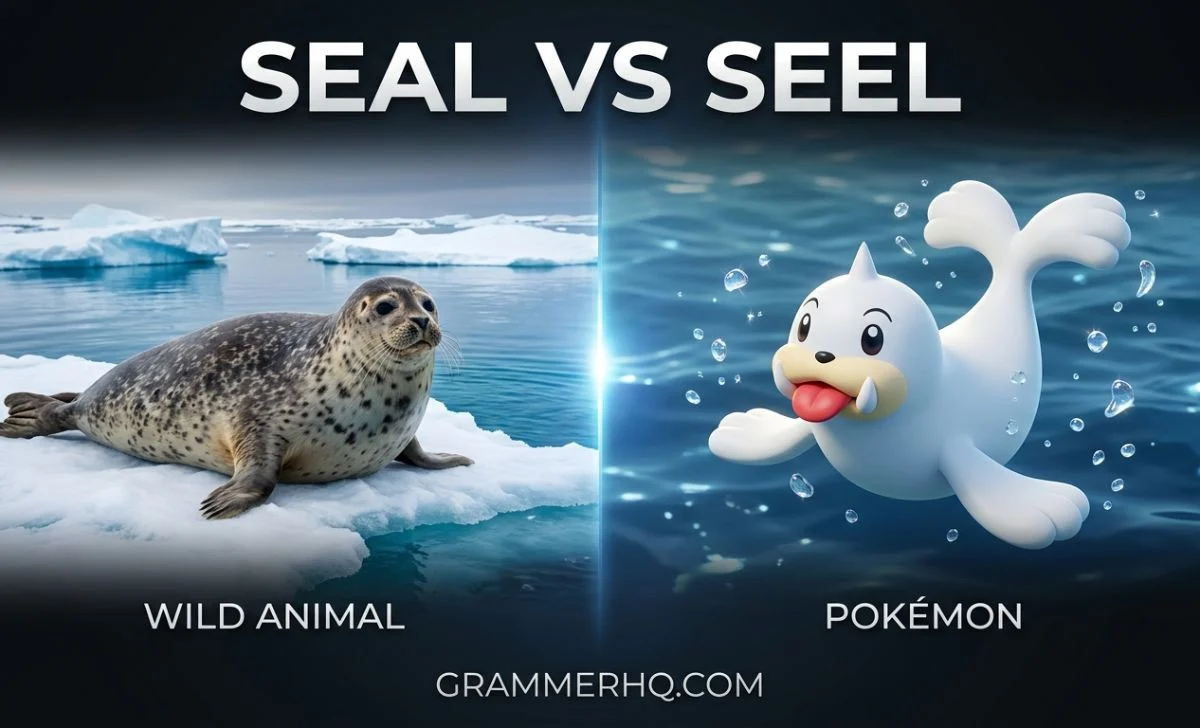
Seal vs seel can be confusing because the two words look and sound very similar, but they have different meanings and uses.
Seal is the standard word used in everyday English for closing or securing something, an official mark, a protective closure, or a marine animal.
Seel is also a real English word, but it is rare and mainly appears in historical or specialized falconry contexts. So, for almost any modern sentence, seal is the spelling you need.
Seal vs Seel: The Difference at a Glance
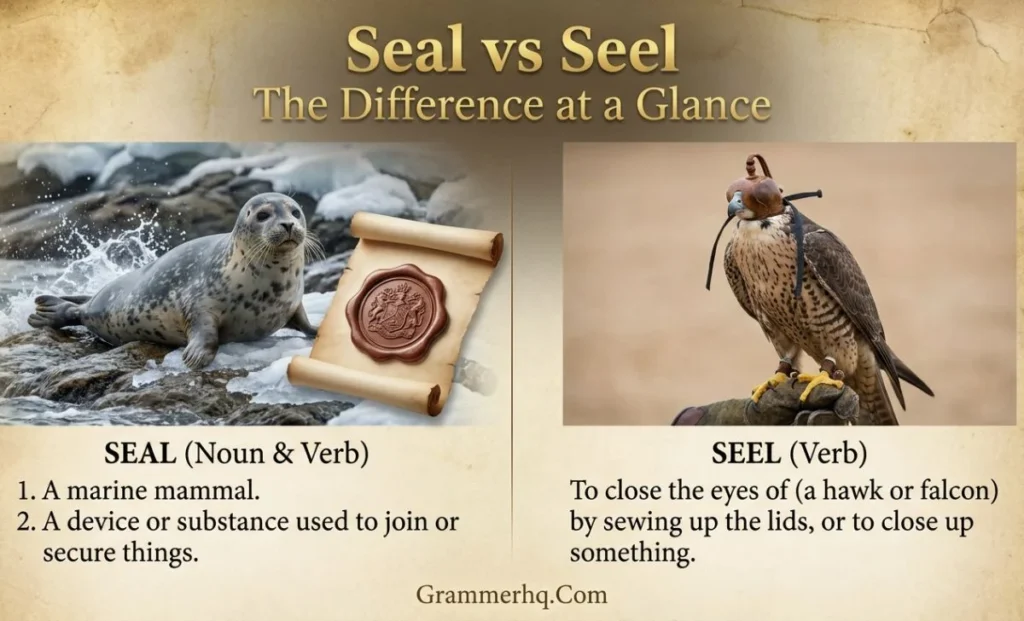
| Word | Part of Speech | Main Meaning | Modern Usage |
|---|---|---|---|
| Seal | Noun, verb | To close, secure, approve, an official mark, or a marine animal | Common |
| Seel | Verb | A historical falconry term | Rare/archaic |
The easiest rule is simple: use seal in normal modern English; use seel only when the context specifically calls for its rare historical meaning.
What Does “Seal” Mean?
Seal is a common English word with several meanings. It can work as both a noun and a verb.
Seal as a Verb
As a verb, seal commonly means to close something securely so that it cannot be opened easily or so that air, liquid, or another substance cannot get through. Cambridge and Collins both list this as a standard modern meaning.
For example:
- Please seal the envelope before mailing it.
- She sealed the package with tape.
- The plumber sealed the pipe to stop the leak.
- Make sure the container is sealed tightly.
You can also use seal when something is formally confirmed or finalized:
The two companies sealed the agreement after months of negotiations.
This is why phrases such as seal the deal are common in business and everyday English.
Seal as a Noun
As a noun, seal can refer to the thing that closes or protects an opening.
For example:
The bottle’s seal was broken.
The damaged rubber seal allowed water to enter the machine.
A seal can help prevent air, liquid, or gas from passing through a container, pipe, door, or other opening.
Seal as an Official Mark
A seal can also be an official mark placed on a document to show authenticity, authority, or approval.
For example:
The certificate carries the official seal of the university.
This meaning appears in legal, government, academic, and historical contexts.
You may also hear seal of approval, which means that someone or an organization has officially or strongly approved something.
Seal as a Marine Animal
A seal is also a marine mammal that lives in or near the sea and can spend time on land or ice.
For example:
We saw a seal resting on the rocks near the shore.
This is another very common meaning of seal, especially in descriptions of wildlife and marine life.
What Does “Seel” Mean?
Seel is a real English word, but this is where many word-comparison articles oversimplify the answer.
It is not simply a misspelling of seal.
The American Heritage Dictionary defines seel as a verb meaning to stitch closed the eyes of a falcon.
The word is associated with falconry, the traditional practice of training and hunting with falcons and other birds of prey.
Seel in Falconry
Historically, seel referred to the practice of closing a falcon’s eyelids as part of traditional falconry.
Today, this word is extremely uncommon. You are most likely to encounter it in:
- historical writing
- older literature
- dictionary entries
- discussions of falconry
- specialized studies of historical English
For example:
The historian explained the old falconry term seel.
In an ordinary email, school assignment, business document, or everyday conversation, seel would almost never be the word you need.
Seal vs Seel: Why Are They Confused?
There are a few simple reasons these words cause confusion.
1. They Look Very Similar
The only spelling difference is the vowel sequence:
seal
seel
When someone hears the word without seeing it written, choosing the correct spelling can be difficult.
2. Their Pronunciation Can Be Similar
Cambridge lists seal as /siːl/ in both its UK and US entries.
Dictionary sources also give a similar pronunciation for seel, although pronunciation information can vary by dictionary and variety of English.
That means sound alone is not enough to determine the spelling.
3. “Seel” Is Unfamiliar to Most People
Most English speakers regularly encounter seal but rarely see seel.
That makes it easy to assume that seel is simply a spelling mistake. In reality, it has a legitimate dictionary history, although its modern use is very limited.
Seal vs Seel: Correct Examples
The easiest way to understand the difference is to see the words in context.
Everyday Uses of “Seal”
Closing an envelope
Please seal the envelope before putting it in the mailbox.
Securing a package
She sealed the box with strong packing tape.
Stopping a leak
The technician sealed the crack in the pipe.
Protecting a container
Keep the food in a sealed container.
Official mark
The document bears the official seal of the organization.
Marine animal
A seal was swimming close to the boat.
Finalizing an agreement
The two businesses sealed the deal yesterday.
Specialized Use of “Seel”
The book describes how falconers historically used the term seel.
Here, seel is appropriate because the sentence refers specifically to the historical falconry term.
Common Mistakes With Seal and Seel
1: “Seel the envelope”
❌ Please seel the envelope.
✅ Please seal the envelope.
When you mean “close the envelope,” the correct word is seal.
2: “The seel was swimming”
❌ We saw a seel near the shore.
✅ We saw a seal near the shore.
The marine animal is a seal.
3: Saying “Seel Is Not a Word”
❌ Seel is not a word.
✅ Seel is a real but rare historical word associated with falconry.
This distinction matters because simply labeling seel as incorrect gives readers an incomplete picture of English vocabulary. Established dictionary sources recognize it.
Seal vs Seel in American and British English
There is no normal American-versus-British spelling difference between seal and seel.
Seal is spelled the same in both varieties when referring to closing, an official mark, a protective closure, or the marine animal.
The main issue is meaning and context, not whether you are writing American or British English.
So whether you are writing for a US or UK audience:
Seal is the normal modern spelling.
Seel remains a rare word used mainly in historical or specialized contexts.
Common Expressions With “Seal”
Because seal is a common modern word, it appears in several familiar expressions.
Seal the Deal
To seal the deal means to finalize an agreement or make a decision certain.
After several meetings, the companies finally sealed the deal.
Seal of Approval
A seal of approval means official or strong approval.
The new product received the customer’s seal of approval.
Seal Someone’s Fate
To seal someone’s fate means to make an outcome certain or unavoidable.
Missing the final deadline sealed his fate.
Seal Off
To seal off an area means to prevent people from entering or leaving it.
Police sealed off the street after the accident.
These modern uses are another reason seal is far more likely to be the word you need. Collins and Cambridge both document several of these uses.
Seal or Seel: Which One Should You Use?
Use seal when you mean:
- close an envelope
- secure a package
- prevent air or liquid from escaping
- protect or close an opening
- refer to an official mark
- refer to a marine animal
- formally confirm an agreement
- use expressions such as seal the deal or seal of approval
Use seel only when you are specifically referring to its rare historical meaning, particularly in falconry.
Easy Memory Trick
Seal is the everyday word. Seel is the rare historical word.
If you are writing a normal sentence and are unsure which one to choose, seal is almost certainly the right answer.
Seal vs Seel: Quick Comparison Examples
| Meaning | Correct Word | Example |
|---|---|---|
| Close an envelope | seal | Seal the envelope before mailing it. |
| Secure a package | seal | She sealed the package carefully. |
| Stop a leak | seal | The worker sealed the pipe. |
| Official mark | seal | The document has an official seal. |
| Marine animal | seal | We saw a seal near the coast. |
| Finalize an agreement | seal | They sealed the deal. |
| Historical falconry term | seel | The text uses the word seel in its historical sense. |
FAQs
Is “seel” a correct English word?
Yes. Seel is a legitimate English word, but it is rare and mainly associated with historical falconry. The American Heritage Dictionary defines it as a verb relating to stitching closed a falcon’s eyes.
Is “seal” or “seel” correct?
For almost all everyday modern-English uses, seal is correct. Use seel only when the context specifically calls for its rare historical meaning.
Are seal and seel pronounced the same?
They can sound very similar, which contributes to the confusion. Seal is pronounced /siːl/ in Cambridge’s UK and US entries.
How do you spell “seal the envelope”?
The correct spelling is:
Seal the envelope.
Not seel the envelope.
What does “seel” mean?
Seel is a rare verb from falconry referring to stitching closed the eyes of a falcon.
Is “seel” just a misspelling of “seal”?
No. Seel is a genuine dictionary word, although most modern readers will rarely encounter it.
Conclusion
Seal is the standard word for almost every modern situation involving closing, securing, an official mark, a protective closure, or the marine animal.
Seel is also a legitimate English word, but it is rare and mainly belongs to historical falconry vocabulary.
So if you are writing an email, assignment, article, business document, or everyday sentence, seal is almost certainly the spelling you need.
Read More Blogs

Hi, I’m Amelia Parker, a grammar enthusiast and writer at GrammarHQ.com. I specialize in explaining spelling differences, confusing words, and common English mistakes through simple, practical, and easy-to-understand guides.










