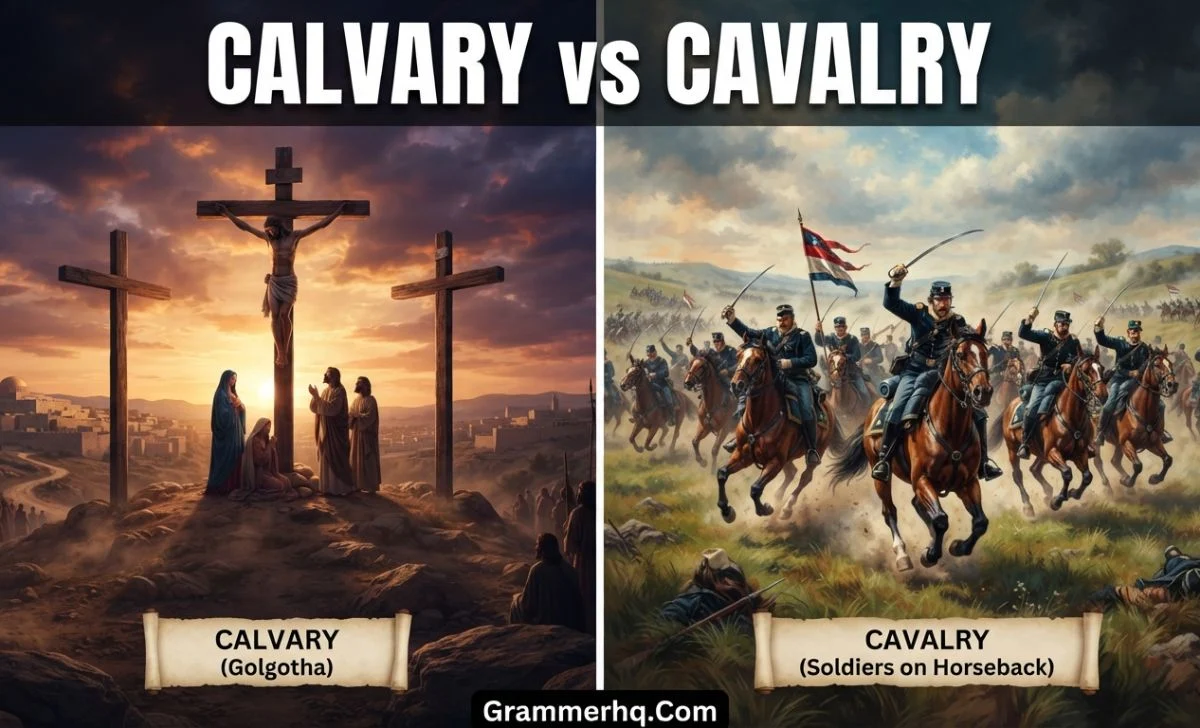
Calvary vs Cavalry is a common word-choice question. Calvary refers to the place associated with the crucifixion of Jesus Christ, while cavalry refers to a military force traditionally associated with soldiers on horseback.
In modern use, cavalry can also describe military units that use armored vehicles or other mobile equipment. The two words look and sound similar, but their meanings are completely different.
Calvary vs Cavalry: The Key Difference
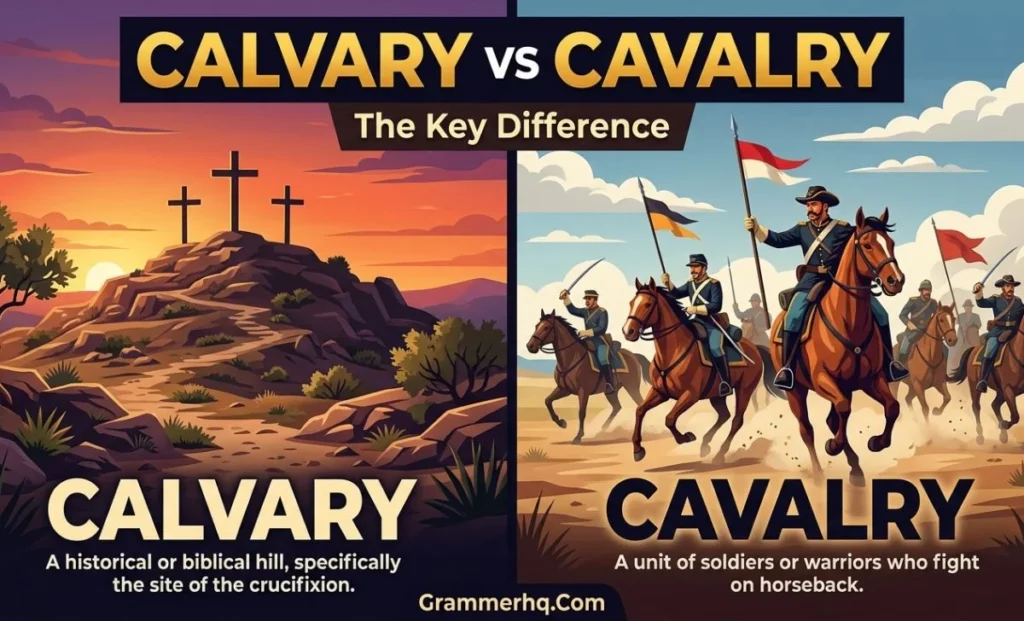
The easiest way to choose the right word is to think about the subject of your sentence:
| Word | Meaning | Context |
|---|---|---|
| Calvary | The place associated with Jesus Christ’s crucifixion | Religion |
| cavalry | A military force traditionally associated with mounted soldiers | Military |
So, Jesus, the cross, and the Crucifixion point to Calvary. Soldiers, battles, and military units point to cavalry.
They are not alternate spellings of the same word.
What Does Calvary Mean?
Calvary refers to the hill outside Jerusalem associated with the crucifixion of Jesus Christ. It is a proper noun when used for this specific biblical place, so it is normally capitalized.
For example:
- The Christian service focused on the events at Calvary.
- The painting depicts Jesus carrying the cross toward Calvary.
- The story follows Jesus to Calvary.
The word has another useful meaning, too. A calvary can refer to a sculpture or painting representing the Crucifixion. In this sense, it can be lowercase.
Calvary as a Figurative Meaning
You may also see calvary used figuratively for a painful ordeal or period of severe suffering. This meaning comes from the suffering associated with the Crucifixion.
For example:
After years of legal battles, the family described the experience as a personal calvary.
Here, the word does not name the biblical place. It describes a difficult experience.
What Does Cavalry Mean?
Cavalry is a military term. Historically, it referred to soldiers who fought on horseback. Mounted troops could move quickly and were used for roles such as attacks, scouting, and pursuit.
For example:
- The cavalry moved toward the enemy lines.
- The general ordered the cavalry to advance.
- The historical film shows a dramatic cavalry charge.
But there is an important modern distinction: cavalry does not always mean soldiers riding horses. Modern military usage can include cavalry units operating from armored vehicles, helicopters, or other mobile platforms.
So if a modern news report says that a cavalry unit was deployed, it does not necessarily mean soldiers arrived on horseback.
Cavalry in Everyday English
Cavalry can also appear in the expression “call in the cavalry.”
It means to bring in extra help or reinforcements when a situation becomes difficult.
For example:
The website crashed just before the launch, so the company called in the cavalry.
No actual soldiers are involved. The expression simply means that additional help was brought in.
Calvary vs Cavalry in Real-Life Examples
Context usually makes the correct word obvious.
Use Calvary for religious contexts
- The church’s Easter service focused on Calvary.
- The guide explained the Christian significance of Calvary.
- The museum displayed a sculpture of Calvary.
- She described the long ordeal as her own calvary.
Use cavalry for military contexts
- The army’s cavalry unit moved into position.
- The documentary showed a historic cavalry charge.
- The commander sent the cavalry ahead for reconnaissance.
- When the technical problem became serious, the team jokingly called in the cavalry.
Why Are Calvary and Cavalry Confused?
The confusion is understandable because the words contain the same seven letters in a different arrangement, and their pronunciation is quite similar. They are not true homophones, but they can easily be confused when heard in conversation.
The meanings, however, have nothing to do with each other.
A useful clue is the surrounding vocabulary:
Jesus + cross + Crucifixion → Calvary
Army + soldiers + battle → cavalry
Calvary vs Cavalry: Pronunciation
They sound similar, but there is a small difference:
- Calvary: roughly KAL-vuh-ree
- Cavalry: roughly KAV-uhl-ree
Because accents can change pronunciation, spelling and context are more reliable than sound alone.
Common Calvary and Cavalry Mistakes
❌ The calvary arrived on the battlefield.
✅ The cavalry arrived on the battlefield.
A military force is cavalry.
❌ Jesus was crucified at the cavalry.
✅ Jesus was crucified at Calvary.
The biblical place is Calvary.
❌ The army sent its calvary unit.
✅ The army sent its cavalry unit.
The military word always takes the spelling cavalry.
Another common mistake is calvery. That spelling is incorrect. If you mean the biblical place, use Calvary; if you mean a military force, use cavalry.
How to Remember Calvary vs Cavalry
You only need one simple memory trick:
Calvary → Christ
Cavalry → Combat
Think of Calvary with Christ and the Crucifixion. Think of cavalry with combat and the military.
Or remember it this way:
Cross → Calvary
Combat → cavalry
Calvary or Cavalry: Which One Should You Use?
Choose Calvary when you are writing about:
- Jesus Christ
- the Crucifixion
- Christianity
- the biblical place near Jerusalem
- a representation of the Crucifixion
- a figurative ordeal or period of suffering
Choose cavalry when you are writing about:
- soldiers
- armies
- battles
- mounted troops
- cavalry units
- armored or highly mobile military forces
- reinforcements in the expression “call in the cavalry”
The simplest rule
If the sentence is about Christ, use Calvary. If it is about combat, use cavalry.
FAQs
Is Calvary the same as cavalry?
No. Calvary is associated with Jesus Christ’s crucifixion, while cavalry is a military term.
Is Calvary a place?
Yes. Calvary refers to the hill outside Jerusalem associated with the crucifixion of Jesus Christ.
Does cavalry always mean soldiers on horses?
No. Historically, cavalry referred to mounted soldiers. Modern cavalry can also operate using armored vehicles and other mobile military equipment.
Can calvary be lowercase?
Yes. When Calvary refers to the specific biblical place, it is capitalized. Lowercase calvary can refer to a representation of the Crucifixion or, in figurative use, a painful ordeal.
Is “calvery” a correct spelling?
No. Calvery is a misspelling. The correct spelling is Calvary for the religious meaning and cavalry for the military meaning.
What is the easiest way to remember the difference?
Remember Calvary = Christ and cavalry = combat. That distinction will help you choose the correct word in most situations.
Conclusion
Calvary and cavalry are easy to confuse because they look and sound alike, but they describe completely different things.
Calvary connects to Jesus Christ and the Crucifixion, while cavalry refers to military forces, historically mounted on horses and, in modern usage, often using other mobile equipment.
When you see Christ or the Cross, think Calvary. When you see combat or the military, think cavalry.
Read More Blogs