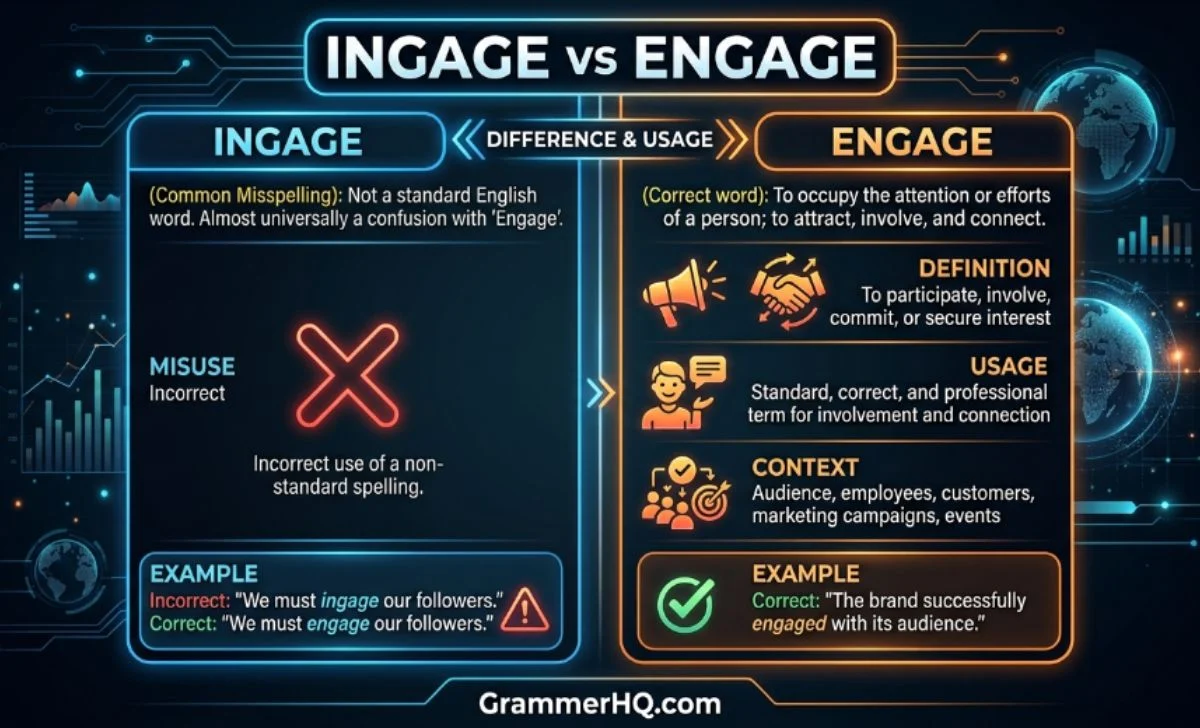
Many people wonder whether Ingage or Engage is the correct spelling because both versions appear in online searches, old documents, and even some websites.
This spelling confusion can easily mislead students, professionals, writers, and English learners. The correct spelling is Engage, which is recognized by all major English dictionaries and widely used in modern English.
Ingage is an outdated or non-standard spelling and should generally be avoided in formal writing. In this complete guide, you’ll discover the meaning, pronunciation, origin, real-life examples, British and American usage, common mistakes, and simple memory tricks to help you remember the correct spelling.
By the end, you’ll know exactly when to use Engage with confidence and avoid one of the most common English spelling mistakes.
Quick Answer
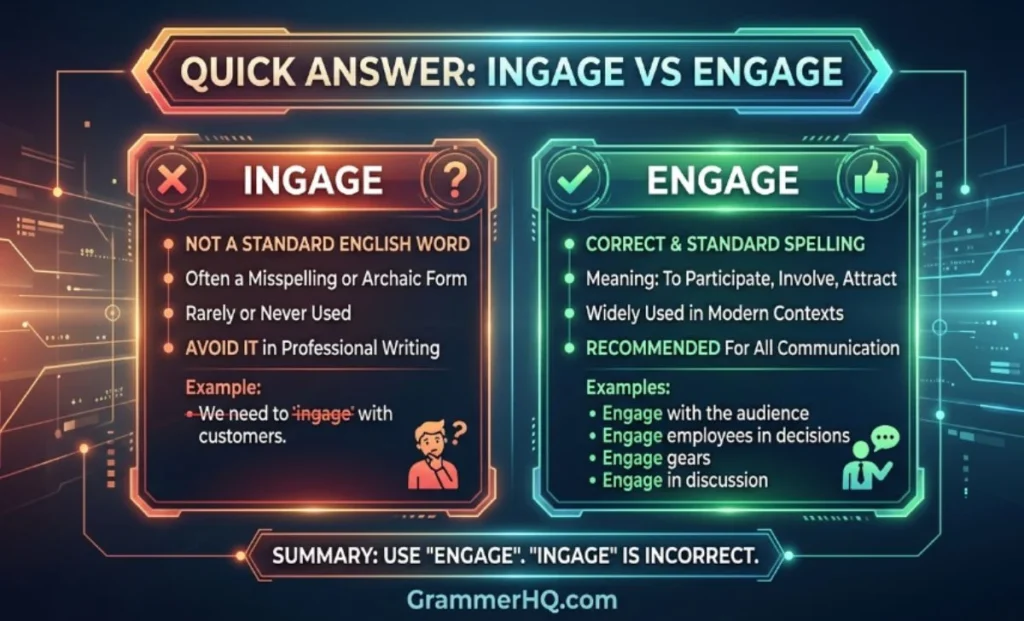
Engage is the correct spelling in modern English. It is the standard form recognized by major English dictionaries and used in both American and British English.
Ingage is an outdated or non-standard spelling that is no longer accepted in standard English. Whether you’re writing an email, school assignment, business document, or social media post, always use Engage.
Is Ingage vs Engage Correct?
Engage is the standard English spelling recognized by major dictionaries and style guides. If your goal is clear, professional communication, this is the spelling you should always choose. Ingage is generally treated as an outdated spelling or a simple misspelling and should not be used in modern writing.
Today, trusted language references such as Oxford, Cambridge, Merriam-Webster, and Collins recognize engage as the accepted form. Spell checkers, grammar tools, and writing software also flag ingage as incorrect.
| Word | Status | Should You Use It? |
|---|---|---|
| Engage | Correct modern English spelling | ✅ Yes |
| Ingage | Non-standard or obsolete spelling | ❌ No |
If you are writing for school, work, exams, or publication, always choose engage.
What Does Engage Mean?
Engage is a versatile verb with several related meanings. Although the exact meaning depends on the context, it usually describes becoming involved, attracting attention, or beginning a connection with someone or something.
Common meanings include:
- To involve someone in an activity.
- To attract someone’s interest or attention.
- To participate actively.
- To begin communication or interaction.
- To hire someone for work or services.
- To occupy or keep someone busy.
Because of these different meanings, engage appears frequently in everyday English, business communication, education, marketing, technology, and professional writing.
Examples:
- The teacher tried to engage every student in the discussion.
- Good storytelling helps engage readers.
- The company decided to engage a legal consultant.
- Please engage with customers politely.
- Interactive lessons engage young learners more effectively.
Although the meanings vary slightly, they all share the idea of involvement, connection, or participation.
Why Do People Write Ingage?
Many writers accidentally type ingage because English spelling is not always predictable. The mistake is understandable, especially for learners who rely on pronunciation rather than dictionary spelling.
Several factors contribute to this confusion.
The pronunciation sounds similar
The first syllable of engage is pronounced with a short en sound. Some learners mistakenly hear it as in, leading them to write ingage.
Typing mistakes
Fast typing often results in replacing en with in. This simple keyboard error can go unnoticed without spell-check software.
Influence of pronunciation
English contains many words beginning with in-, such as:
- Include
- Increase
- Inform
- Inspire
- Invite
Seeing these familiar patterns may encourage writers to assume that ingage follows the same rule.
Older texts
Very old books and historical documents occasionally contain the spelling ingage. It was once used as a historical variant before English spelling became standardized. In modern English, however, it is no longer considered correct.
Is Ingage Ever Correct?
For almost every modern writing situation, the answer is no.
You should not use ingage in:
- Academic writing
- Business emails
- Job applications
- Reports
- Essays
- Websites
- Blog posts
- Marketing materials
- Professional communication
- Social media intended for a professional audience
The only time you might encounter ingage is when reading historical texts or discussing the history of English spelling. Even then, it is presented as an older form rather than the preferred modern spelling.
If you accidentally write ingage, simply replace it with engage before publishing or submitting your work.
Comparison Table
| Feature | Engage | Ingage |
|---|---|---|
| Modern English spelling | ✅ Yes | ❌ No |
| Found in standard dictionaries | ✅ Yes | ❌ Generally No |
| Accepted in academic writing | ✅ Yes | ❌ No |
| Accepted in business writing | ✅ Yes | ❌ No |
| Used in professional communication | ✅ Yes | ❌ No |
| Common in everyday English | ✅ Yes | ❌ No |
| Historical spelling | No | Yes, in some older texts |
| Recommended today | ✅ Always | ❌ Never |
How to Pronounce Engage
The word engage is pronounced similarly in both British and American English.
IPA (UK): /ɪnˈɡeɪdʒ/
IPA (US): /ɪnˈɡeɪdʒ/
Pronunciation:
in-GAYJ
The stress falls on the second syllable.
Although the first sound may resemble in, the correct spelling begins with en, not in. This difference between pronunciation and spelling is one of the main reasons learners mistakenly write ingage.
The Origin of Engage
The word engage has a long history that explains why its spelling differs from what many learners expect.
It entered English through Middle English from Old French engagier, which meant to pledge, bind, or commit. The French word ultimately traces back to Germanic roots related to a pledge or security. Over time, its meaning expanded to include becoming involved, attracting attention, hiring someone, or participating in an activity.
As English spelling became standardized, engage became the accepted form. Although you may occasionally find ingage in very old books or historical documents, it is considered an obsolete variant rather than a correct modern spelling.
Today, all major dictionaries recognize engage as the standard spelling.
Common Forms of Engage
Engage is a verb, but it appears in several related forms. Learning these forms helps you use the word correctly in different situations.
| Word Form | Part of Speech | Example |
|---|---|---|
| Engage | Verb (base form) | Try to engage your audience. |
| Engages | Verb (third-person singular) | She engages students with games. |
| Engaged | Past tense / Adjective | They engaged in a discussion. |
| Engaging | Present participle / Adjective | He gave an engaging presentation. |
| Engagement | Noun | Customer engagement is important. |
| Engagements | Noun (plural) | She has several business engagements this week. |
Each form shares the same core idea of involvement, participation, attention, or commitment.
Real-Life Examples
Seeing the word in different contexts makes it easier to remember the correct spelling.
Everyday Conversation
Please engage with everyone respectfully.
The children quickly engaged in the game.
Her smile helped engage the audience.
School and Education
The teacher used activities to engage the class.
Interactive lessons engage students more effectively.
Group discussions help learners engage with new ideas.
Business Communication
Our goal is to engage customers through excellent service.
The company decided to engage an experienced consultant.
A clear presentation will engage potential investors.
Professional Emails
We would like to engage your company for future projects.
Thank you for taking the time to engage with our proposal.
Academic Writing
Researchers should engage with previous studies before presenting new findings.
Students are encouraged to engage critically with the text.
Social Media
Great content helps engage followers.
Asking questions can engage your audience.
Incorrect Examples
❌ Please ingage with the audience.
✔ Please engage with the audience.
❌ The company will ingage a lawyer.
✔ The company will engage a lawyer.
❌ Teachers should ingage students.
✔ Teachers should engage students.
These errors usually happen because the writer spells the word according to its pronunciation instead of its accepted dictionary spelling.
Common Mistakes to Avoid
1. Writing Ingage Instead of Engage
Why it happens:
Many learners hear the first sound as in instead of en.
❌ We should ingage our customers.
✔ We should engage our customers.
2. Trusting Pronunciation Instead of Spelling
English pronunciation does not always match spelling exactly.
For example:
- enough
- engineer
- energy
- engage
Although these words may begin with a similar sound, they do not all follow the same spelling pattern.
3. Ignoring Spell Check Warnings
Modern grammar checkers usually recognize ingage as incorrect.
Before submitting important writing:
- Proofread your work.
- Use a trusted spell checker.
- Confirm unfamiliar words in a reliable dictionary.
4. Copying Incorrect Spellings Online
Some websites, comments, or social media posts contain spelling mistakes.
Always rely on trusted language references rather than random internet content.
5. Assuming Every Pronounced “In” Uses In-
Many English words start with en-, including:
- enable
- encourage
- enrich
- enjoy
- engage
Memorizing these common en- words reduces spelling mistakes.
Easy Memory Trick
Remember this simple sentence:
“EN means Enter, so ENgage means Enter the conversation.”
Think of engage as entering, connecting, or becoming involved.
Both enter and engage begin with EN.
Whenever you are unsure, remember:
Enter → Engage
Not
In → Ingage
This simple association helps many learners remember the correct spelling instantly.
Real-World Usage
Using the correct spelling matters because it reflects your attention to detail and strengthens your credibility.
Professional Emails
A spelling mistake in an email can make your writing appear rushed or unprofessional. Writing engage correctly creates a better impression on colleagues and clients.
Job Applications
Employers often notice language accuracy. Correct spelling demonstrates strong communication skills.
Academic Writing
Schools, colleges, and universities expect standard English spelling. Using engage instead of ingage helps maintain academic credibility.
Business Communication
Reports, proposals, presentations, and marketing materials should always use the accepted spelling to maintain professionalism.
English Exams
Tests such as IELTS, TOEFL, and other English proficiency exams assess spelling accuracy. Using engage correctly helps avoid unnecessary errors.
Everyday Writing
Whether you are posting on social media, writing a blog, or sending a text, using the standard spelling makes your message clearer and more reliable.
Practice Quiz
Test your understanding of Ingage vs Engage with these short exercises.
1. Multiple Choice
Which spelling is correct in modern English?
A. Ingage
B. Engage
C. Both are equally correct
D. Neither
2. Fill in the Blank
The teacher tried to ________ every student during the lesson.
A. ingage
B. engage
3. Find the Mistake
The company wants to ingage more customers through social media.
Rewrite the sentence correctly.
4. Multiple Choice
Which sentence is correct?
A. We will ingage a new designer next week.
B. We will engage a new designer next week.
C. Both sentences are correct.
D. Neither sentence is correct.
5. Fill in the Blank
Interactive activities help ________ children in learning.
A. engage
B. ingage
6. True or False
Ingage is the standard spelling used in modern dictionaries.
7. Correction Exercise
Correct the sentence:
Students should ingage with the reading material before class.
Quiz Answers
- B. Engage
- engage
- The company wants to engage more customers through social media.
- B. We will engage a new designer next week.
- A. engage
- False
- Students should engage with the reading material before class.
FAQ,s
1: Is Ingage a real English word?
Ingage appears in some historical texts as an obsolete spelling, but it is not accepted in modern standard English. In everyday writing, education, and professional communication, you should always use engage.
2: Is Engage the correct spelling?
Yes. Engage is the correct spelling recognized by major dictionaries, grammar references, and style guides. It is the form used in schools, businesses, academic writing, and everyday English.
3: Why do people spell Engage as Ingage?
Most people make this mistake because the first syllable sounds similar to “in.” Others simply mistype the word or assume it follows the spelling pattern of words beginning with in-.
4: Can I use Ingage in formal writing?
No. Ingage should not be used in formal writing, including essays, reports, business emails, job applications, or published content. Always choose engage.
5: How do you remember the correct spelling?
Think of the phrase:
“Enter and Engage both begin with EN.”
This simple memory trick helps you remember that the correct spelling starts with EN, not IN.
6: Does Engage have different meanings?
Yes. Depending on the context, engage can mean to involve someone, attract attention, participate in an activity, hire someone for a service, or begin communication. Despite its different uses, the spelling never changes.
7: Is there a British and American spelling difference?
No. Both British English and American English use engage. Unlike words such as colour/color or centre/center, there is no regional spelling variation between engage and ingage.
Key Takeaways
- Engage is the correct and standard spelling in modern English.
- Ingage is an obsolete or incorrect spelling and should be avoided in current writing.
- Engage is a verb that can mean to involve, attract attention, participate, communicate, or hire someone, depending on the context.
- The confusion usually comes from pronunciation, typing mistakes, or unfamiliarity with standard English spelling.
- Using engage correctly improves your writing in school, exams, professional communication, and everyday conversations.
- When in doubt, check a trusted dictionary or use a spell checker to confirm the correct spelling.
Conclusion
The confusion between Ingage and Engage is understandable, but the correct choice in modern English is clear.
Engage is the standard spelling accepted by dictionaries, educators, and professional writers, while Ingage is an outdated or incorrect form that should not appear in everyday writing.
By understanding the word’s meaning, pronunciation, origin, and common usage, you can avoid this mistake with confidence.
Whenever you write an email, essay, report, or social media post, remember to use engage to communicate clearly and professionally.
Read More Bloogs: