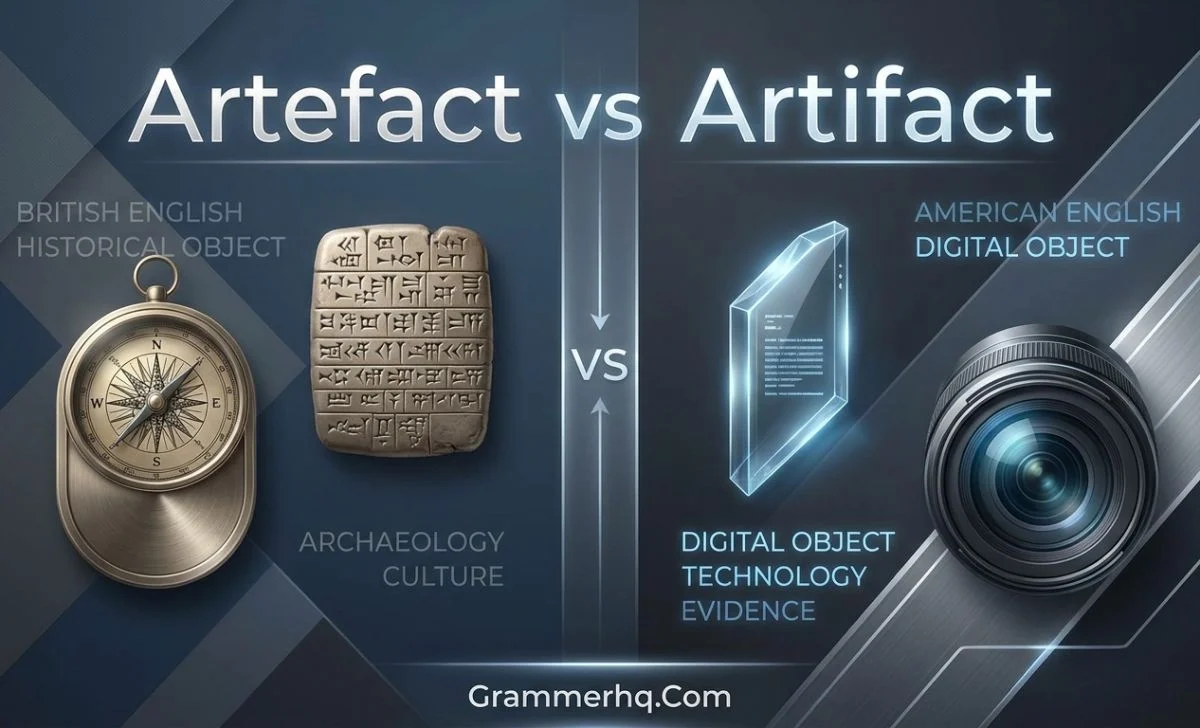
Artefact vs artifact may look like a simple spelling difference, but the choice can reveal which variety of English you are following.
Both words are correct and share the same meaning, yet artifact is the standard spelling in American English, while artefact is mainly preferred in British English.
The distinction does not stop with spelling, either. The word can describe an ancient object discovered by archaeologists, a culturally important item preserved in a museum, or an unwanted effect created during scientific or digital processing.
So, which form should you use? The answer depends on your audience, location, and style guide. In this guide, you’ll learn the difference between artefact and artifact, their meanings, plural forms, examples, and when each spelling is appropriate.
Quick Answer Artefact vs Artifact

| Feature | Artifact | Artefact |
|---|---|---|
| Main usage | American English | British English |
| Meaning | Same core meaning | Same core meaning |
| Singular | Artifact | Artefact |
| Plural | Artifacts | Artefacts |
| Main difference | Regional spelling | Regional spelling |
In short: Use artifact in American English and artefact in British English. Both are legitimate forms of the same word.
What Is the Difference Between Artefact and Artifact?
The difference is mainly spelling and regional preference, not meaning.
American English generally uses artifact, while British English commonly uses artefact. The extra e in artefact does not create a different word or change its basic meaning.
For example:
- American English: The museum displayed an ancient artifact.
- British English: The museum displayed an ancient artefact.
The object being described is exactly the same. Only the preferred spelling changes.
This distinction is similar to other American and British spelling differences, such as color and colour or center and centre.
Therefore, calling artefact a misspelling of artifact is incorrect when British English is intended. Likewise, artifact is perfectly valid when American English is being used.
Artifact in American English
Artifact is the usual spelling in American English. You will commonly find it in writing about archaeology, museums, history, anthropology, culture, science, and technology.
For example:
The archaeologists discovered an ancient artifact during the excavation.
American English also uses artifact in contexts that have nothing to do with ancient objects. In science and research, the word can describe a result or feature produced by a particular method rather than something naturally present.
For instance:
The unusual pattern was an artifact of the testing process.
This broader usage is important because artifact is not limited to historical objects.
Artefact in British English
Artefact is the traditional and widely used British spelling.
A British publication might write:
The archaeologists discovered an ancient artefact during the excavation.
The meaning remains unchanged. The spelling simply follows British English conventions.
British writers may also use artefact in scientific, academic, and technical contexts. For example:
The unusual result was an artefact of the experimental method.
As a result, writers should not assume that artefact is only appropriate when discussing museums or archaeology.
What Does Artifact or Artefact Mean?
The word has several related meanings, depending on the context.
Historical and Archaeological Meaning
An artifact or artefact can refer to an object made or modified by humans that has historical, cultural, or archaeological importance.
Common examples include:
- pottery
- tools
- jewelry
- sculptures
- weapons
- household objects
- religious objects
- written materials
- decorative items
For example:
The museum contains several ancient artifacts.
In British English, the same sentence would normally be:
The museum contains several ancient artefacts.
The meaning does not change with the spelling.
Scientific Meaning
In science and research, an artifact can be something that appears because of the way an experiment, measurement, observation, or analysis was performed.
For example:
The researchers determined that the unusual result was an artifact of the testing method.
Here, the word does not refer to an ancient object. Instead, it describes an apparent result that was introduced by the research process.
This usage can also occur when scientists discuss data, sampling, measurement errors, experimental conditions, or analytical methods.
Computing and Digital Meaning
In computing and digital media, an artifact can refer to an unwanted feature, distortion, or error introduced during the creation, transmission, compression, or processing of digital content.
For example:
The compressed image contains several visible artifacts.
A heavily compressed image may show blocks, distortions, or other unwanted visual effects. Similar problems can occur in video and audio processing.
British English may use artefact for the same concept:
The compressed image contains several visible artefacts.
Thus, the word has important modern technical meanings in addition to its historical sense.
Artifact vs Artefact Examples
Seeing both spellings in complete sentences makes the distinction easier to understand.
Historical Example
American English:
The museum displayed an ancient artifact from the excavation.
British English:
The museum displayed an ancient artefact from the excavation.
Cultural Example
American English:
The object became an important cultural artifact.
British English:
The object became an important cultural artefact.
Archaeological Example
American English:
Archaeologists uncovered several artifacts near the settlement.
British English:
Archaeologists uncovered several artefacts near the settlement.
Scientific Example
American English:
The unusual result was an artifact of the experimental method.
British English:
The unusual result was an artefact of the experimental method.
Digital Example
American English:
The image contains several compression artifacts.
British English:
The image contains several compression artefacts.
These examples show the central rule clearly: the spelling changes according to the English variety, while the meaning stays essentially the same.
Artifact or Artefact: Which One Should You Use?
The best choice depends on your audience and the spelling system you are following.
Use Artifact for American English
Choose artifact when writing for a US audience or following American English conventions.
It is appropriate for:
- American websites
- US school assignments
- American academic writing
- US business content
- American publications
- technical documents for US readers
For example:
The research team identified a possible artifact in the data.
Use Artefact for British English
Choose artefact when following British English conventions.
It is suitable for:
- British publications
- UK academic writing
- British educational materials
- UK institutional documents
- publications using British spelling
For example:
The researchers identified a possible artefact in the data.
What If Your Audience Is International?
International publications may reach readers who use different forms of English. In that situation, consistency matters more than trying to use both spellings.
If your website follows American English, use artifact throughout the article. A publication using British English should consistently use artefact instead.
Likewise, follow any spelling requirements provided by a client, university, employer, publisher, or style guide.
There is no advantage to switching between the two forms simply because both are accepted.
Artifacts vs Artefacts: Plural Forms
The plural is straightforward.
| Singular | Plural |
|---|---|
| artifact | artifacts |
| artefact | artefacts |
For example:
The museum contains several ancient artifacts.
British English:
The museum contains several ancient artefacts.
The same regional spelling rule applies to the plural. If you choose artifact, use artifacts. If you choose artefact, use artefacts.
Is the Pronunciation Different? Artifact vs Artefact
The pronunciation of artifact and artefact is very similar. Any difference you hear is more likely to come from the speaker’s regional accent than from the spelling itself.
For most writers, pronunciation is therefore not the important issue. The main distinction is whether the spelling follows American or British English.
In everyday writing, choosing the appropriate regional form is much more important than worrying about a major pronunciation difference.
Common Mistakes With Artifact and Artefact
Mistake 1: Thinking Artefact Is Wrong
Artefact is not a spelling mistake when British English is being used. It is an established English spelling.
Mistake 2: Thinking Artifact Is Always Wrong in British English
Artifact is the standard American form and is also recognized more broadly in English. A British publication may prefer artefact, but that does not make artifact an inherently incorrect word.
Mistake 3: Mixing the Two Spellings
Using artifact in one section and artefact in another can make your writing appear inconsistent.
Instead, choose the form that matches your intended variety of English and maintain that choice throughout the document.
Mistake 4: Assuming Artifact Only Means an Ancient Object
The word has several modern uses. A research result can be an artifact of an experimental method, while a digital image can contain artifacts caused by compression or processing.
Mistake 5: Treating the Difference as a Grammar Rule
This is primarily a regional spelling difference. Changing artifact to artefact does not change the grammatical role of the word.
Artefact vs Artifact: Quick Comparison
| Question | Artifact | Artefact |
|---|---|---|
| Preferred in American English? | Yes | No, generally |
| Common in British English? | Less common | Yes |
| Same core meaning? | Yes | Yes |
| Can describe a historical object? | Yes | Yes |
| Can be used in science? | Yes | Yes |
| Can be used in computing? | Yes | Yes |
| Singular form | Artifact | Artefact |
| Plural form | Artifacts | Artefacts |
The easiest rule to remember is:
American English → artifact
British English → artefact
Both forms are correct. Your choice should simply match the English variety and style you are using.
FAQs
Is artifact the American spelling?
Yes. Artifact is the usual spelling in American English. It is commonly used in American writing across historical, academic, scientific, and technical contexts.
Is artefact the British spelling?
Yes. Artefact is mainly associated with British English and is widely used in UK writing.
Are artifact and artefact the same word?
Yes. They are spelling variants of the same word. The main difference is regional spelling rather than meaning.
Which is correct, artifact or artefact?
Both are correct. Use artifact for American English and artefact when following British English conventions.
What is the plural of artifact?
The plural of artifact is artifacts.
What is the plural of artefact?
The plural of artefact is artefacts.
Does artifact only refer to an ancient object?
No. The word can also describe an unwanted or misleading effect produced by a scientific method, technical process, or digital system.
Conclusion
Artifact and artefact are two accepted spellings of the same word. Artifact is the usual American English form, while artefact is mainly used in British English.
The word can describe a historical or cultural object, but its meaning extends into science, research, computing, and digital media. Consequently, the correct spelling is not determined by the subject itself. Instead, it depends mainly on the variety of English you are following.
For US readers, choose artifact. For British readers, choose artefact. Most importantly, stay consistent throughout your writing.
Read More Blogs
- Apposed vs Opposed: Definitions, Differences & Examples?
- Scotch vs Whiskey: The Real Difference Explained?