Many English learners pause when they see Leery and Leary because the two words look almost identical. Since both spellings appear online, it’s easy to wonder whether they are interchangeable or if one is simply a misspelling.
This confusion often becomes more noticeable in emails, school assignments, professional writing, and everyday conversations where choosing the correct word matters.
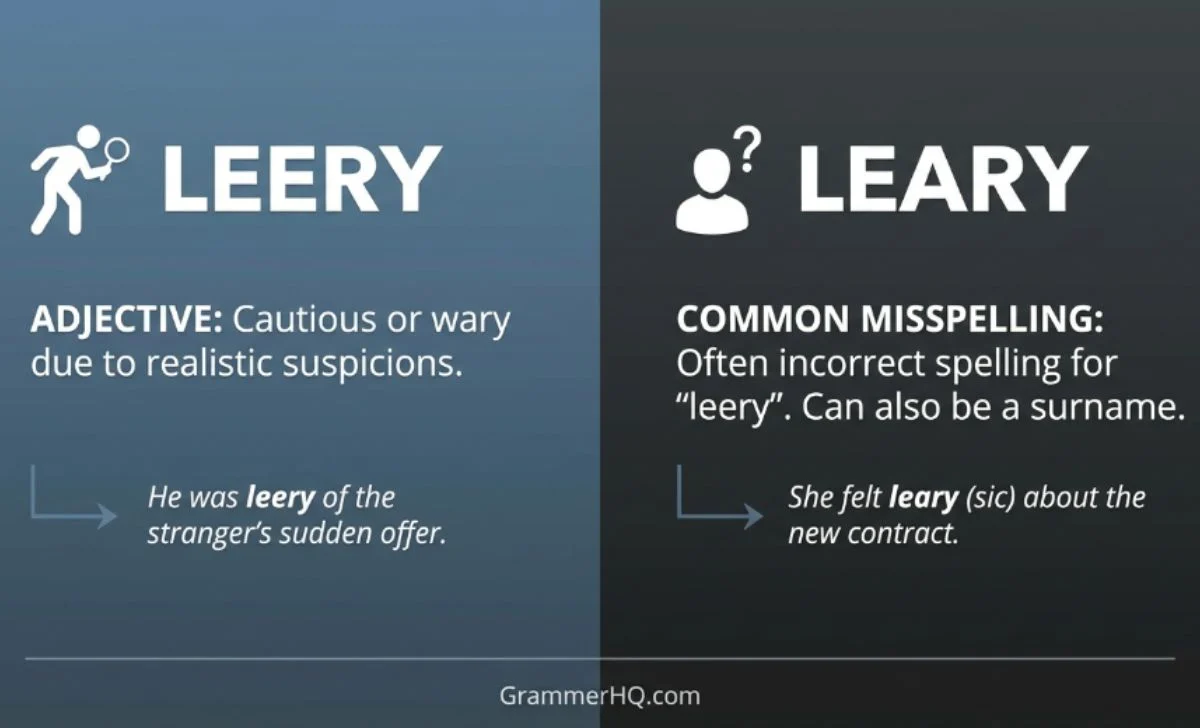
The short answer is that Leery is the standard English word. It means cautious, suspicious, or unwilling to trust someone or something.
Leary is generally considered a misspelling when people intend to write Leery, although it can also appear as a surname, such as the family name of a person.
Knowing this distinction helps you avoid a common spelling mistake and communicate more clearly in both formal and informal English.
Table of Contents
- Quick Answer
- What Does Leery Mean?
- Is Leary a Real Word?
- Pronunciation (IPA)
- Why Do People Confuse Leery and Leary?
- Leery vs Leary Comparison Table
- The Grammar Rule
- Word Origin and Etymology
- Real-Life Examples
- Common Mistakes to Avoid
- An Easy Memory Trick
- Real-World Usage
- Practice Quiz
- Frequently Asked Questions
- Key Takeaways
- Conclusion
Quick Answer
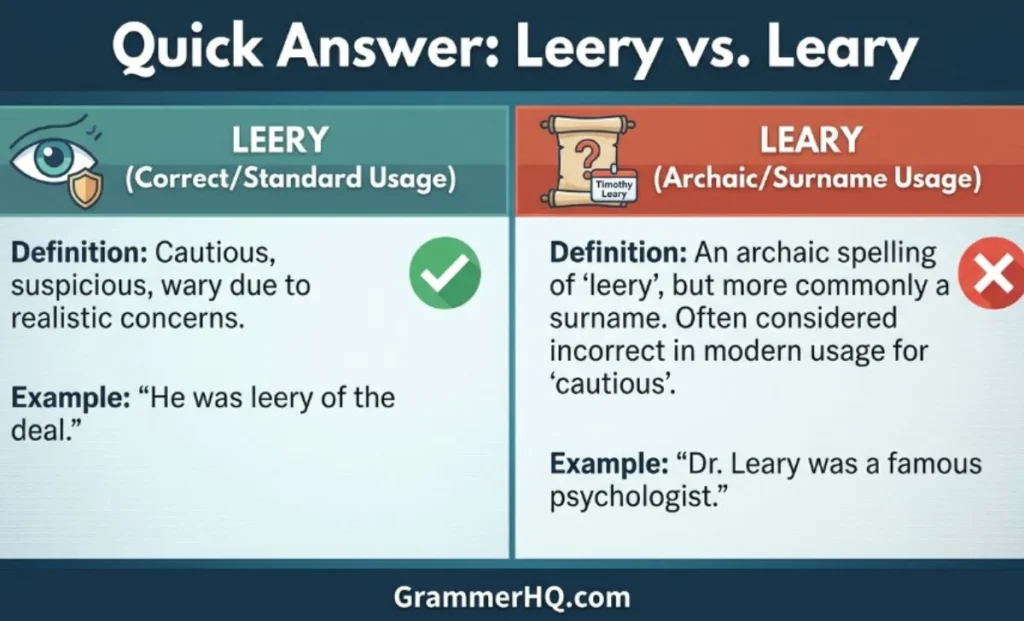
Leery is the correct English adjective when you mean cautious, suspicious, or wary. Leary is usually a spelling mistake in this context, although it can be a surname.
If you’re describing someone who is hesitant or distrustful, always use Leery.
What Does Leery Mean?
Leery is an adjective used to describe someone who feels cautious, suspicious, or reluctant to trust a person, situation, or offer. It suggests that someone is alert to possible danger or deception rather than feeling confident.
People often use Leery when talking about scams, strangers, risky decisions, or unfamiliar situations.
Definition
Leery (adjective): Feeling cautious or suspicious because something seems unsafe, dishonest, or uncertain.
Common Synonyms
- Wary
- Cautious
- Suspicious
- Distrustful
- Skeptical
- Guarded
- Hesitant
- Watchful
- Doubtful
- Careful
Although these words are similar, Leery often carries the idea of being cautious because of previous experience or a lack of trust.
Example Sentences
- She was leery of sharing her credit card details online.
- Many customers remain leery of deals that sound too good to be true.
- I’m leery about investing in a company with no proven track record.
- Parents are often leery of unknown websites.
- He felt leery after receiving an unexpected email asking for personal information.
In each example, Leery describes caution rather than fear.
Is Leary a Real Word?
Yes—but not in the way most people think.
When people search “Leery vs Leary,” they usually want to know which spelling is correct. In almost every grammar and writing situation, Leary is an incorrect spelling of Leery.
However, Leary is a legitimate surname. For example, some well-known people have Leary as their family name. That does not make it the correct adjective for meaning “cautious” or “suspicious.”
Correct
- She is leery of fake websites.
- I’m leery about signing the contract without reading it.
Incorrect
- She is leary of fake websites.
- I’m leary about giving my password to strangers.
Unless you’re referring to a person’s last name, choose Leery.
Pronunciation
Both spellings are commonly pronounced the same way, which is one reason they are frequently confused.
| Word | IPA | Pronunciation |
|---|---|---|
| Leery | /ˈlɪri/ | LEER-ee |
| Leary (surname) | /ˈlɪri/ | LEER-ee |
Because the pronunciation is identical, many writers accidentally replace Leery with Leary. This is a spelling error rather than a pronunciation problem.
Why Do People Confuse Leery and Leary?
The confusion comes from several factors that affect both native speakers and English learners.
They Sound the Same
Both words are pronounced LEER-ee, so people often spell the word the way they think it sounds.
Typing Habits
The letters “ea” appear in many common English words, making Leary look believable even though it is usually incorrect in this context.
Autocorrect and Online Content
Social media posts, informal writing, and user-generated content sometimes contain the misspelling Leary, causing readers to assume it is acceptable English.
Familiarity with the Surname
Many people have seen Leary as a family name. That familiarity can lead them to use it mistakenly when they actually mean Leery.
Limited Exposure
English learners may encounter Leery less often than words like careful or wary, making the correct spelling harder to remember.
Leery vs Leary Comparison Table
| Feature | Leery | Leary |
|---|---|---|
| Part of Speech | Adjective | Usually a proper noun (surname) |
| Meaning | Cautious, suspicious, wary | Family name; not the adjective meaning “cautious” |
| Standard English | ✅ Yes | ❌ No (when used instead of Leery) |
| Correct in Grammar? | ✅ Yes | ❌ Usually incorrect |
| Used in Dictionaries | ✅ Yes | Only as a surname or proper noun |
| Example | She was leery of the offer. | Mr. Leary attended the meeting. |
The Grammar Rule
Use leery when describing someone who feels cautious, suspicious, or hesitant to trust a person, offer, or situation. Leary should not replace leery in standard English because it is generally a surname rather than the adjective you need.
Although the two words sound alike, they do not serve the same purpose in English grammar.
Leery is an adjective
An adjective describes a noun or pronoun. In this case, leery describes a person’s attitude or feeling of caution.
Examples
- The investor was leery of the risky proposal.
- She became leery after receiving several scam calls.
- We’re leery about downloading files from unknown websites.
- Students should be leery of unreliable online sources.
- Many travelers are leery of fake booking websites.
Leary is usually a proper noun
When capitalized, Leary is commonly a surname rather than an adjective.
Examples
- Professor Leary gave today’s lecture.
- Ms. Leary replied to my email.
- The award was presented to Dr. Leary.
If you are talking about caution or suspicion, Leery is the only correct choice.
Word Origin and Etymology
The word leery has been part of English since the early 18th century. Linguists believe it developed from older forms meaning knowing, alert, or suspicious, eventually taking on the modern sense of being cautious or wary.
Unlike many English words with Latin or French roots, leery has a less certain history. Most language experts agree that it evolved through spoken English before becoming established in written usage.
Over time, its meaning settled into the idea of being carefully alert because something seems untrustworthy or risky.
Today, respected dictionaries consistently define leery as meaning:
- cautious
- suspicious
- wary
- reluctant to trust
- watchful
The spelling Leary did not develop as an alternative form of this adjective. Instead, it became widely recognized as a family name.
Leery vs Leary in Real-Life Examples
Seeing words in context is the easiest way to remember them. The examples below show when leery is correct and why Leary is incorrect in ordinary writing.
Everyday Conversation
I’m leery of buying electronics from unknown sellers.
She felt leery about walking home alone at night.
They’re leery of promises that sound unrealistic.
Workplace
Our manager is leery of signing contracts without legal advice.
The finance team remained leery of the unexpected investment offer.
Business Emails
We are leery of sharing confidential information before verifying the client’s identity.
The company became leery after receiving suspicious payment requests.
Academic Writing
Researchers should be leery of drawing conclusions from limited data.
Students should be leery of unreliable sources found on social media.
IELTS & TOEFL
Many candidates are leery of difficult listening sections.
Good writers remain leery of unsupported arguments.
Social Media
People are becoming more leery of fake giveaways.
Users are leery of clicking shortened links.
Online Safety
Always stay leery of emails requesting passwords.
Be leery of websites asking for unnecessary personal information.
Incorrect vs Correct Usage
| ❌ Incorrect | ✅ Correct | Why? |
|---|---|---|
| I’m leary of that website. | I’m leery of that website. | Leery is the adjective. |
| She felt leary after the phone call. | She felt leery after the phone call. | Correct spelling. |
| We are leary of online scams. | We are leery of online scams. | Standard English uses leery. |
| The customer became leary. | The customer became leery. | Leary is usually a surname. |
| He stayed leary throughout the meeting. | He stayed leery throughout the meeting. | Use leery for caution or suspicion. |
Common Mistakes People Make
Most mistakes happen because leery and Leary sound identical. Understanding the reason behind each error makes it easier to avoid repeating it.
1. Writing the Word Exactly as It Sounds
Many people assume the spelling should be Leary because it matches the pronunciation.
Wrong
She was leary of strangers.
Correct
She was leery of strangers.
2. Confusing It with a Person’s Name
After seeing people with the surname Leary, writers sometimes use that spelling everywhere.
Remember:
- Leary → person’s last name
- Leery → adjective
3. Trusting Autocorrect or Informal Posts
Not every social media post follows standard English.
Always verify spelling using reliable dictionaries instead of copying online comments.
4. Mixing It with “Weary”
Many learners accidentally confuse three similar-looking words.
| Word | Meaning |
|---|---|
| Leery | Cautious or suspicious |
| Weary | Tired or exhausted |
| Wary | Careful or alert |
These words are related in meaning but are not interchangeable.
5. Assuming Both Spellings Are Accepted
English contains many regional spelling differences, such as color/colour or organize/organise.
However, Leery and Leary are not an American vs. British spelling pair.
There is only one standard adjective:
✅ Leery
Easy Memory Trick
The simplest way to remember the correct spelling is to connect leery with another familiar word.
Remember this:
LeERY people have an EYE on danger.
Both Leery and Eye contain the letter E, reminding you to stay alert and cautious.
Another quick reminder:
- Leery = Look carefully
- Leary = Last name
If you’re talking about caution, choose Leery every time.
Why This Difference Matters in Real Life
Using the correct spelling improves both clarity and credibility. Small spelling mistakes can distract readers and make professional writing appear less polished.
Professional Emails
Writing “We’re leary of the proposal” may create a poor impression.
Correct:
We’re leery of the proposal until we receive additional information.
Academic Writing
Teachers and examiners expect standard English spelling.
Using leery demonstrates accuracy and careful proofreading.
Job Applications
A spelling mistake in a résumé or cover letter can reduce your professionalism.
Correct grammar helps employers focus on your qualifications instead of your errors.
Business Communication
Contracts, reports, and client emails require precise language.
Choosing leery instead of Leary prevents unnecessary confusion.
Everyday Conversations
Although the words sound the same in speech, writing the correct spelling makes your message clearer and more reliable.
Practice Quiz
Choose the correct answer.
1. Which spelling means cautious or suspicious?
A. Leary
B. Leery
C. Both
2. Fill in the blank.
I’m ________ of offers that promise instant success.
A. Leary
B. Leery
3. Which sentence is correct?
A. She became leary of fake websites.
B. She became leery of fake websites.
4. Which word is usually a surname?
A. Leary
B. Leery
5. Fill in the blank.
Parents should remain ________ of online scams targeting children.
A. Leery
B. Leary
Quiz Answers
- B
- Leery
- B
- A
- A (Leery)
FAQ,s
Is Leery or Leary the correct spelling?
Leery is the correct spelling when you mean cautious, suspicious, or wary. Leary is generally a surname and should not replace leery in standard English writing.
Is Leary a real English word?
Yes, but usually as a proper noun (a family name). It is not the standard adjective for describing someone who is cautious or suspicious.
What does Leery mean?
Leery means careful, cautious, suspicious, or unwilling to trust someone or something. People often use it when talking about scams, risky situations, strangers, or uncertain offers.
Is Leery the same as Wary?
They are very similar but not always identical. Wary means generally careful or alert, while leery often suggests caution because something seems suspicious or untrustworthy.
Is Leery the same as Weary?
No. These words have different meanings.
- Leery = cautious or suspicious
- Weary = tired or exhausted
Although they look and sound somewhat alike, they should never be used interchangeably.
How do you pronounce Leery?
Leery is pronounced LEER-ee.
IPA: /ˈlɪri/
Its pronunciation is one reason many people mistakenly spell it as Leary.
Can I use Leary in formal writing?
Only if you are referring to a person’s surname, such as Professor Leary or Ms. Leary. If you mean cautious or suspicious, always write Leery.
Key Takeaways
- Leery is the correct adjective meaning cautious, suspicious, or wary.
- Leary is usually a surname, not an alternative spelling.
- Both words are pronounced LEER-ee, which causes frequent spelling confusion.
- Leery is commonly used in everyday conversation, business communication, academic writing, and professional emails.
- Remember the simple rule: If you mean cautious, choose Leery.
Conclusion
Although Leery and Leary look and sound alike, they are not interchangeable. Leery is the accepted English adjective for describing someone who feels cautious, suspicious, or hesitant to trust, while Leary is typically a family name.
Using the correct spelling improves clarity and strengthens your writing in school, the workplace, and everyday communication.
Whenever you’re unsure, ask yourself whether you’re describing a person’s attitude or referring to someone’s name. If it’s about caution or suspicion, Leery is always the right choice.
Read More Bloogs: