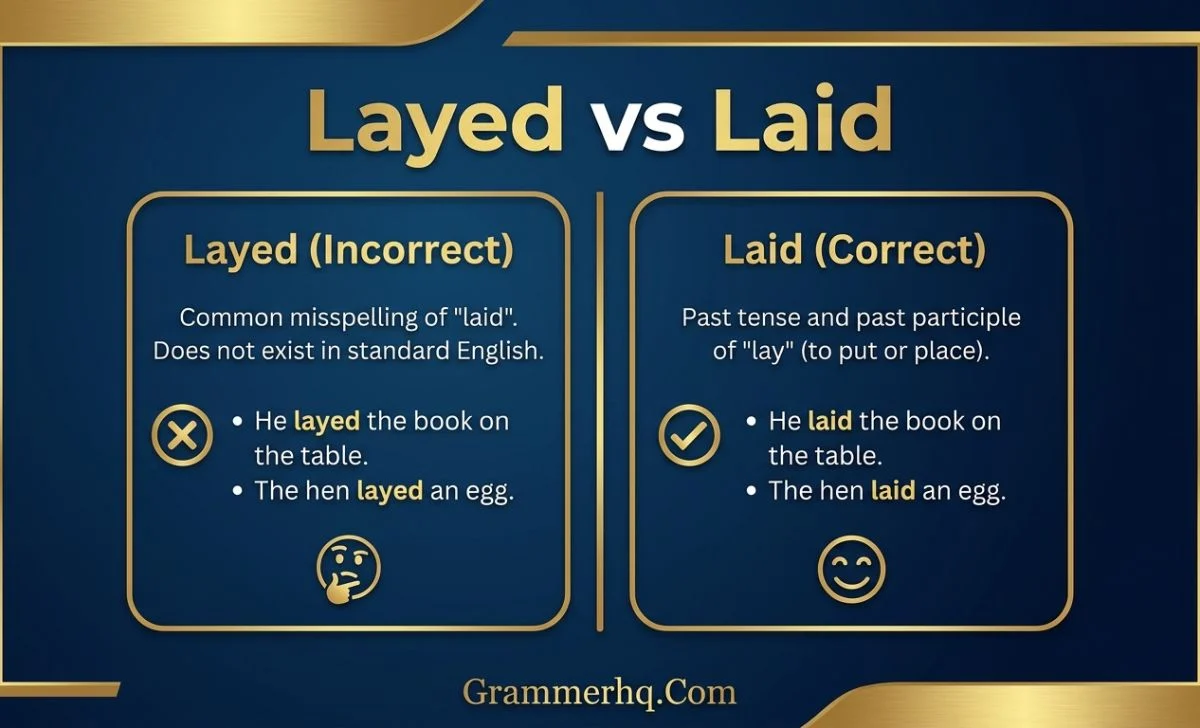
Choosing between layed vs laid can be confusing because many English verbs form their past tense by adding -ed.
It may seem natural to change lay into layed, but standard English does not work that way. The correct past tense and past participle of lay are laid.
The confusion becomes even greater because lay and lie are different verbs, yet their forms overlap. For example, laid comes from lay, while lay is also the past tense of lie.
That small difference causes many common mistakes, especially in phrases such as “I layed down.”In this guide, you will learn which form is correct, what laid means, how it differs from lay and lie, and how to use each form naturally.
Quick Answer: Layed vs Laid
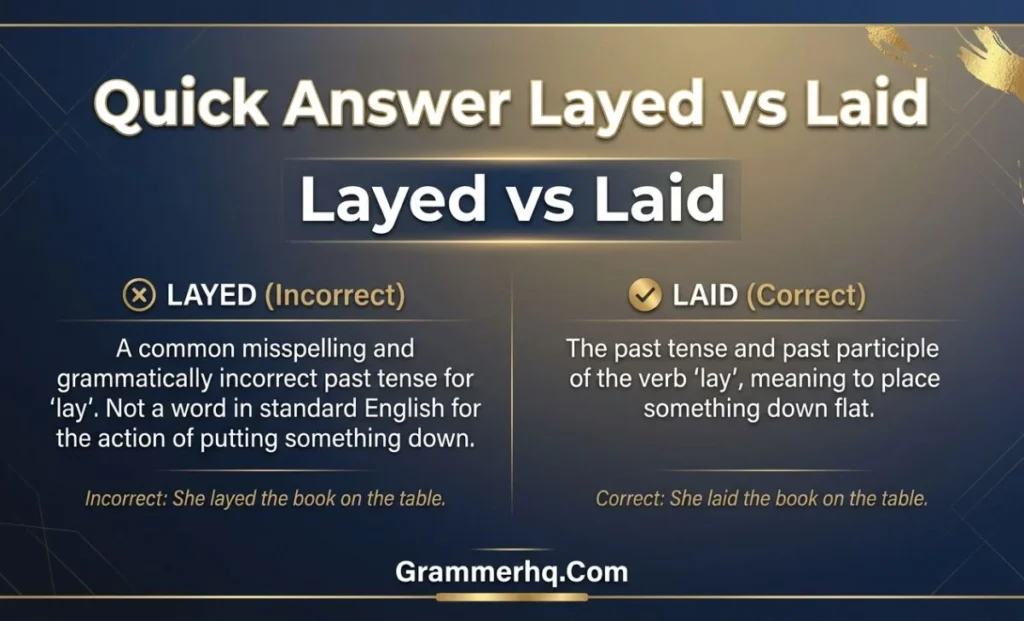
Laid is correct. Layed is not the standard past tense or past participle of lay.
| Word | Status | Use |
|---|---|---|
| laid | Correct | Past tense and past participle of lay |
| layed | Incorrect in standard English for this meaning | Not the standard past form of lay |
Examples
- Correct: She laid the book on the desk.
- Incorrect: She layed the book on the desk.
- Correct: They laid the foundation last year.
- Incorrect: They layed the foundation last year.
The standard verb pattern is:
lay → laid → laid
Cambridge Dictionary specifically identifies laid as the past simple and -ed form of lay and notes that the spelling is laid, not layed.
However, there is an important exception to watch for: if you mean rest or recline, the verb is lie, whose past tense is lay.
What Does “Laid” Mean?
Laid is the past tense and past participle of lay, a verb that commonly means to put or place something somewhere, especially in a flat or horizontal position.
For example:
- She laid the keys on the table.
- He laid the baby on the bed.
- We laid the papers beside the computer.
- The workers laid the foundation for the building.
In each example, something is being placed somewhere.
Cambridge Dictionary defines lay in this sense as putting something down, often carefully or in a particular position, and gives laid as its past form.
Forms of Lay
| Verb form | Word | Example |
|---|---|---|
| Base form | lay | I lay the book on the desk. |
| Third-person singular | lays | She lays the book on the desk. |
| Past tense | laid | She laid the book on the desk. |
| Past participle | laid | She has laid the book on the desk. |
| Present participle | laying | She is laying the book on the desk. |
Notice the important point:
lay → laid → laid
There is no layed in this standard verb pattern.
Why Do People Write “Layed”?
The spelling layed looks reasonable because many common English verbs form their past tense with -ed:
- walk → walked
- clean → cleaned
- open → opened
- play → played
So it is easy to assume:
lay → layed
But English has many verbs whose past forms do not follow that pattern. In this case, the correct form is:
lay → laid
That is why:
- ❌ She layed the book on the table.
- ✅ She laid the book on the table.
The mistake becomes even more confusing because lay is also the past tense of another verb, lie. That overlap is the real reason many people mix these forms up.
Lay vs Laid vs Lie vs Lain
This is the most important grammar distinction to understand.
Lay
Lay means to put or place something somewhere. It normally takes a direct object.
Please lay the documents on the desk.
The object is the documents.
Laid
Laid is the past tense and past participle of lay.
She laid the documents on the desk yesterday.
Lie
Lie means to rest or be in a horizontal position. In this meaning, it does not take a direct object.
I lie on the sofa when I am tired.
Lain
Lain is the past participle of lie.
I have lain on that beach many times.
So the two main verb patterns are:
| Meaning | Present | Past | Past Participle |
|---|---|---|---|
| Put/place something | lay | laid | laid |
| Rest/recline | lie | lay | lain |
Cambridge gives the same distinction: lay means to put something down and takes an object, while lie means to be or put yourself in a horizontal position and does not take an object.
Is “I Layed Down” Correct?
No. If you mean that you rested or reclined, “I layed down” is not standard English.
The correct sentence is:
I lay down yesterday.
Why?
Because this lay comes from the verb lie:
lie → lay → lain
Compare:
- Present: I lie down when I am tired.
- Past: I lay down yesterday.
- Past participle: I have lain down for a while.
Cambridge specifically identifies lay as the past form of lie.
But What About “I Laid Down”?
This is where context matters.
Laid down can be completely correct when something is being placed somewhere:
I laid down the book.
Here, laid comes from lay, meaning “put.”
So compare:
I lay down after dinner.
I laid down the book after dinner.
The first means I rested.
The second means I placed the book somewhere.
That single distinction can help you avoid one of the most common mistakes involving lay, laid, and lie.
Why “Layed” Is Incorrect
Layed is incorrect when it is being used as the past tense or past participle of lay in standard English.
The reason is not simply that “layed looks wrong.” There is a specific grammatical form:
lay → laid → laid
For example:
- Present: They lay the tiles.
- Past: They laid the tiles.
- Present perfect: They have laid the tiles.
Writing layed in those sentences replaces the established past form with a form that English does not normally use.
Cambridge’s grammar guidance directly warns that the past simple and -ed form of lay is laid, not layed.
Common Uses of “Laid”
Laid is not limited to physically placing an object.
It can appear in several common expressions and contexts.
1. Placing something
She laid her phone on the counter.
2. Placing something carefully
He laid the baby on the bed.
3. Building or preparing something
The workers laid the foundation.
4. Putting something down
She laid the papers on the desk.
5. Establishing the basis for something
The agreement laid the groundwork for future cooperation.
6. Eggs
The verb lay can also mean to produce eggs:
The hen laid three eggs.
This is another standard use of laid. Cambridge lists produce eggs as a separate meaning of lay.
Examples in Everyday English
Here are natural examples of laid in different situations:
- She laid her keys on the kitchen counter.
- He laid his jacket on the chair.
- I laid the documents on your desk.
- They laid new tiles in the bathroom.
- The workers laid the foundation last month.
- She laid the baby gently on the bed.
- We laid flowers at the memorial.
- The company laid the groundwork for the new project.
- The hen laid two eggs this morning.
- He laid the cards on the table.
These examples show why laid is a useful and common English verb form rather than simply a spelling correction.
Common Mistakes:Layed vs Laid
| Incorrect | Correct |
|---|---|
| She layed the book on the desk. | She laid the book on the desk. |
| He layed the keys on the table. | He laid the keys on the table. |
| They layed the foundation. | They laid the foundation. |
| She has layed the papers here. | She has laid the papers here. |
| I layed down yesterday. | I lay down yesterday. |
| He layed on the sofa all afternoon. | He lay on the sofa all afternoon. |
Notice that the last two errors are slightly different. They do not need laid. They need lay because they describe the past tense of lie.
British English vs American English
There is no standard British-American spelling difference between laid and layed.
Both American and British English use:
lay → laid → laid
when lay means “put” or “place.”
For example:
- US: She laid the book on the table.
- UK: She laid the book on the table.
The same distinction between lay and lie also applies in both varieties.
So you should not choose layed because you think it is an American or British spelling. It is not the standard regional alternative to laid.
Pronunciation
Laid is pronounced like “lade”:
/leɪd/
It has the same vowel sound as lay, with a final d sound.
Layed, when seen as a misspelling of laid, does not represent a different standard pronunciation or a British-American spelling variant.
An Easy Memory Trick
Use this simple rule:
If you PUT something somewhere:
lay → laid → laid
I lay the book down.
I laid the book down yesterday.
I have laid the book down.
If you REST somewhere:
lie → lay → lain
I lie on the sofa.
I lay on the sofa yesterday.
I have lain on the sofa before.
A quick memory line is:
Put it down → laid. Rest yourself → lay.
This is much more useful than simply memorizing that layed is wrong because it tells you why the correct form changes.
Trusted Source
The grammar distinction in this article is supported by Cambridge Dictionary’s English Grammar Today, which identifies laid as the past simple and past participle of lay and distinguishes lay from lie.
Cambridge’s dictionary entry for lay also gives laid as the past form and shows common uses such as placing something, laying foundations, and laying eggs.
Practice Session: Layed vs Laid
Choose the correct form.
- She ___ the book on the table yesterday.
(laid / layed) - He ___ his keys beside the computer.
(laid / layed) - They ___ the foundation last year.
(laid / layed) - The hen ___ three eggs this morning.
(laid / layed) - I have ___ the documents on your desk.
(laid / layed) - Please ___ the papers here.
(lay / laid) - I ___ down for a short rest yesterday.
(lay / laid) - She is ___ the plates on the table.
(laying / layed) - He ___ on the sofa all afternoon yesterday.
(lay / laid) - They have ___ the groundwork for the project.
(laid / layed)
Answers
- laid
- laid
- laid
- laid
- laid
- lay
- lay
- laying
- lay
- laid
FAQs
Which is correct: layed or laid?
Laid is correct when you need the past tense or past participle of lay. Layed is not the standard form.
Is layed a real word?
Layed is not the standard past form of lay in modern English. In ordinary writing, use laid instead.
What is the past tense of lay?
The past tense of lay is laid.
Present: I lay the book down.
Past: I laid the book down.
What is the past tense of lie?
When lie means to rest or recline, its past tense is lay.
I lie on the sofa every evening.
I lay on the sofa yesterday.
Is “I layed down” grammatically correct?
No. If you mean that you rested or reclined, say “I lay down.”
Is “I laid down” ever correct?
Yes. It is correct when laid has an object meaning that something was placed somewhere.
I laid down the book.
What is the difference between laid and lay?
Laid is the past tense and past participle of lay meaning “put” or “place.” Lay can be the present form of lay, but it is also the past tense of lie.
Is laid the same in American and British English?
Yes. Both American and British English use laid as the standard past form of lay.
How do I remember lay, laid, and lain?
Think of two separate patterns:
lay → laid → laid = put or place something
lie → lay → lain = rest or recline
Final Answer:Layed vs Laid
The correct choice between layed vs laid is laid when you mean the past tense or past participle of lay.
Remember:
lay → laid → laid
But do not confuse this with the separate verb lie:
lie → lay → lain
So, “She laid the book on the table” is correct, while “She layed the book on the table” is not. If you mean that someone rested, use “She lay down,” not “She layed down.”
Once you separate putting something somewhere from resting yourself, these confusing forms become much easier to use correctly.
Read More Blogs
- Seal vs Seel: Which Is Correct? Meaning, Spelling & Usage
- Scotch vs Whiskey: The Real Difference Explained?
- Calvary vs Cavalry: Spelling, Meaning & Usage Guide
- Die vs Dice: What’s the Difference? Meaning, Rules & Examples

Hi, I’m Amelia Parker, a grammar enthusiast and writer at GrammarHQ.com. I specialize in explaining spelling differences, confusing words, and common English mistakes through simple, practical, and easy-to-understand guides.










