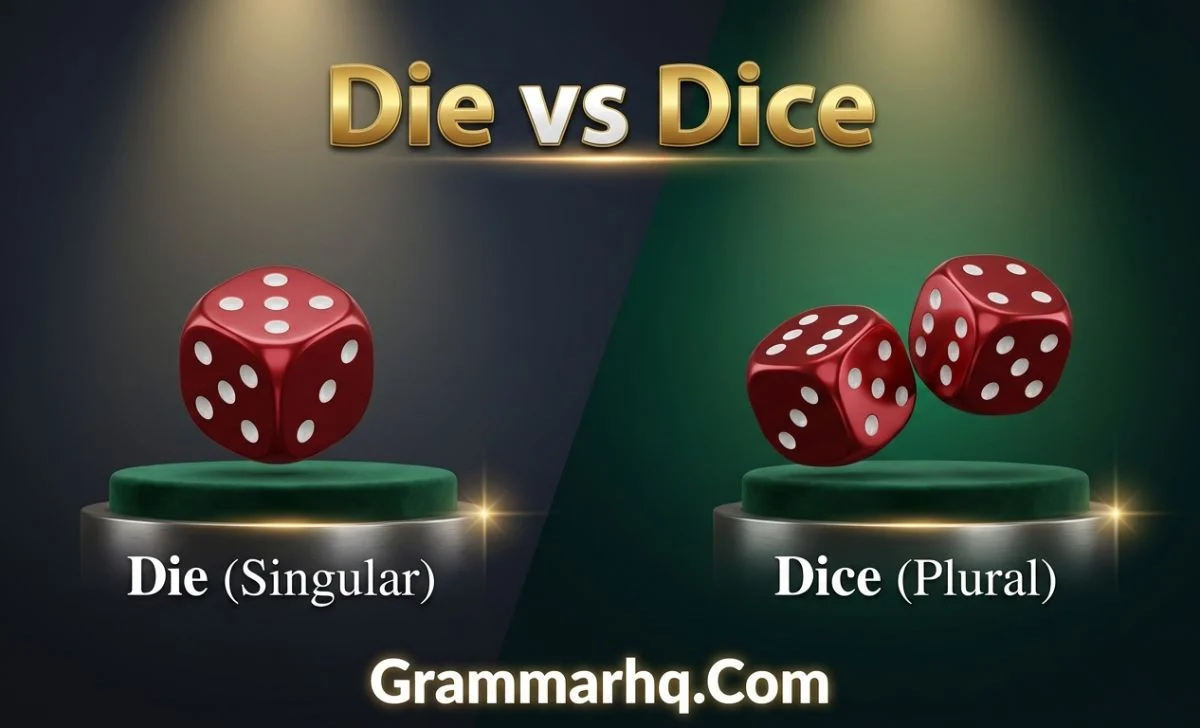
Die vs dice is a common English usage question, especially when talking about board games. Traditionally, die refers to one gaming cube, while dice refers to two or more.
However, modern English also uses dice for a single cube in some contexts. The right choice depends on the meaning, audience, and level of formality.
There is another detail worth knowing: die can also mean a manufacturing tool, and its plural is dies. As verbs, die means to stop living, while dice means to cut food into small cubes.
Understanding these differences will help you choose the correct word in everyday conversations, school assignments, recipes, and professional writing.
Quick Answer: Die vs Dice
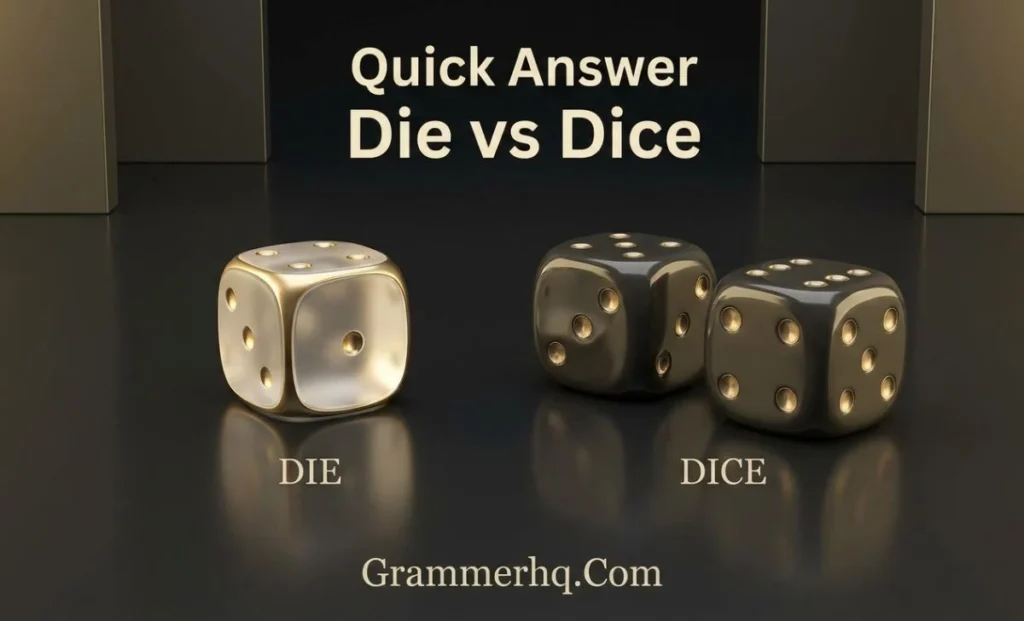
- Die: Traditionally, one gaming cube.
- Dice: Traditionally, two or more gaming cubes; also used for a single cube in some varieties of modern English.
- Dies: The plural of die when referring to manufacturing tools.
- To die: To stop living.
- To dice: To cut food into small cubes.
Example: “I rolled one die, then rolled two dice.”
For formal American English, one die, two dice is a clear and reliable rule. Cambridge Dictionary also recognizes dice as a singular countable noun in its British English entry, illustrating that usage varies.
Die vs Dice: Key Differences
| Feature | Die | Dice |
|---|---|---|
| Traditional gaming use | Singular | Plural |
| Example | Roll one die. | Roll two dice. |
| Pronunciation | /daɪ/ — rhymes with “eye” | /daɪs/ — rhymes with “ice” |
| Manufacturing use | One shaping or cutting tool | Not the usual plural for this meaning |
| Manufacturing plural | Die | Dies |
| Verb meaning | To stop living | To cut into small cubes |
The main distinction is grammatical number when discussing gaming cubes. However, dice can function as a singular noun in modern usage, so context matters.
What Does Die Mean?
The word die has several meanings. It can refer to a gaming cube, a manufacturing tool, or the act of stopping living.
Die as a Gaming Noun
A die is a small object used in games of chance. A standard gaming die has six faces, typically marked with dots numbered from one to six.
Examples:
- I rolled one die and got a four.
- The die landed beside the board.
- Each player receives one die at the beginning of the game.
In traditional grammar, die is the singular form. If you are writing formal instructions or explaining the rule to English learners, one die is the clearest choice.
Die as a Verb
As a verb, die means to stop living. This meaning is unrelated to gaming.
Examples:
- Some plants die without enough water.
- The flowers began to die in the summer heat.
- The family hoped their injured pet would not die.
The word also appears in expressions such as die down, which means to become weaker or less intense.
Example: “The noise began to die down after the crowd left.”
Die in Manufacturing
In manufacturing, a die is a specially shaped tool used to cut, press, or form materials. Dies are used in processes such as metalworking and industrial production.
Examples:
- The factory replaced a damaged die.
- The technician inspected the die before production started.
- The manufacturer ordered several new dies.
Notice the plural: one die, several dies.
The meaning of the noun determines its plural form. Gaming cubes traditionally use dice, while manufacturing tools generally use dies.
What Does Dice Mean?
The word dice is commonly associated with gaming cubes. It also functions as a verb meaning to cut something into small cubes.
Dice as a Plural Noun
Traditionally, dice is the plural of die. It refers to two or more gaming cubes.
Examples:
- We need two dice to play the game.
- The player rolled the dice across the table.
- Both dice landed on six.
This is the standard traditional pattern:
One die → two dice → several dice
Unlike regular plurals such as books and cards, dice does not simply add an s to die. It is an irregular plural.
Can Dice Be Singular?
Yes. Although die is the traditional singular form, dice is also used for a single gaming cube in modern English.
For example:
- Traditional form: “Please pass me a die.”
- Modern usage: “Please pass me a dice.”
The second form is used in some varieties of English, including British usage. Dictionary conventions differ, so it is too broad to say that a dice is always incorrect. Cambridge Dictionary lists dice as a countable noun for the gaming object and notes die as an American or older alternative in its British entry.
Writing tip: If you want to follow the traditional rule, especially in formal American English, use one die and two dice. In casual conversation, readers may encounter dice used for either number.
Dice as a Verb
As a verb, to dice means to cut food into small, roughly cube-shaped pieces. It is common in recipes and cooking instructions.
Examples:
- Dice the onions before adding them to the pan.
- She diced the carrots for the soup.
- Please dice two potatoes for dinner.
The verb changes form according to the sentence:
- Present: dice
- Third-person singular: dices
- Past tense: diced
- Present participle: dicing
For example, “He dices the vegetables every evening.”
Here, dices is a verb form, not the traditional plural of the gaming noun die. Cambridge Dictionary confirms the food-preparation meaning of dice.
Die vs Dice Examples in Sentences
These examples show how the words work in everyday contexts.
Examples Using Die
- I rolled one die and got a six.
- The die bounced off the table.
- The worker replaced the damaged die.
- Some flowers die when they receive too little water.
- The excitement began to die down after the match.
The first two examples use die as a gaming noun. The third uses it for a manufacturing tool. The final two use the verb.
Examples Using Dice
- We rolled two dice to decide who would start.
- The dice landed on different numbers.
- She bought a new set of dice.
- Dice the tomatoes before adding them to the salad.
- He is dicing potatoes for dinner.
The first three examples use dice as a noun. The final two use it as a verb.
Common Mistakes to Avoid
1: Using the traditional singular and plural incorrectly
- Traditional: “I rolled one dice.”
- Preferred traditional form: “I rolled one die.”
Although one dice appears in modern usage, one die follows the traditional distinction.
2: Confusing gaming cubes with manufacturing tools
- Gaming: “We rolled two dice.”
- Manufacturing: “The factory replaced two dies.”
Both plural forms are possible, but they refer to different meanings.
3: Confusing the verbs
- “The plant may die” means the plant may stop living.
- “Dice the potatoes” means cut the potatoes into small cubes.
The surrounding words make the intended meaning clear.
What Is the Plural of Die?
The plural depends on what die means in the sentence.
| Meaning | Singular | Plural |
|---|---|---|
| Gaming cube | One die | Two dice |
| Manufacturing tool | One die | Two dies |
For example:
- “The player rolled three dice.”
- “The factory inspected three dies.”
Both sentences are correct because they use different meanings of die.
If you are writing about board games, use dice as the traditional plural. If you are writing about manufacturing equipment, dies is generally the correct plural.
FAQs
Is it one die or one dice?
Traditionally, one die is the standard form for a single gaming cube. However, one dice is also used in some varieties of modern English. For formal American writing, one die is the safest choice.
Is it two dice or two dies?
Use two dice for gaming cubes and two dies for manufacturing tools. The correct form depends on the meaning of die.
Is dice singular or plural?
Traditionally, dice is plural and die is singular. However, dice is also used as a singular noun in modern English, and dictionary conventions vary by region.
What is the difference between die, dice, and dies?
Die traditionally means one gaming cube or one manufacturing tool. Dice traditionally means multiple gaming cubes. Dies is the usual plural of die when referring to manufacturing tools.
Is “dices” a word?
Yes. Dices is a verb form of dice, as in “She dices the onions.” It is not the traditional plural of the gaming noun die; that plural is dice.
What does “the die is cast” mean?
“The die is cast” means that a decision has been made or an action has occurred that cannot easily be reversed.
Example: “Once the company announced the merger, the die was cast.”
Conclusion
The difference between die vs dice depends on meaning and context. Traditionally, die is the singular form for a gaming cube, while dice is the plural.
Modern English also uses dice for a single cube in some varieties. In manufacturing, the plural of die is dies. As verbs, die means to stop living, while dice means to cut food into small cubes.
For formal writing, remember the traditional rule: one die, two dice—but one manufacturing die, two manufacturing dies.
Read More Blogs
- Seal vs Seel: Which Is Correct? Meaning, Spelling & Usage
- Scotch vs Whiskey: The Real Difference Explained?