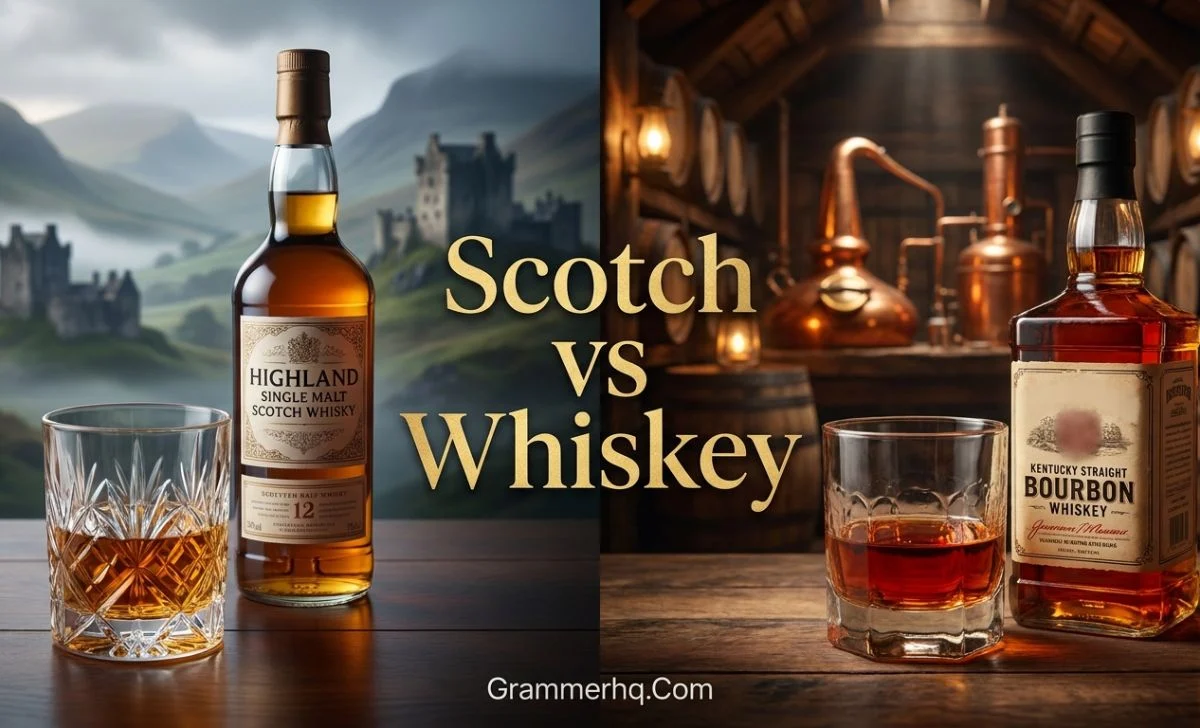
Scotch vs Whiskey can be confusing because the two terms are related, but they do not mean exactly the same thing.
Scotch is a specific type of whisky made in Scotland under strict legal rules, while whiskey is commonly used for several styles produced in countries such as the United States and Ireland.
The spelling can also change from whisky to whiskey, depending on where the spirit is made.
Quick Answer
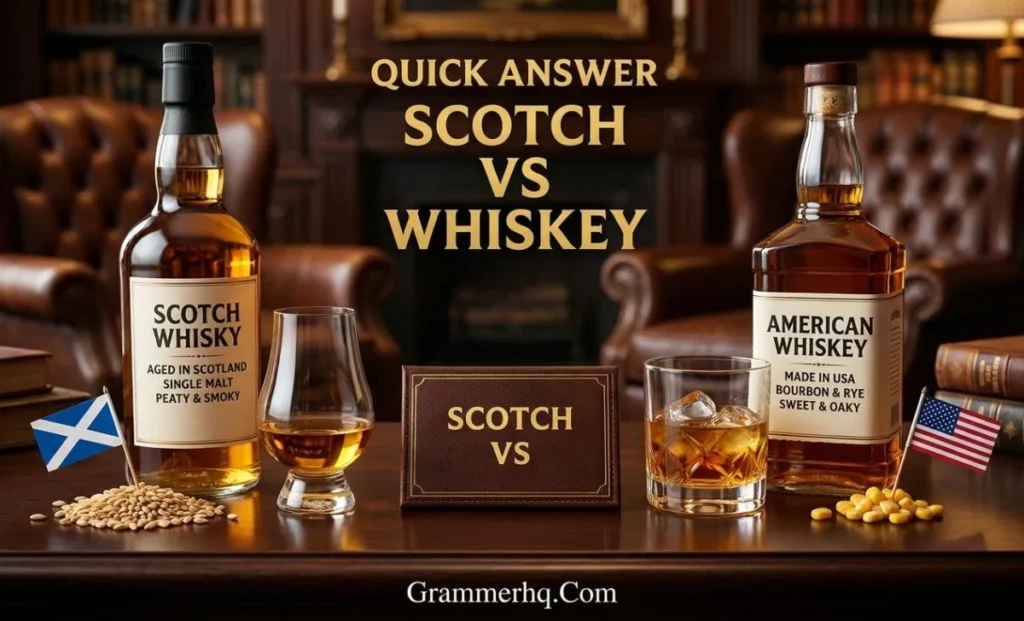
The simplest way to remember the difference is this:
Scotch is a type of whisky, but not all whisky is Scotch.
Scotch must be produced and matured in Scotland and meet specific requirements for ingredients, distillation, maturation, and bottling.
The broader whisk(e)y family includes Scotch, bourbon, Irish whiskey, rye whiskey, Canadian whisky, and Japanese whisky.
| Feature | Scotch | Whiskey / Whisky |
|---|---|---|
| What is it? | A specific type of whisky | A broad family of spirits |
| Main origin | Scotland | Several countries |
| Common spelling | Whisky | Whiskey or whisky |
| Grains | Cereals, including malted barley | Varies by style |
| Aging | Scotch must mature for at least 3 years | Rules vary by country and style |
| Flavor | Can be smoky, fruity, malty, spicy, or light | Varies widely by style |
So, Scotch is not separate from whisky; it is one category within the larger world of whisk(e)y.
What Is Whiskey?
Whiskey is a distilled spirit made from fermented grain mash and matured in wooden casks, although the exact legal definition varies between countries and styles.
Grain choices can include barley, corn, rye, wheat, or combinations of these.That is why whiskey does not have one single flavor.
For example, bourbon is strongly associated with corn, while rye whiskey is known for using a significant amount of rye. Irish whiskey follows its own production rules, too.
In other words, “whiskey” tells you the broad type of spirit, but it does not tell you exactly where it came from or how it tastes.
The wider whisk(e)y category is governed by different national and regional regulations rather than one worldwide legal definition.
What Is Scotch Whisky?
Scotch whisky is whisky that meets the legal requirements for Scotch Whisky in Scotland.
It is made from cereals, water, and yeast. Under the Scotch Whisky Regulations, it must be distilled and matured in Scotland for at least three years, matured in oak casks, and bottled at a minimum strength of 40% ABV.
That means a whisky made outside Scotland cannot simply be called Scotch.
There is also an important misconception to avoid: not all Scotch is single malt. Scotch includes single malt, single grain, blended malt, blended grain, and blended Scotch Whisky.
Scotch vs Whiskey: 6 Key Differences
1. Where They Are Made
The biggest distinction is geographical.
Scotch comes from Scotland. Whiskey and whisky are produced in many parts of the world, including Ireland, the United States, Canada, and Japan.
For example, a spirit made in Kentucky may be bourbon whiskey, while a spirit made in Scotland may qualify as Scotch Whisky if it follows the required rules.
This is why origin matters so much when identifying a bottle.
2. Whisky vs Whiskey Spelling
The spelling is one of the easiest clues to notice.
Scotch whisky is normally written without the e.
Irish whiskey and American whiskey commonly use the e.
However, spelling is not an absolute rule. There are exceptions, including American producers that use “whisky.” WSET notes that spelling generally follows regional custom rather than serving as a universal legal definition.
So if you see Scotch whisky, the spelling reflects its Scottish tradition.
3. Grains and Ingredients
Scotch is made from cereals, water, and yeast. Different Scotch categories use different combinations of grains.
A Single Malt Scotch Whisky, for example, is made at one distillery from water and malted barley without other cereals and is distilled in pot stills. Single Grain Scotch has a broader grain definition.
Other whiskies can use grains such as corn, rye, wheat, or barley depending on the style and local rules.
So it is inaccurate to say that all Scotch is simply barley whisky.
4. Aging and Casks
Scotch has a specific legal maturation requirement.
It must be matured in Scotland for at least three years and in oak casks with a capacity not exceeding 700 litres. It must also meet other legal requirements before it can be sold as Scotch Whisky.
Other whiskey styles follow different aging rules.
For example, bourbon has its own U.S. legal requirements, so you cannot assume that the aging rules for Scotch apply to every whiskey.
5. Production Rules
Scotch is protected by a detailed legal framework.
The rules cover matters such as:
- ingredients
- distillation
- maturation
- cask requirements
- geographical production
- minimum bottling strength
- labeling categories
The five legally recognized Scotch categories are Single Malt, Single Grain, Blended Malt, Blended Grain, and Blended Scotch Whisky.
That is one reason the word Scotch means more than simply “whisky from Scotland.”
6. Taste and Flavor
There is no single flavor that defines all Scotch or all whiskey.
Scotch can have notes of:
- malt
- fruit
- vanilla
- oak
- spice
- smoke
- peat
Some Scotch is famous for strong smoky or peaty character, while other expressions can be light, fruity, floral, or delicate. Scotch Whisky regions themselves show considerable variation in flavor.
Whiskey can also range from sweet and smooth to spicy, rich, smoky, or woody.
So saying “Scotch is always smoky” is a myth.
Why Is Scotch Spelled “Whisky” Without the E?
The difference between whisky and whiskey has a long history.
Today, the spelling generally follows regional tradition. Scotland, Canada, and Japan commonly use whisky, while Ireland and the United States generally use whiskey. But there are exceptions.
The distinction became established over time through differences in whisky-producing traditions, language, and industry history.
The important point for everyday writing is simple:
Scotch whisky is the standard spelling for whisky from Scotland.
You should not assume, however, that the presence or absence of the e tells you everything about the spirit inside the bottle. Production method, grains, cask type, maturation, and category can be much more informative.
Is Scotch a Type of Whiskey?
Yes, in the broad sense, Scotch belongs to the larger whisk(e)y family.
But the more precise term is Scotch whisky, because Scotch has specific Scottish production and legal requirements.
Think of it this way:
Whisky/whiskey → the larger family
Scotch → a specific Scottish type
Bourbon → a specific American whiskey style
Irish whiskey → a specific Irish style
Therefore:
All Scotch is whisky, but not all whisky is Scotch.
That single distinction clears up most of the confusion surrounding the term.
What Are the Different Types of Scotch?
UK law recognizes five categories of Scotch Whisky:
Single Malt Scotch Whisky
Made at a single distillery from malted barley and distilled in pot stills.
Single Grain Scotch Whisky
Made at a single distillery but does not meet the definition of Single Malt Scotch Whisky.
Blended Malt Scotch Whisky
A blend of two or more Single Malt Scotch Whiskies from different distilleries.
Blended Grain Scotch Whisky
A blend of two or more Single Grain Scotch Whiskies from different distilleries.
Blended Scotch Whisky
A blend of one or more Single Malt Scotch Whiskies with one or more Single Grain Scotch Whiskies.
This is why Scotch does not automatically mean single malt.
Scotch vs Bourbon vs Irish Whiskey
These terms are related, but they identify different traditions.
| Type | Main association | Common spelling | Key point |
|---|---|---|---|
| Scotch | Scotland | Whisky | Must meet Scotch Whisky rules |
| Bourbon | United States | Whiskey | A distinct American whiskey style |
| Irish Whiskey | Ireland | Whiskey | Follows Irish whiskey requirements |
| Canadian Whisky | Canada | Whisky | Canadian style and regulations |
| Japanese Whisky | Japan | Whisky | Strongly influenced by Scotch tradition |
The exact production rules differ by jurisdiction, so it is better to compare individual styles rather than assume that every whisky or whiskey follows the same process.
Common Myths About Scotch and Whiskey
1: All Scotch is smoky.
False. Some Scotch is heavily peated and smoky, but many expressions have fruity, floral, malty, sweet, or lighter profiles.
2: Scotch means single malt.
False. Scotch includes five legal categories, including blended and grain styles.
3: Whisky and whiskey are completely different drinks.
Not exactly. The terms generally belong to the same broad family, while spelling often reflects regional tradition.
4: Every American whiskey uses “whiskey.”
Usually, but not always. Regional spelling conventions have exceptions.
5: Older whiskey is automatically better.
Not necessarily. Age is only one factor. Grain, distillation, cask type, maturation, blending, and the character of the final spirit also matter.
Scotch vs Whiskey: Which One Is Better?
Neither is automatically better.
Someone who enjoys a smoky, peaty dram may prefer a Scotch from a style or region known for those characteristics. Another person may prefer the sweeter profile of bourbon or the character of an Irish whiskey.
The better choice comes down to style and personal taste, not simply the word on the label.
FAQs
Is Scotch a type of whiskey?
Yes. Scotch is a specific type of whisky produced in Scotland under defined legal requirements.
What is the main difference between Scotch and whiskey?
The biggest difference is that Scotch is a specific Scottish category with legally defined production and maturation requirements, while whiskey/whisky is the broader family.
Why is Scotch spelled whisky?
Scotch traditionally uses whisky, without the “e.” American and Irish products commonly use whiskey, although exceptions exist.
Is all Scotch whisky?
Yes. Scotch is whisky that meets the specific requirements for Scotch Whisky.
Is whiskey and whisky the same thing?
They are generally terms for the same broad family of grain-based distilled spirits, but the spelling often reflects regional tradition and specific local usage.
Is Scotch always smoky?
No. Some Scotch is smoky and peaty, while other Scotch can be fruity, floral, malty, sweet, or light.
Is Scotch stronger than whiskey?
Not automatically. Scotch must be bottled at a minimum of 40% ABV, but whiskey strength varies by style and product.
Is bourbon a type of Scotch?
No. Bourbon is an American whiskey style, while Scotch is a Scottish whisky category.
Conclusion
The easiest way to understand Scotch vs Whiskey is to remember the hierarchy: Scotch is a type of whisky, while whisky/whiskey is the broader family.
Scotch has specific Scottish production and maturation rules, including at least three years of maturation in Scotland and a minimum bottling strength of 40% ABV.
The spelling also provides a useful clue: Scotch whisky normally uses the spelling without the “e,” while whiskey is common in Ireland and the United States.
Still, spelling alone does not define the spirit. Origin, production method, grains, casks, maturation, and category tell you much more.
Read More Blogs