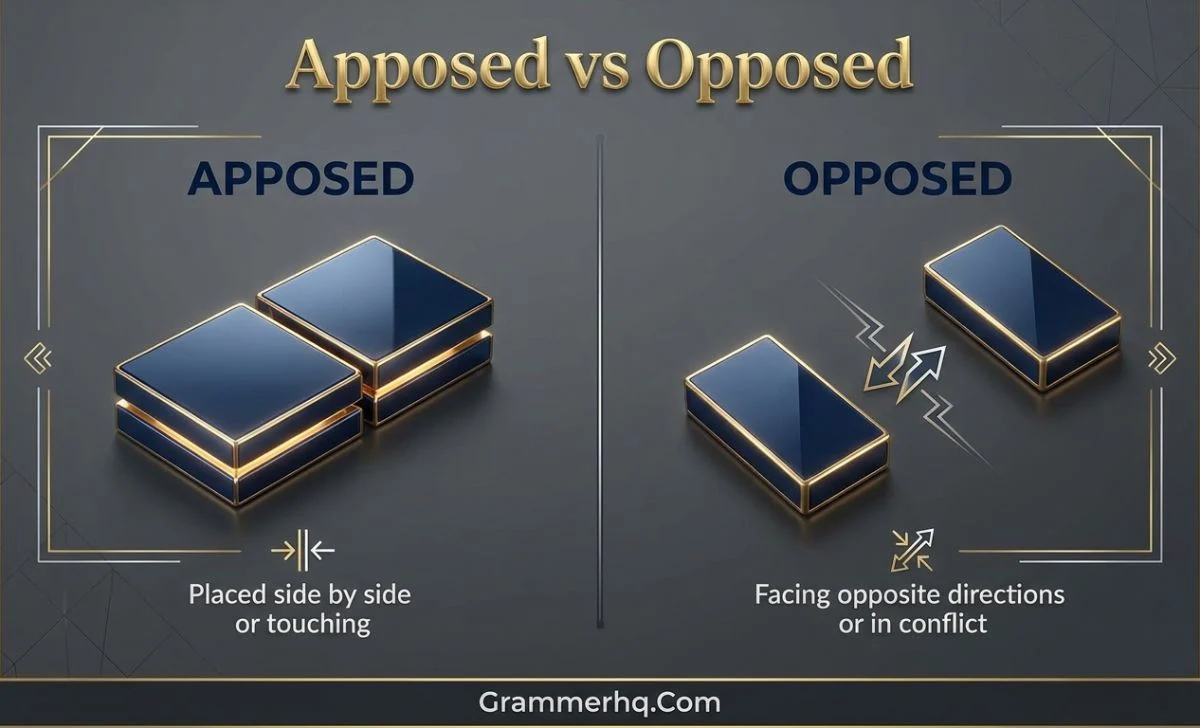
Apposed vs opposed can be confusing because the two words look almost identical, but they do not mean the same thing.
Apposed means placed next to or close to something, while opposed usually means against, disagreeing with, or in conflict with something.
The words also appear in very different contexts: apposed is more common in formal or technical writing, while opposed is widely used in everyday and professional English. Understanding that difference will help you choose the right word without guessing.
Quick Answer
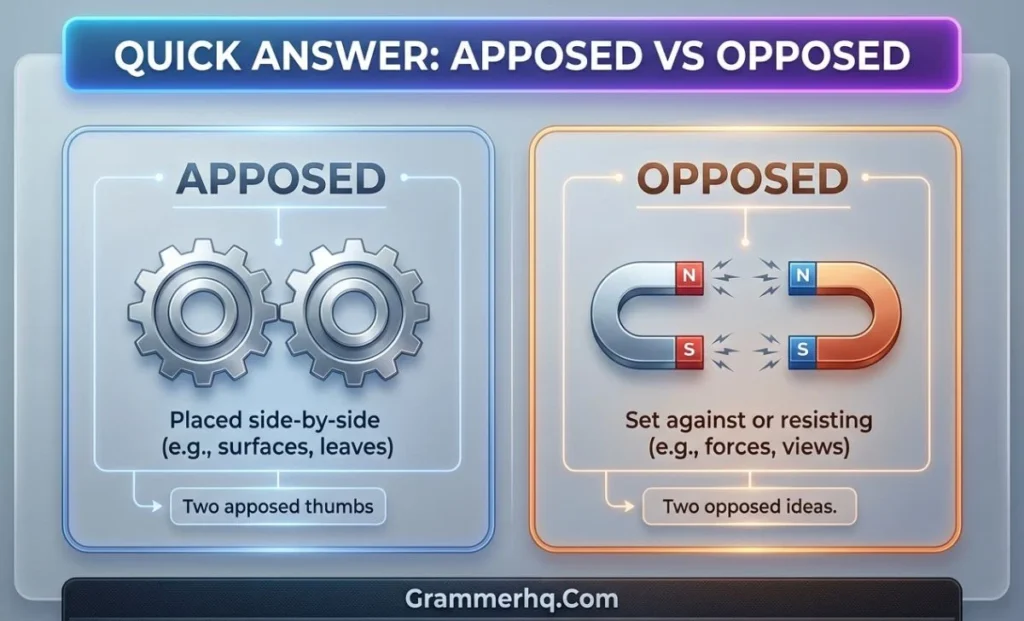
Apposed means placed next to or close to something. It comes from the formal verb appose and is especially useful in technical or scientific descriptions.
Opposed means against, disagreeing with, or contrary to something. It can also describe things that are opposite or facing each other.
- Apposed = placed close together
- Opposed = against or in disagreement
- As opposed to = rather than or in contrast with
For example:
The two surfaces were apposed.
The residents were opposed to the new plan.
The first sentence describes position. The second describes opposition.
Apposed vs Opposed: Key Difference
| Word | Main meaning | Typical use | Example |
|---|---|---|---|
| Apposed | Placed next to or close to something | Technical, scientific, medical | The two surfaces were apposed. |
| Opposed | Against, disagreeing, or contrary | Everyday and formal English | She was opposed to the proposal. |
A simple way to remember the difference is:
Apposed describes position. Opposed describes opposition.
However, opposed has more than one meaning. It can describe disagreement, something completely different or contrary, or something positioned opposite another thing.
What Does “Apposed” Mean?
Apposed is the past tense and past participle of appose, a formal verb meaning to place something next to or close to something else. Cambridge classifies appose as formal and gives examples from scientific contexts.
For example:
The two layers were closely apposed.
This means the layers were positioned very close together.
Another example:
The membranes remained apposed during the examination.
Here, apposed describes a physical relationship between the membranes.
Where Is “Apposed” Used?
You are most likely to encounter apposed in specialized writing, such as:
- Anatomy
- Biology
- Medicine
- Dentistry
- Scientific research
- Technical descriptions
Cambridge’s corpus examples include anatomical and biological structures described as being closely apposed, showing that the word has a genuine technical use rather than being a misspelling of opposed.
In ordinary conversation, however, people would usually choose simpler expressions such as next to, beside, alongside, or close to.
What Does “Opposed” Mean?
Opposed comes from the verb oppose. In its most common sense, it means being against something or disagreeing with it.
For example:
The committee was opposed to the proposal.
The committee did not support the proposal.
Similarly:
Several residents opposed the new development.
Here, opposed expresses resistance or disagreement.
Cambridge defines oppose as disagreeing with something or someone, often by speaking or taking action against it. It also recognizes oppose + -ing as a standard grammatical pattern.
“Opposed” Has Other Meanings, Too
Depending on the context, opposed can mean:
- Against or disagreeing: They were opposed to the decision.
- Completely different or contrary: The two views are diametrically opposed.
- Opposite or facing: The buildings stood on opposed sides.
So, opposed is broader than simply “against.”
Apposed vs Opposed Examples
Seeing the words in real sentences makes the distinction much easier.
1: Physical position
The two surfaces were apposed.
They were placed very close together.
2: Disagreement
The board was opposed to the proposal.
The board disagreed with the proposal.
3: Scientific writing
The membranes remained closely apposed.
The word describes the physical position of the membranes.
4: Everyday English
Many parents were opposed to the new policy.
Here, opposed means they disagreed with or did not support the policy.
The key question is simple: Are you describing where something is, or what someone is against?
If it is about close physical placement, apposed may be appropriate. If it is about disagreement or resistance, opposed is normally the correct choice.
“Apposed To” vs “Opposed To”
This is where the difference matters most for everyday writing.
Apposed to
Apposed to can describe something positioned next to or close to another thing, especially in technical contexts.
The two structures were apposed to one another.
The phrase describes their physical relationship.
Opposed to
Opposed to is commonly used when someone disagrees with something or does not support it.
She is opposed to the new policy.
They are opposed to changing the schedule.
Cambridge specifically recognizes be opposed to something as meaning to disagree with a principle or plan.
A Common Mistake
❌ I am apposed to the new rule.
✅ I am opposed to the new rule.
If you mean “I disagree with the new rule,” use opposed, not apposed.
“As Opposed To” — What Does It Mean?
As opposed to is a separate and very common expression. It means rather than, instead of, or in contrast with.
For example:
I prefer tea as opposed to coffee.
This means:
I prefer tea rather than coffee.
Another example:
The course focuses on practical skills as opposed to memorization.
Here, the phrase contrasts practical skills with memorization.
“As Apposed To” or “As Opposed To”?
The correct expression is:
✅ as opposed to
Not:
❌ as apposed to
This is one of the most common spelling mistakes involving these words.
Oppose vs Appose: Understanding the Base Verbs
The easiest way to understand the two words is to look at their base verbs.
Appose → Apposed
Appose means to place something next to or close to something else.
The surgeon apposed the edges of the wound.
The verb describes bringing the edges together.
Oppose → Opposed
Oppose means to disagree with, resist, or act against something.
Several employees opposed the proposed changes.
It can also be followed by an -ing form:
I oppose changing the current system.
Cambridge confirms this oppose + -ing construction.
So:
appose → apposed → physical placement
oppose → opposed → resistance or disagreement
Is “Apposed” a Real Word or a Misspelling?
Yes. Apposed is a real English word.
It is not simply a misspelling of opposed. It comes from the verb appose, which Cambridge lists as a formal English verb meaning to place something next to or close to something else.
The reason it can look incorrect is that opposed is much more familiar to most English speakers. Apposed is relatively specialized and appears more often in scientific, medical, anatomical, and technical contexts.
So if you see:
The two membranes were closely apposed.
there is no spelling error. The writer is describing their physical relationship.
Why Are Apposed and Opposed So Easy to Confuse?
The two words differ by only one letter, and both are connected to the idea of positioning or relationships between things. Their similar appearance makes them easy to mix up, especially when typing quickly.
There is also a practical reason for the confusion: opposed is common, while apposed is comparatively uncommon.
That means many readers are familiar with opposed long before they encounter apposed.
The safest approach is not to judge the word by how familiar it looks. Instead, check the intended meaning:
Close together? → apposed
Against or disagreeing? → opposed
Rather than/in contrast with? → as opposed to
Common Mistakes With Apposed and Opposed
1. Writing “as apposed to”
❌ The event is indoors, as apposed to outdoors.
✅ The event is indoors, as opposed to outdoors.
As opposed to is the established expression meaning “rather than” or “in contrast with.”
2. Using “apposed” for disagreement
❌ I am apposed to the decision.
✅ I am opposed to the decision.
The intended meaning is disagreement, so opposed is correct.
3. Assuming “apposed” is always wrong
❌ The word “apposed” is a spelling mistake.
✅ Apposed is a legitimate word used mainly in formal and technical contexts.
4. Treating the words as interchangeable
They are not interchangeable.
The membranes were apposed.
describes their position.
The researchers were opposed to the proposal.
describes their disagreement.
Changing one word can completely change the meaning of the sentence.
Apposed vs Opposed: Easy Memory Trick
Use this simple rule:
APPOSED = positioned close
OPPOSED = against
Or remember it this way:
Position → Apposed
Opposition → Opposed
And for the common phrase:
As opposed to → rather than
Once you connect each word with its meaning, the spelling becomes much easier to remember.
FAQs
Is “apposed” a correct word?
Yes. Apposed is the past tense and past participle of the formal verb appose, meaning to place something next to or close to something else.
What does “apposed” mean?
Apposed means placed next to or close to something, particularly in formal or technical contexts.
What does “opposed” mean?
Opposed commonly means against or disagreeing with something. It can also mean opposite, facing, or completely different, depending on context.
Is “I am apposed to it” correct?
Usually, no. If you mean that you disagree with something, write “I am opposed to it.”
Should I use “apposed” or “opposed”?
Use apposed when you mean physically placed close to something. Use opposed when you mean against, disagreeing, or contrary.
What is the difference between “opposed to” and “as opposed to”?
Opposed to usually means against or disagreeing with.
As opposed to means rather than or in contrast with.
Is “as apposed to” correct?
No. The standard expression is as opposed to.
Is “apposed” commonly used in English?
Not in everyday conversation. It is a relatively specialized word, particularly useful in scientific and technical writing.
What is the difference between apposing and opposing?
Apposing means placing things next to or close to each other. Opposing means resisting, disagreeing with, or acting against something.
Conclusion
Apposed and opposed are both correct English words, but they have different jobs. Use apposed when describing things placed next to or close to each other, especially in technical or scientific contexts.
Use opposed when you mean against, disagreeing, resisting, or contrary. And when you mean “rather than” or “in contrast with,” use the familiar expression as opposed to.
The easiest rule to remember is:
Apposed = close together.
Opposed = against.
As opposed to = rather than.
Read More Blogs
- Parents vs Parent’s vs Parents’: What’s the Difference?
- Seal vs Seel: Which Is Correct? Meaning, Spelling & Usage