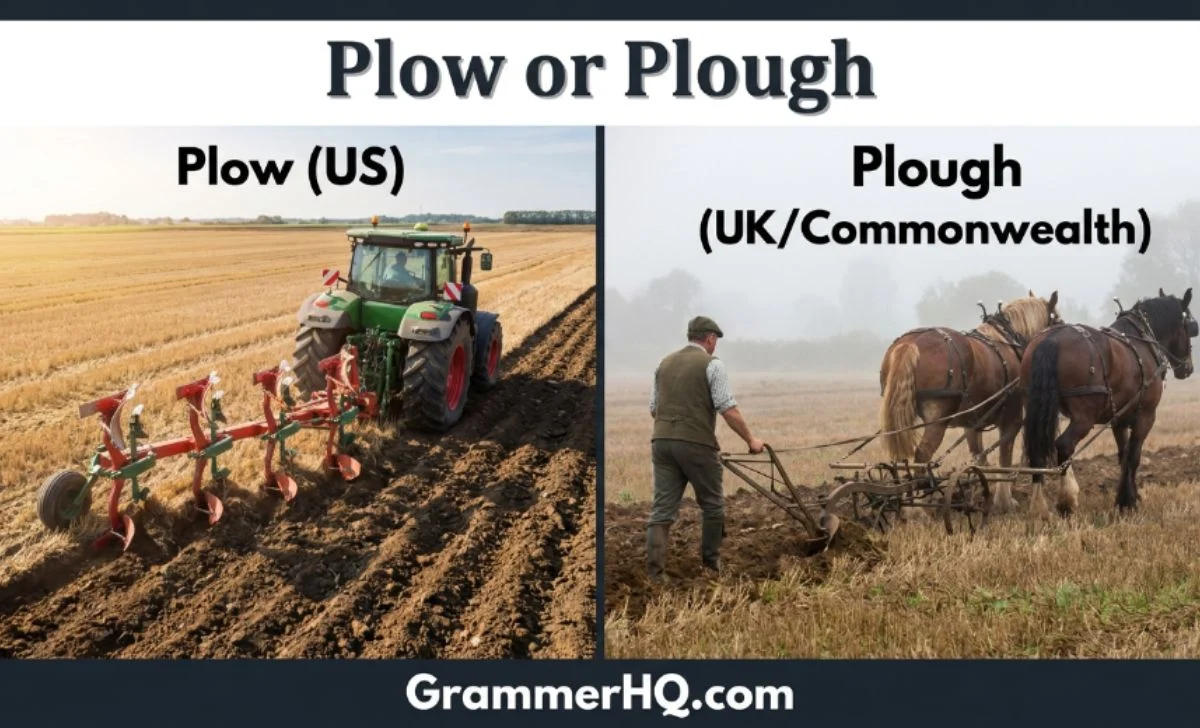
If you’ve ever wondered whether plow or plough is the correct spelling, you’re not alone. Both words refer to the same farming tool and the action of turning over soil, yet you’ll see different spellings depending on where the English is used.
This difference often confuses students, writers, English learners, and even native speakers. The good news is that neither spelling is wrong. The choice depends on whether you’re writing in American or British English.
Understanding when to use each form will help you write more accurately and maintain consistency in academic papers, professional documents, exams, and everyday communication.
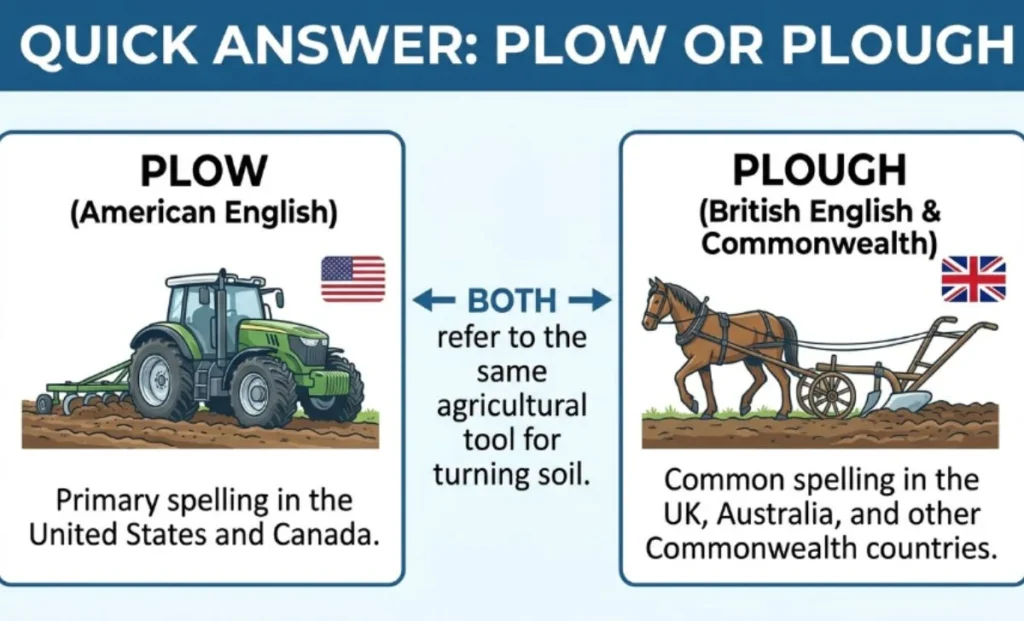
Plow and plough are two accepted spellings of the same word. Plow is the standard spelling in American English, while plough is preferred in British English and many other English-speaking countries.
Both can be used as a noun (a farming implement) or a verb (to turn over soil). Choose the spelling that matches your audience and use it consistently throughout your writing.
What Does Plow or Plough Mean?
A plow (plough in British English) is a farming tool or machine used to turn, loosen, and prepare soil before planting crops. As a verb, it means to cultivate land by cutting and turning the earth, creating furrows that help seeds grow.
The word appears in both traditional agriculture and modern farming, where tractors pull different types of agricultural machinery to prepare fields efficiently.
As a Noun
A plow/plough is a piece of farm equipment used to prepare land for planting.
Examples
- The farmer repaired the plow before spring planting.
- The old wooden plough is displayed in the village museum.
- Modern tractors can pull several types of plows for large farms.
As a Verb
To plow/plough means to turn over soil so crops can be planted.
Examples
- Farmers plow the field before sowing corn.
- They ploughed the land after the first rainfall.
- The workers spent all morning plowing the field.
Is Plow or Plough Correct?
Yes. Both spellings are correct, but they belong to different varieties of English.
| Spelling | Used In | Status |
|---|---|---|
| Plow | American English | Standard |
| Plough | British English, Australian English, New Zealand English, Irish English | Standard |
Neither spelling is more correct than the other. The key is to remain consistent within the same document.
For example:
- An American newspaper will almost always write plow.
- A British farming magazine will usually write plough.
This spelling difference is similar to:
- Color → Colour
- Center → Centre
- Organize → Organise
- Tire → Tyre
Each pair follows regional spelling conventions rather than different meanings.
Plow vs Plough: Comparison Table
| Feature | Plow | Plough |
|---|---|---|
| Meaning | Farming tool or the act of turning soil | Same meaning |
| Part of Speech | Noun and Verb | Noun and Verb |
| Preferred Region | United States | United Kingdom and most Commonwealth countries |
| Pronunciation | Same | Same |
| Formal Writing | Correct in American English | Correct in British English |
| Meaning Difference | None | None |
Bottom line: The spelling changes, but the meaning, pronunciation, and grammar stay the same.
Pronunciation
Although the spellings differ, both words are pronounced exactly the same.
IPA
/plaʊ/
It rhymes with:
- cow
- now
- how
- wow
Pronunciation Tips
- Begin with the “pl” sound.
- Finish with the “ow” sound as in how.
- The letters -ough in plough are not pronounced separately.
This surprises many learners because English words ending in -ough can have several pronunciations, such as:
| Word | Pronunciation |
|---|---|
| Though | /ðoʊ/ |
| Through | /θruː/ |
| Thought | /θɔːt/ |
| Rough | /rʌf/ |
| Plough | /plaʊ/ |
English spelling is not always phonetic, which is why plough looks more difficult than it sounds.
Why People Confuse Plow and Plough
The confusion isn’t about meaning—it’s about regional spelling.
Several factors contribute to this mistake:
1. Different English Standards
American schools teach plow, while British schools teach plough. Learners often encounter both online and assume one must be incorrect.
2. The Unusual -ough Ending
English words ending in -ough follow different pronunciation patterns, making learners question whether plough is even the same word.
3. Global Content
Today, people read articles, watch videos, and study materials from around the world. Someone in Pakistan, India, or Europe may see both spellings regularly because websites follow different style guides.
4. Spell Checkers
Word processors usually follow the language setting you choose. If your document is set to American English, plough may be flagged. If it’s set to British English, plow may appear as a spelling suggestion instead.
5. Farming and Non-Farming Contexts
Many people first encounter the word while reading about agriculture, soil cultivation, farm machinery, or history, so they may not realize they’re simply seeing two regional spellings of the same word.
British English vs American English
The only difference between plow and plough is regional spelling. Plow is the standard form in American English, while plough is preferred in British English and most Commonwealth countries. Their meaning, pronunciation, grammar, and usage are identical.
English has many spelling variations that developed over time. One of the best-known differences is between American and British English. The word plow/plough follows the same pattern as other spelling pairs such as color/colour and center/centre.
American English
American English simplifies the traditional -ough ending to -ow in several words. As a result, plow became the standard spelling in the United States.
Examples:
- Farmers plow the fields every spring.
- The tractor pulled a heavy plow across the land.
- Snowplows cleared the roads after the storm.
British English
British English keeps the historical spelling plough, which remains standard in the United Kingdom and many Commonwealth countries.
Examples:
- The farmer used a horse-drawn plough.
- They ploughed the field before planting wheat.
- The old plough is displayed in the agricultural museum.
Regional Usage at a Glance
| Region | Preferred Spelling |
|---|---|
| United States | Plow |
| United Kingdom | Plough |
| Australia | Plough |
| New Zealand | Plough |
| Ireland | Plough |
| Canada | Both are seen, but plough is traditionally more common in British-style writing, while plow also appears in North American contexts. |
Writing Tip: Always use the spelling that matches the variety of English you’re writing in. Avoid switching between plow and plough in the same document.
Word Origin and History
Both plow and plough come from the same ancient Germanic root. The spelling changed over centuries as English evolved, and American English later adopted the shorter form plow.
The history of this word stretches back more than a thousand years.
Old English
The earliest forms appeared in Old English as words similar to plōh, referring to a tool used for cultivating land.
Middle English
As spelling became less standardized, forms such as plough became common in Britain.
Modern English
In the 18th and 19th centuries, American English gradually adopted simpler spellings for many words. During this period, plow became the preferred American form, while Britain continued using plough.
Although the spellings differ today, they still refer to the same farming implement and the same agricultural activity.
Which Spelling Should You Use?
Choose plow if you’re writing for an American audience. Choose plough if your readers use British English. If your audience is international, follow one style consistently from beginning to end.
Ask yourself these questions before choosing:
Are you writing for an American audience?
Use plow.
Examples include:
- American schools
- U.S. businesses
- American newspapers
- U.S. government documents
Are you writing for a British or Commonwealth audience?
Use plough.
Examples include:
- UK universities
- British publishers
- Australian organizations
- New Zealand businesses
Writing for an International Audience
If your organization follows:
- American English Style Guide → use plow
- British English Style Guide → use plough
Consistency matters much more than choosing one spelling over the other.
Real-Life Examples
Seeing words in context is one of the fastest ways to remember them. These examples show how plow and plough are used naturally in everyday English.
American English Examples
The farmer plowed the field before planting corn.
We bought a new plow for the tractor.
Snowplows kept the highways open all night.
The workers finished plowing the land before sunset.
Modern plows save farmers both time and effort.
British English Examples
The horse pulled a traditional plough across the field.
They ploughed the soil after the harvest.
The old plough is still used during farming demonstrations.
Every autumn, local farmers plough their land.
The museum has a collection of antique ploughs.
Everyday Conversation
My grandfather still owns an old plough.
The farmer uses a GPS-guided plow today.
Academic Writing
Farmers use a plow to prepare the soil for planting.
Traditional ploughing improves soil aeration before sowing certain crops.
Business Communication
The company introduced a new plow designed for large-scale farming.
Common Mistakes
Most mistakes happen because writers mix British and American spelling or assume one version is incorrect. Both forms are valid when used in the appropriate variety of English.
1: Mixing Both Spellings
❌ The farmer used a plow and later repaired his plough.
✅ Choose one spelling style and keep it throughout the document.
2: Thinking One Spelling Is Wrong
❌ Only plow is correct.
✅ Both spellings are correct.
The difference is regional, not grammatical.
3: Using British English with American Spelling
❌ The report follows British English but uses plow throughout.
✅ Use plough if the rest of the document follows British spelling conventions.
4: Assuming the Meaning Changes
❌ A plow and a plough are different farming tools.
✅ They are exactly the same tool.
Only the spelling changes.
5: Mispronouncing “Plough”
❌ Pronouncing plough as “pluff.”
✅ It is pronounced /plaʊ/, exactly like plow.
Easy Memory Trick
Remember this simple rule:
America likes shorter spellings, so use Plow. Britain keeps the traditional Plough.
Another easy way to remember:
- OW = America
- OUGH = Britain
Just like:
- Color → Colour
- Honor → Honour
- Labor → Labour
If you can remember those spelling pairs, you’ll remember Plow vs Plough as well.
Real-World Usage
Using the correct regional spelling makes your writing look more professional and consistent. While plow and plough mean exactly the same thing, choosing the right version for your audience improves clarity and credibility.
Academic Writing
Schools, colleges, and universities often require students to follow a specific variety of English.
- If your assignment follows American English, write plow.
- If it follows British English, write plough.
Changing between the two spellings in the same paper may be marked as inconsistent.
Professional Emails
Businesses usually have a company style guide.
For example:
American company
Our new plow has improved field preparation efficiency.
British company
Our latest plough is designed for heavy clay soils.
Business and Marketing
Agricultural companies normally use the spelling preferred by their target market.
- U.S. farm equipment manufacturers advertise plows.
- UK agricultural suppliers promote ploughs.
Matching local spelling helps build trust with customers.
Competitive Exams
English proficiency tests such as IELTS, TOEFL, and other academic exams generally accept either spelling, provided you remain consistent with the variety of English you choose.
Everyday Conversation
In spoken English, there is no difference because both spellings share the same pronunciation.
Whether someone writes plow or plough, listeners hear the same word.
Practice Quiz
Test your understanding before moving on.
1. Which spelling is standard in American English?
A. Plough
B. Plow
C. Both equally in formal writing
Answer: B. Plow
2. Which spelling is preferred in British English?
A. Plough
B. Plow
C. Neither
Answer: A. Plough
3. Fill in the blank.
The farmer used a modern ______ to prepare the field. (American English)
Answer: plow
4. Fill in the blank.
The workers ______ the land before planting wheat. (British English)
Answer: ploughed
5. True or False
Plow and plough have different meanings.
Answer: False
6. Correct the sentence.
❌ The British farming magazine reviewed several modern plows and traditional ploughs in the same article.
Corrected Version:
✅ The British farming magazine reviewed several modern ploughs and traditional ploughs in the same article.
FAQ,s
Is plow or plough the correct spelling?
Both are correct. Plow is the standard spelling in American English, while plough is the standard spelling in British English and many Commonwealth countries.
Is there any difference in meaning?
No. Both words refer to the same farming implement and the action of turning over soil before planting crops.
Why does British English use plough?
British English preserves the historical spelling that developed over centuries. American English later adopted the shorter spelling plow as part of broader spelling simplifications.
Which spelling should I use in school?
Follow your school’s required style guide. If your institution uses American English, write plow. If it uses British English, write plough.
How do you pronounce plough?
It is pronounced /plaʊ/, exactly the same as plow. The -ough ending is not pronounced separately.
Can I use both spellings in one document?
It’s best not to. Choose either American or British English and use that spelling consistently throughout your writing.
Is snowplow also spelled differently?
Yes. American English uses snowplow, while British English commonly writes snowplough.
Key Takeaways
- Plow and plough have the same meaning.
- Plow is the standard spelling in American English.
- Plough is the standard spelling in British English and most Commonwealth countries.
- Both words function as nouns and verbs.
- They share the same pronunciation: /plaʊ/.
- The most important rule is to stay consistent with one variety of English.
Conclusion
Choosing between plow and plough is not about right versus wrong—it’s about using the spelling that matches your audience.
Plow is the preferred form in American English, while plough remains the standard in British English and many Commonwealth countries.
Since both words have the same meaning, pronunciation, and grammatical function, consistency is what matters most.
Whether you’re writing an academic paper, a business document, or everyday content, selecting the appropriate regional spelling will make your writing look polished, professional, and accurate.
Read More Bloogs:
- Dammit or Damnit: What Do Dictionaries Say?
- Receive or Recieve: The Correct Spelling Explained Simply
- Imbed vs Embed, Which Spelling Should You Use?
- Molding vs Moulding: American vs British English Explained