Receive or Recieve is a common spelling question, but there is only one correct answer: receive. If you mean to get, be given, or take something that someone sends or offers, use receive, not recieve.
The mistake is easy to make because English has many familiar words with ie, including believe, achieve, and relieve. However, receive follows a different spelling pattern, with ei after c.
This small letter switch can also cause related mistakes such as recieved, recieving, and reciever. Once you understand why receive uses ei, these forms become much easier to spell correctly.
In this guide, you will learn the difference between receive and recieve, the correct spelling pattern, common mistakes, and simple ways to remember it.
Quick Answer
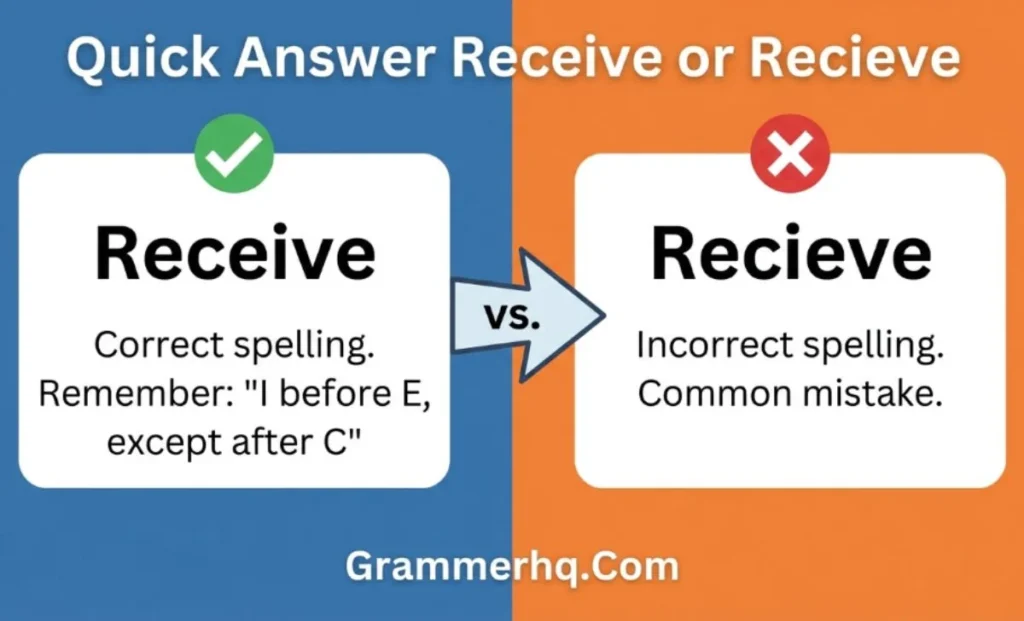
Receive ✅ — correct
Recieve ❌ — incorrect
The verb receive means to get or be given something.
Did you receive my message?
On the other hand, recieve has no separate meaning. Writers use it as an incorrect spelling of receive.
What Does Receive Mean?
Receive usually means to get or be given something.
For example, you can receive an email, package, payment, invitation, award, or piece of information.
She received an invitation to the event.
The verb can also describe other situations. A host can receive guests, while an idea or proposal can be well received, meaning people respond to it positively.
The new proposal was well received by the team.
So, the exact meaning depends on the situation, but the basic idea remains connected to getting, accepting, or experiencing something.
Why Is Receive Spelled With EI?
The tricky part of receive is the ei sequence.
A traditional spelling aid says:
I before E except after C.
This phrase helps explain why receive uses ei rather than ie. However, English has many exceptions, so you should treat it as a memory aid rather than a perfect rule.
For receive, a simpler approach works well: remember the ei after c.
You can also connect the spelling with other -ceive words, including:
- deceive
- conceive
- perceive
- receive
Therefore, remembering the -ceive pattern can help you recognize the correct spelling more quickly.
Receive vs Recieve Examples
Here are some everyday examples:
Please let me know when you receive the documents.
I received a package this morning.
We expect to receive payment tomorrow.
She received an award for her work.
Did you receive my text?
In each sentence, receive refers to getting or being given something. Because the word appears frequently in emails, messages, business writing, and everyday communication, learning its spelling is useful.
Receive, Received, Receiving, and Receiver
The base word receive also appears in several related forms.
| Correct Form | Common Misspelling |
|---|---|
| receive | recieve |
| receives | recieves |
| received | recieved |
| receiving | recieving |
| receiver | reciever |
Received
Received is the past tense and past participle of receive.
We received your application yesterday.
Receiving
Receiving is the -ing form.
The store is receiving new stock today.
When you add -ing, the final e in receive drops:
receive → receiving
Notice that the ei remains unchanged.
Receiver
A receiver is a person or thing that receives something.
The radio receiver stopped working.
Learning these forms together makes the related spellings easier to recognize.
Why Do People Write Recieve?
The error usually comes from familiar ie spellings.
Words such as believe, achieve, relieve, piece, and field can make recieve look natural, especially when someone writes quickly.
Pronunciation creates another problem. The incorrect spelling does not normally sound different from receive, so listening cannot tell you which form to write.
Instead, focus on the letters in the middle of the word.
A useful visual reminder is rec-EI-ve.
Receive in American and British English
American and British English use the same spelling: receive.
| English Variety | Correct Spelling |
|---|---|
| American English | receive |
| British English | receive |
| Canadian English | receive |
| Australian English | receive |
Therefore, you do not need to change the spelling for a US or UK audience. Receive remains the standard form.
Common Spelling Mistakes
The spelling mistake does not stop at recieve. The same ie/ei confusion often appears in other forms of the word.
For example:
- recieve ❌ → receive ✅
- recieved ❌ → received ✅
- recieves ❌ → receives ✅
- recieving ❌ → receiving ✅
- reciever ❌ → receiver ✅
These errors all come from changing the ei in receive to ie.
Remember the correct base spelling, and the related forms become much easier to write:
receive → received → receiving → receiver
This keeps the ei pattern in the correct position wherever it applies.
How to Remember Receive
If you often write recieve, keep the memory trick simple:
EI after C
The same spelling pattern appears in words such as deceive, conceive, and perceive.
You can also remember that the word starts with rec- and contains -ceive:
re + ceive
This approach is easier than trying to memorize a long list of spelling rules.
FAQs
1: Is receive or recieve correct?
Receive is correct. Recieve is a misspelling.
2: How do you spell receive?
The correct spelling is:
R-E-C-E-I-V-E
3: Is “recieve” a real word?
No. Standard English uses receive. The spelling recieve represents a common writing error.
4: Is it received or recieved?
Received is correct.
I received your email.
5: Is it receiving or recieving?
Receiving is correct.
We are receiving new applications.
6: Is it receiver or reciever?
Receiver is correct.
The receiver needs to be replaced.
7: Is receive spelled differently in British English?
No. British and American English both use receive.
8: What is an easy way to remember receive?
Remember EI after C. You can also connect receive with deceive, conceive, and perceive.
Conclusion
Conclusion
When it comes to receive or recieve, the correct spelling is always receive. Recieve is a common spelling mistake, not a different or acceptable form of the word.
The easiest way to remember the correct spelling is EI after C: rec-ei-ve. This same pattern appears in related words such as deceive, conceive, and perceive, making it easier to recognize the correct spelling.
Remember receive → received → receiving → receiver, and you can avoid several common mistakes in this word family. When in doubt, choose receive.
Read More Blogs
- Succesful vs Successful: Which Spelling Is Correct?
- Crummy vs Crumby: Meaning, Difference & Correct Usage
- Humor vs Humour: American vs British English Explained?