Goodmorning or good morning? The correct standard English form is good morning, written as two separate words.
It is a common greeting used when you meet someone in the morning, whether you are speaking to a friend, greeting a coworker, starting an email, or addressing a group.
Cambridge Dictionary lists good morning as a greeting used when meeting someone in the morning.
The one-word form goodmorning may appear in usernames, social media posts, or quick typing, but it is not the standard spelling of the everyday greeting. The same distinction applies in both American and British English.
Quick Answer
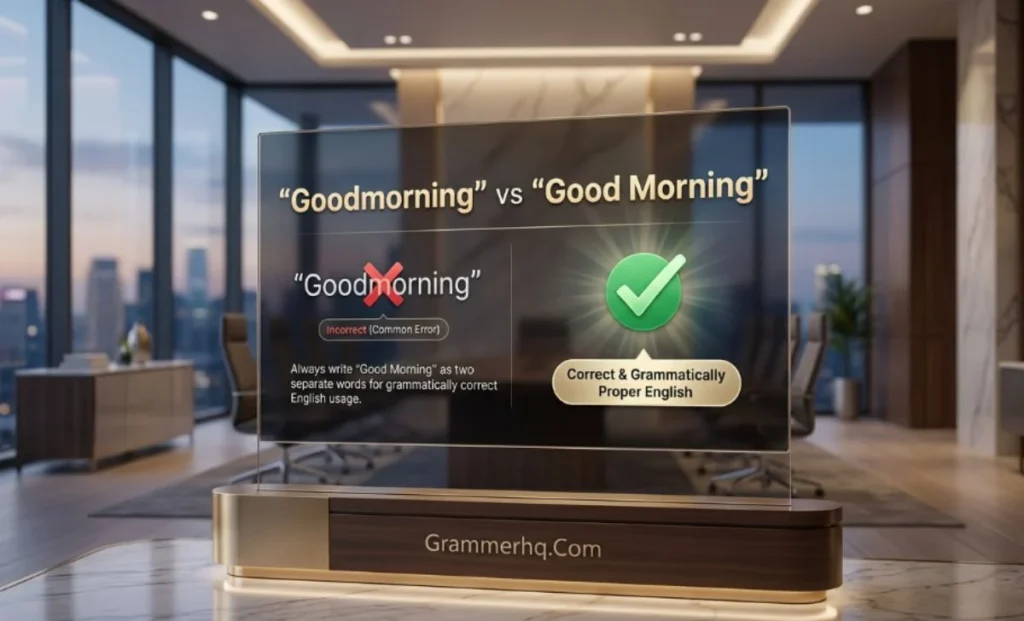
Good morning is correct. Goodmorning is not the standard spelling of the greeting.
| Form | Standard English? | Example |
|---|---|---|
| good morning | ✅ Yes | Good morning, Sarah. |
| Good morning | ✅ Yes | Good morning, everyone. |
| goodmorning | ❌ No | Avoid it in standard writing. |
| good-morning | ❌ Not the standard greeting | Do not hyphenate it as a greeting. |
Cambridge Dictionary records good morning as an English greeting and gives examples such as “Good morning!” and “Good morning, everyone.”
So, if you are writing a school assignment, professional email, message, article, or formal document, use good morning.
Why Is “Good Morning” Written as Two Words?
Good morning is an established two-word greeting.
The word good functions as an adjective, while morning is a noun. Together, they form the familiar expression used to greet someone during the morning.
For example:
- Good morning!
- Good morning, Mr. Lee.
- I hope you have a good morning.
- Good morning, team. Let’s get started.
The fact that the phrase is commonly spoken as one smooth expression does not make it one written word. English has many expressions that sound closely connected but remain separate words in writing.
It is also important not to create a broad rule that every adjective-noun combination must be written separately. English compounds develop according to established usage.
Words such as bedroom and toothbrush are closed compounds, while expressions such as high school and coffee table remain open. The standard spelling of this particular greeting is simply good morning.
Goodmorning vs Good Morning
The difference is mainly about word spacing.
Good morning
Use good morning when you are giving the normal morning greeting.
Examples:
Good morning, Sarah.
Good morning, everyone.
Good morning! How are you today?
I said good morning to my teacher before class.
Goodmorning
Goodmorning is not the standard written form of the greeting.
You may still see it online because people type quickly, combine words in usernames, or use unusual branding and styling. Seeing goodmorning online does not change the standard spelling.
For standard English, write:
Good morning ✅
not:
Goodmorning ❌
This distinction matters particularly in professional emails, schoolwork, applications, business communication, and published writing.
Is “Good Morning” Capitalized?
It depends on where the phrase appears.
At the beginning of a sentence
Capitalize Good because it begins the sentence:
Good morning, everyone.
Good morning! How are you?
In the middle of a sentence
Use lowercase when the phrase appears as part of an ordinary sentence:
I said good morning to my neighbor.
She wished everyone a good morning.
In a title or heading
Capitalization can depend on the title style being used:
Good Morning Messages for Friends
Good Morning: A Simple Guide to Morning Greetings
The important point is that capitalization does not turn “good morning” into a different spelling. The phrase remains two words.
Do You Need a Comma After “Good Morning”?
When you directly address a person or group, a comma normally separates the greeting from the name or direct address.
For example:
Good morning, James.
Good morning, everyone.
Good morning, team.
The comma is known as a direct-address comma. The Chicago Manual of Style notes that the comma in greetings such as “good morning, Joe” is the standard form and is appropriate when the greeting directly addresses someone.
However, you do not need a comma when good morning stands alone:
Good morning!
Good morning.
So the useful rule is simple:
Greeting + person’s name/group = use a comma.
Standalone greeting = no comma needed.
Is “Goodmorning” Ever Correct?
For the ordinary English greeting, goodmorning is not the standard form.
However, context matters. You might encounter the closed spelling as:
- a username
- a social media handle
- a brand or product name
- stylized online content
- an informal typing error
A special name or brand can intentionally use unusual spelling. That does not make the spelling standard English.
For example, if a company officially calls itself Goodmorning, you would preserve its name when referring to that company. But when you are simply greeting someone, write good morning.
How to Use “Good Morning” in an Email
Good morning works naturally in both professional and casual emails. Your punctuation and wording can change according to the relationship and level of formality.
Professional email
Good morning, Ms. Carter,
Thank you for sending the report.
Workplace email
Good morning, team,
Here are the updated meeting notes.
Email to someone you know
Good morning, David,
I hope you’re doing well.
Short message
Good morning! I’ll send the file shortly.
For a professional message, Good morning gives you a clear and conventional opening. The greeting itself does not need to be changed to goodmorning.
Can You Write “Good Morning” in a Text Message?
Yes. Good morning is completely natural in text messages, chats, and social media.
For example:
Good morning! Hope you have a great day.
Good morning 😊
Good morning, everyone. Are we still meeting at 10?
In very casual digital communication, people sometimes use lowercase:
good morning! hope you slept well.
That is a style choice, not a reason to remove the space between the words.
So:
good morning ✅
goodmorning ❌ in standard English
Good Morning vs Goodnight: Why Are They Different?
This is one reason people hesitate over the spelling.
English uses:
- good morning
- good afternoon
- good evening
- goodnight
The forms do not all follow the same spacing pattern.
You cannot assume that because goodnight is commonly written as one word, good morning should also become one word. English spelling includes many established compounds and open phrases, and their forms have developed through usage.
There is also a difference in how these expressions can function. Good morning is commonly used as a greeting, while goodnight is commonly used when saying farewell or wishing someone a good night.
The safest approach is not to invent a spelling pattern from one expression. Use the established form for each phrase.
Common Mistakes With “Good Morning”
A few small mistakes can change the way good morning looks in standard English. The good news is that each one is easy to fix.
1. Joining the two words
❌ Goodmorning, Sarah.
✅ Good morning, Sarah.
The standard greeting uses a space between good and morning.
2. Leaving out the comma
❌ Good morning Sarah.
✅ Good morning, Sarah.
When you address someone directly, a comma normally separates the greeting from the person’s name.
3. Using unnecessary capital letters
❌ I said Good Morning to him.
✅ I said good morning to him.
Here, the greeting appears in the middle of the sentence, so good morning does not need initial capitals.
4. Adding a hyphen
❌ Good-morning, everyone.
✅ Good morning, everyone.
Unlike a hyphenated compound, the standard greeting is written as two separate words.
5. Joining the words in a message
❌ I sent a “goodmorning” message.
✅ I sent a “good morning” message.
Even in casual digital writing, keeping the space makes the standard spelling clear.
Overall, the main rule is simple: write “good morning” as two words. Then, depending on the sentence, use capitalization and punctuation that fit the context.
Good Morning: Quick Usage Guide
| Situation | Correct form |
|---|---|
| Greeting one person | Good morning |
| Greeting a group | Good morning, everyone |
| Professional email | Good morning, Sarah, |
| Casual text | Good morning! |
| Middle of a sentence | good morning |
| Beginning of a sentence | Good morning |
| Standard spelling | good morning |
| One-word spelling | goodmorning ❌ |
FAQs
Is “good morning” one word or two?
Good morning is two words. It is the standard English form of the morning greeting.
Is “goodmorning” correct?
Not as the standard spelling of the ordinary greeting. Use good morning instead.
Should “Good Morning” be capitalized?
Capitalize Good when the phrase begins a sentence or is used according to the capitalization style of a title. In the middle of a normal sentence, use lowercase: good morning.
Do you put a comma after “Good morning”?
Use a comma when directly addressing someone: Good morning, James. A standalone greeting does not need a comma: Good morning! The Chicago Manual of Style supports the comma in direct-address greetings.
Can I use “good morning” in a professional email?
Yes. Good morning is a natural and professional email greeting. For example: Good morning, Ms. Carter,.
Why is “goodnight” one word but “good morning” two?
They are established English expressions with different standard forms. The spelling of goodnight does not create a rule that good morning should be written as one word.
Is “Good Morning” correct in American and British English?
Yes. Good morning is standard in both American and British English. Cambridge provides both UK and US dictionary entries for the expression.
Conclusion
If you’re choosing between goodmorning or good morning, use good morning. It is the standard two-word English greeting used in conversations, emails, texts, workplace communication, and everyday writing.
Remember three simple points: keep the space, capitalize according to sentence or title context, and use a comma when directly addressing someone.
Good morning, Sarah. ✅
Goodmorning, Sarah. ❌
Once you remember that the standard greeting is good morning, this common spelling question becomes easy to settle.
Read More Blogs

Hi, I’m Amelia Parker, a grammar enthusiast and writer at GrammarHQ.com. I specialize in explaining spelling differences, confusing words, and common English mistakes through simple, practical, and easy-to-understand guides.










