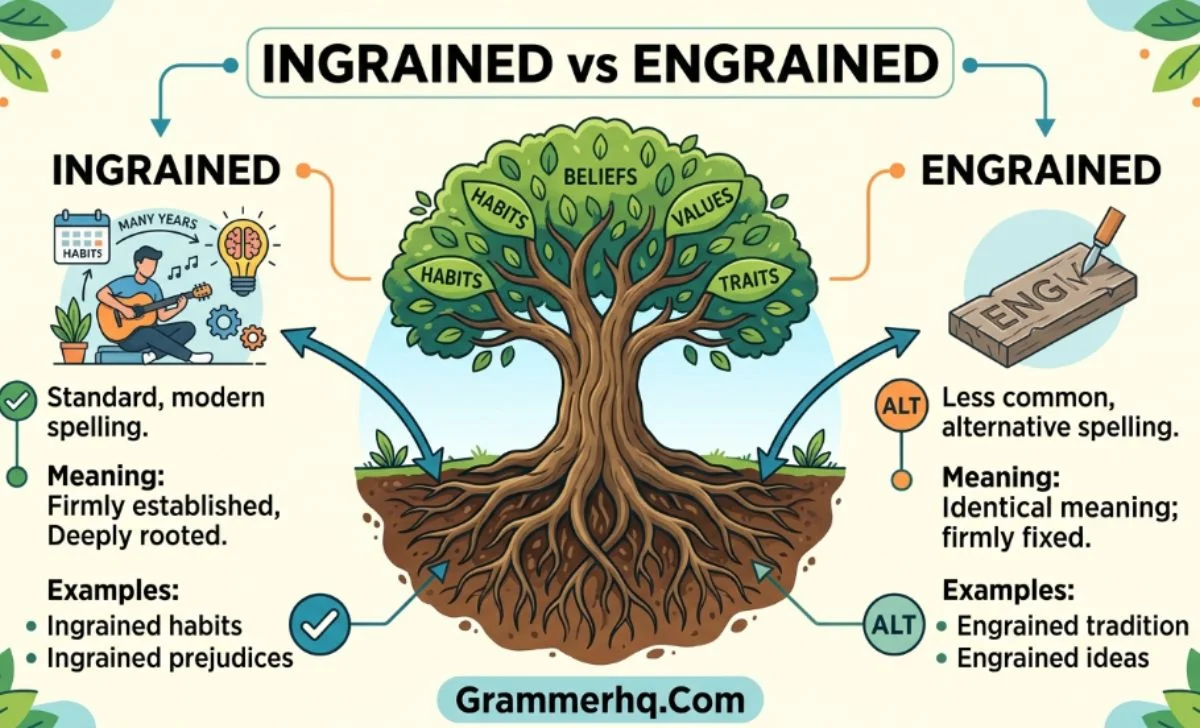
Ingrained and engrained look almost the same, so it is easy to wonder which spelling you should use. Both forms appear in English, but they do not have the same level of use today.
In most cases, ingrained is the spelling you want. It describes a habit, belief, attitude, or behavior that has become deeply fixed and hard to change.
Engrained is much less common and can overlap with ingrained, but most modern writers choose ingrained.So, if you are writing an email, article, essay, or professional document, ingrained is the safer choice.
Quick Answer
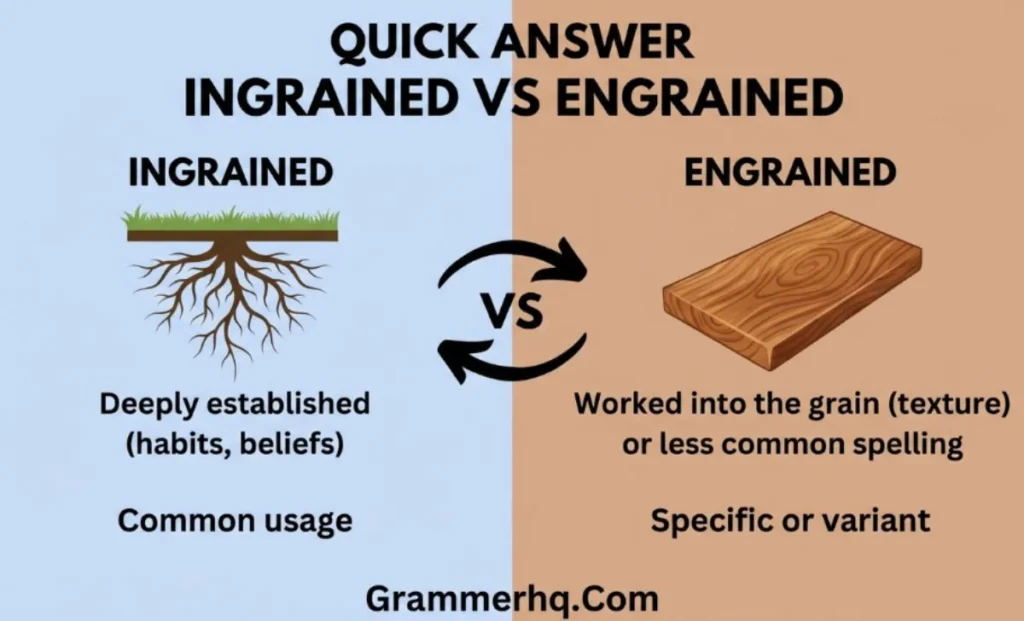
Ingrained is the standard and much more common spelling in modern English.
Use ingrained when you mean something that is:
- deeply fixed
- firmly established
- difficult to change
- deeply rooted in someone’s thoughts or behavior
Engrained is also found in English, but it is far less common.
Example:
Her habit of checking every detail is deeply ingrained.
Simple rule: When you mean a deeply fixed habit, belief, attitude, or behavior, choose ingrained.
What Does Ingrained Mean?
Ingrained means deeply fixed or firmly established. It often describes something that develops over time and becomes difficult to change.
You can use it for habits, beliefs, attitudes, behaviors, traditions, and other qualities.
Examples of Ingrained
- He has an ingrained habit of arriving early.
- Her love of books is ingrained in her personality.
- The belief is deeply ingrained in the community.
- Years of practice created an ingrained routine.
- Good manners became ingrained from childhood.
In all these examples, ingrained shows that something has become a strong and lasting part of a person or group.
What Does Engrained Mean?
Engrained is a less common English form that overlaps with ingrained. Some writers use it to describe something deeply fixed, marked, or embedded.
However, modern readers see ingrained much more often, especially when the word describes a habit, belief, attitude, or behavior.
For that reason, engrained can look unusual even though you may find it in dictionaries or published writing.
Examples of Engrained
You may see engrained in sentences such as:
The pattern was engrained into the surface.
The image left an engrained mark.
These uses focus more on the idea of something being deeply impressed or embedded.
Still, when you want to describe a person’s habit or belief, ingrained remains the better choice.
Ingrained vs Engrained: What Is the Difference?
The main difference comes down to common usage and meaning.
| Word | Main idea | Modern usage |
|---|---|---|
| Ingrained | Deeply fixed or firmly established | Very common |
| Engrained | Deeply fixed, marked, or embedded | Much less common |
For most everyday writing, ingrained is the clear winner.
For example:
She has an ingrained habit of checking her work.
This sounds natural to modern English readers.
You could find engrained in similar writing, but it is much less common:
She has an engrained habit of checking her work.
The first version is the better choice for normal modern English.
Why Do People Confuse Ingrained and Engrained?
The two words cause confusion for several simple reasons.
First, they look almost identical. The only major spelling difference is the first vowel.
Second, they sound very similar in normal speech.
Finally, engrained appears in real English, so writers may wonder whether it is simply another correct spelling of ingrained.
That last point matters. Engrained is not just a random misspelling. It has a history of use and can appear in dictionaries and published sources.
However, frequency matters when you choose a word. Ingrained has become the normal choice for the meaning “deeply fixed” or “firmly established.”
When Should You Use Ingrained?
Choose ingrained when you describe something that has become a strong part of someone’s thinking, behavior, or character.
Common examples include:
- ingrained habit
- ingrained belief
- ingrained attitude
- ingrained behavior
- ingrained tendency
- ingrained tradition
- deeply ingrained idea
- deeply ingrained fear
Example Sentences
His fear of failure is deeply ingrained.
The team has an ingrained culture of hard work.
Her attention to detail is an ingrained part of her work.
These traditions are deeply ingrained in the local culture.
Here, ingrained clearly means deeply established.
When Can You Use Engrained?
You may encounter engrained in two main situations.
1. As a less common form of ingrained
Some writers use engrained with the same general meaning as ingrained.
For example:
The idea was engrained in his mind.
This form exists, but most writers would choose:
The idea was ingrained in his mind.
2. For something deeply marked or embedded
Some uses of engrained connect with the idea of something being deeply impressed into a surface or material.
For example:
The design was engrained in the material.
Even here, the exact choice can depend on the writer and context. If you simply want to describe something that has become deeply fixed in someone’s mind or behavior, ingrained remains the safest option.
Ingrained vs Engrained Examples
These examples show the usual difference more clearly.
Habits
Preferred:
Checking his work twice became an ingrained habit.
Beliefs
Preferred:
The belief is deeply ingrained in her thinking.
Behavior
Preferred:
His calm behavior is ingrained after years of training.
Traditions
Preferred:
The custom is deeply ingrained in the community.
A physical mark
You may see engrained when a writer wants to suggest that something has become deeply marked or embedded:
Dirt was engrained in the fabric.
However, writers often choose ingrained in figurative contexts and may use other words such as embedded, ground in, or etched for physical contexts.
Is Ingrained More Common Than Engrained?
Yes. Ingrained is much more common in modern English.
This difference becomes especially clear in phrases such as:
- deeply ingrained beliefs
- deeply ingrained habits
- deeply ingrained attitudes
- deeply ingrained behavior
- deeply ingrained traditions
These phrases are well established and widely understood.
Therefore, if you want your writing to sound natural and familiar, ingrained should usually be your first choice.
Is Engrained Wrong?
No, not in every context.
It would be too simple to call engrained completely wrong because the word has real usage and appears in dictionaries and published English.
The better approach is to look at the meaning and context.
If you mean deeply fixed or firmly established, use ingrained.
If you come across engrained, it may represent a less common variant or a context involving something deeply marked or embedded.
For general writing, though, ingrained is the safer and more familiar option.
Ingrained or Engrained: Which One Should You Use?
Use this quick rule:
Use “ingrained” for habits, beliefs, attitudes, behaviors, traditions, and ideas that are deeply fixed.
For example:
Good manners were ingrained in him from childhood.
Her fear of public speaking is deeply ingrained.
The tradition is ingrained in the culture.
If you are unsure which spelling to choose, ingrained will usually be the right answer.
How to Remember the Spelling
Think of ingrained as something that has become deeply rooted.
A habit can become so strong that it feels like part of a person’s nature. That is the main idea behind ingrained.
For example:
Waking up early became an ingrained habit.
Once you connect ingrained with “deeply rooted,” the spelling becomes easier to remember.
Common Mistakes With Ingrained and Engrained
One common mistake is choosing engrained simply because it looks like the natural spelling.
Another mistake is assuming that engrained and ingrained have exactly the same level of popularity.
They do not.
For most modern English writing, ingrained is the familiar and preferred form.
Incorrect choice for most standard usage:
She has an engrained belief in hard work.
Better choice:
She has an ingrained belief in hard work.
The second sentence sounds more natural and matches common modern usage.
FAQs
1: Is ingrained or engrained correct?
Ingrained is the standard and much more common choice when you mean deeply fixed, firmly established, or difficult to change. Engrained also appears in English but is much less common.
2: Is engrained a misspelling of ingrained?
Not necessarily. Engrained has real usage and appears in dictionaries and published sources. However, many writers use it where ingrained would be the more familiar choice.
3: Which is more common: ingrained or engrained?
Ingrained is much more common in modern English, especially when the word describes habits, beliefs, attitudes, and behavior.
4: Should I say deeply ingrained or deeply engrained?
Use deeply ingrained. It is the standard and far more familiar expression.
5: What does deeply ingrained mean?
Deeply ingrained means something has become very firmly fixed or rooted and may be difficult to change.
For example:
The habit is deeply ingrained.
6: Is ingrained an adjective?
Yes. Ingrained commonly works as an adjective. It describes something that has become deeply fixed or firmly established.
7: What is the difference between ingrained and engraved?
Ingrained usually describes something deeply fixed in thoughts, habits, behavior, or character. Engraved usually means that words, pictures, or marks have been cut or pressed into a physical surface.
Final Verdict
When choosing between ingrained vs engrained, go with ingrained in most cases.
Ingrained is the standard, familiar spelling for something that has become deeply fixed, rooted, or difficult to change. It works especially well for habits, beliefs, attitudes, behaviors, traditions, and ideas.
Engrained is a much less common form and can appear in some contexts, but it is not the spelling most readers expect.
The easiest rule to remember is simple:
Deeply fixed or rooted = ingrained.
If you are writing for a general audience and you are unsure which form to use, ingrained is the safest choice.
Read More Blogs