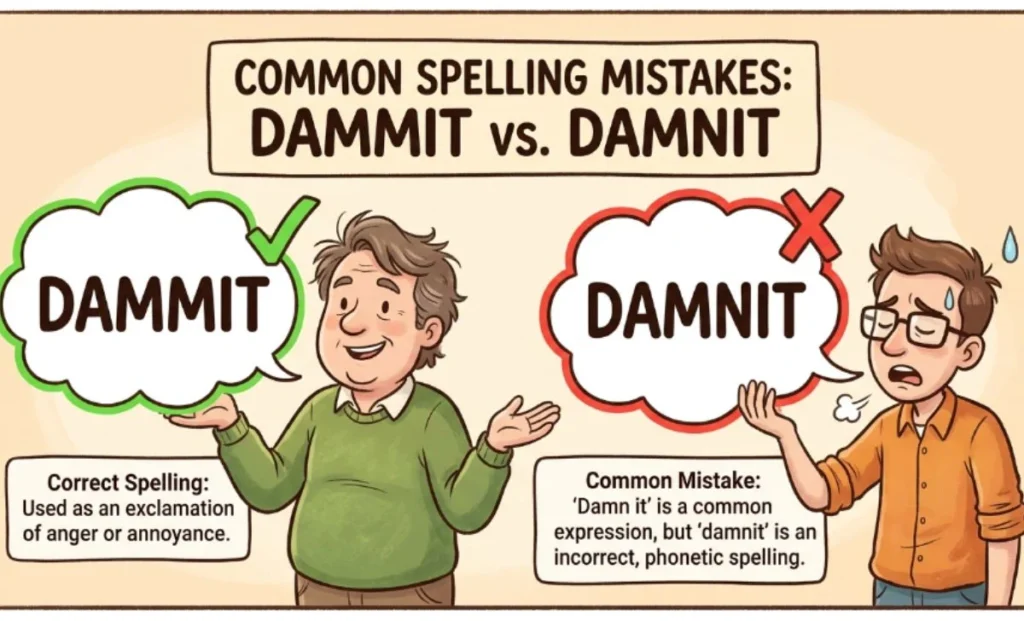
If you are wondering about Dammit or Damnit 2026, you are not alone. These two spellings are often confused because they look and sound very similar, but dammit is the standard spelling in modern English.
Damnit is commonly seen as a variant or informal spelling, but it is less widely accepted in standard English writing.
Understanding the difference can help you choose the appropriate form when writing dialogue, informal messages, or everyday English.
Quick Answer
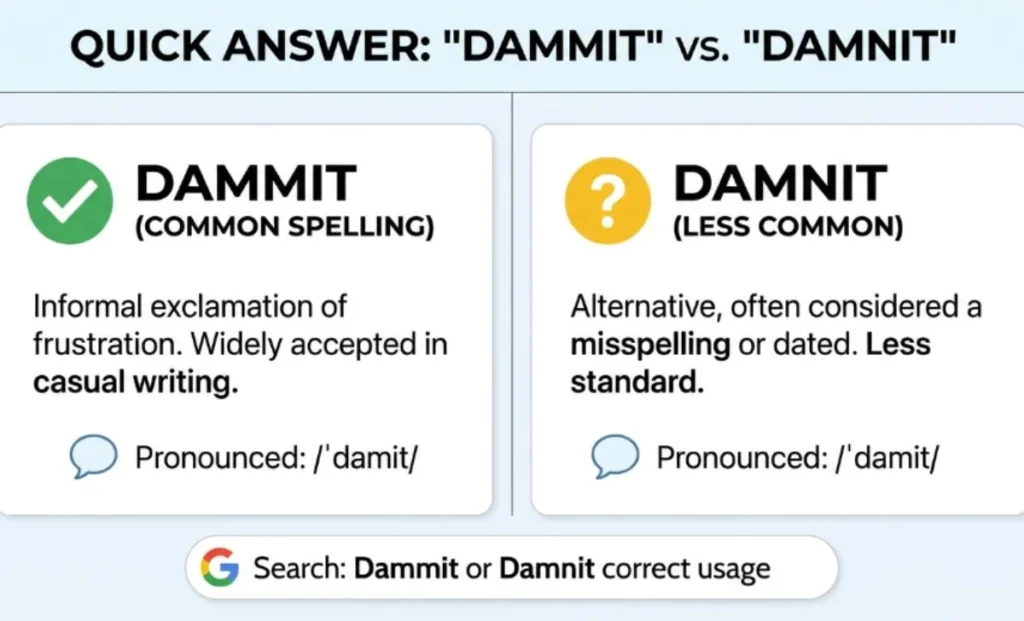
The preferred spelling is dammit. It is an informal exclamation derived from the phrase damn it and is commonly used to express frustration, annoyance, anger, or disappointment.
The spelling damnit appears online, but most dictionaries and style guides do not recognize it as the standard form. In formal writing, the best choice is usually damn it.
Correct Examples
- Dammit, I forgot my keys again.
- Dammit, that was my last chance.
- He shouted, “Dammit!” after dropping his phone.
Incorrect Examples
- Damnit, I forgot my keys again.
- Damnit, that was my last chance.
- He shouted, “Damnit!” after dropping his phone.
What Does Dammit or Damnit Mean?
Both spellings are intended to express the same emotion. They function as an interjection used when someone feels upset, frustrated, annoyed, or disappointed.
Common Meanings
| Term | Meaning |
|---|---|
| Dammit | Informal expression of frustration, annoyance, or anger |
| Damnit | Informal variant or misspelling of dammit |
| Damn it | Standard phrase from which dammit developed |
The expression is commonly used during moments of irritation, surprise, disappointment, or emotional reaction.
Simple Usage Examples
- Dammit, I missed the bus.
- Dammit, the file was not saved.
- Damn it, I made the same mistake again.
- She whispered, “Dammit,” after losing the game.
The Origin of Dammit or Damnit
Understanding the history of these spellings helps explain why one form became more common than the other.
Word History
The phrase damn it has existed in English for centuries. It combines the verb damn with the pronoun it and is used as an emotional expression.
Over time, speakers began blending the two words together in casual speech. This led to the development of dammit, which became popular in novels, films, television shows, and everyday conversation.
Why the Confusion Happens
Several factors contribute to the confusion:
- Both words sound nearly identical when spoken.
- Informal writing often ignores standard spelling conventions.
- Social media encourages creative spellings.
- Many people spell words based on pronunciation.
- Online forums frequently spread nonstandard variants.
Because of these factors, many writers mistakenly assume that dammit and damnit are equally correct.
British English vs American English
Unlike many English spelling differences, there is no significant regional variation between these forms.
Comparison Table
| English Version | Preferred Form |
|---|---|
| American English | Dammit |
| British English | Dammit |
| Canadian English | Dammit |
| Australian English | Dammit |
| International English | Dammit |
Across major English-speaking countries, dammit remains the preferred informal spelling.
Dammit or Damnit vs Other Variations
Several alternative spellings appear online, but only a few are considered acceptable.
Spelling Comparison Table
| Spelling | Correct? | Usage |
|---|---|---|
| Damn it | Yes | Formal and standard |
| Dammit | Yes | Informal and widely accepted |
| Damnit | No | Nonstandard variant |
| Dam it | No | Misspelling |
The safest option in formal writing is always damn it.
Which Spelling Should You Use?
The correct choice depends on your audience and writing style.
US Audience
American writers typically use dammit in casual communication and damn it in formal writing.
UK Audience
British English follows the same pattern. Formal publications generally prefer damn it, while dialogue and casual writing may use dammit.
International Writing
For global audiences, damn it remains the clearest and most universally accepted choice.
Academic Writing
Academic essays, reports, and research papers should generally avoid both spellings and use formal language instead.
Social Media Usage
Social media users commonly choose dammit because it reflects natural speech patterns. Although damnit appears occasionally, it is far less common.
Common Mistakes with Dammit or Damnit
Many writers make similar errors when using these expressions.
Frequent Errors
- Assuming damnit is the standard spelling.
- Using damnit in professional writing.
- Confusing dammit with damn it.
- Following internet slang instead of accepted English usage.
- Mixing different spellings within the same document.
Corrected Examples
| Incorrect | Correct |
|---|---|
| Damnit, I forgot. | Dammit, I forgot. |
| Damnit, that hurts. | Dammit, that hurts. |
| I always write damnit. | I always write dammit. |
| Dammit is wrong. | Dammit is an accepted informal spelling. |
Dammit or Damnit in Everyday Examples
These expressions appear in various forms of communication.
Emails
Informal email example:
“Dammit, I attached the wrong file.”
Social Media
“Dammit, my internet stopped working again.”
News Writing
Professional journalism generally avoids emotional exclamations and uses neutral language instead.
School Writing
Students should avoid slang expressions and use formal language whenever possible.
Business Writing
Business communication should remain professional and avoid informal exclamations.
Dammit Dool
- The phrase “Dammit Dool” is not a recognized English word or standard expression, making it confusing for many readers.
- In most cases, it appears because of a typo, a misspelling, or a reference to a person’s name rather than a dictionary term.
- If you encountered “Dammit Dool” online, check the surrounding context to understand its intended meaning.
- For accurate English writing, use the correct spelling of established words instead of relying on unfamiliar phrases.
- When in doubt, verify the expression with a trusted dictionary or the original source.
Good dammit meaning
- “Good dammit” is a strong emotional expression people use to show surprise, frustration, excitement, or emphasis, depending on the situation.
- The meaning of “good dammit” changes with context and tone, making it a common phrase in everyday English conversations.
- Many English learners search for “good dammit meaning” to understand whether the phrase is rude, offensive, or acceptable in casual speech.
- In this guide, you’ll learn the exact meaning of “good dammit,” its origin, pronunciation, examples, and when it is appropriate to use.
- If you’re confused about what “good dammit” means, this article explains its definition in simple English with real-life examples and common alternatives.
Dammit or damnit grammar
- “Dammit or damnit” is a common spelling confusion, but “dammit” is the standard and more widely accepted spelling in English grammar.
- Many writers search for “dammit or damnit grammar” to learn which spelling is correct in formal and informal writing.
- This guide explains the difference between dammit vs. damnit, their meanings, pronunciation, and correct usage with clear examples.
- You’ll also discover whether “damnit” is a spelling mistake, an acceptable variant, or simply a less common alternative.
- If you’re unsure whether to write “dammit” or “damnit,” this article will help you choose the correct spelling with confidence.
Dammit synonym
- Dammit synonyms are mild alternative expressions people use to show frustration, annoyance, or disappointment without changing the meaning.
- The best synonym depends on the situation, as some are more polite while others are more emotional. Common alternatives include darn, dang, shoot, and drat, which are widely used in everyday English.
- These words help soften strong language while still expressing your feelings naturally. Choosing the right synonym makes your speech or writing sound more appropriate for different audiences.
Examples:
- Dammit → Darn: Darn, I forgot my wallet at home.
- Dammit → Dang: Dang, I missed the last bus.
- Dammit → Shoot: Shoot, I deleted the wrong file.
- Dammit → Drat: Drat, it’s starting to rain again.
Related Grammar Rules
Understanding related spelling and grammar topics can help improve overall writing accuracy.
Similar Spelling Mistakes
- Woah or Whoa
- Naive or Nieve
- Label or Lable
- Adviser or Advisor
- Embedded or Imbedded
- Verbiage or Verbage
Helpful Grammar Tips
- Use trusted dictionaries when uncertain.
- Follow standard English spelling conventions.
- Avoid relying on social media spellings.
- Proofread before publishing.
- Stay consistent throughout your writing.
FAQ,s
Is dammit or damnit correct?
Dammit is the preferred informal spelling. Damnit is generally considered a nonstandard variant.
What is the correct formal version?
The correct formal version is damn it.
Is damnit a real word?
It appears in informal writing, but it is not widely accepted as the standard spelling.
Why do people write damnit?
Many people spell the word based on pronunciation rather than standard usage.
Can I use dammit in professional writing?
Professional writing generally benefits from more formal language and should avoid informal exclamations.
Is dammit a bad word?
Some people consider it mild profanity, depending on context and audience.
Which spelling is more common?
Dammit is significantly more common than damnit.
Should students use dammit in essays?
No. Academic writing should generally avoid informal exclamations.
Conclusion
The answer to dammit or damnit is straightforward. Dammit is the accepted informal spelling derived from the phrase damn it, while damnit is generally regarded as a nonstandard variant that appears mainly in casual online communication.
If you are writing for academic, professional, or formal purposes, damn it remains the safest and most grammatically correct choice.
Knowing the difference helps improve writing accuracy, maintain consistency, and strengthen credibility.
Whenever you’re unsure, use damn it in formal contexts and dammit in casual situations to ensure your writing aligns with accepted English standards.
Read More Blogs:
- Breath or Breathe – Which Word Should You Use?
- Buffalo or Bison? The One Difference Most People Never Notice
- Leery vs Leary: Which Spelling Is Correct?
- Putty or Puddy: Which Spelling Is Correct?

Hi, I’m Amelia Parker, a grammar enthusiast and writer at GrammarHQ.com. I specialize in explaining spelling differences, confusing words, and common English mistakes through simple, practical, and easy-to-understand guides.