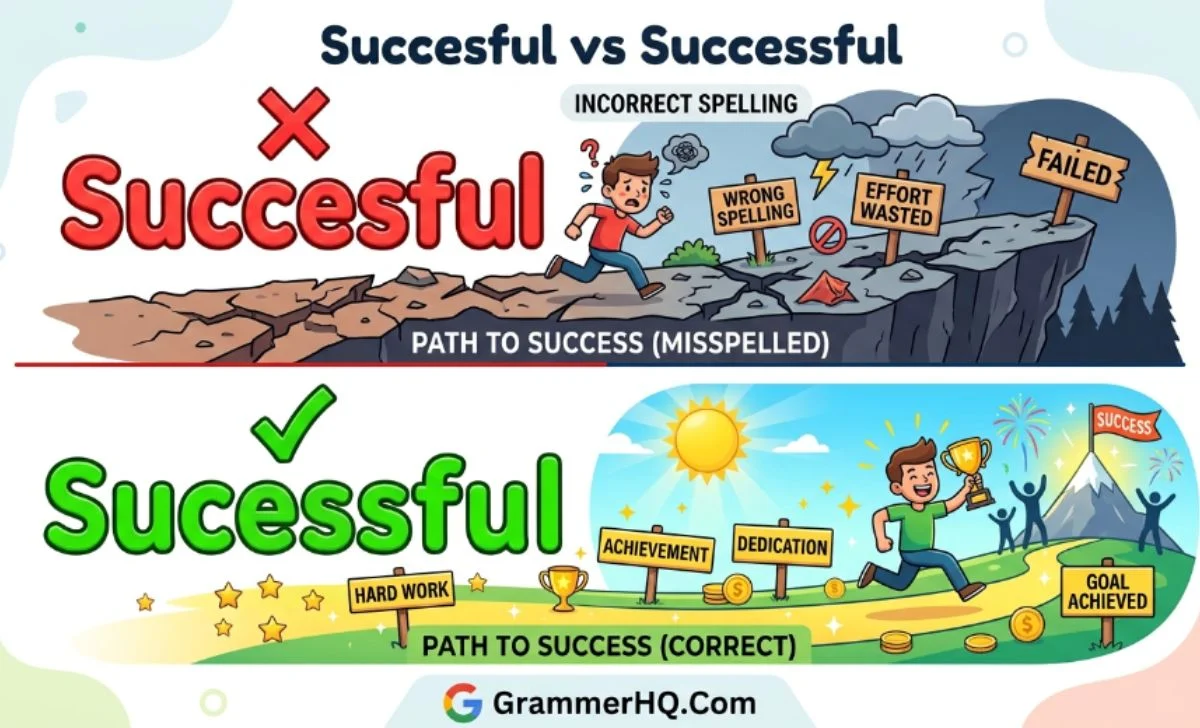
Have you ever paused while typing succesful and wondered if something looked off? You’re not alone. This is one of the most common English spelling mistakes, especially among students, job seekers, content writers, and English learners.
Because the word appears so often in emails, resumes, academic writing, and social media, even confident writers sometimes drop a letter without noticing.
The good news is that the rule is simple once you understand how the word is formed. In this guide, you’ll learn the correct spelling, why succesful is incorrect, how to remember successful easily, and how to use it naturally in everyday writing.
Along the way, we’ll also look at pronunciation, word origin, real-life examples, and common mistakes so you can avoid this error with confidence.
Quick Answer
Which spelling is correct?
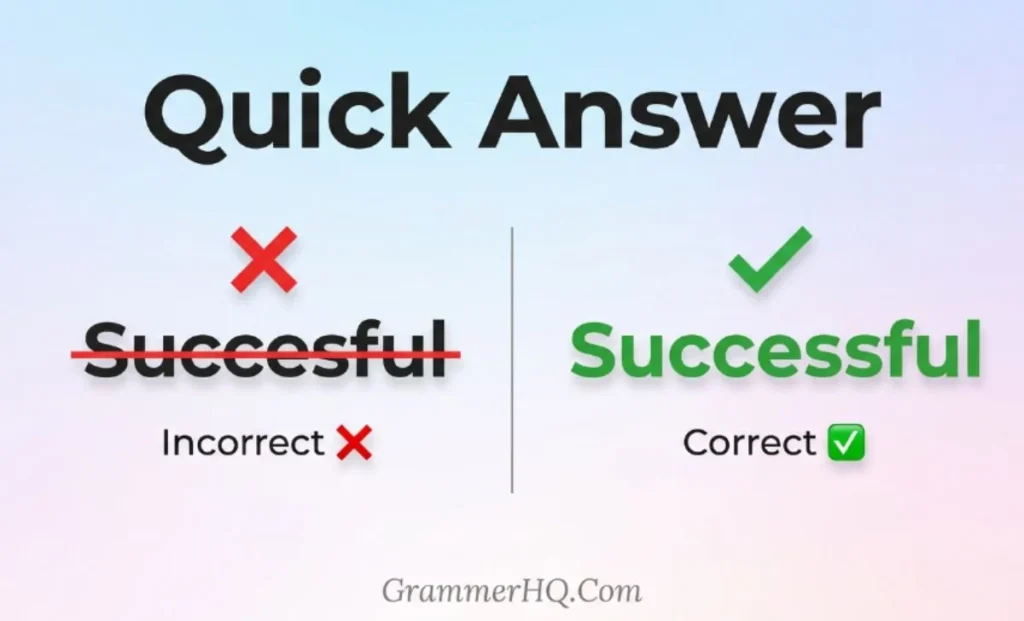
Successful is the correct spelling in both American English and British English.
Succesful is an incorrect spelling and is not accepted by standard English dictionaries or style guides.
| Word | Correct? | Meaning |
|---|---|---|
| Successful | ✅ Yes | Having achieved a desired goal or result |
| Succesful | ❌ No | Incorrect spelling of successful |
Quick takeaway
If you’re writing an essay, sending a professional email, updating your résumé, or posting online, always use successful.
Correct: She became a successful entrepreneur after years of hard work.
Incorrect: She became a succesful entrepreneur.
What Does “Successful” Mean?
Definition
The adjective successful describes a person, project, business, event, or effort that achieves its intended goal. It often refers to positive outcomes, accomplishments, or favorable results.
In simple terms, if something works well or reaches its objective, it can be described as successful.
Examples include:
- A successful business
- A successful student
- A successful interview
- A successful surgery
- A successful marketing campaign
Although the word is commonly associated with money or fame, success can also mean reaching personal, academic, or professional goals.
Part of speech
Successful is an adjective.
It describes a noun.
Examples:
- She is a successful doctor.
- The launch was successful.
- They built a successful startup.
Related word forms include:
| Word | Part of Speech | Example |
|---|---|---|
| Success | Noun | Success takes patience. |
| Succeed | Verb | She worked hard to succeed. |
| Successful | Adjective | He became a successful lawyer. |
| Successfully | Adverb | They successfully completed the project. |
Understanding these related forms also makes it easier to remember the correct spelling.
Pronunciation
Successful is pronounced as:
/səkˈses.fəl/
A simple pronunciation guide is:
suhk-SES-fuhl
The stress falls on the second syllable:
suc-CESS-ful
Even though the pronunciation sounds straightforward, many writers accidentally leave out one of the letters while spelling the word.
Why Is “Succesful” Incorrect?
The missing letter changes the spelling
The mistake happens because many people assume adding -ful to success means removing one s. In reality, English spelling doesn’t work that way.
The base word is:
success
When the suffix -ful is added, the spelling becomes:
success + ful = successful
Notice that the letters from success stay intact before adding the suffix. Nothing is removed.
That is why:
- successful ✅
- succesful ❌
The incorrect version drops one s, creating a spelling that does not exist in standard English.
Why do people spell it as “succesful”?
There are several reasons this mistake is so common.
Double letters are easy to miss
English contains many words with repeated consonants, and our brains often skip one while typing quickly.
Examples include:
- Accommodation
- Occasion
- Embarrass
- Necessary
- Successful
Fast typing
Many spelling errors happen simply because of speed. Writers accidentally omit a letter without realizing it.
Pronunciation doesn’t reveal every letter
When people say successful, the second s isn’t strongly emphasized. Since pronunciation doesn’t clearly highlight every letter, it’s easy to assume only one s is needed.
Influence of other words
Some English words ending in -ful contain only one repeated consonant, leading learners to apply the same pattern incorrectly.
For example:
- Helpful
- Useful
- Careful
However, successful follows the spelling of its root word, success, not the pattern of these simpler adjectives.
Why Is “Successful” Spelled with Two C’s and Two S’s?
Understanding the word’s structure makes the spelling much easier to remember.
It comes from the noun “success”
The adjective successful is built from the noun success.
The noun already contains:
- two c letters
- two s letters
When -ful is added, the original spelling remains unchanged.
Word formation:
- Success
- Success + ful
- Successful
Nothing is removed from the base word.
Understanding the -ful suffix
The suffix -ful means:
- full of
- characterized by
- having
Examples:
| Base Word | Adjective |
|---|---|
| Beauty | Beautiful |
| Hope | Hopeful |
| Care | Careful |
| Meaning | Meaningful |
| Success | Successful |
So, successful literally means full of success or having achieved success.
A simple spelling rule to remember
A useful way to avoid this mistake is to remember the base word first.
Think about the word:
Success
If you can spell success, you can spell successful.
Just add -ful without changing anything.
Success → Successful
This simple habit prevents one of the most common spelling mistakes in English.
Why This Mistake Matters in Real Life
Misspelling successful may seem minor, but it can affect how your writing is perceived in professional and academic settings.
For example:
- A résumé that says “I led a succesful project” may leave a weaker impression on recruiters.
- A student who repeatedly writes succesful in assignments can lose marks for spelling accuracy.
- Business emails or LinkedIn profiles with noticeable spelling errors may appear less polished.
Modern spell-checkers often catch the mistake, but they aren’t perfect—especially when typing on mobile devices, working offline, or using software with limited proofreading features.
Developing the habit of spelling successful correctly helps improve clarity, professionalism, and confidence in every type of writing.
Succesful vs Successful:Comparison
Understanding the difference becomes easy when you compare the two spellings directly.
| Feature | Succesful | Successful |
|---|---|---|
| Correct spelling | ❌ No | ✅ Yes |
| Accepted in dictionaries | ❌ No | ✅ Yes |
| Used in American English | ❌ No | ✅ Yes |
| Used in British English | ❌ No | ✅ Yes |
| Appropriate for academic writing | ❌ No | ✅ Yes |
| Appropriate for professional writing | ❌ No | ✅ Yes |
| Meaning | None (misspelling) | Achieving a desired goal or outcome |
The comparison is straightforward: successful is the only standard spelling accepted in modern English.
When should you use “Successful”?
Use successful whenever you describe someone or something that has achieved its goal.
Examples:
- The company had a successful product launch.
- She became a successful architect after years of practice.
- The operation was successful.
- We completed the project successfully despite the tight deadline.
British English vs American English
Is there any spelling difference?
No. Unlike pairs such as color vs colour or organize vs organise, there is no British-American spelling difference here.
Whether you’re writing in the United States, the United Kingdom, Canada, Australia, New Zealand, or any other English-speaking country, the correct spelling remains:
Successful ✅
Why do people think there are two spellings?
Many English learners assume that if some words have regional spelling variations, succesful might be an accepted British form.
It isn’t.
Major English dictionaries and style references use only successful.
That means you can confidently use the same spelling in:
- Academic essays
- Business reports
- Professional emails
- Books
- News articles
- Blogs
- Social media posts
Common Misspellings Related to “Successful”
Dropping one s isn’t the only mistake people make.
Here are several common misspellings you should avoid.
| Incorrect | Correct |
|---|---|
| Succesful | ✅ Successful |
| Successfull | ✅ Successful |
| Succesfully | ✅ Successfully |
| Succesfullyy | ✅ Successfully |
| Sucessful | ✅ Successful |
| Sucessfully | ✅ Successfully |
These errors usually happen because English contains many words with double consonants, making it easy to forget a letter while typing.
How to Remember the Correct Spelling
You don’t have to memorize complicated grammar rules. A few simple techniques can help you remember the spelling naturally.
Memory Trick #1: Start with “Success”
The easiest trick is to focus on the base word.
Success
Now simply add:
-ful
You get:
Successful
Don’t remove any letters.
Think:
Success + ful = Successful
Memory Trick #2: Success Comes First
Remember this sentence:
You can’t be successful without success.
Since success has two c’s and two s’s, successful keeps them too.
Memory Trick #3: Say It Slowly
Break the word into parts:
Suc + cess + ful
Writing it in chunks helps reduce spelling mistakes, especially during exams or while typing quickly.
Examples of “Successful” in Everyday Sentences
Seeing the word in context makes it easier to remember and use correctly.
School and Education
- She became one of the most successful students in her class.
- Their science project was successful because everyone worked together.
- A successful presentation requires preparation and confidence.
Workplace and Business
- The company launched a successful advertising campaign.
- He is a successful entrepreneur who started with a small business.
- Our meeting was successful, and every goal was achieved.
Job Applications
- She has a successful track record in project management.
- The candidate completed several successful software implementations.
Everyday Conversations
- We had a successful family gathering last weekend.
- Their vacation turned out to be very successful despite the rain.
- The event was more successful than anyone expected.
Real-Life Examples
The word successful appears in almost every area of daily life.
Business
A startup develops a useful app. Within two years, millions of people download it. News reports describe it as a successful startup because it achieved rapid growth.
Education
A student studies consistently for months and earns top grades in the final exams. Teachers often describe that student as successful because they reached their academic goals.
Healthcare
After a complex medical procedure, doctors may announce that the surgery was successful, meaning it achieved the intended outcome.
Sports
A football team wins the league after months of training. Commentators call it a successful season because the team’s hard work produced results.
In every example, successful describes a positive achievement—not perfection.
Words Related to “Successful”
Learning related words expands your vocabulary and strengthens your understanding of the word family.
| Word | Part of Speech | Meaning |
|---|---|---|
| Success | Noun | Achievement of a goal |
| Succeed | Verb | To achieve a goal |
| Successful | Adjective | Having achieved success |
| Successfully | Adverb | In a successful manner |
| Successes | Noun (plural) | Multiple achievements |
Examples:
- Hard work often leads to success.
- She hopes to succeed in her new role.
- The experiment was successful.
- They successfully solved the problem.
- His greatest successes came later in life.
Knowing these related forms helps you choose the right word depending on the sentence.
Common Mistakes to Avoid
Even experienced writers occasionally make spelling mistakes. These habits can help you avoid them.
Don’t rely only on autocorrect
Spell-check tools are helpful, but they can miss errors or fail when you’re using unfamiliar software. Reading your work one final time is always worthwhile.
Remember the root word
Before writing successful, think of success first. This simple habit naturally guides you to the correct spelling.
Watch for double letters
Words with repeated consonants are among the most common sources of spelling mistakes.
Examples include:
- Accommodation
- Occasion
- Necessary
- Embarrass
- Successful
Paying extra attention to these words improves both accuracy and confidence.
Proofread important documents
Before submitting a résumé, sending an email, or publishing an article, scan for frequently misspelled words like successful. A quick review can prevent small errors from creating an unprofessional impression.
Did You Know?
Many people assume successful is difficult because it’s a long word. In reality, the spelling becomes much easier once you remember its root:
Success → Successful
Instead of memorizing the entire word letter by letter, focus on how it’s built. Understanding the pattern is far more effective than rote memorization and helps you spell related words correctly as well.
FAQ,s
Is succesful ever correct?
No. Succesful is always a misspelling. The correct spelling is successful, regardless of whether you’re writing in American English or British English.
How do you spell successful correctly?
The correct spelling is:
S-U-C-C-E-S-S-F-U-L
A simple way to remember it is to start with the word success and then add -ful.
Success + ful = Successful
Why does successful have two c’s and two s’s?
The word comes from the noun success, which already contains two c’s and two s’s. When the suffix -ful is added, the original spelling remains unchanged.
Is successful the same in British and American English?
Yes. Unlike words such as color/colour or center/centre, successful has only one accepted spelling in both British and American English.
What part of speech is successful?
Successful is an adjective. It describes a person, thing, event, or action that has achieved its intended goal.
Examples:
- A successful athlete
- A successful business
- A successful interview
What is the noun form of successful?
The noun form is success.
Example:
- Her success inspired the entire team.
What is the verb related to successful?
The related verb is succeed.
Example:
- If you work consistently, you are more likely to succeed.
What is the adverb form of successful?
The adverb is successfully.
Example:
- The software was successfully installed on all devices.
Why do so many people write succesful?
The mistake usually happens because writers accidentally remove one s while typing. Double letters are easy to overlook, especially in longer words. Understanding that successful comes directly from success makes the correct spelling much easier to remember.
Can spelling successful incorrectly affect professional writing?
Yes. A misspelling in a résumé, job application, business email, academic assignment, or website content can make your writing appear less polished. While one typo may not change your message, consistent spelling accuracy builds credibility and professionalism.
Key Takeaways
Before you leave, remember these essential points:
- Successful is the only correct spelling.
- Succesful is an incorrect spelling and should never be used.
- The word is formed from success + -ful.
- Both British English and American English use the spelling successful.
- Remember the root word success to avoid spelling mistakes.
- Proofreading important documents helps catch common errors before they matter.
Mastering this one spelling rule also makes it easier to use related words like success, succeed, and successfully with confidence.
Conclusion
Although succesful and successful differ by just one letter, only successful is correct in standard English. The confusion often comes from the word’s double letters, but once you understand that it comes directly from success, the spelling becomes much easier to remember.
Whether you’re writing an academic paper, updating your résumé, sending a professional email, or creating online content, using the correct spelling reflects attention to detail and strengthens your credibility. Whenever you’re unsure, think of the root word success, add -ful, and you’ll arrive at the correct form every time.
Read More Blogs:
- Is It Shinning or Shining? The Correct English Spelling Explained
- Leery vs Leary: Which Spelling Is Correct?