You’re typing fast, the word comes out, and suddenly you’re staring at it thinking, does this have one “e” too many? You’re not overthinking it.
This is one of those spellings where your ear and the dictionary genuinely disagree, and almost everyone gets tripped up by it at least once — writers, developers, even editors who should know better.
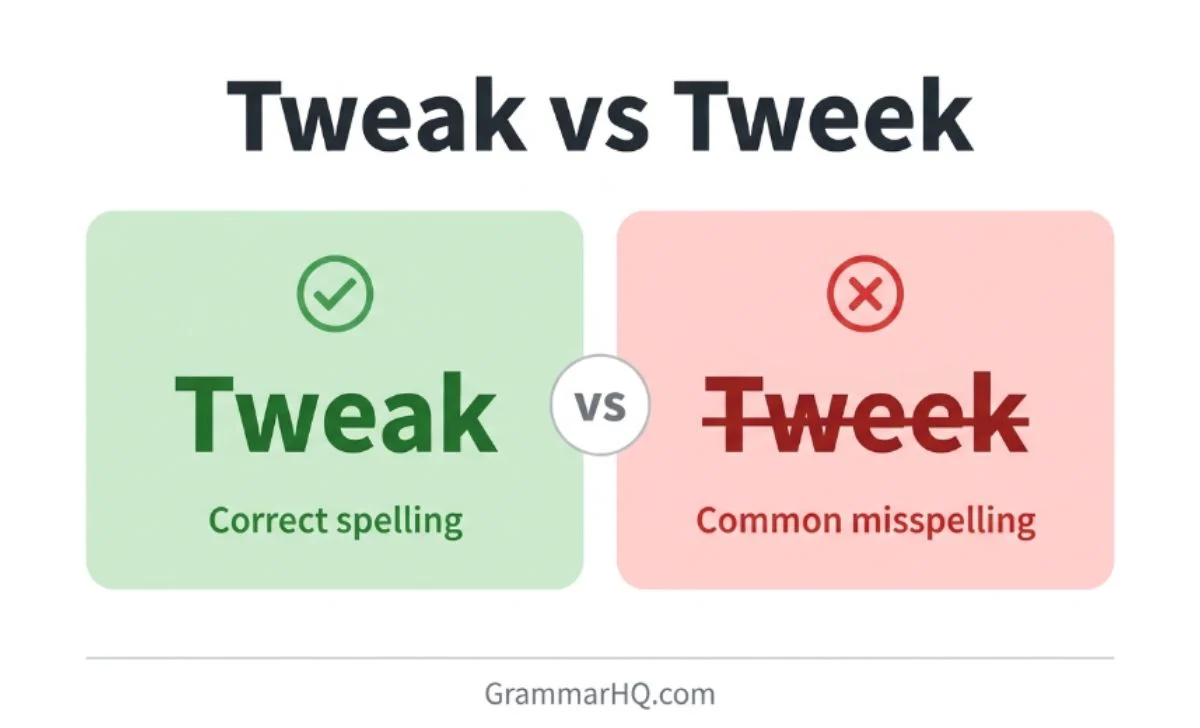
Here’s the short version: Tweak is the word you want. Tweek isn’t one — except as a name.
Here’s everything else, in case you want the full picture.
Quick Answer
| Tweak | Tweek | |
|---|---|---|
| Real word? | Yes | No (proper noun only) |
| Part of speech | Verb / Noun | — |
| Meaning | Small, precise adjustment | — |
| Dictionary entry | Merriam-Webster, Oxford, Cambridge | None |
| Where “Tweek” shows up | Nowhere in standard English | South Park character “Tweek Tweak” |
| Use it in writing? | Always | Never, unless naming that character |
What “Tweak” Means
To tweak something is to nudge it toward better — a small, deliberate change rather than a rebuild. The word shows up the same way across very different fields, always carrying that same sense of scale:
- Everyday speech: “She tweaked her schedule to fit the new meeting.”
- Business: “We need to tweak the proposal before it goes out.”
- Technology: “The team tweaked the app to shave off load time.”
- Design: “The designer tweaked the color balance for better contrast.”
Notice the pattern — nobody “tweaks” something into an entirely new thing. You tweak a paragraph or a setting; you don’t tweak a house into a mansion. That ceiling on scale is baked into the word itself.
Where the Word Comes From
“Tweak” traces back to the Old English twiccian, meaning “to pinch or pull sharply” — the same root that gave us “twitch.” For centuries it described a literal, physical pinch (think of tweaking someone’s ear as a scolding gesture). Industrial and later digital use gradually softened that into today’s meaning: precise, controlled adjustment.
That lineage matters more than it looks. “Twitch,” “tweak,” and even the idea of a quick pinch all share the same DNA of small, sharp, controlled motion — which is exactly why “tweak” still reads as deliberate rather than vague, even in a completely different context like software or design.
Why “Tweek” Feels So Tempting
Every rhyming neighbor of “tweak” — week, peek, seek — spells its long “ee” sound with a double E. “Tweak” quietly breaks that pattern, joining the -eak family instead, alongside speak, creak, and streak. Your ear hears one thing; the spelling rule follows another.
Texting speed and autocorrect make it worse. Autocorrect tools sometimes let “tweek” pass silently, because it’s technically a valid proper noun elsewhere in the English-speaking internet — which brings us to the one real exception.
The One Time “Tweek” Is Correct
Tweek Tweak, a character in South Park, is the sole legitimate use of that spelling — a deliberate pun on being jittery or “tweaked out.” Outside of naming that character, “Tweek” has zero standing in English, formal or casual.
Pronunciation
Tweak is pronounced /twiːk/ — rhyming exactly with sleek, peek, and week. The vowel sound is a long “ee,” even though the spelling uses “ea” instead of “ee.”
Quick rule: if it rhymes with sleek, it’s spelled tweak, not tweek. The sound gives you no clue about the spelling — you have to memorize the pattern separately, the same way you do with “break” and “steak.”
Every Grammatical Form
| Base | Past | Present participle | Plural noun |
|---|---|---|---|
| Tweak | Tweaked | Tweaking | Tweaks |
The “a” survives every conjugation. People who spell the base word correctly sometimes still slip on “tweeked” or “tweeking” — the rule holds across all four forms without exception.
| Wrong | Correct | Note |
|---|---|---|
| Tweek | Tweak | Most common error |
| Tweeked | Tweaked | Same “ee” mistake, past tense |
| Tweeking | Tweaking | Same mistake, continuous form |
| Twik | Tweak | Informal internet shorthand — avoid in writing |
Slang: Three Different Meanings, One Spelling
- Standard use — fine-tuning something: “I tweaked my resume before sending it.”
- Older street slang — erratic, hyperactive behavior, sometimes linked to stimulant use: “He’s been tweaking all night.”
- Gen Z usage — overreacting to something minor: “Why are you tweaking? It’s just a text.”
Context alone tells you which one is in play — none of these are wrong, they just belong to different rooms.
Synonyms, by How Big the Change Is
| Word | Scale of change | Example |
|---|---|---|
| Tweak | Smallest | “Tweak the thermostat by one degree.” |
| Adjust | Small–medium | “Adjust the thermostat for the season.” |
| Refine | Medium, quality-focused | “Refine the argument in paragraph two.” |
| Modify | Medium–large | “Modify the contract terms.” |
| Revise | Large, structural | “Revise the essay’s conclusion.” |
If the change is more than small, a word further down this list fits better than “tweak” — using “tweak” for a major overhaul actually undersells what you did.
When Spelling It Wrong Actually Costs You
A misspelled “tweek” rarely confuses anyone about meaning — context usually saves it. What it does cost is credibility:
- In business writing, it reads as a rushed, unproofread message, which shapes how carefully the rest of your email gets read.
- In technical documentation, an inconsistent spelling next to code or specs looks like it wasn’t reviewed.
- In content published online, search engines and readers both associate correct spelling with trustworthiness, especially on educational or informational pages.
It’s a small error, but it’s a visible one — the kind that’s easy to notice and easy to fix.
Quick Self-Check
Pick the correct spelling in each line:
- Please ___ the settings. (tweak)
- She ___ the recipe last night. (tweaked)
- Stop ___ over something this small. (tweaking)
- That was a minor ___, not a redesign. (tweak)
If you answered “tweak” every time, the spelling has already stuck.
Remembering It for Good
“Tweak” and “adjust” both contain the letter a. That link is the whole trick — no need to fight the rhyme once it sticks. A second backup: picture a dial with a small letter “A” on it, standing for Adjust. Two E’s means you’ve pictured the wrong word.
FAQs
Is “tweek” ever correct in writing? Only as the proper noun Tweek Tweak from South Park. Anywhere else, it’s a misspelling.
Why does “tweak” break the usual spelling pattern? Because English is inconsistent — most long-“ee” words double the E, but “tweak” follows the -eak pattern instead, like “speak” and “creak.”
What’s the difference between “tweak” and “adjust”? Both mean making a change, but “tweak” implies something smaller and more precise, while “adjust” can cover a wider range of modifications.
Does “tweak” mean the same thing in slang as it does formally? No — in slang it can mean fine-tuning (same as formal use), acting erratically, or overreacting, depending entirely on who’s using it and where.
Is “tweaking” in Gen Z slang the same as the dictionary meaning? No. The dictionary meaning is about physical or technical adjustment. The Gen Z usage describes someone overreacting or spiraling about something minor — a completely separate, informal sense.
How is “tweak” pronounced? As /twiːk/, rhyming with “sleek” and “peek” — the spelling just doesn’t match the sound the way those words do.
What’s the fastest way to remember the correct spelling? Link it to “adjust” — both share the letter “a.” If you picture two E’s, that’s your signal you’ve got the wrong word.
Bottom Line
Tweak is the only version recognized by dictionaries and accepted in professional, academic, and everyday writing.
Tweek is either a typo or, capitalized, a reference to one specific cartoon character — nothing else. One letter, the letter “a,” is the entire difference between the two.
Read More Bloogs:
- Capital or Capitol: Which Word Is Correct and Why Does It Matter?
- Discreet or Discrete: Correct Usage, Meaning, and Examples