Have you ever found yourself typing humor in one sentence and humour in another, wondering which spelling is actually correct? If so, you’re far from alone.
This spelling difference confuses students, writers, bloggers, editors, and English learners because both versions appear in books, websites, dictionaries, and professional writing. The truth is that humor and humour have the same meaning and pronunciation.
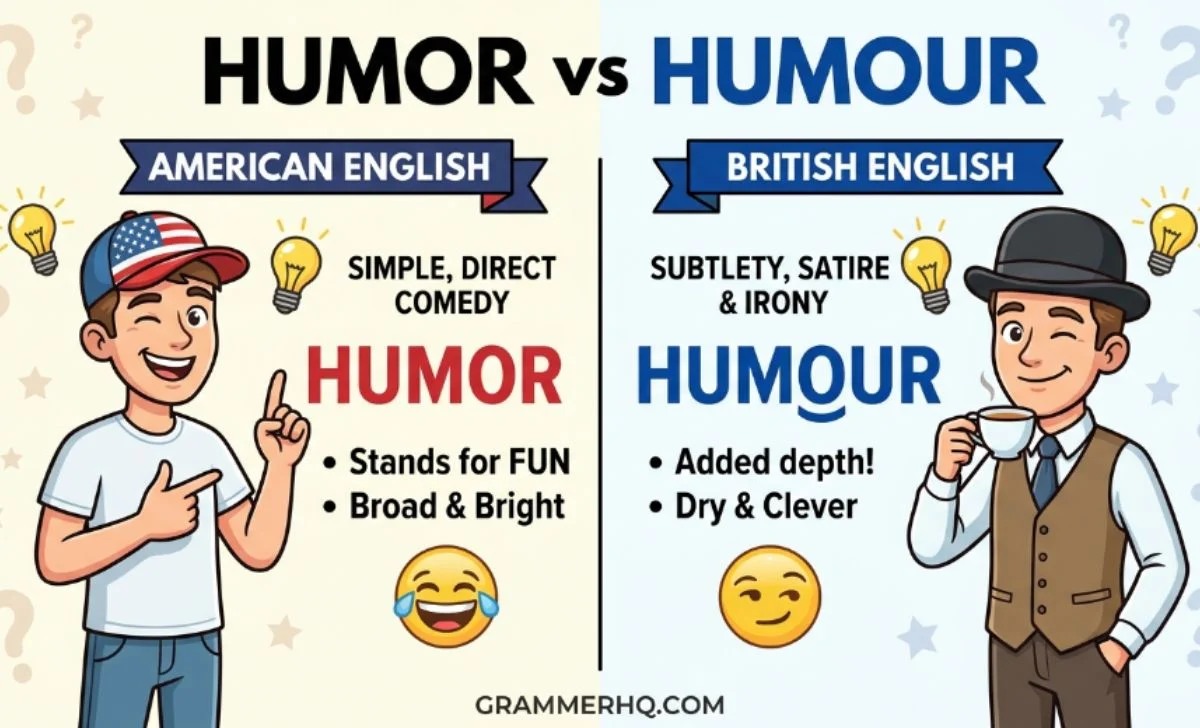
The only difference is the variety of English being used. Humor is the standard spelling in American English, while humour is preferred in British English, Canadian English, Australian English, and most Commonwealth countries.
In this guide, you’ll discover the difference between humor vs humour, learn when to use each spelling, understand why both forms exist, avoid common mistakes, and see practical examples that make choosing the right version effortless.
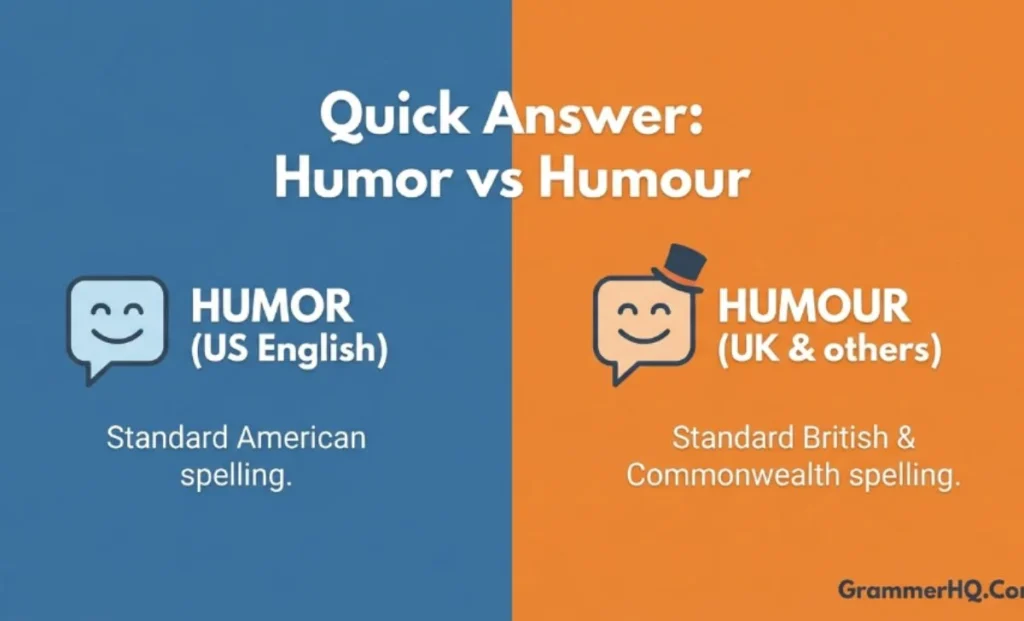
Quick Answer
| Word | Used In | Correct? |
|---|---|---|
| Humor | American English (United States) | ✅ Yes |
| Humour | British English (United Kingdom, Australia, New Zealand, and many Commonwealth countries) | ✅ Yes |
Both words have the same pronunciation, meaning, and grammatical function. The only difference is the spelling convention followed in different regions.
Quick Rule:
Write humor for American audiences and humour for British or international audiences that follow British English conventions.
For example:
- Americans usually write: She has a great sense of humor.
- British writers usually write: She has a great sense of humour.
Humor vs Humour at a Glance
Before exploring the history behind these spellings, here’s a quick comparison that answers the questions most readers have.
Comparison Table:
| Feature | Humor | Humour |
|---|---|---|
| Meaning | The ability to find things funny or amusing | The ability to find things funny or amusing |
| English Variety | American English | British English |
| Pronunciation | Same | Same |
| Grammar | Noun | Noun |
| Correctness | Correct | Correct |
| Used in the United States | ✅ Yes | Rare |
| Used in the United Kingdom | Rare | ✅ Yes |
| Used in Australia & New Zealand | Rare | ✅ Yes |
| Used in Academic Writing | Depends on the style guide | Depends on the style guide |
Key Difference:
The only real difference between humor and humour is the inclusion of the letter “u.”
This pattern appears in several other British and American spelling pairs:
| American English | British English |
|---|---|
| color | colour |
| honor | honour |
| favor | favour |
| labor | labour |
| neighbor | neighbour |
If you’re already familiar with these spelling differences, humor vs humour follows the same rule.
What Does Humor (or Humour) Mean?
Whether you spell it humor or humour, the meaning remains identical.
Definition
Humor (Humour) refers to:
- the ability to recognize or express something funny
- the quality that makes people laugh
- amusing speech, writing, or behavior
- a person’s sense of what is funny
In everyday English, the word often describes jokes, wit, comedy, or light-hearted situations.
Examples in Everyday English
- His humor made the meeting much less stressful.
- British readers appreciated the novel’s dry humour.
- A good teacher often uses humor to keep students engaged.
- Her sense of humour helped everyone stay positive during difficult times.
Notice that changing the spelling doesn’t change the meaning—it simply reflects the writer’s regional English preference.
Common Contexts
You’ll frequently see humor or humour in:
- comedy and entertainment
- books and novels
- newspapers and magazines
- workplace communication
- speeches and presentations
- education
- psychology
- media reviews
- everyday conversation
Because the word is used in so many contexts, choosing the right spelling helps your writing feel natural to your target audience.
Why Are There Two Spellings?
Many English learners assume one spelling is old and the other is incorrect. In reality, both developed through the history of the English language.
Understanding why humor and humour coexist makes the spelling difference much easier to remember.
British English Kept the Traditional Form
For centuries, English borrowed thousands of words from French and Latin. Many of these words included the ending -our, which became standard in British English.
As a result, British English continues to use spellings such as:
- colour
- favour
- honour
- labour
- humour
These spellings remain the accepted standard in the United Kingdom and many countries that follow British English.
American English Preferred Simpler Spellings
During the early years of the United States, American educators and lexicographers promoted more consistent and simplified spelling conventions.
One of the most influential figures was Noah Webster, whose dictionaries encouraged spellings like:
- color instead of colour
- honor instead of honour
- labor instead of labour
- humor instead of humour
These simplified forms gradually became the standard across American English and are still used today.
The Difference Isn’t About Correctness
A common misconception is that one spelling is “more correct” than the other. That’s not true.
Think of it this way:
- If you’re writing for readers in the United States, humor is the expected spelling.
- If your audience is in the United Kingdom or follows British English, humour is the preferred choice.
Professional writers, publishers, universities, and businesses simply choose the spelling that matches their regional style guide and then use it consistently throughout the document.
Why Consistency Matters More Than the Spelling
One mistake many writers make is mixing humor and humour in the same article without a reason.
For example:
❌ The author’s humour is brilliant, and his humor makes every chapter enjoyable.
This looks inconsistent unless you’re intentionally comparing American and British English.
Instead, stick with one spelling throughout your article:
✅ The author’s humor is brilliant, and it makes every chapter enjoyable.
or
✅ The author’s humour is brilliant, and it makes every chapter enjoyable.
Consistency improves readability, looks more professional, and aligns with the expectations of style guides, editors, and search audiences.
Which Countries Use Humor and Which Use Humour?
The choice between humor and humour depends on the variety of English your audience expects. Neither spelling is better than the other—they simply follow different language standards.
Understanding regional usage is especially important if you write for international readers, publish online, or create academic or business content.
United States
In the United States, humor is the standard spelling.
You’ll find it in:
- Newspapers
- Universities
- Government publications
- Business documents
- American books
- Websites and blogs
Examples:
- She has an excellent sense of humor.
- The movie is full of clever humor.
If your audience is primarily American, this is the spelling you should use consistently.
United Kingdom
British English uses humour.
It appears in:
- British newspapers
- UK universities
- Publishing houses
- Educational materials
- Government documents
Examples:
- British readers enjoy dry humour.
- His humour made the speech memorable.
Canada:
Canadian English is unique because it combines elements of both British and American English.
Traditionally, Canadian dictionaries and many government publications prefer humour, following British spelling conventions. However, American spellings such as humor also appear, especially in digital content, marketing, and cross-border communication.
The safest approach is to follow the style guide required by your organization or publication and remain consistent.
Australia and New Zealand
Both countries follow British English, so humour is the standard spelling.
Examples include:
- Australian school textbooks
- Newspapers
- Government websites
- Publishing
Other English-Speaking Regions
Many countries that follow British English conventions—including Ireland, South Africa, and several Commonwealth nations—generally use humour.
Pronunciation Guide
One of the biggest surprises for English learners is that humor and humour are pronounced exactly the same.
The extra “u” changes the spelling—not the pronunciation.
American Pronunciation
Humor
IPA: /ˈhjuː.mɚ/ (or /ˈjuː.mɚ/ in some accents)
Example:
“His sense of humor makes everyone laugh.”
British Pronunciation
Humour
IPA: /ˈhjuː.mə/
Example:
“Her sense of humour is wonderfully dry.”
Although the final sound varies slightly between American and British accents, that difference comes from the accent itself—not from the spelling.
Remember: Never choose one spelling because you think it sounds different. It doesn’t.
When Should You Use Humor?
Choose humor whenever you’re writing in American English or targeting readers in the United States.
Academic Writing
If you’re following an American style guide such as APA or Chicago, use humor.
Example:
The study examined how humor influences classroom engagement.
Business Writing
American companies expect American spelling.
Examples:
- company blogs
- marketing campaigns
- internal reports
- emails
- product descriptions
Example sentence:
Our brand uses humor to make technical topics easier to understand.
Websites and SEO Content
If your website mainly serves U.S. visitors, use humor consistently across:
- URLs
- Headings
- Meta titles
- Meta descriptions
- Body content
Consistency helps create a professional reading experience and aligns with audience expectations.
When Should You Use Humour?
Use humour whenever your content follows British English conventions.
British Publications
British magazines, publishers, and newspapers almost always use humour.
Example:
British literature often includes subtle humour.
Education
Schools and universities in the UK typically teach and expect British spelling.
Example:
The essay explores the role of humour in Shakespeare’s plays.
International Organizations
Many organizations outside the United States adopt British English for consistency across international audiences.
If that’s your style guide, humour is the correct choice.
Real-Life Examples
Understanding the rule is helpful, but seeing it in everyday situations makes it much easier to remember.
Everyday Conversation
American English
I love her sense of humor.
British English
I love her sense of humour.
The message is identical. Only the regional spelling changes.
School Assignment
American Student
Mark Twain used humor to criticize society.
British Student
Charles Dickens often included humour in his novels.
Business Email
American Company
We believe a little humor makes customer support feel more personal.
British Company
A touch of humour can make professional communication more engaging.
Social Media
American Brand
Monday meetings need more humor.
British Brand
Mondays always need more humour.
The tone remains the same while the spelling matches the audience.
Publishing
Imagine you’re publishing the same novel in two markets.
U.S. Edition
The author’s humor shines throughout the story.
U.K. Edition
The author’s humour shines throughout the story.
Many international publishers localize spelling for different editions instead of changing the content itself.
Common Mistakes to Avoid
Even experienced writers sometimes make simple spelling mistakes when switching between American and British English.
Mixing Both Spellings
❌ Incorrect
The novel combines British humour with American humor throughout.
Unless you’re specifically comparing the two spellings, this looks inconsistent.
✅ Better
Choose one spelling and use it throughout the document.
Assuming One Spelling Is Wrong
Many learners think humour is outdated or that humor is incorrect.
Neither belief is true.
Both spellings are accepted by major dictionaries. The only difference is regional usage.
Ignoring Your Audience
Suppose you’re writing a university application for a British institution.
Using humor repeatedly may appear inconsistent with British English conventions.
Likewise, filling an American publication with humour can look unusual to U.S. readers.
Always write for the audience you expect to read your work.
Copying Different Sources Without Editing
This often happens when writers combine information from multiple websites.
For example:
- One source uses humor.
- Another uses humour.
If you paste examples from both without checking, your article becomes inconsistent.
A quick proofreading pass can prevent this problem.
Easy Memory Trick
Need a simple way to remember the difference?
Think About the Letter “U”
- Humour has an extra U.
- United Kingdom also starts with U.
So you can remember:
U for United Kingdom → Humour
No extra U?
That’s the American spelling:
Humor → United States
This trick also works for similar spelling pairs:
- color → colour
- honor → honour
- favor → favour
- labor → labour
Once you recognize the pattern, these spelling differences become much easier to remember.
Humor vs Humour in Popular Style Guides
Professional writers don’t choose spellings randomly. They follow the style guide required by their organization, publisher, or institution.
APA Style
APA follows the language variety you choose at the beginning of your document.
- American English → humor
- British English → humour
The important rule is consistency.
MLA Style
MLA also recommends remaining consistent with the chosen variety of English.
If your paper uses American English, continue using humor throughout.
If you’re writing in British English, use humour consistently.
Chicago Manual of Style
The Chicago Manual of Style generally follows American English, so humor is the standard choice unless a publisher specifies otherwise.
Oxford Style
Oxford and most British publishing standards use humour because they follow British English spelling conventions.
Quick Recap Before Moving On:
So far, we’ve established that:
- Humor is the standard spelling in American English.
- Humour is the standard spelling in British English.
- Both words have the same meaning, pronunciation, and grammatical role.
- The only difference is regional spelling preference.
- The most important writing rule is to choose one spelling and stay consistent throughout your document.
FAQ,s
Is humor or humour correct?
Both are correct. Humor is the standard spelling in American English, while humour is the preferred spelling in British English and many Commonwealth countries. The meaning and pronunciation are the same.
Why do British people spell it humour?
British English preserves the traditional -our spelling that developed through French and Latin influences. That’s why British English also uses words such as colour, honour, favour, and labour.
Why did American English remove the “u”?
American English gradually adopted simplified spellings during the 19th century. Lexicographer Noah Webster promoted forms like color, honor, labor, and humor to create a more consistent American spelling system.
Does humor mean something different from humour?
No. Both words have exactly the same meaning. They refer to the ability to recognize, appreciate, or express something funny or amusing.
Which spelling should I use in academic writing?
Follow the style guide or language variety required by your school, university, journal, or publisher.
- Use humor for American English.
- Use humour for British English.
Whichever spelling you choose, use it consistently throughout your document.
Is humour used in Canada?
Yes. Canadian English traditionally prefers humour, although humor also appears in some digital, business, and cross-border content. The best choice depends on the organization’s style guide.
Can I use both spellings in the same article?
Generally, no.
Unless you’re specifically comparing American and British English—as this article does—you should choose one spelling and use it consistently from beginning to end.
Does pronunciation change?
No. Both spellings are pronounced almost identically. Any small difference you hear comes from the speaker’s accent rather than the spelling itself.
Which spelling should English learners use?
Learn both spellings because you’ll encounter each in books, websites, exams, and everyday reading.
When writing, simply match the variety of English you’re using.
Final Verdict: Humor or Humour?
After comparing both spellings, the answer is straightforward.
Quick Recap:
- Humor = American English
- Humour = British English
- Same pronunciation
- Same meaning
- Same grammar
- Only the regional spelling differs
Neither spelling is more correct than the other. The best choice depends entirely on your audience.
Which Spelling Should You Choose?
Use humor if you’re writing for:
- American readers
- U.S. businesses
- American universities
- Websites targeting the United States
- Content following American style guides
Use humour if you’re writing for:
- British readers
- UK publishers
- Australian and New Zealand audiences
- Many Commonwealth countries
- Content following British English conventions
If your audience is global, decide which variety of English you’ll follow before you begin writing—and stay consistent from the first sentence to the last.
Conclusion
Choosing between humor and humour isn’t about finding one “correct” spelling—it’s about using the spelling that matches your audience and the variety of English you’re writing in.
Humor is the standard form in American English, while humour is preferred in British English and many Commonwealth countries.
Since both words share the same meaning, pronunciation, and grammatical function, consistency is far more important than the spelling itself.
By understanding this simple regional difference, you’ll write with greater confidence and present polished, professional content wherever your audience is.
Read More Blogs:
- Molding vs Moulding: American vs British English Explained
- Plow or Plough: British vs American English?

Hi, I’m Amelia Parker, a grammar enthusiast and writer at GrammarHQ.com. I specialize in explaining spelling differences, confusing words, and common English mistakes through simple, practical, and easy-to-understand guides.