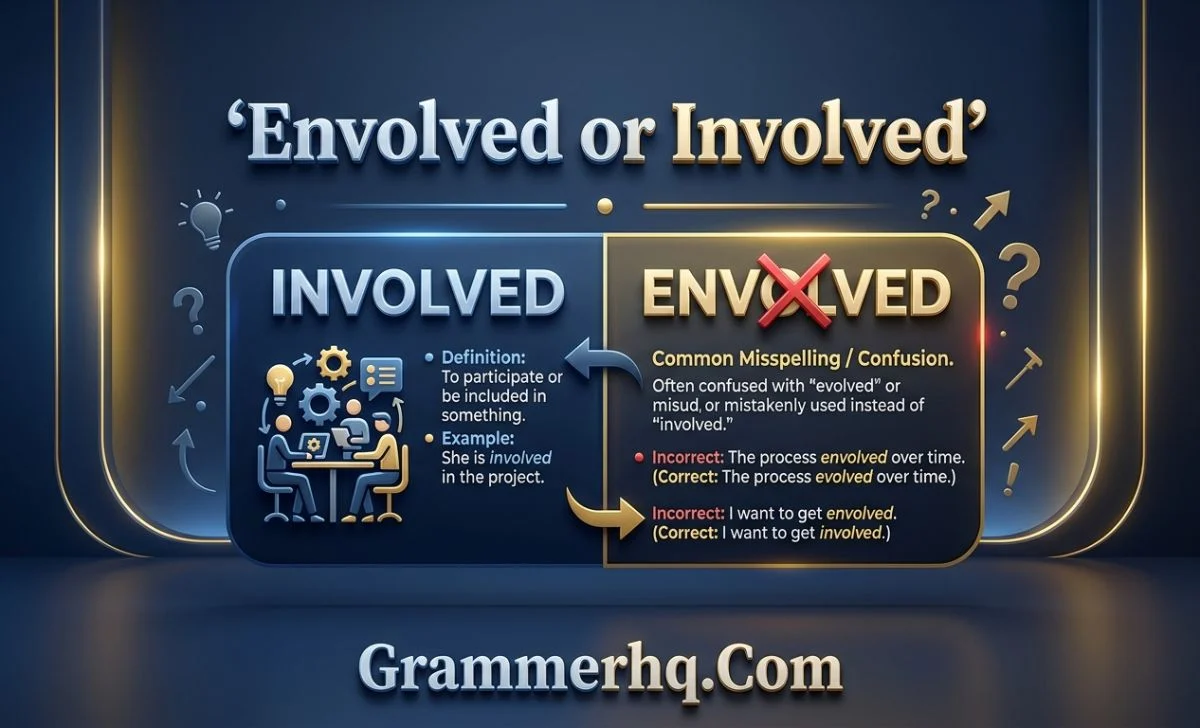
Envolved or involved? Involved is the correct spelling in modern English. Envolved is not the standard modern form of involve.
Use involved when you mean connected, included, participating, affected, or emotionally connected.She was involved in the school project.
The modern word family follows a clear pattern:
involve, involves, involved, involving, involvement
However, one historical detail explains why envolved can look familiar. Older English used envolve as a spelling of involve. Today, standard contemporary English uses involve and involved.
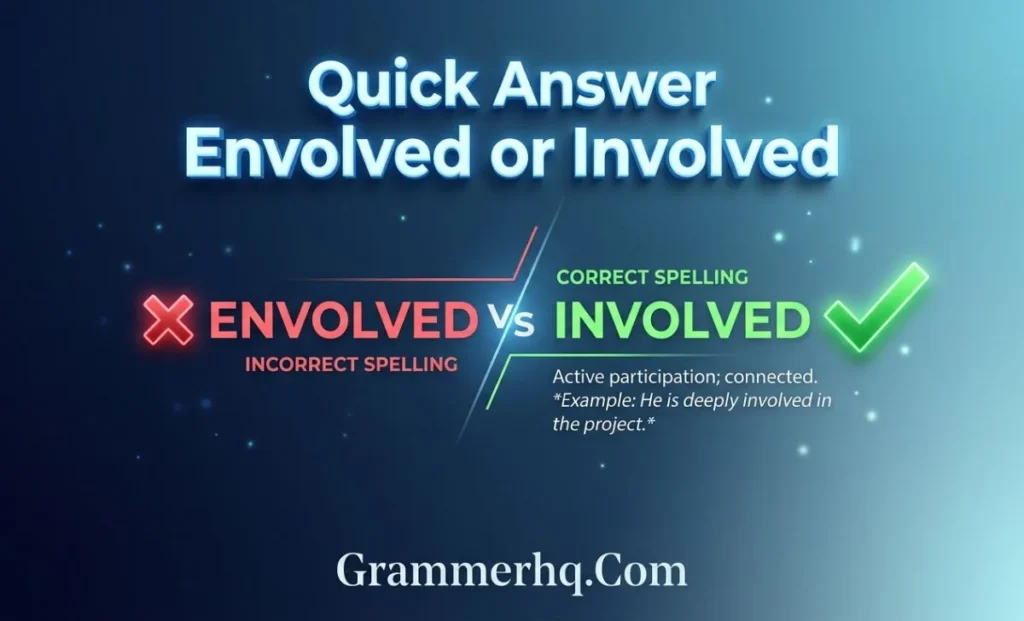
Quick Answer
| Spelling | Modern English | Meaning |
|---|---|---|
| involved | ✅ Correct | Connected, included, participating, affected, or complicated |
| envolved | ❌ Not standard | Not the modern form of involve |
For example:
- ✅ She was involved in the project.
- ✅ Several students were involved in the competition.
- ✅ Two vehicles were involved in the accident.
- ❌ She was envolved in the project.
So, the easiest rule is:
involve → involved
If you are writing an email, essay, report, application, website, or school assignment, choose involved.
Envolved or Involved: Why Is “Involved” Correct?
Modern English uses involve as the standard verb. Its past tense and past participle both take the form involved.
Consider the main forms:
involve → involves → involved → involving
For example:
The job involves working with customers.
For a past situation, use involved:
The job involved working with customers.
The spelling pattern stays consistent across these forms. In particular, involved, involving, and involvement all keep the invol- beginning.
Therefore, envolved does not match the standard modern word family.
Is “Envolved” a Real Word?
In contemporary standard English, envolved is not the form you should use.
There is, however, a useful historical explanation. Older English used envolve as an alternative spelling of involve. As a result, an older text may contain envolve or a related form.
That historical usage can make envolved look familiar. Still, historical spelling does not determine the standard form used today.
For modern writing, remember:
involve → involved
Older English may show:
envolve
Today, however, writers should choose involve and involved for standard contemporary English.
What Does “Involved” Mean?
The meaning of involved changes slightly with context. Most often, the word describes participation, connection, inclusion, effect, or complexity.
Involved Means Taking Part
When someone participates in an activity, project, event, or organization, involved describes that participation.
Sarah is involved in the community project.
Several students were involved in the competition.
In these examples, the people take part in the activity.
Involved Means Included or Affected
The word can also describe people or things connected to a situation.
Two cars were involved in the accident.
Several departments were involved in the decision.
Here, involved tells us that someone or something forms part of the situation.
Involved Means Engaged
A person can become involved when they give time, attention, or effort to something.
Maria is actively involved in local sports.
He became deeply involved in the project.
In this context, the word suggests a strong level of participation.
Involved Means Complicated
The adjective involved can also describe something complicated or detailed.
The legal procedure was extremely involved.
The application process became more involved than I expected.
Here, involved does not describe participation. Instead, it describes something with many details or parts.
Involved Can Describe a Relationship
The word can also describe an emotional or romantic connection.
They became emotionally involved.
She was romantically involved with him.
The surrounding words make the intended meaning clear.
Involve, Involved, Involving, and Involvement
Learning the whole word family makes the spelling easier to remember.
| Word | Grammar | Example |
|---|---|---|
| involve | Base verb | The job may involve travel. |
| involves | Present-tense form | The job involves travel. |
| involved | Past tense / past participle / adjective | She was involved in the project. |
| involving | -ing form | The report covers issues involving education. |
| involvement | Noun | Her involvement was important. |
The same spelling pattern appears throughout the modern family:
involve → involved → involving → involvement
Because the invol- beginning remains consistent, forms such as envolved, envolving, and envolvement do not match the standard modern word family.
Once you remember that pattern, the correct spelling becomes much easier to recognize.
Involved or Evolved: What Is the Difference?
Involved and evolved look similar, but they have different meanings.
The word involved usually describes connection, participation, or inclusion.
The manager was involved in the project.
By contrast, evolved describes gradual development or change.
The project evolved into a larger program.
Use involved when a person or thing connects to a situation, activity, or project. In comparison, evolved works when something develops or changes over time.
A simple memory aid makes the difference easier to remember:
Involved = connected or participating
Evolved = developed or changed
For example, a teacher can become involved in a new program, while that program may evolve over several years.
Involved or Enveloped: What Is the Difference?
Enveloped creates another common spelling trap. Although the words look somewhat alike, their meanings differ.
The verb envelop means to surround or cover something.
Thick fog enveloped the town.
Meanwhile, involved can describe participation or connection.
Local residents were involved in the emergency response.
Compare them here:
| Word | Meaning | Example |
|---|---|---|
| involved | Connected or participating | She was involved in the project. |
| evolved | Developed gradually | The plan evolved over time. |
| enveloped | Surrounded or covered | Fog enveloped the valley. |
As a result, involved, evolved, and enveloped should not replace one another.
Involved In or Involved With?
Both involved in and involved with are correct. The best choice depends on the relationship you want to describe.
When to Use “Involved In”
Use involved in for participation in an activity, project, event, investigation, or situation.
She is involved in the project.
He was involved in the investigation.
Several people were involved in the accident.
They are involved in organizing the event.
This construction commonly focuses on participation or connection to an activity.
When to Use “Involved With”
Use involved with when you want to describe a connection with a person, organization, group, activity, or relationship.
She is involved with a local charity.
He became involved with the organization.
She was romantically involved with him.
Both constructions work in standard English. Context determines the more natural choice.
How Do You Pronounce “Involved”?
The pronunciation differs slightly between British and American English.
- UK: /ɪnˈvɒlvd/
- US: /ɪnˈvɑːlvd/
The final -ed does not create another syllable. Instead, it ends with a /d/ sound.
Compare:
involve → /ɪnˈvɒlv/
involved → /ɪnˈvɒlvd/
For English learners, the key point is simple: pronounce the word as one word with the stress on the second syllable.
Why Do People Write “Envolved”?
Several factors can make envolved look believable.
The First Vowel Sounds Less Clear
The first syllable in involved does not carry the main stress. During quick speech, that unstressed vowel can sound less distinct.
As a result, some writers may choose the wrong initial letter when they spell the word from memory.
Evolved Looks Similar
The words involved and evolved share the ending -volved.
involved
evolved
Because of that visual similarity, writers can mix them up.
“En-” Is a Familiar English Beginning
English contains many words that begin with en-. Consequently, envolved may look like a plausible English spelling even though modern English does not use it as the standard form of involve.
Historical Spelling Adds Another Layer
The historical spelling envolve also matters. Older texts may contain that form, so readers can encounter it and assume that envolved remains acceptable today.
Modern usage has settled on involve and involved.
Common Envolved and Involved Mistakes
These examples show the standard modern forms:
| ❌ Nonstandard modern form | ✅ Standard modern form |
|---|---|
| She was envolved in the project. | She was involved in the project. |
| He is deeply envolved in his work. | He is deeply involved in his work. |
| Three cars were envolved in the accident. | Three cars were involved in the accident. |
| The research envolved several universities. | The research involved several universities. |
| His envolvement was important. | His involvement was important. |
| The report discusses issues envolving education. | The report discusses issues involving education. |
The pattern stays consistent: modern forms use invol-.
Once you remember that pattern, the correct spelling becomes much easier to recognize.
Real-Life Examples of “Involved”
You can use involved in many everyday situations.
- At work: Our design team took part in the product launch.
- At school: Several students joined the science competition.
- In an accident: Two vehicles were involved in the collision.
- In research: The study involved more than 500 participants.
- In a community project: Local residents joined the cleanup effort.
- In a relationship: They became emotionally involved.
- For something complicated: The application process proved more involved than I expected.
These examples show why context matters. The same spelling can describe participation, connection, emotional attachment, or complexity.
A Simple Trick to Remember the Spelling
Try this memory trick:
If you’re IN something, you’re INvolved in it.
Think of the connection:
IN → INvolved
For example:
I am in the project.
I am involved in the project.
You can also memorize the main word family:
involve → involved → involving → involvement
The invol- pattern remains stable, so you can use it as a spelling check whenever you hesitate.
Is “Envolved” Ever Correct in Modern English?
For ordinary contemporary writing, choose involved rather than envolved.
Older English presents a different situation because envolve appeared as a historical spelling of involve. Therefore, readers may find the older form in historical material.
That historical usage does not make envolved the standard modern spelling.
For current writing, use:
❌ envolved
✅ involved
This rule works for emails, essays, websites, reports, applications, assignments, and everyday messages.
FAQs
Is “envolved” correct or “involved”?
Involved is the correct modern spelling. Envolved is not the standard modern form of involve.
Is “envolved” a word?
Envolved is not the standard modern form of involve. However, envolve appeared historically as a spelling of involve, which explains why the form may look familiar.
What is the past tense of “involve”?
The past tense is involved.
The job involved working with customers.
What is the past participle of “involve”?
The past participle is also involved.
Several people took part in the project.
Is “involved” a verb or an adjective?
It can function as both. As a verb form, involved gives the past tense and past participle of involve. As an adjective, it can describe someone or something as connected, participating, emotionally attached, or complicated.
What is the difference between “involved” and “evolved”?
Involved describes connection, participation, or inclusion. In contrast, evolved describes gradual development or change.
She was involved in the project.
The project evolved over time.
What is the difference between “involved” and “enveloped”?
Involved can mean connected with or participating in something. On the other hand, enveloped means surrounded or covered.
The volunteers were involved in the rescue effort.
Dense fog enveloped the road.
Should I use “involved in” or “involved with”?
Both are correct. Involved in commonly describes participation in an activity, project, event, or situation. Meanwhile, involved with often describes a connection with a person, organization, group, or relationship.
How do you pronounce “involved”?
The UK pronunciation is /ɪnˈvɒlvd/, while the US pronunciation is /ɪnˈvɑːlvd/. In both cases, the final -ed produces a /d/ sound.
What is the noun form of “involved”?
The related noun is involvement.
Her involvement in the project was valuable.
What are the correct forms of “involve”?
The main modern forms are:
involve — involves — involved — involving
The related noun is involvement.
Did “envolve” ever exist?
Yes. Envolve appeared historically as a spelling of involve. However, modern English uses involve and involved.
Final Answer
When you are choosing between envolved or involved, use involved in modern English.
❌ envolved
✅ involved
Use involved when you mean participating, connected, included, affected, emotionally connected, or, depending on the context, complicated.
The easiest memory trick is:
IN → INvolved
Remember the modern word family:
involve → involved → involving → involvement
Although older English used envolve as a spelling of involve, contemporary standard English uses involve and involved.
So, whether you are writing an email, essay, article, school assignment, report, application, or everyday message, the standard modern spelling is:
Involved.
Read More Blogs