Bear or bare? They sound the same, but using the wrong one can completely change your sentence. You might write “bare with me” when the correct expression is “bear with me,” or confuse “bare minimum” with the incorrect “bear minimum.”
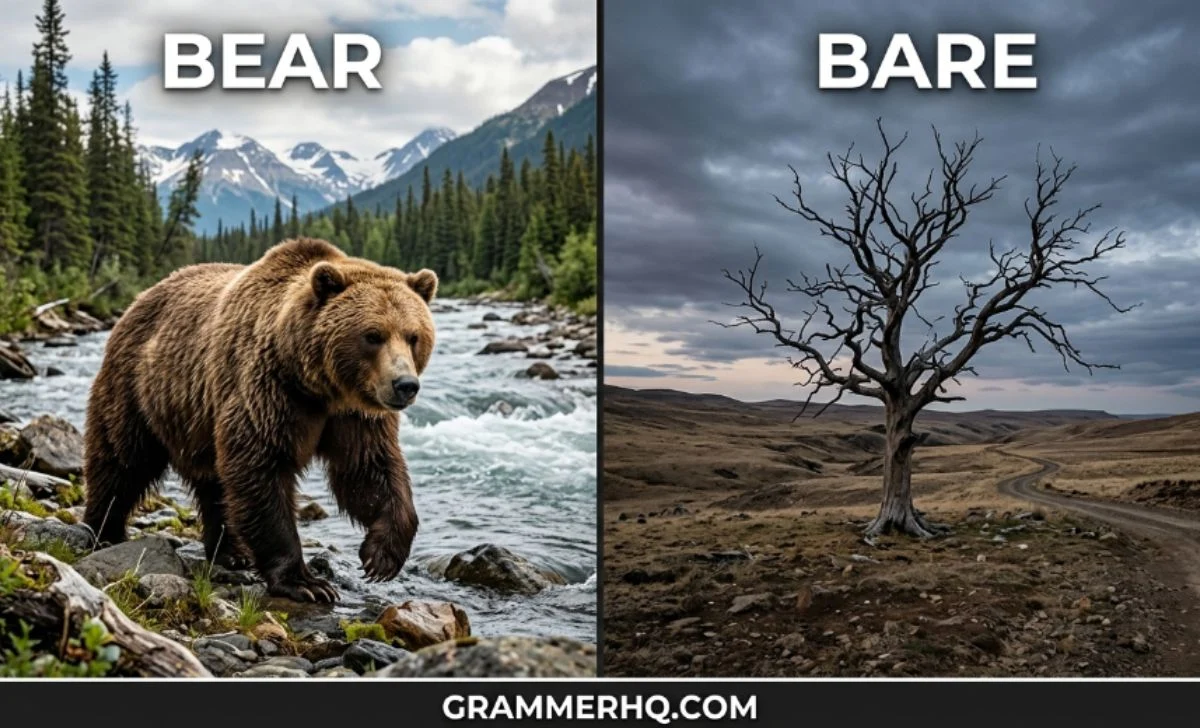
The good news is that the difference is easy once you connect each word with its meaning. Bear can refer to an animal or mean to carry, support, or endure something.
Bare usually means uncovered or exposed. This guide breaks down both words with clear explanations, everyday examples, common expressions, and simple memory tricks.
Quick Answer
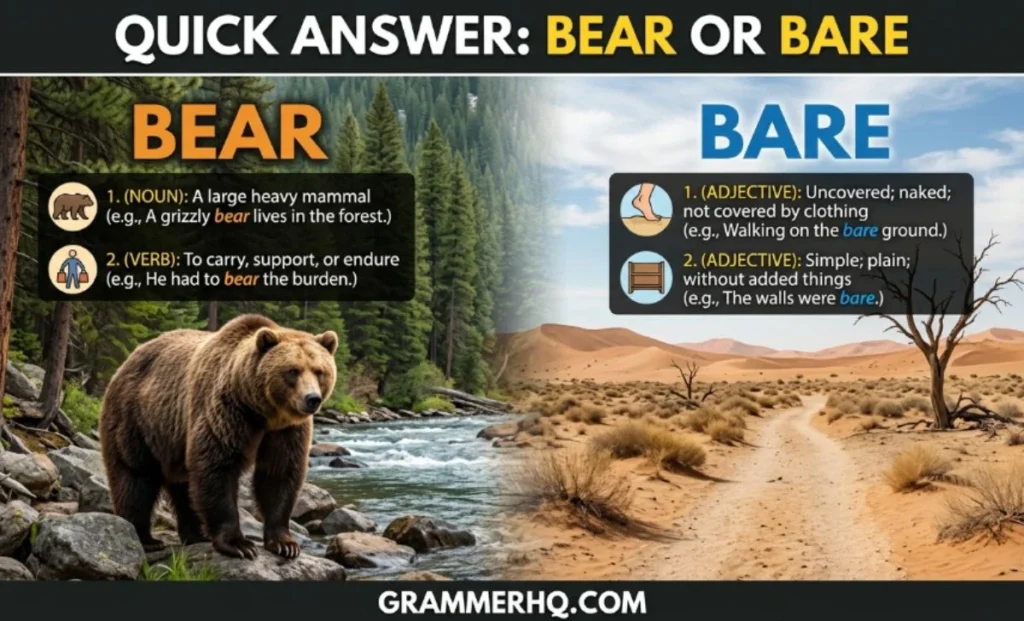
Bear and bare are homophones in varieties of English where they share the same pronunciation. However, their meanings and grammatical uses are different.
- Bear = an animal, or to carry, support, tolerate, or endure.
- Bare = uncovered, exposed, or without the usual covering; it can also mean to reveal.
The easiest rule
Bear means carry, endure, or the animal. Bare means uncovered or reveal.
For example:
- I cannot bear the pain.
- She walked with bare feet.
What Does Bear Mean?
Bear has several meanings, so context matters.
Bear as a Noun
As a noun, bear refers to a large mammal.
Examples:
- A bear crossed the road.
- The polar bear lives in Arctic regions.
- My nephew sleeps with a teddy bear.
This is the easiest meaning to recognize.
Bear as a Verb
Examples:
As a verb, bear can mean carry, support, tolerate, or endure.
- The bridge can bear the weight of the truck.
- I cannot bear this noise.
- She had to bear the responsibility alone.
- The tree bears fruit every summer.
The word also appears in different forms, including bore, borne, and born, depending on the grammatical context.
For example:
She bore the difficult situation with patience.
So, whenever the idea involves carrying a burden, tolerating something, supporting weight, or producing something, bear may be the correct choice.
What Does Bare Mean?
Bare usually describes something that is uncovered, exposed, empty, or lacking something extra.
Bare as an Adjective
As an adjective, bare describes something without its normal covering or without unnecessary additions.
Examples:
- He walked on the beach with bare feet.
- The apartment had bare walls.
- She gave me the bare facts.
- We have only the bare minimum.
In each case, the idea is that something is uncovered, plain, or reduced to the essentials.
Bare as a Verb
As a verb, bare means to uncover or reveal.
Examples:
- The dog bared its teeth.
- He bared his feelings.
- The evidence bared the truth.
A useful connection is:
Bare = uncover or reveal.
Bear vs Bare: What Is the Difference?
| Word | Meaning | Common Use | Example |
|---|---|---|---|
| Bear | Animal | Noun | The bear ran into the forest. |
| Bear | Carry/support | Verb | The shelf can bear the weight. |
| Bear | Tolerate/endure | Verb | I cannot bear the pain. |
| Bare | Uncovered | Adjective | He has bare feet. |
| Bare | Minimal/plain | Adjective | They provided the bare minimum. |
| Bare | Reveal/uncover | Verb | She bared her feelings. |
The spelling depends on what you mean, not how the word sounds.
Bear With Me or Bare With Me?
This is probably the most common real-life confusion between the two words.
Correct: Bear with me ✅
Bear with me means please be patient with me.
Examples:
- Bear with me while I check your account.
- Please bear with me for another minute.
- Bear with me while I explain what happened.
Incorrect: Bare with me ❌
When you mean “please be patient,” bare is not the correct word.
The reason is simple: bear can mean tolerate or endure something. Therefore, bear with me asks someone to patiently tolerate the situation.
Bare Minimum or Bear Minimum?
The correct expression is:
Bare minimum ✅
It means the smallest amount or level necessary.
Examples:
- He did the bare minimum to pass the course.
- We need the bare minimum of equipment.
- Completing the form is the bare minimum requirement.
Bear minimum ❌ is incorrect.
Think of bare as meaning nothing extra.
Bare Feet or Bear Feet?
For human feet without shoes or socks, use:
Bare feet ✅
Example:
The children ran across the grass with bare feet.
Here, bare means uncovered.
Bear feet would literally mean the feet of a bear. Therefore, if you are talking about your own uncovered feet, the correct phrase is bare feet.
Common Expressions With Bear
Understanding common phrases makes bear easier to recognize.
Bear in Mind
It means remember or consider something.
Bear in mind that the deadline is Friday.
Bear Responsibility
It means accept or carry responsibility.
The company must bear responsibility for the mistake.
Bear Witness
It means to witness or confirm something.
Several people were asked to bear witness.
Bear Fruit
It means produce a result, especially a positive one.
Her hard work eventually began to bear fruit.
Grin and Bear It
It means accept something unpleasant without complaining.
The journey was uncomfortable, but we had to grin and bear it.
Common Expressions With Bare
The word bare appears in several everyday expressions too.
Bare Bones
Bare-bones means containing only the basic or essential parts.
The plan is a bare-bones version of the original.
Bare Facts
This means the basic facts without additional detail.
The article gives only the bare facts.
Bare Hands
This means without gloves or protective covering.
He lifted the box with his bare hands.
Bare Necessities
These are the things that are absolutely necessary.
We packed only the bare necessities.
Bare Your Soul
This means to reveal your deepest thoughts or feelings.
She finally bared her soul to her closest friend.
Bear vs Bare: Common Mistakes
Here are some of the mistakes learners make most often:
| Incorrect ❌ | Correct ✅ |
|---|---|
| Bare with me | Bear with me |
| Bear minimum | Bare minimum |
| Bear feet | Bare feet |
| I can’t bare it | I can’t bear it |
| Bear your soul | Bare your soul |
| The tree bares fruit | The tree bears fruit |
The trick is to identify the meaning first and choose the spelling second.
Easy Ways to Remember Bear vs Bare
You do not need to memorize complicated grammar rules.
Remember Bear with “Carry”
The bridge can bear the weight.
Think: bear = carry/support.
Remember Bear with “Endure”
I cannot bear the pain.
Think: bear = tolerate/endure.
Remember Bare with “Uncovered”
She has bare feet.
Think: bare = uncovered.
Remember Bare with “Reveal”
He bared his feelings.
Think: bare = reveal.
One-line memory trick
Bear carries. Bare uncovers.
That simple distinction will help in most everyday situations.
Bear vs Bare in Real-Life Sentences
Seeing the words in natural sentences makes the difference easier to remember.
- I cannot bear this heat.
- She walked home with bare feet.
- Please bear with me while I find the document.
- He did the bare minimum.
- The old tree still bears fruit.
- She finally bared her feelings.
- A large bear appeared near the campsite.
- The company will bear the cost.
- The room had bare walls.
- We brought only the bare necessities.
Notice how the meaning changes the spelling every time.
Are Bear and Bare British or American Spellings?
No. Bear and bare are not British-versus-American spelling differences.
Both words are standard in British English and American English.
The difference is about meaning, grammar, and context.
That makes them different from pairs such as color/colour or organize/organise.
Bear vs Bare: Quick Quiz
Choose the correct word.
- Please ___ with me for a moment.
- She walked with ___ feet.
- I cannot ___ the pain.
- He did the ___ minimum.
- The tree will ___ fruit.
- The dog ___ its teeth.
- We saw a ___ near the river.
- She had to ___ the responsibility.
Answers
- Bear
- Bare
- Bear
- Bare
- Bear
- Bared
- Bear
- Bear
FAQs
1: What is the difference between bear and bare?
Bear can mean an animal or can mean to carry, support, tolerate, or endure. Bare usually means uncovered or exposed and can also mean to uncover or reveal something.
2: Is it “bear with me” or “bare with me”?
Bear with me is correct when you mean please be patient with me.
3: Is it “bare minimum” or “bear minimum”?
The correct phrase is bare minimum. It means the smallest amount necessary.
4: Is it “bare feet” or “bear feet”?
For human feet without shoes or socks, the correct phrase is bare feet.
5: Are bear and bare homophones?
Yes. In varieties of English where they share the same pronunciation, they sound alike but have different spellings and meanings.
6: Can bear be a verb?
Yes. Bear can mean to carry, support, tolerate, endure, or produce something.
7: Can bare be a verb?
Yes. Bare can mean to uncover or reveal something, as in bare your teeth or bare your feelings.
8: What is the easiest way to remember bear and bare?
Remember: Bear carries or endures. Bare uncovers or reveals.
Conclusion
The difference between bear and bare is easier than it first appears. Bear refers to an animal or describes carrying, supporting, tolerating, enduring, or producing something.
Bare, meanwhile, means uncovered, exposed, minimal, or revealed. The most useful phrases to remember are bear with me, bare minimum, and bare feet.
When you focus on the meaning of the sentence rather than the sound of the word, choosing the correct spelling becomes natural. Bear carries; bare uncovers keep that simple rule in mind, and you will avoid most common mistakes.
Read More Blogs: