Have you ever typed “obay” and wondered whether it was the correct spelling? You’re not alone. Many English learners, students, and even native speakers accidentally write obay instead of obey because both words sound almost the same.
This spelling mistake appears in school assignments, emails, social media posts, and online searches every day.
The good news is that the answer is simple. Obey is the correct English word, while obay is a common misspelling. Understanding why this mistake happens will help you avoid it in both writing and speaking.
By the end of this guide, you’ll know the correct spelling, pronunciation, meaning, grammar, real-life examples, and an easy trick to remember it forever.
Quick Answer
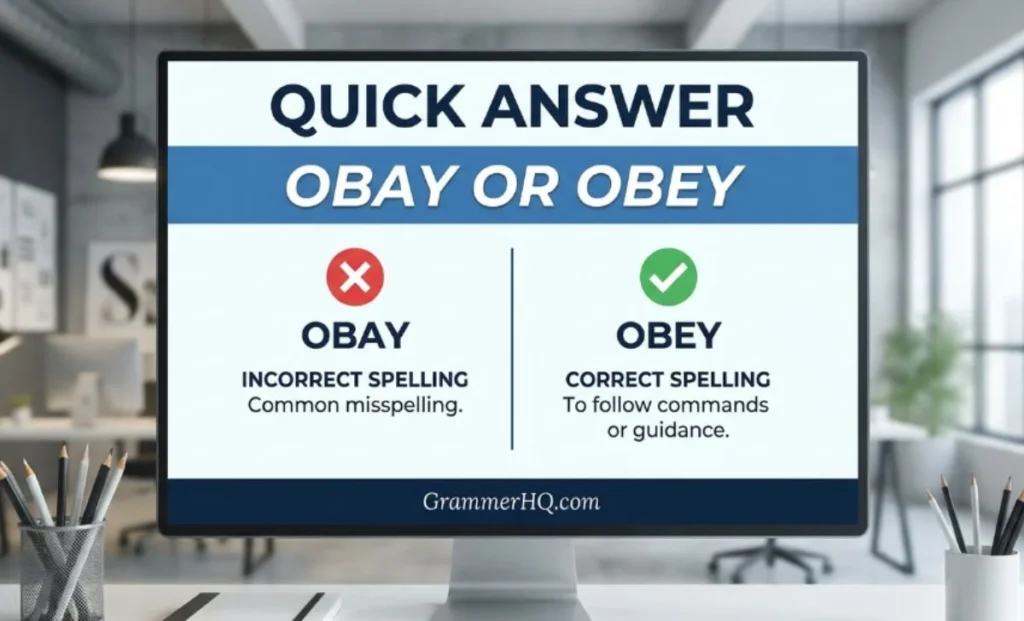
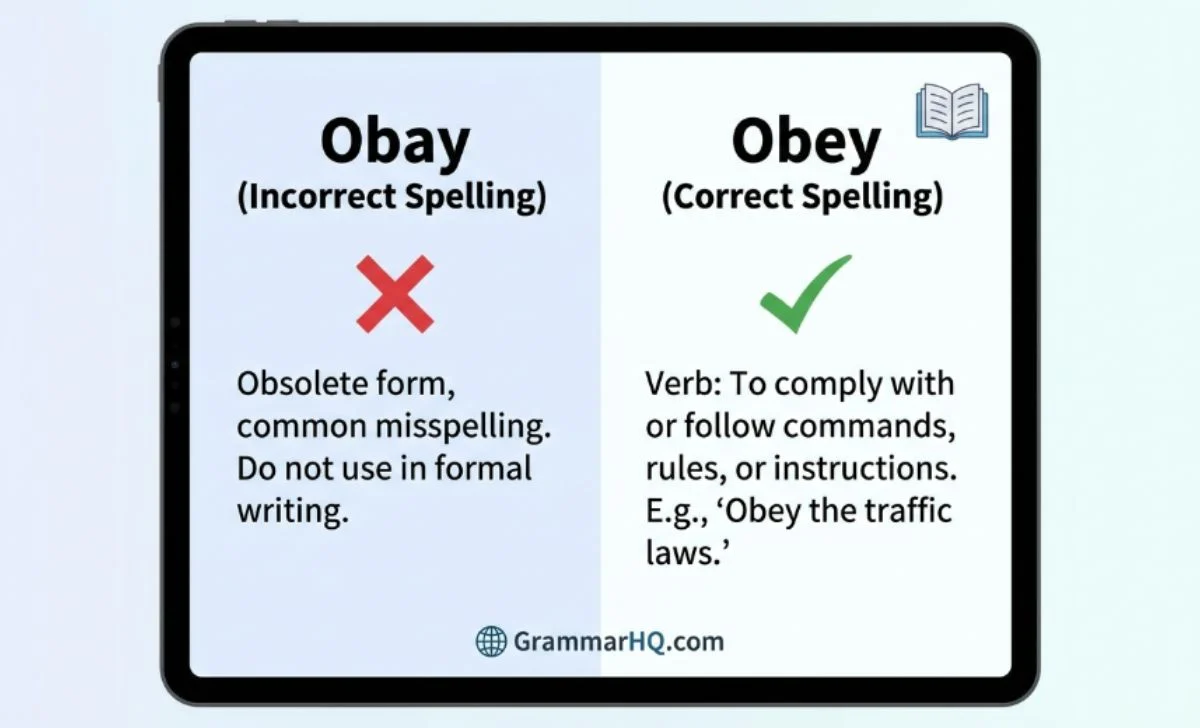
Obey is the correct spelling in English. It is a verb that means to follow instructions, rules, laws, or orders. Obay is not a recognized English word and appears because of a spelling mistake or typing error.
Whenever you want to express following someone’s instructions or complying with rules, always write obey.
Obay or Obey: Which Is Correct?
The correct spelling is obey.
| Word | Is It Correct? | Meaning |
|---|---|---|
| Obey | ✅ Yes | To follow orders, instructions, rules, or laws |
| Obay | ❌ No | Incorrect spelling of obey |
Although obay appears in online searches and social media posts, no major English dictionary recognizes it as a standard English word.
If you’re writing an essay, email, exam, business document, or professional message, always choose obey.
Correct Examples
- Children should obey their parents.
- Everyone must obey the traffic laws.
- Soldiers are trained to obey commands.
- Employees should obey company policies.
Incorrect Examples
- ❌ Children should obay their parents.
- ❌ Drivers must obay traffic rules.
- ❌ Please obay the instructions.
In each example above, obay should be replaced with obey.
Comparison Table
| Feature | Obey | Obay |
|---|---|---|
| Correct English spelling | ✅ Yes | ❌ No |
| Dictionary word | ✅ Yes | ❌ No |
| Part of speech | Verb | Not an English word |
| Used in formal writing | ✅ Yes | ❌ Never |
| Used in exams | ✅ Yes | ❌ Incorrect |
| Accepted by dictionaries | ✅ Yes | ❌ No |
| Recommended spelling | ✅ Always | ❌ Avoid |
What Does Obey Mean?
Obey means to do what someone tells you to do or to follow a rule, law, instruction, or command.
It describes acting in accordance with authority, guidance, or established rules. Depending on the context, it may refer to parents, teachers, employers, laws, safety instructions, or official regulations.
Common meanings of obey
- Follow instructions
- Follow orders
- Follow rules
- Comply with laws
- Respect authority
- Carry out commands
- Observe regulations
Everyday examples
- Students should obey their teachers.
- Drivers must obey speed limits.
- Always obey safety instructions.
- Citizens are expected to obey the law.
- Dogs can learn to obey simple commands.
In every example, obey expresses compliance with a person, rule, or authority.
Pronunciation of Obey
The standard pronunciation is:
IPA: /əˈbeɪ/
It sounds like:
uh-BAY
The final sound is “bay,” not “bye.”
Pronunciation Tips
- Say uh
- Then say BAY
- Combine them smoothly:
- uh-BAY
Because the pronunciation includes the long “ay” sound, many learners mistakenly assume the spelling should be obay. However, English spelling does not always match pronunciation, which is why the correct written form remains obey.
Why Do People Spell Obey as Obay?
This confusion is extremely common among English learners.
Several factors contribute to the mistake.
1. Pronunciation Confusion
People hear uh-BAY and naturally expect the word to end with -ay.
However, English spelling follows historical patterns rather than pronunciation alone.
2. Phonetic Guessing
Instead of remembering the dictionary spelling, learners often write words exactly as they sound.
That leads to:
- obey → obay ❌
3. Fast Typing
While texting or posting on social media, many people type quickly without checking spelling.
Autocorrect sometimes fixes the mistake, but not always.
4. Limited Vocabulary
Beginners who haven’t seen the word in books often rely only on pronunciation.
As a result, they create a logical—but incorrect—spelling.
5. Influence of Similar Words
English contains many words ending in -ay, such as:
- play
- stay
- today
- display
Because of these familiar patterns, writers may incorrectly assume obey should follow the same spelling rule.
The Grammar Rule
Obey is a regular transitive verb.
That means it normally takes an object.
Correct
- Obey the law.
- Obey your parents.
- Obey the instructions.
- Obey the rules.
Less Common (No Object)
Sometimes obey is used without an object when the context is already understood.
Example:
- You should learn to obey.
However, in most everyday situations, an object follows the verb.
Verb Forms of Obey
| Verb Form | Word |
|---|---|
| Base Form | obey |
| Third Person Singular | obeys |
| Past Tense | obeyed |
| Past Participle | obeyed |
| Present Participle | obeying |
Examples
- She obeys her coach.
- They obeyed every instruction.
- We have always obeyed the rules.
- He is obeying the teacher.
Word Origin (Etymology)
Understanding where obey comes from makes it easier to remember why its spelling is obey, not obay.
The word obey entered English through Old French obeir, which came from the Latin verb oboedire, meaning “to listen to,” “to comply,” or “to carry out a command.” Over time, the spelling changed as the word moved into Middle English, eventually becoming the modern English verb obey.
This historical development explains why the word ends in -ey instead of -ay. Its spelling reflects its linguistic origin rather than its pronunciation.
British vs American English
There is no spelling difference between British and American English.
| English Variety | Correct Spelling |
|---|---|
| British English | Obey |
| American English | Obey |
| Canadian English | Obey |
| Australian English | Obey |
Unlike words such as colour/color or organise/organize, obey has the same spelling, pronunciation, and meaning in all major varieties of English.
Therefore:
- 🇬🇧 British English → Obey
- 🇺🇸 American English → Obey
- 🇨🇦 Canadian English → Obey
- 🇦🇺 Australian English → Obey
Real-Life Examples of Obey
Seeing a word in different contexts helps you remember how to use it naturally.
Everyday Conversation
- Please obey your parents.
- Children should obey family rules.
- Always obey your teacher.
School
- Students must obey classroom rules.
- Everyone should obey the exam instructions.
Workplace
- Employees are expected to obey company policies.
- Workers must obey safety procedures.
Law and Public Safety
- Every driver must obey traffic signals.
- Citizens should obey the law.
- Visitors must obey park regulations.
Sports
- Players have to obey the referee’s decisions.
Military
- Soldiers are trained to obey lawful orders.
Technology
- The robot was programmed to obey voice commands.
IELTS and Academic Writing
- Successful societies depend on citizens who obey the law.
- Students should obey academic integrity policies.
Correct vs Incorrect Usage
| Correct | Incorrect |
|---|---|
| She obeys her parents. | ❌ She obays her parents. |
| We obey the rules. | ❌ We obay the rules. |
| He obeyed the instructions. | ❌ He obayed the instructions. |
| Always obey the signs. | ❌ Always obay the signs. |
| They are obeying the law. | ❌ They are obaying the law. |
Common Mistakes
Many learners know the meaning of obey but still make spelling or grammar mistakes. Here are the most common ones.
1. Writing Obay Instead of Obey
❌ Incorrect
Please obay the rules.
✅ Correct
Please obey the rules.
Why it happens: Writers spell the word according to its pronunciation instead of its dictionary spelling.
2. Using the Wrong Past Tense
❌ Incorrect
He obayed the teacher.
✅ Correct
He obeyed the teacher.
Why it happens: The incorrect base spelling leads to an incorrect past-tense form.
3. Spelling the Present Participle Incorrectly
❌ Incorrect
She is obaying the instructions.
✅ Correct
She is obeying the instructions.
Why it happens: Learners build the -ing form from the misspelled word obay.
4. Confusing Obey with Listen
Although they are related, they are not always interchangeable.
- Listen means to hear carefully.
- Obey means to follow instructions or commands.
Example:
- I listened to the teacher. ✅
- I obeyed the teacher’s instructions. ✅
These sentences have different meanings.
5. Forgetting the Object
Because obey usually acts as a transitive verb, it often needs an object.
Better:
- Obey the rules.
- Obey your parents.
- Obey the instructions.
These sentences clearly show what should be obeyed.
Easy Memory Trick
A simple memory trick can help you avoid this spelling mistake forever.
Think of the Letter E
Ob E y
The letter E reminds you of:
- Education
- English
- Exams
If you’re writing correct English, remember that obey always contains the letter E before Y.
Another easy reminder is:
You obey every rule with an “E.”
If you can remember that sentence, you’ll never write obay again.
Real-World Usage
Using the correct spelling is important because obey appears in many everyday situations.
Professional Emails
Writing obay in a business email can make your writing appear careless.
Correct:
Please obey the safety guidelines before entering the laboratory.
Job Applications
Employers expect applicants to use correct spelling and grammar.
Writing obey correctly helps create a professional impression.
Academic Writing
Teachers and examiners often deduct marks for spelling mistakes.
Using obey instead of obay improves the accuracy of essays, assignments, and examinations.
Competitive Exams
Tests such as IELTS, TOEFL, and other English proficiency exams assess spelling and vocabulary.
Knowing the correct spelling prevents avoidable errors.
Social Media and Online Communication
Even in informal writing, using correct spelling improves clarity and credibility.
Instead of:
Always obay the rules.
Write:
Always obey the rules.
Correct spelling makes your message look more polished and trustworthy.
Practice Quiz
Test your understanding of Obay or Obey with these quick questions.
1. Which spelling is correct?
A. Obay
B. Obey
C. Obaie
D. Obee
2. Fill in the blank.
Everyone should ______ the traffic laws.
3. Which sentence is correct?
A. Students should obay their teachers.
B. Students should obey their teachers.
4. Choose the correct past tense.
A. Obayed
B. Obeyed
C. Obaying
D. Obeys
5. Correct the spelling mistake.
Please obay your parents.
6. Fill in the blank.
Employees must ______ company policies.
Quiz Answers
- B. Obey
- obey
- B. Students should obey their teachers.
- B. Obeyed
- Please obey your parents.
- obey
FAQ,s
Is Obay a real English word?
No. Obay is not recognized as a standard English word in modern dictionaries. It is simply a common misspelling of obey.
Is Obey the correct spelling?
Yes. Obey is the correct spelling. It means to follow instructions, rules, laws, commands, or orders.
Why do people write Obay instead of Obey?
Most people spell it according to its pronunciation. Since obey sounds like uh-BAY, many learners mistakenly replace -ey with -ay.
What is the meaning of obey?
Obey means to follow instructions, comply with rules, carry out commands, or respect authority.
Example:
Drivers must obey traffic laws.
How do you pronounce obey?
The standard pronunciation is:
IPA: /əˈbeɪ/
It sounds like:
uh-BAY
Although it ends with the “ay” sound, the correct spelling ends with -ey.
What is the past tense of obey?
The past tense and past participle are both obeyed.
Example:
She obeyed every instruction carefully.
Is obey used in both British and American English?
Yes. Obey has the same spelling, pronunciation, and meaning in British, American, Canadian, and Australian English.
Conclusion
If you’ve ever wondered whether to write Obay or Obey, the answer is straightforward: obey is the only correct spelling. While obay often appears because of pronunciation-based guessing or typing mistakes, it is not accepted in standard English.
Learning the correct spelling, understanding its meaning, and seeing it used in real-life examples will help you write with greater confidence.
Whenever you’re talking about following instructions, rules, laws, or commands, always choose obey. Making this small correction will improve your grammar, strengthen your writing, and help you communicate more accurately in school, the workplace, and everyday life.
Read More Bloogs:

Hi, I’m Amelia Parker, a grammar enthusiast and writer at GrammarHQ.com. I specialize in explaining spelling differences, confusing words, and common English mistakes through simple, practical, and easy-to-understand guides.