A unique or an unique, which one should you use? The answer may seem confusing because unique starts with the vowel letter u, but the correct article is a, not an.
The reason is simple: English articles depend on pronunciation, not just spelling. Unique begins with the /j/ sound, as in you, so it starts with a consonant sound.
Therefore, we say a unique idea, a unique opportunity, and a unique experience. In this guide, you’ll learn the exact a vs. an rule, how to pronounce unique.
Why the letter u can be misleading, when an unique may appear, and how the same pattern works with words such as university, useful, and European.
Quick Answer
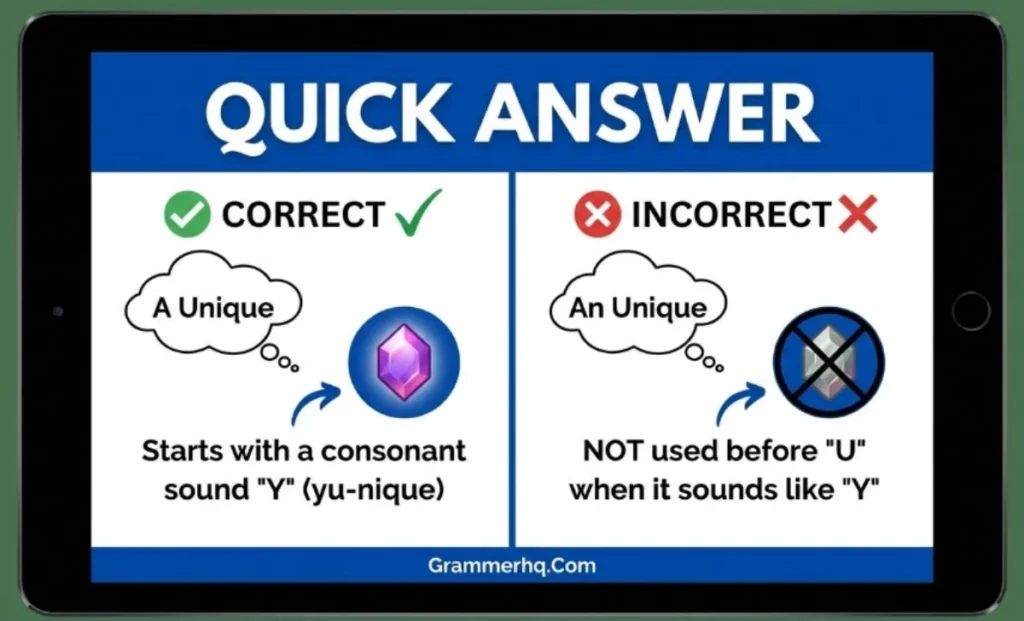
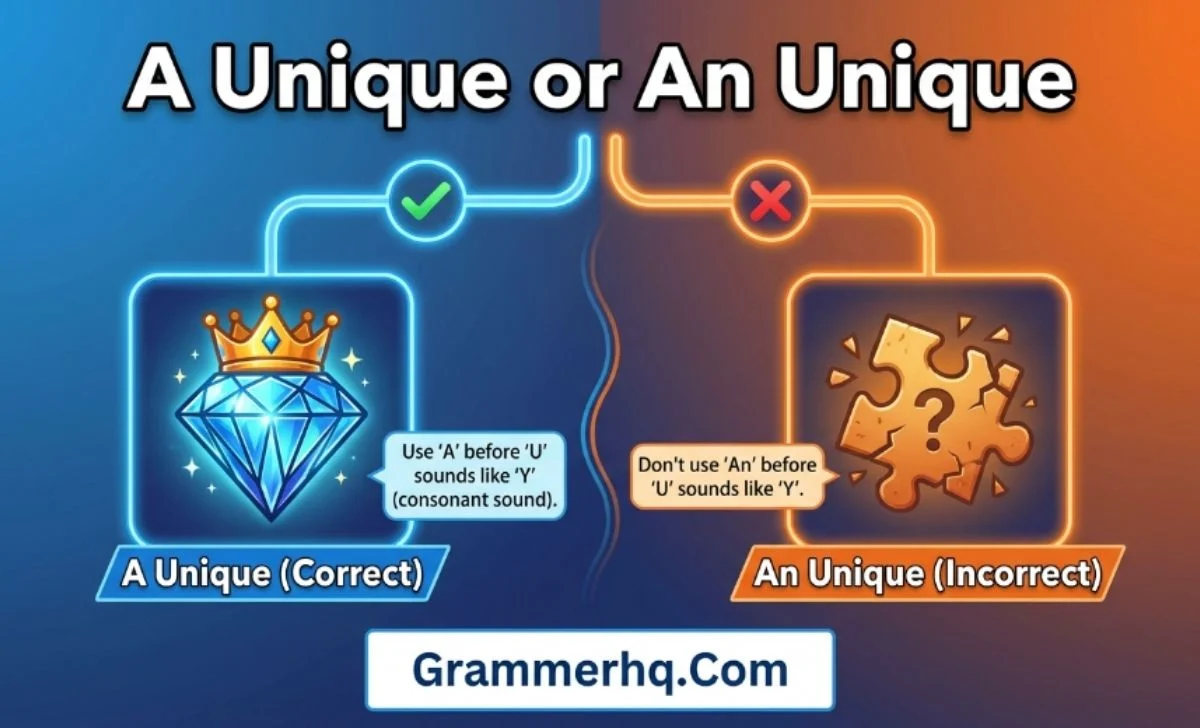
A unique is correct.
An unique is not the standard choice in modern English.
The reason is pronunciation. Unique begins with the /juː/ sound, commonly heard as “yoo.” The first sound is the consonant /j/, so the correct indefinite article is a.
Correct: a unique idea
Incorrect: an unique idea
Remember:
Use “a” before a consonant sound and “an” before a vowel sound.
So although unique begins with the vowel letter u, its first sound makes a unique the correct modern form.
Why Is It “A Unique,” Not “An Unique”?
The answer becomes much easier when you separate letters from sounds.
English Articles Are Based on Pronunciation
The English indefinite articles are a and an.
Use a before a word that begins with a consonant sound:
- a book
- a car
- a teacher
- a university
- a useful tool
- a unique idea
Use an before a word that begins with a vowel sound:
- an apple
- an orange
- an umbrella
- an unusual event
- an hour
- an honest person
The key is the first sound, not the first written letter.
That is why:
a unique
is correct even though unique begins with u.
Why the Letter “U” Causes Confusion
The letter u is a vowel, so it is tempting to think:
“Unique starts with a vowel, so it must take an.”
But that rule is incomplete.
English pronunciation can make a vowel letter sound like it begins with a consonant.
Compare:
unique → “yoo-neek”
The first sound is /j/.
So:
a + unique
becomes:
a unique
The article follows the sound you actually pronounce.
Unique Begins With the “Yoo” Sound
The pronunciation of unique is commonly represented as:
/juːˈniːk/
A simple pronunciation guide is:
yoo-NEEK
The first part, /juː/, is similar to the beginning of you.
This is why the phrase sounds natural:
a unique experience
The same pronunciation principle explains:
a university
a useful idea
a user account
a European city
A Unique vs. An Unique: The Clear Difference
| Expression | Standard modern English? | Why? |
|---|---|---|
| a unique | ✅ Yes | Unique begins with /j/ |
| an unique | ❌ Normally no | The word does not begin with a vowel sound |
| a unique idea | ✅ Yes | “Unique” starts with “yoo” |
| a unique opportunity | ✅ Yes | Consonant sound follows a |
| an unique idea | ❌ Normally no | Article does not match the initial sound |
The easiest rule is:
Unique starts with “yoo,” so use “a.”
The Simple “You” Trick for Remembering A Unique
If grammar rules feel difficult to memorize, use pronunciation instead.
Say:
unique → yoo-neek
Now add the article:
a + yoo-neek
That gives:
a unique
You can use the same trick with other words:
- a unique idea
- a university
- a useful tool
- a user
- a usual problem
- a European country
- a union
They all begin with a sound similar to “you.”
The Golden Rule
Don’t ask:
“Does the word begin with a vowel letter?”
Ask:
“What sound do I hear first?”
That small change in thinking eliminates many common a vs. an mistakes.
A vs. An: The Rule That Actually Works
A common grammar shortcut says:
A before consonants; an before vowels.
That is useful, but it can be misleading if you think about letters instead of sounds.
A better version is:
A before consonant sounds; an before vowel sounds.
Use “A” Before a Consonant Sound
Examples:
- a dog
- a house
- a student
- a university
- a unique opportunity
- a useful application
- a European country
- a user account
Use “An” Before a Vowel Sound
Examples:
- an apple
- an elephant
- an umbrella
- an unusual situation
- an urgent message
- an hour
- an honest answer
Why “An Hour” Is Correct
Hour begins with the letter h, but the h is silent.
It is pronounced approximately:
our
So it begins with a vowel sound.
Therefore:
an hour
This is another powerful reminder that pronunciation controls article choice.
A Unique and Other Tricky U-Words
The letter u creates some of the most common article mistakes in English.
| Word | First sound | Correct article | Example |
|---|---|---|---|
| unique | “yoo” /j/ | a | a unique idea |
| university | “yoo” /j/ | a | a university |
| useful | “yoo” /j/ | a | a useful tool |
| user | “yoo” /j/ | a | a user |
| usual | “yoo” /j/ | a | a usual problem |
| union | “yoo” /j/ | a | a union |
| umbrella | vowel sound | an | an umbrella |
| unusual | vowel sound | an | an unusual event |
| urgent | vowel sound | an | an urgent request |
Notice something important:
The same letter can take different articles.
Both unique and umbrella start with u.
But:
a unique
an umbrella
Why?
Because their initial sounds are different.
Why Do People Write “An Unique”?
The error usually comes from confusing vowel letters with vowel sounds.
A learner sees:
unique → U
and knows:
U → vowel letter
Then they apply:
vowel → an
But the missing step is pronunciation.
The actual sequence is:
unique → /juː/ → consonant /j/ → a
So the correct form is:
a unique
This is why memorizing individual phrases is less useful than understanding the underlying pronunciation rule.
Once you know the rule, you can apply it to new words you have never seen before.
Is “An Unique” Ever Correct?
For modern standard English, a unique is the normal and recommended form.
However, readers may occasionally encounter an unique in older texts, historical writing, or less-standard usage. English article patterns have changed over time, and pronunciation has also influenced how speakers choose between a and an.
That historical occurrence does not mean that an unique is the preferred form today.
For modern:
- academic writing
- business communication
- websites
- professional documents
- school assignments
- everyday English
use:
a unique
For example:
The company developed a unique solution.
She presented a unique perspective.
We discovered a unique opportunity.
If you’re unsure, a unique is the clear modern choice.
What Does “Unique” Mean?
Unique is an adjective used to describe something that is different from everything else or, in its strongest sense, the only one of its kind.
Depending on context, it can mean:
- one of a kind
- distinctive
- unusual
- special
- unlike anything else
- unmatched
For example:
She has a unique personality.
Here, unique means her personality is notably different from others.
The building has a unique design.
This means the design is distinctive or unusual.
Unique To
The phrase unique to has a particularly useful meaning:
This plant is unique to the region.
Here, it means the plant is characteristic of or specifically associated with that region.
Understanding the meaning of unique helps you recognize why the adjective appears naturally in many different sentence patterns.
How to Pronounce “Unique”
The standard pronunciation is:
/juːˈniːk/
An easy pronunciation guide is:
yoo-NEEK
The stress falls on the second syllable.
The most important part for grammar is the beginning:
/j/
This is the sound you hear at the beginning of:
- you
- yes
- young
- yellow
Compare:
you → /juː/
unique → /juːˈniːk/
That shared initial sound explains why we say:
a unique
rather than:
an unique
Is the “U” in Unique a Vowel Sound?
This is where many learners get stuck.
The letter U is a vowel letter.
But the beginning of unique is not simply the vowel sound /uː/.
Instead, the pronunciation begins with:
/j/ + /uː/
So:
/juː/
sounds approximately like:
yoo
That initial /j/ sound is what matters when choosing the indefinite article.
Therefore:
a unique
is grammatically natural.
This distinction between orthography (spelling) and phonology (sound structure) is one of the most useful concepts for understanding English articles.
British English vs. American English
Both British English and American English normally use:
a unique
Examples:
British English:
It was a unique experience.
American English:
It was a unique experience.
There is no significant difference in article choice here.
The same sound-based principle applies in both varieties.
You may see differences between British and American English in spelling, vocabulary, and pronunciation, but a unique is standard in both.
The Origin of the Word “Unique”
The word unique has an interesting connection with the idea of being “one.”
English ultimately received the word through French, which traces back to the Latin unicus, meaning “one” or “only one.” It is related to the Latin unus, meaning “one.”
That origin fits naturally with the modern meaning of unique: something singular, distinctive, or unlike another.
Over time, the word developed broader usage. Today, unique can describe something that is literally one of a kind as well as something that is particularly unusual or distinctive.
Unique, Uniquely, and Uniqueness
The word unique has several related forms that are useful in English.
Unique
Unique is an adjective.
The artist created a unique design.
Uniquely
Uniquely is an adverb.
The building is uniquely designed.
It describes something done in a distinctive or unusual way.
Uniqueness
Uniqueness is a noun.
The uniqueness of the product made it popular.
It refers to the quality of being unique.
Understanding this word family can improve both vocabulary and sentence variety.
A Unique in Real Sentences: 20 Examples
Everyday English
- She has a unique personality.
- This restaurant offers a unique dining experience.
- He found a unique solution to the problem.
- The house has a unique design.
- We had a unique experience during our trip.
Academic English
- The study provides a unique perspective.
- The researcher developed a unique method.
- The university offers a unique learning environment.
- The paper presents a unique approach.
- The experiment produced a unique result.
Business and Professional English
- The company offers a unique service.
- The brand has a unique identity.
- The product provides a unique customer experience.
- Our team developed a unique strategy.
- The business has a unique advantage.
Conversation
- That’s a unique idea.
- You have a unique talent.
- It was a unique opportunity.
- She gave me a unique gift.
- He has a unique way of explaining things.
Every example follows the same pronunciation-based principle:
unique → /j/ → consonant sound → a unique
Common Mistakes With “A Unique”
❌ An Unique Idea
Incorrect in standard modern usage.
Correct:
a unique idea
❌ An Unique Opportunity
The same problem occurs here.
Correct:
a unique opportunity
❌ An Unique Solution
The initial sound of unique is still /j/.
Correct:
a unique solution
❌ An University
The word university begins with the “yoo” sound.
Correct:
a university
❌ An Useful Tool
Useful also begins with the “yoo” sound.
Correct:
a useful tool
The Real Mistake
All these errors come from the same misunderstanding:
Choosing the article from the first letter instead of the first sound.
Fix that one habit, and many article problems disappear.
A Unique or An Unique: Quick Grammar Test
If you want to test yourself, choose a or an:
- ___ unique opportunity
- ___ university
- ___ umbrella
- ___ useful idea
- ___ unusual experience
- ___ hour
- ___ European country
- ___ honest answer
Answers
- a unique opportunity
- a university
- an umbrella
- a useful idea
- an unusual experience
- an hour
- a European country
- an honest answer
The pattern is consistent once you listen to the first sound.
FAQs
1: Is “a unique” grammatically correct?
Yes. A unique is the standard form in modern English because unique begins with the consonant /j/ sound, approximately pronounced “yoo.”
2: Is “an unique” grammatically correct?
It is not the normal form in modern standard English. Historical and nonstandard examples can be found, but modern writing should normally use a unique.
3: Why do we use “a” before unique?
Because article choice depends on pronunciation. Unique begins with /juː/, whose first sound is /j/. Since /j/ is a consonant sound, a is used.
4: Why doesn’t the letter U require “an”?
Because a and an are selected according to sound, not simply spelling. Unique begins with the sound “yoo,” while umbrella begins with a vowel sound.
5: Is “unique” a vowel sound?
The word unique begins with the consonant /j/ sound followed by /uː/. Its pronunciation begins /juː/, approximately “yoo.”
6: Do you say “a unique opportunity”?
Yes. A unique opportunity is the standard and grammatically correct expression.
7: Do you say “an unique opportunity”?
Not normally in modern standard English. The preferred form is a unique opportunity.
8: Is “a unique” correct in British English?
Yes. A unique is standard in modern British English.
9: Is “a unique” correct in American English?
Yes. American English also uses a unique.
10: What is the easiest way to remember “a unique”?
Pronounce unique as “yoo-neek.” Since it starts with the “you” sound, use a:
a unique
11: What other words work like “unique”?
Words such as university, useful, user, usual, union, European, and similar words can take a when their pronunciation begins with the /j/ (“yoo”) sound.
Final Verdict
There is a simple answer:
✅ A unique
❌ An unique
The letter u may look like a reason to use an, but English articles do not depend on spelling alone. They depend on the sound that follows the article.
Unique begins with /juː/, approximately “yoo-neek.” Because the first sound is /j/, a consonant sound, the correct form is:
a unique
The same principle explains a university, a useful tool, and a European country, while words such as umbrella, unusual, and hour take an because they begin with vowel sounds.
Remember the golden rule:
Don’t choose “a” or “an” by the first letter. Choose it by the first sound.
Read More Blogs:
- Quantify vs Qualify: What’s the Difference?
- Further or Farther: Difference, Meaning, Usage & Examples

Hi, I’m Amelia Parker, a grammar enthusiast and writer at GrammarHQ.com. I specialize in explaining spelling differences, confusing words, and common English mistakes through simple, practical, and easy-to-understand guides.