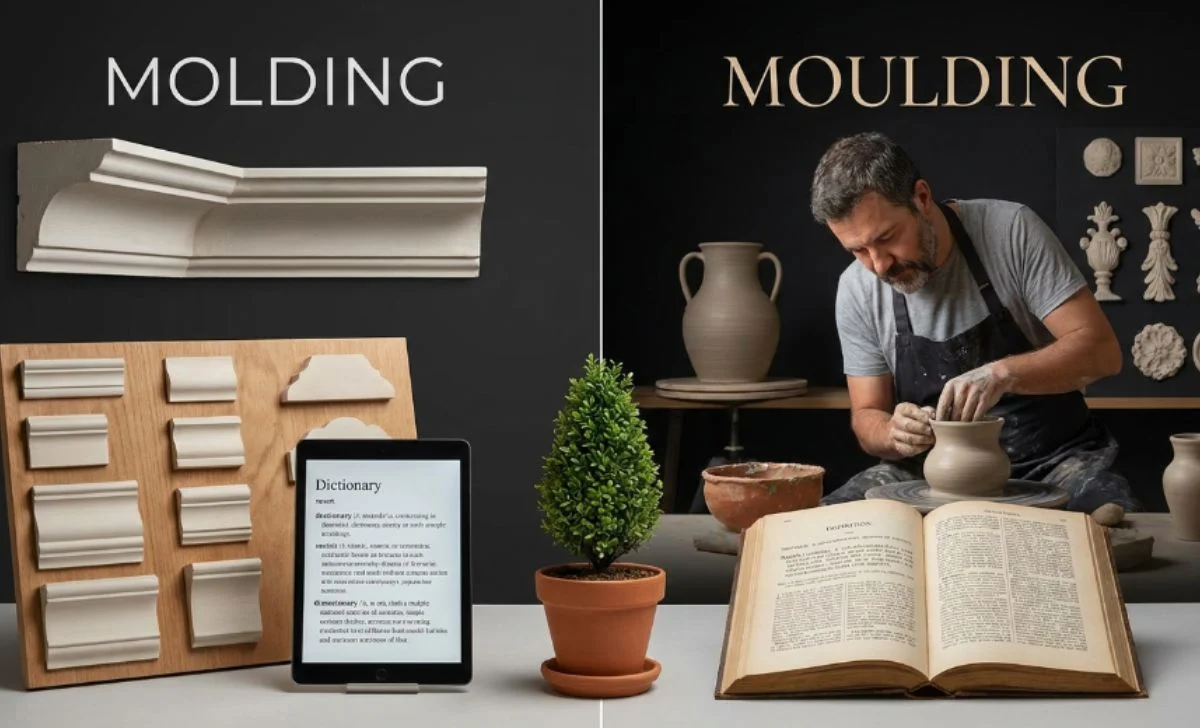
If you’ve ever paused while writing and wondered whether it’s “molding” or “moulding,” you’re not alone — this is one of the most common spelling confusions in English.
The good news is both spellings are completely correct; the right choice simply depends on which version of English you’re writing in.
“Molding” is the preferred American English spelling, widely used across the United States and Canada, while “moulding” follows British English conventions and is standard in the UK, Australia, India, Pakistan, and other Commonwealth nations.
Despite the spelling difference, both words share identical meaning, pronunciation, and usage. In this complete guide, you’ll discover the correct spelling for your target audience.
Quick Answer
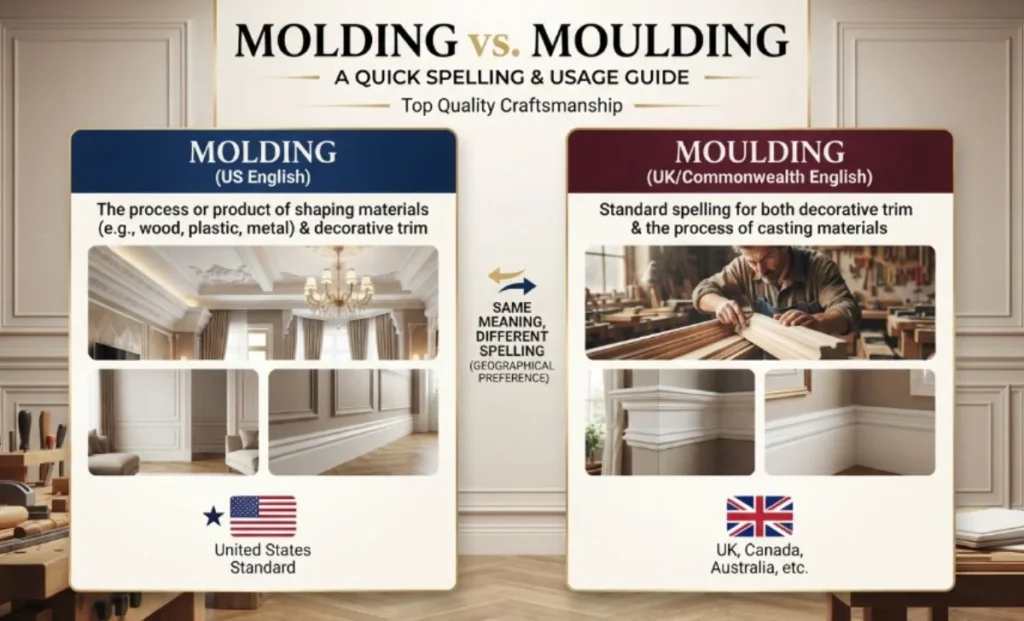
Both “molding” and “moulding” are correct spellings of the same word, with no difference in meaning or pronunciation.
The only difference lies in regional English usage — American English uses “molding,” while British English uses “moulding.”
If you’re writing for a US audience, choose molding; for UK, Australian, or Commonwealth readers, use moulding. This spelling pattern matches other American-British word pairs like color/colour and favor/favour.
Examples:
- Molding (US): The company specializes in plastic molding for automotive parts.
- Moulding (UK): The old cottage has beautiful wooden moulding along the ceiling.
- Molding (US): Good parenting plays a big role in molding a child’s character.
- Moulding (UK): The craftsman spent hours moulding the clay into perfect shapes.
Pronunciation of Molding or Moulding
Both “molding” and “moulding” have the same pronunciation, despite their different spellings in American and British English. They are pronounced /ˈmoʊl.dɪŋ/ (MOHL-ding), with the stress on the first syllable.
The silent “u” in the British spelling “moulding” does not affect the pronunciation. This is one of the main reasons people often confuse the two spellings, as they sound exactly the same in spoken English.
The only difference appears in writing: “molding” is the American English spelling, while “moulding” is the British English spelling.
Examples:
- The architect explained how crown molding (/ˈmoʊl.dɪŋ/) enhances a room’s design.
- In London, the carpenter discussed the moulding (/ˈmoʊl.dɪŋ/) around the antique mirror.
- During the workshop, the instructor demonstrated proper molding (/ˈmoʊl.dɪŋ/) techniques for beginners.
- The British designer described intricate moulding (/ˈmoʊl.dɪŋ/) patterns found in Victorian homes.
Why People Confuse Molding or Moulding
There are several reasons people mix up these spellings.
Same Pronunciation
Both words sound exactly alike. Since there is no difference in pronunciation, many writers do not realize they represent different regional spellings.
Different English Standards
American English removes the “u” from many words, while British English keeps it.
Examples include:
- Color → Colour
- Favor → Favour
- Honor → Honour
- Molding → Moulding
Global Content
People regularly read websites, books, and social media posts from different countries. This exposes them to both spellings, making it difficult to know which one is correct.
Spell Check Settings
Word processors often follow the language setting. A document set to American English may flag moulding as incorrect, while British English settings may suggest changing molding to moulding.
Easy Trick to Remember Molding or Moulding
A simple memory trick can help you choose the correct spelling every time.
- Molding = America = No “U”
- Moulding = Britain = Has “U”
Remember this sentence:
If your audience uses “colour,” write “moulding.” If they use “color,” write “molding.”
This works because the spelling pattern is consistent across many British and American English words.
Quick Memory Chart
| If You Write For… | Correct Spelling |
|---|---|
| United States | Molding |
| United Kingdom | Moulding |
| Australia | Moulding |
| New Zealand | Moulding |
| International audience | Follow your preferred English style consistently |
The Origin of Molding or Moulding
The word comes from the verb mould (British spelling) or mold (American spelling), meaning to shape or form something.
Its history goes back to the Old French word modle, which was influenced by the Latin word modulus, meaning a measure, model, or small standard. Over time, the word entered Middle English and developed two accepted spellings.
When American English spelling became more standardized in the 18th and 19th centuries, many words dropped the silent “u” to simplify spelling. British English kept the traditional form.
Today:
- Molding follows American spelling conventions.
- Moulding follows British spelling conventions.
Despite the spelling difference, both words have exactly the same meaning and are considered correct in their respective forms of English.
British English vs American English Spelling
The only difference between molding and moulding is the regional spelling. Their meaning, pronunciation, and grammar are exactly the same.
| Feature | American English | British English |
|---|---|---|
| Standard spelling | Molding | Moulding |
| Pronunciation | MOHL-ding | MOHL-ding |
| Meaning | Decorative trim or the process of shaping material | Decorative trim or the process of shaping material |
| Used in | United States | United Kingdom, Australia, New Zealand, and many Commonwealth countries |
Examples
| American English | British English |
|---|---|
| The contractor installed new molding. | The contractor installed new moulding. |
| Plastic molding reduces production costs. | Plastic moulding reduces production costs. |
| Crown molding adds elegance to the room. | Crown moulding adds elegance to the room. |
| The factory specializes in injection molding. | The factory specialises in injection moulding. |
The spelling difference follows the same pattern as many other American and British English words:
| American | British |
|---|---|
| Color | Colour |
| Honor | Honour |
| Favor | Favour |
| Mold | Mould |
| Molding | Moulding |
Which Spelling Should You Use?
The correct spelling depends entirely on your audience.
Use Molding if your audience is in:
- United States
- American businesses
- US schools and universities
- American websites and publications
Use Moulding if your audience is in:
- United Kingdom
- Australia
- New Zealand
- Ireland
- South Africa
- Most Commonwealth countries
For International Content
If your website follows American English, use molding consistently throughout the article.
If your website follows British English, use moulding consistently instead.
Avoid switching between the two spellings in the same article unless you are specifically comparing them, as in this guide.
Common Mistakes with Molding or Moulding
Many writers make small but avoidable mistakes when using these spellings.
| Incorrect Usage | Correct Usage | Why? |
|---|---|---|
| Using molding in a British document | Use moulding | British English prefers moulding. |
| Using moulding in an American article | Use molding | American English uses molding. |
| Mixing both spellings randomly | Stay consistent | Choose one English style for the entire document. |
| Thinking one spelling is wrong | Both are correct | They differ only by regional spelling. |
Common Writing Tips
- Match the spelling to your audience.
- Keep the same English style throughout your document.
- Check your spell-check language settings before publishing.
- Remember that pronunciation never changes.
Molding or moulding Clay
Molding or Moulding Clay refers to the process of shaping soft clay into different forms, objects, or designs using hands, tools, or molds — a technique loved by artists, students, and hobbyists alike.
Whether you spell it “Molding Clay” (American English) or “Moulding Clay” (British English), the process remains the same: taking a lump of soft, workable clay and turning it into something meaningful, from simple shapes to detailed sculptures.
This craft is popular not just for pottery and art projects, but also as a stress-relieving and mindful activity that improves focus and hand-eye coordination.
Many people search for “how to mold clay” or “clay moulding techniques for beginners” to learn easy, step-by-step methods for shaping clay at home or in a classroom.
From kids exploring their creativity to professional potters crafting fine art, molding or moulding clay remains one of the most accessible and rewarding forms of hands-on art.
Examples:
- How to mold clay into a pot at home
- Easy clay moulding techniques for beginners
- DIY clay molding ideas for kids
- Step-by-step clay sculpture moulding for art class
Molding or Moulding in Everyday Examples
1. Molding in Everyday Life Examples
- Ice cube tray molding water into cubes
- Jelly/pudding molded into shapes
2. Moulding Examples in Science
- Casting metal into a mold to make tools
- Clay hardening into a specific shape
3. Molding vs Moulding – Difference with Examples
- American English: “molding” a plastic toy
- British English: “moulding” a clay pot
4. Molding Process in Manufacturing
- Injection molding of plastic bottles
- Molding of rubber tires
5. Moulding in Human Body & Biology
- Skull moulding of a newborn baby during birth
- Bone remodeling/moulding during growth
6. Character Moulding Examples (Figurative Use)
- Parents moulding a child’s habits
- Teachers moulding students’ personalities
7. Molding in Cooking & Baking
- Molding dough into bread shapes
- Chocolate molded into different figures
8. Moulding in Construction & Architecture
- Decorative wall moulding/cornice designs
- Concrete molded into building blocks
9. Molding in Art & Craft
- Sculpting clay into statues
- Molding wax into candles
10. Molding in Psychology & Behavior
- Environment molding a person’s mindset
- Social pressure molding public opinion
FAQ,s
1. What is the difference between Molding and Moulding?
- “Molding” is used in American English
- “Moulding” is used in British English
- Both have the same meaning and usage
2. What does Molding mean in everyday language?
- Giving shape to something (like plastic or clay)
- Pressing something into a specific form
- Figurative meaning: shaping personality or character
3. What is an example of Molding in real life?
- Making ice cubes using an ice tray
- Shaping plastic toys with a machine
- Shaping dough into bread
4. What is Moulding used for in construction?
- Installing decorative cornices on walls
- Using moulding for ceiling designs
- Making concrete blocks using molds
5. Is Moulding the same as Casting?
- Casting involves pouring liquid material into a mold
- Moulding is the general process of giving shape
- Both are used in manufacturing but are slightly different
6. What is Molding in Biology or Medical terms?
- Moulding of a newborn baby’s skull during birth
- Bone reshaping during the healing process
- Natural cell growth and shaping
7. What is Character Moulding?
- Parents shaping their children’s upbringing
- Teachers developing students’ thinking
- Society shaping a person’s values
8. What industries use the Molding process?
- Plastic industry (bottles, toys)
- Rubber industry (tires, seals)
- Metal industry (casting parts)
9. What is Injection Molding?
- Heating plastic and pouring it into a mold
- Fast production using machines
- Making toys, containers, and parts
10. Why is Moulding important in Art?
- Making statues from clay
- Designing candles from wax
- Giving shape in sculpture art
Conclusion
In the end, “Molding” and “Moulding” are simply two different spellings of the same word — the only real difference lies in regional English usage.
Americans prefer “Molding,” while British, Australian, and other Commonwealth English speakers use “Moulding.”
Regardless of spelling, the meaning remains the same: shaping, forming, or influencing something into a desired structure — whether it’s a physical object like plastic, clay, or metal, or something abstract like a person’s character and habits.
Read More Blogs:
- Offense or Offence Meaning: What Is the Difference?
- Barbeque or Barbecue: Which Spelling Is Correct?