If you are unsure whether to write naive or nieve, you are dealing with a common spelling mix-up. The correct English spelling is naive.
You may also see naïve, which is an accepted variant. Nieve is not the standard English spelling when you mean someone who is inexperienced, innocent, or too trusting.
The confusion is understandable because naive does not look exactly like it sounds. In this guide, you will learn the correct spelling, meaning, pronunciation, usage, and the difference between naive, naïve, and nieve.
Quick Answer
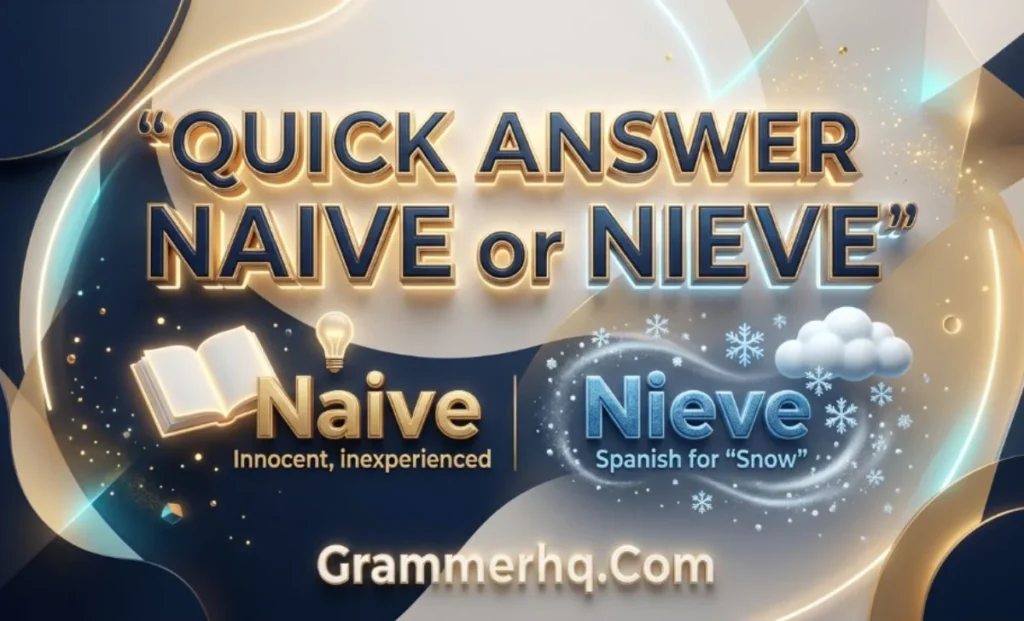
Naive is the correct spelling in standard English.
- Naive ✓ Correct
- Naïve ✓ Also correct
- Nieve ✗ Not the standard English spelling for this meaning
Use naive when describing someone or something that lacks experience, knowledge, or good judgment.
Example:
She was naive to believe that everyone she met was trustworthy.
Naive or Nieve: Which One Is Correct?
The correct English word is naive.
Nieve is a common misspelling when people are trying to write naive. The unusual vowel order in naive, combined with its pronunciation, can make the spelling easy to mix up.
However, nieve is a real word in Spanish, where it means “snow.” That does not make it an alternative English spelling of naive.
| Spelling | Correct in standard English? | Meaning |
|---|---|---|
| naive | Yes ✓ | Inexperienced, innocent, or too trusting |
| naïve | Yes ✓ | Same word, with a diaeresis |
| nieve | No ✗ for this English meaning | Spanish for “snow” |
So, if you are writing an English sentence about someone who lacks experience or judgment, choose naive.
What Does Naive Mean?
Naive is an adjective. It commonly describes a person, idea, belief, question, or decision that shows a lack of experience or understanding.
It can also describe someone who is too willing to believe that other people are honest or that a situation will be simple.
For example:
- She was naive to trust a stranger so quickly.
- That was a naive assumption.
- He asked a naive question because he had little experience with the subject.
- It would be naive to think there are no risks.
Importantly, naive does not simply mean lacking intelligence. A person can be intelligent and still be naive about a particular situation because they lack experience or information.
Naive or Naïve: Are Both Correct?
Yes. Naive and naïve are both accepted forms in English. Oxford lists naïve as an alternative form of naive.
The two dots over the i are called a diaeresis. The accented form reflects the word’s French history.
In modern English, especially in everyday digital writing, you will commonly see the simpler form:
naive
The form naïve is also correct, so you do not need to treat one as a spelling mistake.
Why Is Nieve Incorrect in English?
The main problem is the order of the vowels.
The correct spelling is:
N-A-I-V-E
Not:
N-I-E-V-E
Because the word is pronounced approximately ny-EVE, some people spell it based on how they think the sounds should appear in writing.
English spelling does not always follow pronunciation perfectly, and naive is one of the words where the written form can be easy to forget.
A simple way to remember it is:
NA + IVE = NAIVE
How Do You Pronounce Naive?
Naive is commonly pronounced approximately:
ny-EVE
Cambridge gives the pronunciation /naɪˈiːv/ in both US and UK English.
The pronunciation can make the spelling confusing because the first syllable does not make the written na-i sequence immediately obvious.
Naive Examples in Sentences
Here are some natural examples:
- She was naive to believe every promise she heard.
- His naive question showed that he was new to the subject.
- It would be naive to ignore the possible risks.
- The young buyer was naive about how expensive repairs could be.
- They made a naive assumption about the company’s success.
- I was naive enough to think the process would take only one day.
These examples show that naive can describe a person, question, assumption, belief, decision, or attitude.
Naive Synonyms
Depending on the context, possible synonyms include:
- inexperienced
- innocent
- trusting
- gullible
- unsophisticated
- credulous
- unworldly
- artless
However, these words are not always interchangeable. Naive usually focuses on a lack of experience, judgment, or awareness.
Naive or Nieve: Common Mistake
A common mistake is writing:
❌ He was nieve about the dangers.
The correct sentence is:
✓ He was naive about the dangers.
Another example:
❌ It was nieve to trust the offer.
✓ It was naive to trust the offer.
Remember that nieve may be meaningful in Spanish, but it is not the standard English spelling for this adjective.
Is Naive an American or British Spelling?
There is no American-vs-British spelling difference between naive and naïve for this word.
Both forms are used in English.
The important distinction is between the accepted forms:
naive / naïve
and the misspelling:
nieve
Cambridge lists naive with naïve as an alternative form and gives the same pronunciation for US and UK English.
Where Does the Word Naive Come From?
The English word naive entered English through French. Oxford traces it to French naïf, with the word ultimately coming from Latin nativus, meaning “native” or “natural.”
This French connection also helps explain why you may encounter the spelling naïve with the diaeresis.
FAQs
Is naive or nieve correct?
Naive is correct in standard English. Nieve is not the standard English spelling for this meaning.
Is naïve also correct?
Yes. Naïve is an accepted variant of naive.
What does naive mean?
It describes someone or something lacking experience, knowledge, or good judgment, often with a tendency to trust too easily.
Is nieve a word?
Nieve is a Spanish word meaning “snow,” but it is not the standard English spelling of naive.
How do you pronounce naive?
It is commonly pronounced approximately ny-EVE, with Cambridge giving /naɪˈiːv/.
Does naive mean lacking intelligence?
No. Naive usually refers to a lack of experience, knowledge, or judgment. An intelligent person can still be naive about something they have little experience with.
Final Answer
If you are writing in English and mean inexperienced, innocent, or too trusting, use naive.
Naive ✓ Correct
Naïve ✓ Correct alternative
Nieve ✗ Incorrect for this English meaning
For most everyday English writing, naive is the simple form to choose. If you see naïve, it is not a different word it is an accepted spelling variant.
Read More Blogs
- Vender vs Vendor: Which Spelling Is Correct?
- Puting or Putting: Which Spelling Is Correct?
- Input vs Imput: Which Spelling Is Correct?
- Caribbean vs Carribean: The Correct Spelling?

Hi, I’m Amelia Parker, a grammar enthusiast and writer at GrammarHQ.com. I specialize in explaining spelling differences, confusing words, and common English mistakes through simple, practical, and easy-to-understand guides.