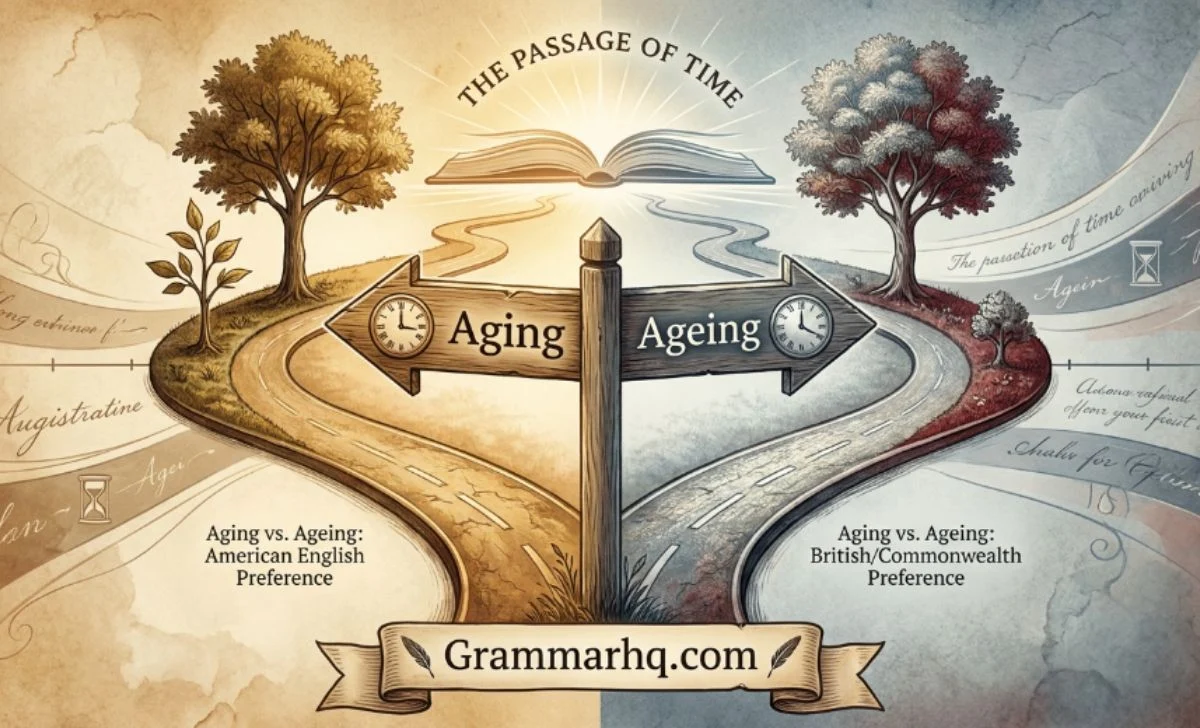
Aging vs ageing is a common spelling question, but the answer is simple: both are correct. The main difference is regional.
Aging is the standard spelling in American English, while ageing is preferred in British English. Both forms have the same meaning and refer to the process of becoming older.
The difference becomes noticeable in phrases such as aging population, ageing population, healthy aging, healthy ageing, anti-aging, and anti-ageing. The meaning remains unchanged; only the spelling varies between English varieties.
In this guide, you’ll learn how to pronounce aging vs ageing, why the extra e appears in the British spelling, what dictionaries say, and which form you should use for your audience.
Quick Answer
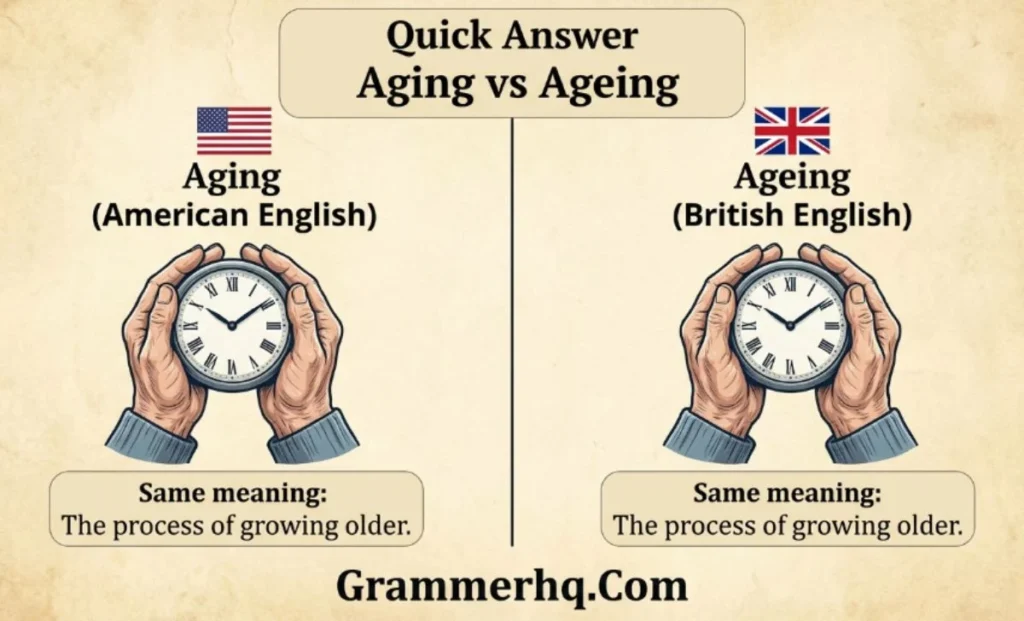
Aging and ageing are two accepted spellings of the same word.
- Aging is the preferred form in American English.
- Ageing is the preferred form in British English.
- Both mean becoming older or the process of growing older.
- Both are normally pronounced /ˈeɪ.dʒɪŋ/.
- Neither spelling is simply “wrong.”
For example:
The aging population is creating new healthcare challenges.
In British English:
The ageing population is creating new healthcare challenges.
The meaning is exactly the same. The spelling reflects the variety of English being used.
What Do Aging and Ageing Mean?
Both words come from the verb age.
As a verb, age means to become older or to make something older or more mature. Its -ing form can describe the process itself or something that is becoming older.
Aging Meaning
Aging means the process of becoming older.
Aging is a natural part of life.
It can also describe something that has become older:
The aging building needs repairs.
The word appears frequently in healthcare, science, demographics, lifestyle writing, and everyday conversation.
Common expressions include:
- aging population
- aging process
- healthy aging
- aging gracefully
- aging workforce
- skin aging
Ageing Meaning
Ageing has the same meaning.
Ageing is a natural part of life.
The ageing building needs repairs.
British English commonly uses this spelling in phrases such as:
- ageing population
- ageing process
- healthy ageing
- ageing workforce
- skin ageing
So, if you’re comparing the meanings of the two spellings, there is no meaningful difference. The important difference is regional spelling.
Aging vs Ageing: What’s the Difference?
The simplest way to remember the distinction is:
| Feature | Aging | Ageing |
|---|---|---|
| Meaning | Becoming older | Becoming older |
| Pronunciation | /ˈeɪ.dʒɪŋ/ | /ˈeɪ.dʒɪŋ/ |
| American English | Preferred | Less common |
| British English | Less common | Preferred |
| Grammar | Same | Same |
| Meaning difference | None | None |
Cambridge Dictionary identifies aging as the US spelling and ageing as the UK spelling. Oxford Learner’s Dictionaries likewise identifies ageing with British English and aging as especially North American.
That means the choice isn’t really about right versus wrong. It’s about which variety of English you’re following.
Why Does Ageing Have an Extra “E”?
At first glance, the extra e in ageing can make the word look like a completely different form. It isn’t.
Both spellings come from the verb age. The difference developed through the spelling conventions used in different varieties of English.
British English has retained ageing, while American English commonly uses aging.
It’s tempting to turn this into a simple rule such as “British English always keeps the e,” but English spelling isn’t that predictable. Different words have different historical spelling patterns.
For this particular word, the practical distinction is much easier:
American English → aging
British English → ageing
You don’t need to change the pronunciation or meaning.
Is Aging American or British English?
Aging is primarily the American spelling.
You will commonly see it in American newspapers, books, websites, academic material, healthcare information, and everyday writing.
For example:
The aging population is changing the way healthcare services are delivered.
Researchers are studying how aging affects memory.
Healthy aging involves regular exercise and a balanced diet.
If your content follows American spelling conventions, aging is the natural choice.
Is Ageing British English?
Yes. Ageing is the traditional British spelling.
For example:
The ageing population is putting pressure on healthcare services.
Researchers are studying how ageing affects memory.
Healthy ageing involves regular exercise and a balanced diet.
If you’re writing in British English, ageing will normally fit better with other British spellings.
For example, a British-style article might use:
- colour
- organise
- centre
- behaviour
- ageing
An American-style article might use:
- color
- organize
- center
- behavior
- aging
The goal is not to mix spelling systems unnecessarily.
Are Aging and Ageing Pronounced the Same?
Yes. In normal pronunciation, aging and ageing are pronounced the same:
/ˈeɪ.dʒɪŋ/
A simple approximation is:
AY-jing
The extra e in ageing does not normally create a separate syllable or a different pronunciation.
That makes this pair different from words where a spelling change can affect pronunciation. Here, the distinction is mainly visible on the page.
How Are Aging and Ageing Used Grammatically?
Both forms perform the same grammatical functions.
As a Present Participle
The population is aging rapidly.
British English:
The population is ageing rapidly.
Here, the word forms part of the verb phrase is aging/is ageing.
As a Gerund
The word can also function as a noun describing the process.
Aging is a natural biological process.
Ageing is a natural biological process.
As an Adjective
It can describe a person, group, object, or system that is becoming older.
The company is preparing for an aging workforce.
The company is preparing for an ageing workforce.
The grammar does not change when you switch between the two spellings.
Aging vs Ageing in Different English Varieties
The British-American distinction is the most important one, but international English is broader than just two varieties.
American English
Aging is the normal choice.
The country has an aging population.
British English
Ageing is the normal choice.
The country has an ageing population.
Australian and New Zealand English
British spelling conventions have traditionally had strong influence in both varieties, so ageing is commonly used.
Canadian English
Canadian English uses a mixture of British and American conventions. Aging is widely used, although individual publications and style guides may differ.
For professional writing, the safest approach is to check the style guide of the publication, organization, or audience you’re writing for rather than assuming that every country follows one rigid spelling rule.
Aging vs Ageing in Everyday Phrases
You’ll often encounter both forms in exactly the same expressions.
Aging Population vs Ageing Population
American:
The aging population is increasing demand for healthcare.
British:
The ageing population is increasing demand for healthcare.
Healthy Aging vs Healthy Ageing
American:
Healthy aging involves more than avoiding disease.
British:
Healthy ageing involves more than avoiding disease.
Aging Process vs Ageing Process
American:
Scientists are studying the aging process.
British:
Scientists are studying the ageing process.
Aging Gracefully vs Ageing Gracefully
American:
She believes in aging gracefully.
British:
She believes in ageing gracefully.
These aren’t different expressions with different meanings. They’re regional spelling variants.
What About Anti-Aging and Anti-Ageing?
The same spelling difference appears in anti-aging and anti-ageing.
American English commonly uses:
anti-aging products
British English commonly uses:
anti-ageing products
You’ll see these expressions frequently in skincare, cosmetics, beauty, health, and lifestyle content.
For example:
The company launched a new anti-aging skincare product.
British version:
The company launched a new anti-ageing skincare product.
Cambridge recognizes both forms, with the regional spelling following the same US/UK pattern.
Aging vs Ageism: What’s the Difference?
The words aging and ageism are connected to the topic of age, but their meanings are very different.
Aging is the process of becoming older.
Aging is a natural part of human life.
Ageism refers to prejudice, stereotyping, or discrimination based on age.
The company introduced new policies to address ageism in the workplace.
A simple way to remember it:
Aging = growing older
Ageism = unfair attitudes or treatment based on age
This distinction matters in discussions about employment, healthcare, older adults, and social policy.
Is “Ageing” a Spelling Mistake?
No.
Ageing is an established spelling in British English.
If you see a British newspaper, university website, or publication using ageing, that does not mean the writer made a spelling mistake.
Oxford Learner’s Dictionaries lists ageing as the British form and identifies aging as especially North American.
So a British writer can correctly write:
The ageing population is growing.
Is “Aging” a Spelling Mistake?
No.
Aging is the standard American spelling.
For example:
The aging population is growing.
This is completely normal American English.
Merriam-Webster’s entry for age recognizes aging or ageing as forms of the verb, reinforcing that both spellings are established forms rather than one being a simple error.
Common Mistakes to Avoid
1. Calling “Ageing” Wrong
If you’re accustomed to American English, ageing may look unusual. But it is standard British spelling.
2. Calling “Aging” Wrong
If you learned British English, you may expect the extra e. That doesn’t make aging incorrect.
3. Assuming the Words Have Different Meanings
They don’t normally differ in meaning. The spelling reflects English variety.
4. Pronouncing the Words Differently
The two forms are normally pronounced alike.
5. Mixing Regional Spelling Without a Reason
A document that uses color, organize, and center but suddenly switches to ageing may look inconsistent if there is no deliberate reason for the change.
6. Treating One Spelling Rule as Universal
English spelling contains many historical exceptions. Don’t assume that every word ending in -ing follows the same pattern as aging/ageing.
Which Spelling Should You Use?
This is where the choice becomes practical.
Use “Aging” If You Write in American English
Choose aging when your audience, publication, or style guide follows American English.
For example:
The report examines the effects of aging on the workforce.
Use “Ageing” If You Write in British English
Choose ageing when you’re following British English.
For example:
The report examines the effects of ageing on the workforce.
What If You’re Writing for a Global Audience?
Don’t switch between the two forms randomly.
Instead, establish a consistent editorial style.
If the rest of your website uses American spellings such as color, center, organize, and behavior, then aging will usually be the better fit.
If it uses British spellings such as colour, centre, organise, and behaviour, then ageing will usually be more consistent.
Consistency makes your writing look deliberate and professional.
Aging vs Ageing: Real-Life Examples
Healthcare
American:
The aging population needs accessible healthcare.
British:
The ageing population needs accessible healthcare.
Workplace
American:
Companies are adapting to an aging workforce.
British:
Companies are adapting to an ageing workforce.
Science
American:
Researchers are investigating the biological effects of aging.
British:
Researchers are investigating the biological effects of ageing.
Skincare
American:
Sun exposure can contribute to premature skin aging.
British:
Sun exposure can contribute to premature skin ageing.
Everyday Life
American:
We cannot stop aging, but healthy habits can improve our quality of life.
British:
We cannot stop ageing, but healthy habits can improve our quality of life.
Notice the pattern: the spelling changes, but the sentence’s meaning does not.
What Do Major Dictionaries Say?
When you’re unsure about a spelling difference, authoritative dictionaries provide a much better answer than relying on spell-check alone.
Cambridge Dictionary
Cambridge recognizes aging as the US spelling and ageing as the UK spelling. The dictionary also gives the same pronunciation for the two forms.
Oxford Learner’s Dictionaries
Oxford identifies ageing as British English and describes aging as especially North American.
Merriam-Webster
Merriam-Webster recognizes aging or ageing as forms associated with the verb age.
The dictionary evidence supports the same conclusion: both forms are legitimate; regional preference determines which one is normally expected.
Easy Trick to Remember Aging vs Ageing
Need a quick memory trick?
Ageing has an E → E for England.
So remember:
America → aging
England/British English → ageing
It’s not a universal rule for every British-American spelling difference, but it works well for this particular pair.
FAQs
1: Is aging or ageing correct?
Both are correct. Aging is preferred in American English, while ageing is preferred in British English.
2: Is aging American or British?
Aging is the standard American spelling and is also widely used in North American English.
3: Is ageing British English?
Yes. Ageing is the standard British spelling.
4: Do aging and ageing mean the same thing?
Yes. Both normally refer to the process of becoming older.
5: Are aging and ageing pronounced the same?
Yes. Both are normally pronounced /ˈeɪ.dʒɪŋ/.
6: Is anti-aging or anti-ageing correct?
Both are correct. Anti-aging is the common American form, while anti-ageing is the common British form.
7: Which spelling should I use in formal writing?
Follow the English variety and style guide required by your audience or publication. Most importantly, remain consistent.
8: Can I use both aging and ageing in the same article?
You can, but unless you’re deliberately comparing British and American English, choosing one spelling and using it consistently is usually better.
Final Verdict:
Aging and ageing are both correct spellings.
The main difference is regional:
- American English → aging
- British English → ageing
Both words have the same meaning, serve the same grammatical functions, and are normally pronounced the same way. The extra e in ageing does not change the meaning or pronunciation.
So, the better question is not which spelling is universally correct, but which variety of English are you using?
For American English, choose aging. British English normally uses ageing. Writers addressing an international audience can use either form, but the most important thing is to maintain a consistent spelling style throughout the content.
Once you understand this regional difference, choosing between aging and ageing becomes simple.
Read More Blogs:
- Humor vs Humour: American vs British English Explained?
- Succesful vs Successful: Which Spelling Is Correct?

Hi, I’m Amelia Parker, a grammar enthusiast and writer at GrammarHQ.com. I specialize in explaining spelling differences, confusing words, and common English mistakes through simple, practical, and easy-to-understand guides.