If you’ve ever typed “Carribean cruise” into a search bar and quietly watched autocorrect fix it, you’ve run into the classic Caribbean vs Carribean mix-up one of the most commonly misspelled place names in English.
Most explanations online stop at “just remember it has two b’s,” without actually telling you why the word looks the way it does.
So here’s the full picture: the correct spelling, why the mistake happens, where the word actually comes from, and how even professional writers still get it wrong.
Quick Answer
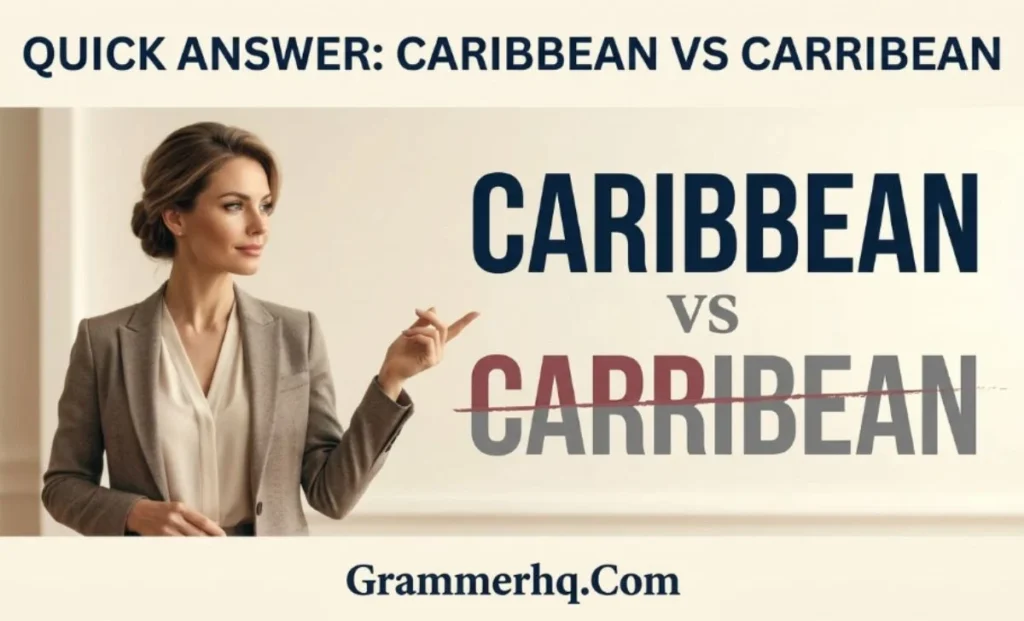
“Caribbean” is correct — one r, two b’s: C-A-R-I-BB-E-A-N.
“Carribean,” on the other hand, has two r’s and one b, and it’s simply a misspelling. No dictionary lists it, no region accepts it as a variant, and despite what a few myths claim it has no valid use case, not even in brand names. More on that below.
Why “Caribbean” Trips People Up
The Letter-Swap Instinct
Most people who write “Carribean” aren’t guessing randomly. Instead, they’re doubling the wrong consonant.
When you type quickly, your fingers tend to double whichever letter feels emphasized when you say the word out loud, and since casual speech often stresses the middle of “Caribbean,” it feels natural to double the “r” there instead of the “b.”
The Word Doesn’t “Look” Like It Sounds
Unlike more phonetic words, “Caribbean” doesn’t spell itself the way people say it. As a result, the usual safety net — sounding a word out to guess its spelling — doesn’t work here. That mismatch, not carelessness, is the real root of the error.
Where “Caribbean” Actually Comes From
This is the part most spelling guides skip entirely, yet it’s genuinely useful for locking in the correct form.
“Caribbean” isn’t an invented geographic label. Instead, it takes its name directly from a real people: the Caribs, an Indigenous group from northern South America and the Lesser Antilles who used that name for themselves.
That name entered Spanish as “Caribe,” then passed into English by around the 1750s as an adjective describing both the Carib people and the sea between the West Indies and the South American mainland. According to Merriam-Webster, English writers first used “Caribbean” in its current sense in 1772.
So the double “b” isn’t an arbitrary quirk it comes from the Spanish “Caribe” plus a Latin-style adjective ending, not from any doubling-for-emphasis rule.
That’s also exactly why “Carribean,” with its extra r, has no historical basis in any language the word passed through. The letter simply was never there.
How to Pronounce “Caribbean” US vs. UK
Pronunciation adds to the instability too, since it isn’t one-size-fits-all:
| Region | Pronunciation | Stressed syllable |
|---|---|---|
| Common in the US | kar-uh-BEE-uhn | 3rd syllable |
| Common in the UK and across the Caribbean itself | kuh-RIB-ee-uhn | 2nd syllable |
Dictionaries treat both pronunciations as correct, listing them as regional variants rather than ranking one above the other.
Still, neither version supports a doubled r the letter-doubling mistake is purely a typing habit, not something rooted in how the word actually sounds.
Every Way People Misspell “Caribbean”
“Carribean” is by far the most common error, but it isn’t the only one out there:
| Misspelling | The mistake |
|---|---|
| Carribean | Double r, single b |
| Carribbean | Double r and double b |
| Caribean | Single r, single b |
| Carribeans / Carribean’s | The double-r error, pluralized or possessive |
Only “Caribbean” appears in standard dictionaries Merriam-Webster, Oxford, Collins, and Dictionary.com all agree on this single spelling.
The Myth: “Carribean Is Sometimes Correct for Brand Names”
You may have come across claims that “Carribean” works as an acceptable alternate spelling in certain business or place names. It doesn’t and it’s worth explaining exactly why this myth keeps circulating.
The example people cite most often, oddly enough, is a real airline: Trinidad and Tobago’s national carrier.
But the airline itself spells its name the standard way Caribbean Airlines, one r, two b’s. In reality, no legitimate brand, place, or proper noun anywhere in the region uses the double-r spelling.
So if you ever spot “Carribean” in a business name, that business simply made a typo; nobody has ever approved it as a legitimate variant.
“Caribbean” in Real Sentences
- A cruise confirmation email: “Your 7-night Caribbean itinerary departs from Fort Lauderdale and stops in Nassau, San Juan, and St. Thomas.”
- A recipe blog intro: “This jerk chicken marinade is a staple of Caribbean cooking, especially in Jamaica.”
- A news headline: “Tropical storm tracks toward the eastern Caribbean this week.”
- A packing-list app reminder: “Don’t forget reef-safe sunscreen — Caribbean waters have strict rules protecting coral.”
- A study-abroad brochure: “Students spend a semester researching marine biology across the Caribbean Sea.”
Notice that across every one of these contexts — travel, food, weather, education — the spelling never shifts, no matter how formal or casual the tone.
Caribbean vs. Carribean at a Glance
| Caribbean | Carribean | |
|---|---|---|
| Dictionary spelling | Yes | No |
| Used by airlines, tourism boards, news outlets | Yes | No |
| Etymologically justified | Yes (from Carib, via Spanish) | No |
| Acceptable in formal or informal writing | Yes | No |
FAQs
Is “Carribean” a real word?
No. You won’t find it in Merriam-Webster, Oxford, Collins, or Dictionary.com. It’s a straightforward misspelling, not an informal or regional variant.
Why are there two accepted pronunciations?
Because the word settled into different English-speaking regions — the US on one side, the UK and the Caribbean itself on the other — at slightly different points in history. Each region developed its own stress pattern, and English speakers in both places now treat their version as standard.
Is “Caribbean” always capitalized?
Yes. Whenever it refers to the region, sea, or people — “the Caribbean,” “Caribbean islands,” “Caribbean cuisine” — it stays capitalized, even as an adjective.
What’s the plural — “Caribbean” or “Caribbeans”?
“Caribbean” works as a collective term for the whole region. People do sometimes use “Caribbeans” informally to describe individuals from the region, though “people from the Caribbean” reads as more standard in formal writing.
Does Caribbean Airlines ever use the double-r spelling?
Never. The airline, headquartered in Trinidad and Tobago, uses the standard spelling across all of its official branding: “Caribbean Airlines,” not “Carribean.”
Key Takeaways
- “Caribbean” is correct: one r, two b’s.
- The word comes from “Carib,” the Indigenous people of the region, by way of Spanish — not from any doubling rule.
- Two pronunciations exist (US and UK/Caribbean), but neither one supports a double r.
- “Carribean” has no valid use anywhere — not in casual writing, not in brand names, not once.
Read More Blogs